
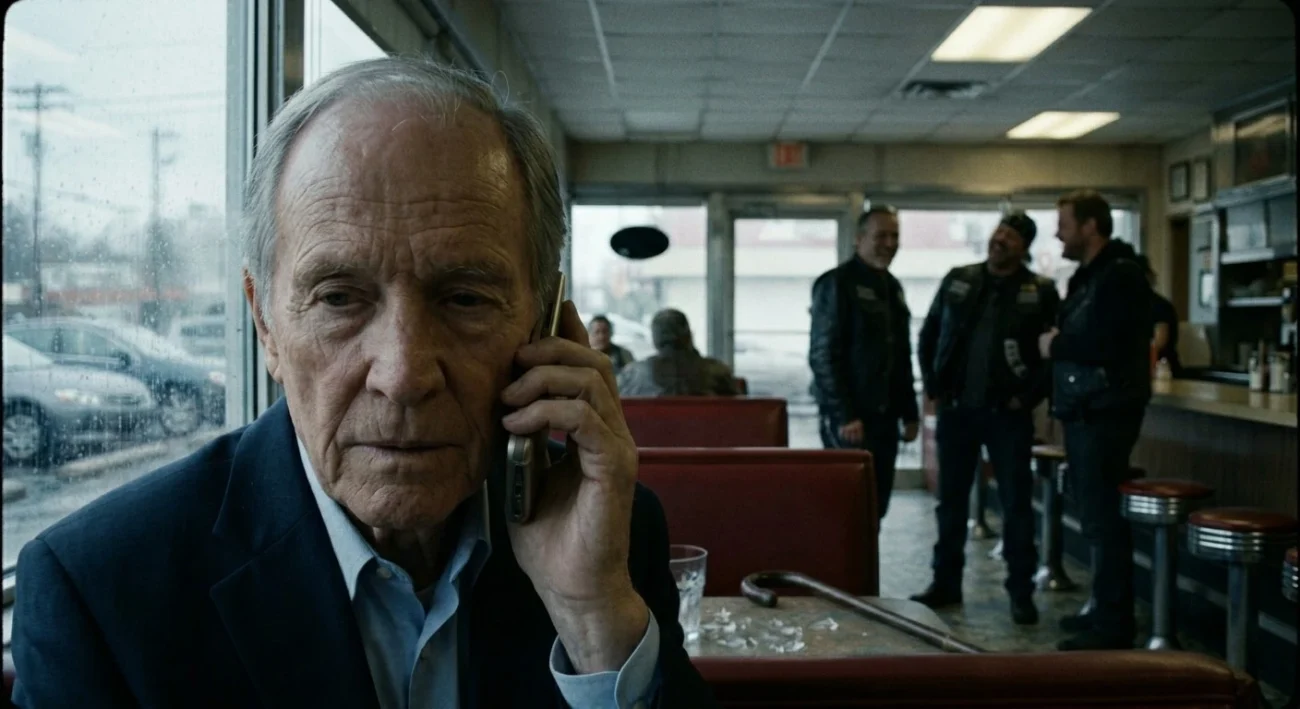
The old man always sat in Booth Seven.
Same diner. Same black coffee. Same quiet stare out the rain-streaked window.
Nobody knew much about him. The waitresses called him Mr. Hale. White hair. Trimmed beard. A worn wooden cane resting beside him like it had been there a hundred years. The kind of man who never raised his voice, yet somehow made everyone around him speak a little softer.
Every Tuesday. Exactly noon. Always alone.
Diane, the morning waitress, had worked the diner for eleven years. She’d never once seen him be anything but still.
“The usual, Mr. Hale?” she’d say.
“Please,” he’d say, without looking up from the window.
That was the whole conversation. It had been the whole conversation for years.
She never asked about the cane. Never asked about the faint scar that ran from his left jawline down under his collar. Never asked why his hands, though old and weathered, had the kind of stillness that didn’t come from rest — it came from discipline.
Some things, Diane figured, you just don’t ask.
It was a Tuesday in late November when the bikers arrived.
Six motorcycles roared into the parking lot like thunder punching through the quiet noon air. The windows rattled. A coffee mug trembled on the counter. Little Tommy Garrett, all of seven years old, pressed his face to the glass with wide eyes.
His mother pulled him back.
The diner doors swung open hard.
Heavy boots on the linoleum. Leather vests. The smell of exhaust and something colder underneath it. They came in loud — laughing about something that had happened on the highway, a story involving a minivan and a speed trap, the kind of story that got louder every time it was told.
Six men. All of them big. All of them the kind of men who moved through the world like the world owed them space.
Their leader was Rex.
He was the kind of man who walked into a room expecting it to change. Six-foot-two, thick through the shoulders, a jaw like a cinder block. His leather vest was covered in patches — club insignias, road names, a death’s-head in the center. His hair was black and pulled back, and his eyes were pale and restless, always scanning, always measuring.
He spotted Mr. Hale immediately.
Something about the old man’s stillness irritated him. Rex had walked into a lot of places and made a lot of people nervous. The old man in Booth Seven didn’t even look up.
Rex smirked. He nudged the man to his left — a thick, square-faced guy they called Dub — and nodded toward the booth.
Dub grinned.
Rex walked over.
He stood at the edge of the booth for a full three seconds, waiting. The old man watched the rain on the window. His coffee sat half-finished. His hands were flat on the table.
“Well, look at this.”
Rex’s hand came down on the table — not a slam, but a slap. Hard enough to make the coffee jump.
“A king without a kingdom.”
The old man didn’t move.
The bikers behind Rex laughed. A few of the other diner customers shifted in their seats. Diane gripped the edge of the counter.
Rex leaned down, closer now, voice dropping into a mocking drawl.
“Can’t hear me, Grandpa?”
Nothing.
The silence only fueled him. Rex’s jaw tightened. He glanced back at his crew — this was becoming a performance now, and performances had to land.
Then he grabbed the cane.
One hard yank. The table jerked sideways. Coffee splashed across the laminate surface, spilled over the edge, hit the floor. A water glass tipped and shattered.
A woman near the door gasped. Someone’s child started crying.
The diner erupted — not in protest, but in nervous, uncomfortable laughter from Rex’s crew. The kind of laughter that fills a room because silence would feel like a verdict.
Rex spun the cane in the air, one full rotation, like a baton.
“Careful, boys.” He grinned at his crew. “This might be the only thing keeping him alive.”
More laughter. Phones came out. Three of them, four. People were recording.
Diane took one step toward the booth.
“Sir, you need to—”
“Stay right there, sweetheart,” Rex said, without looking at her. “We’re just having a conversation.”
She stopped. Her hand was shaking.
But the old man didn’t move.
Didn’t beg. Didn’t threaten. Didn’t even turn his head to look at the cane spinning in Rex’s hand.
He just watched.
Watched the coffee drip slowly off the table’s edge. Watched the broken glass catch the light. His breathing was even. His eyes were steady. He seemed like a man who had waited out worse things than this — and had the patience left over to prove it.
Then his eyes moved.
Slowly. Deliberately. They traveled from the puddle on the table, up Rex’s forearm, across the leather vest, to the collar.
And stopped.
There, half-hidden beneath the fold of the leather — a patch.
Small. Faded. Silver thread on dark backing.
A hawk with its wings spread.
The moment Mr. Hale saw it, something changed in his face. Not anger. Not pain. Something quieter and more precise.
Recognition.
He reached into his jacket.
Slowly. One hand. The motion deliberate enough that everyone watching could see it wasn’t a threat.
He pulled out a small black key fob. The kind that might open a car — or might not. Plain. Unmarked.
The bikers laughed again.
“What is that?” one of them called out.
Rex grinned. “Calling life support?”
The old man pressed the single button on the fob.
A quiet click. Then he raised it to his ear like a phone.
The laughter petered out into confusion. It wasn’t a phone. There was no screen, no earpiece, nothing anyone could identify.
The diner had gotten quieter without anyone deciding to be quiet.
“It’s me,” the old man said.
A pause.
“Bring him here.”
He lowered the fob and set it gently on the table beside his coffee cup.
Rex laughed. A single sharp sound.
But nobody else did.
Because outside, something was happening.
Tires.
Not one car — multiple. The sound of brakes, the low mechanical precision of vehicles that moved in formation.
Everyone in the diner turned toward the windows.
One black SUV rolled into the parking lot.
Then another.
Then another.
Then a fourth.
They parked in a line, not in the spaces — directly across the lot entrance. The windows were dark. The license plates were government plates. The kind that don’t have county stickers. The kind that don’t show up in any database you’re authorized to search.
The diner went completely silent.
Doors opened.
Men stepped out in dark suits. Not security guards — they didn’t have that mall-cop posture, that nervous hand near the hip. Not local police. These men moved the way people move when they’ve stopped thinking about movement and just act.
Eight of them. Eyes scanning the diner windows before they’d even cleared the vehicles.
Every single one of them walked toward the front door.
Rex’s smile was gone.
The suited men entered single file. The first one — older, silver at his temples, a jaw like a former soldier — stopped just inside the door and swept the room in under two seconds.
His eyes landed on Booth Seven.
He moved directly toward it. The others followed.
Rex took one step back without deciding to.
The old man stood up.
No one helped him. He didn’t reach for the cane. He rose with the slow, controlled effort of a man managing pain he’d lived with long enough to make peace with — and when he was upright, he was straight. Still as a post. The kind of posture that doesn’t come from good health. It comes from twenty years of being the person in the room everyone else adjusts to.
The first suited man stopped two feet away.
His face changed. It went through several things in about one second — surprise, disbelief, and then something that looked almost like relief, the way relief looks when it’s mixed with weight.
He brought his hand up.
A full salute.
Every man behind him did the same.
The room didn’t breathe.
Little Tommy Garrett, still pressed against the window, whispered, “Mom, why are they doing that?”
His mother didn’t answer. Her hand found his shoulder and held on.
Mr. Hale let the salute hold for three seconds. Then he nodded, once, and the men lowered their hands.
He looked at Rex.
Rex was still standing in the same spot he’d been when he grabbed the cane. He hadn’t moved. The cane was still in his hand, hanging now at his side like he’d forgotten it was there.
Mr. Hale’s voice was calm.
Deadly calm.
“Where did you get that patch?”
Rex’s jaw moved. He glanced down at his collar. Back up.
“It — it was my dad’s,” he said. “He gave it to me.”
Mr. Hale’s eyes narrowed by a fraction.
“Your father gave it to you.”
“Yeah.” Rex’s voice had lost something. The performance was gone. “Said it was a family thing. Said I should wear it.”
“How old are you?”
The question landed strange. Rex blinked.
“Thirty-four.”
Mr. Hale nodded slowly. Something was moving behind his eyes — calculation, or memory, or both.
“Your father,” he said. “What was his name?”
Rex hesitated. “Danny. Danny Colton.”
The old man was quiet for a moment.
“And his father?”
The question hung there. Rex’s brow furrowed.
“My grandfather? Ray. Ray Colton.” He paused. “He died before I was born. Some kind of—”
“Operation,” Mr. Hale said.
Rex stopped.
“Some kind of classified operation,” the old man continued. “That’s what your family was told. That’s all they were ever told.”
The color left Rex’s face slowly, like water draining from a tub.
“How do you know that?”
Mr. Hale took one step forward.
“Because I was the one who told them.”
Nobody in the diner moved. Behind Rex, his crew had gone completely still. Dub had put his phone down. The recording had stopped.
Mr. Hale’s gaze moved from Rex’s eyes to the silver hawk patch, and when it moved back up, something in it had shifted — something older, and heavier, had risen to the surface.
“I designed that patch,” he said.
Rex said nothing.
“I designed it in 1974. I drew it myself on a napkin at a briefing table in a building that doesn’t exist anymore, in a location that was never on any map.” He paused. “I had it made by a woman in Virginia who didn’t ask questions. And I pinned it onto every member of the unit, personally, the night before we deployed.”
He took another step.
“We had a name. We didn’t use it outside the unit. We didn’t talk about what we did. We didn’t file reports through standard channels. We answered to two people — one of whom is dead, and one of whom is in a building in Washington right now, wondering why I haven’t returned his call this morning.”
He stopped directly in front of Rex.
“Only one man ever wore that exact patch. The silver thread. The slightly wider wingspan.” His voice dropped, not from weakness, but from the weight of what was coming. “I had it made different. I had it made different because it was for my son.”
The silence in the diner was total.
Rex’s hands had dropped to his sides. The cane hung from his fingers and then, without a word, he held it out.
Mr. Hale didn’t take it. Not yet.
“His name was James,” he said. “James Arthur Hale. He was twenty-two years old. He had his mother’s eyes and my stubbornness and he was the best operator in the unit by the time we deployed.” His voice didn’t crack. It stayed level, the way a levee stays level — through structure, not absence. “He was also the one I couldn’t save.”
He looked at Rex.
“I carried him home. I kept his patch because there was nothing else left. And then someone took it from the case in my house — I never knew how, never knew who — and it disappeared. For decades it disappeared.” He looked down at the patch. “Until today.”
Rex’s voice, when it came, was barely audible.
“My grandfather — Ray — he served?”
“Raymond Colton.” Mr. Hale nodded. “He was James’s closest friend in the unit. The two of them were inseparable from training. When James died, Raymond was the one who sat with the body until the extraction team arrived. He was the one who held his hand.” He paused. “I didn’t know Raymond had taken the patch. I don’t know if James gave it to him or if he took it to keep a piece of him. But I believe — standing here now — that it wasn’t done out of disrespect.”
Rex’s eyes were wet. He wasn’t trying to hide it. The man who had walked into this diner thirty minutes ago, all performance and noise, was somewhere far behind him.
“I didn’t know any of this,” Rex said. “My dad didn’t talk about it. He just said it was a soldier’s patch. Said it was ours.”
“It is yours,” Mr. Hale said quietly. “It belongs to your blood. I’m not asking for it back.”
He finally reached out — not for the cane, but for the patch. His fingers touched the silver thread without unpinning it. He held it there for just a moment.
“I’m asking you to know what it means.”
Rex set the cane on the table.
Carefully. Both hands. Like it was something that could break.
“I’m sorry,” he said. “For what I did. For the table. For — all of it. I didn’t know.”
“You didn’t know,” Mr. Hale agreed. “But you chose to do it anyway. To a man you believed had no protection. To a man you thought couldn’t answer back.” He picked up the cane. “That’s what I want you to sit with.”
Rex nodded. There was nothing else to say.
Mr. Hale turned to the first suited man — still standing three feet away, still quiet, still patient.
“Give me five minutes.”
“Yes, sir.”
He sat back down in Booth Seven.
He set the cane beside him. He looked at his coffee — cold now, the mug half-tipped from when Rex had slapped the table.
Diane appeared from behind the counter. She moved to the booth without being asked, set a fresh mug down, filled it without a word. Her hand was steadier now.
“Thank you, Diane,” he said.
She stopped.
He’d never used her name before.
She looked at him — really looked, maybe for the first time in eleven years.
“Of course, Mr. Hale,” she said.
She went back to the counter.
Rex didn’t leave right away.
He stood near the door for a minute, his crew waiting behind him, the diner still holding its breath. Then he walked back to Booth Seven.
He didn’t sit down. He stood at the edge, hands at his sides.
“Can I ask something?”
Mr. Hale looked up.
“What was he like? James.”
The old man was quiet for a moment.
“Stubborn,” he said. “Never stopped moving. Couldn’t sit still for more than ten minutes. Hated paperwork. Made every other man in the unit laugh even when they had no business laughing.”
A pause.
“He would’ve hated everything about today.”
Something crossed Rex’s face — not quite a smile, but the shape of one.
“I’ll take care of the patch,” Rex said.
“I know you will.”
Rex looked at the silver hawk one more time. Then he nodded — once, the way men nod when words have run out — and walked to the door.
His crew followed.
They didn’t say anything on the way out. The heavy boots were quieter this time. The door closed without slamming.
Outside, six motorcycles started up, one by one.
And then they were gone.
The diner stayed quiet for a long moment.
Then, gradually, it came back to itself. A fork scraped a plate. Someone asked for a coffee refill. Tommy Garrett pressed his face to the window again, watching the parking lot.
“Mom,” he said, “who was that man?”
His mother looked at Booth Seven — at the old man sitting straight-backed in his seat, hands flat on the table, eyes on the window, coffee steaming in front of him.
“I don’t know, baby,” she said.
But she said it the way you say something when you know the answer would take too long.
The first suited man walked to the booth.
“Sir. When you’re ready.”
Mr. Hale finished his coffee. Set the mug down. Reached for the cane.
He stood without help.
“Tell them I’ll be late,” he said.
“Yes, sir.”
He put on his coat. He straightened the collar. He looked out the rain-streaked window one last time — at the empty lot, at the tire tracks the motorcycles had left on the wet asphalt.
Then he walked out.
The suited men formed up around him, not in front, not behind, but beside — the way you walk next to someone you’re not guarding, but not leaving alone either.
The four black SUVs pulled out of the lot, quiet and certain.
Diane watched them go from behind the counter.
Then she walked to Booth Seven.
She picked up the coffee mug. She wiped down the table — the same table she’d wiped down a hundred Tuesday mornings before, with the same cloth, in the same practiced motion.
She stopped when she found it.
Under the edge of the coffee mug.
A folded piece of paper.
She opened it slowly.
Inside, in handwriting that was old but still exact:
For the glass. And for standing your ground.
Below it, a name. Not “Mr. Hale.”
A full name.
A rank.
And a number with a Washington area code.
Diane stood in the empty booth for a long time.
Then she folded the note, put it in her apron pocket, and went to start the next pot of coffee.
The booth sat empty for the rest of the afternoon.
But the following Tuesday, exactly at noon, the cane appeared first — resting against the seat — and then the old man settled in behind it, same as always.
Same diner. Same black coffee. Same quiet stare out the rain-streaked window.
The waitresses still called him Mr. Hale.
But Diane, when she set his cup down that morning, met his eyes for the first time.
“The usual?” she said.
He looked at her — steady and unhurried and completely seen.
“Please,” he said.
And that, for both of them, was enough.
Original fictional stories. AI-assisted creative content.
