
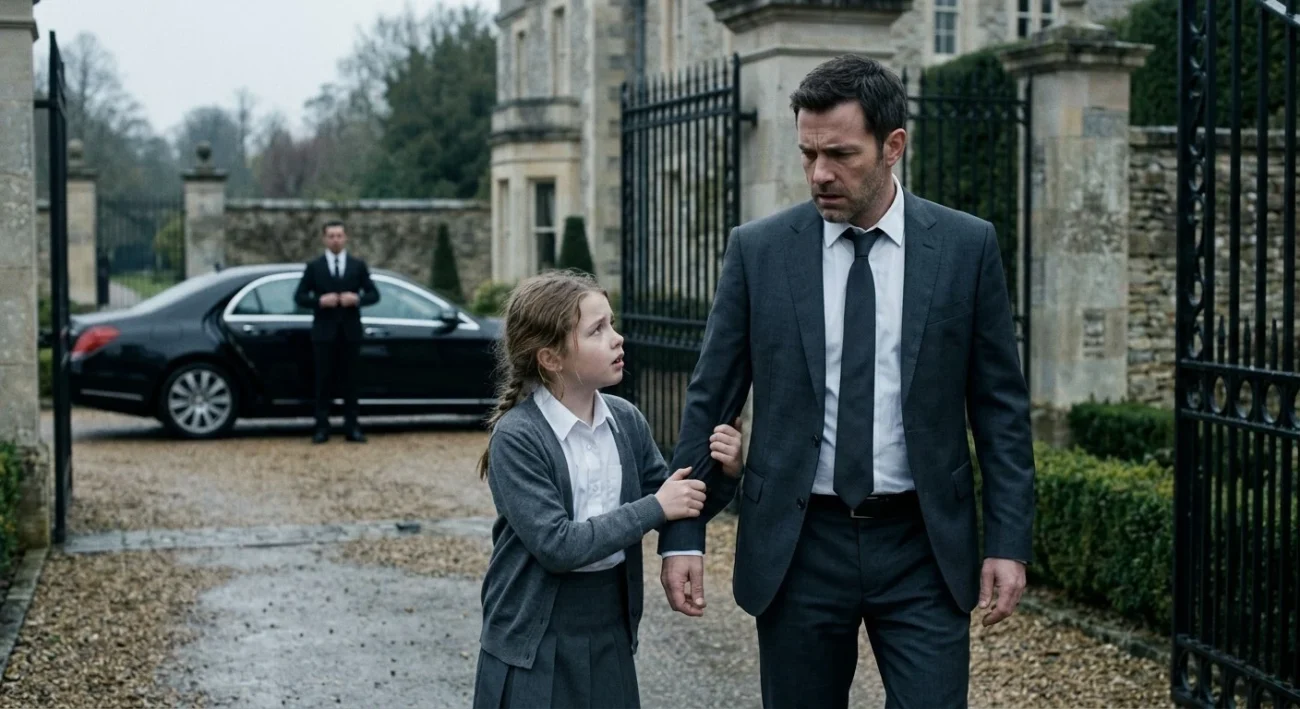
The morning Abril Reyes saved Santiago Robles, he was eleven seconds from stepping into a car that would have erased him.
He came down the front steps of his Lomas de Chapultepec mansion in a charcoal suit, phone in one hand, keys in the other. Monterrey by ten. A merger worth two hundred million by noon.
A small hand grabbed his sleeve.
“Don’t say anything, sir,” Abril whispered. “Just walk with me.”
He looked down. Tomás’s daughter. Twelve years old, red ribbon in her hair, face white as paper.
“Abril, not now. I’m late.”
“Please.” Her grip tightened. “Don’t let them see you.”
“Who?”
She was already pulling him toward the clay pots lining the driveway. He almost yanked his arm free — and then he saw her eyes. Something in them stopped him cold.
He crouched.
From behind the pots, the gate was clearly visible. A black sedan idled outside, exhaust curling in the morning air. The rear door stood open. A driver in a dark suit waited beside it.
“That’s not your driver,” Abril said.
“Of course it is. Marco’s worked for me six years.”
“Marco opens the door with his right hand. Keys stay in his left. I watch him every morning when I walk to school.” She pointed. “That man just used his left hand. And look at the plate.”
Santiago squinted. Same black sedan. Same chrome trim. Same everything.
Except the last digit was wrong.
His stomach dropped half an inch. “How do you know all this?”
Abril’s voice shrank. “Yesterday. Behind the greenhouse. I heard your wife talking to someone.”
The world tilted slightly. “Say that again.”
“She said you never notice anything because you’re always on your phone. She said today they’d swap the car. She said once you got in—” Abril swallowed. “—you wouldn’t make it to the airport.”
“You’re accusing my wife.” His voice went flat and dangerous. “Do you understand what you just said?”
“Yes, sir.” She didn’t flinch. She pulled an old phone from her sweater pocket. “That’s why I recorded it.”
Before she could press play, his phone rang.
VALERIA.
He answered. “Where are you, my love?” Her voice was warm honey. “Marco says you haven’t come out. You’ll miss the flight.”
Santiago stared at the sedan. At the open door. At the man standing too still beside it.
“I’m on my way,” he said.
“Hurry. The meeting matters.”
“I know it does.”
He hung up slowly. Stood.
“I have to go,” he said.
Abril grabbed his hand, both of hers around his one. “If I’m wrong, fire my father. We’ll be gone by tonight. But if I’m right and you walk through that gate—” Her voice cracked. “You won’t come back.”
He went still. “What else did you hear?”
Tears spilled down her cheeks. “They said they’d take your phone. Your wallet. Drive you somewhere with nothing around. Leave you there until—” She couldn’t finish.
“Until what.”
“Until you couldn’t fight anymore.”
His mouth went dry. “And after that?”
“Everyone thinks you disappeared.” A whisper now. “And she gets twenty million dollars from the insurance.”
He wanted to laugh. He wanted to call it insane. Valeria had known him before any of this — before the house, before the jet, before his name meant anything. Back when they shared a studio apartment and he skipped lunch so she could eat dinner.
She wouldn’t. She couldn’t.
“Come,” Abril said, tugging him along the hedge line. “There’s more.”
They moved low, past the rose beds, toward the greenhouse. Through a wall of bougainvillea, two shapes stood close together.
Valeria. And a man in a tailored shirt Santiago had never seen before.
She reached up and touched his face.
Then she kissed him — slow, certain, like a woman who’d done it a hundred mornings before.
“Just a little longer,” she murmured against his mouth. “After today, we won’t have to hide.”
The man smiled.
“I love you,” Valeria said.
Santiago didn’t breathe. Didn’t move. Twelve feet away, his entire life rearranged itself in silence.
Behind them, beyond the gate, the engine was still running. The door was still open.
He didn’t go back the way he came.
Instead he walked straight to the side gate, the one only staff used, and slipped out onto the street unseen. Abril followed, gripping his sleeve like he might vanish if she let go.
Three blocks down, he stopped at a coffee shop and bought a burner phone with cash.
“Sir?” Abril asked.
“Call your father. Tell him to take you both home and lock the door. Don’t answer it for anyone but me.”
“What are you going to do?”
Santiago looked back toward the mansion, toward the black car still idling at his gate. “I’m going to disappear,” he said. “Just not the way they planned.”
By noon, the fake driver had given up and driven off — the “package” never showed. By one, Santiago sat in the back office of a private security firm owned by an old college roommate, watching the footage from Abril’s cracked-screen phone for the third time.
Valeria’s voice, crisp and businesslike: “He won’t notice. He never does. Just make sure the plate’s close enough that security doesn’t flag it at the gate.”
The man’s voice — younger, eager: “And after?”
“After, you disappear for six months. I file the missing person’s report on day two. Insurance pays out in ninety days for confirmed disappearance with foul play indicators. I’ve already talked to the adjuster.”
“You’ve thought about this a lot.”
“I’ve had four years to think about it.”
Santiago closed the laptop.
“Four years,” he said quietly. “We’ve been married seven.”
His friend, Hector, leaned back. “You want me to call the police, or you want to handle this the way people like us handle things?”
Santiago thought about the gardener’s daughter, twelve years old, hands shaking, standing in front of a billionaire and telling him the truth anyway.
“Both,” he said. “But carefully. I want her arrested with the evidence airtight — and I want her to know, before they cuff her, that it was a twelve-year-old who took her down.”
That evening, Valeria came home to find the house staff gone, the gates locked, and Santiago sitting calmly in the living room with two men in suits she didn’t recognize.
“Santiago? What’s going on? Where’s Marco?”
“Marco’s at the police station,” Santiago said. “Giving a statement about the man who paid him eight thousand dollars to call in sick this morning.”
Color drained from her face. “I don’t know what you’re talking about.”
“No?” He held up the burner phone and pressed play.
Her own voice filled the room. “After, you disappear for six months. I file the missing person’s report on day two…”
“That’s — that’s not — ” Valeria’s composure cracked. “Where did you get that?”
“From a twelve-year-old,” Santiago said, standing. “Tomás’s daughter. The girl whose lunch you complained was ‘too garlicky’ for the staff break room. The girl who’s been watching this house more closely than anyone you hired.”
“Santiago, please. Let me explain—”
“You already did. This morning. Behind the greenhouse.” His voice didn’t rise. It didn’t need to. “You told him you loved him. You told him it would be over soon. You were right about that part.”
One of the men in suits stepped forward with a folder. “Mrs. Robles, we have a warrant. Conspiracy to commit kidnapping, fraud, and attempted murder for insurance gain.”
“This is insane! He’s my husband!”
“Was,” Santiago said.
As they led her out — past the rose beds, past the greenhouse, past the spot where Abril had hidden him that morning — Valeria turned back one last time.
“You’d be dead right now if it weren’t for that little girl,” she spat.
“I know,” Santiago said. “That’s exactly why she gets what you were trying to take.”
Three weeks later, Tomás found a letter on his doorstep. Inside: a deed to a small house in Coyoacán, fully paid, in Abril’s name — to be held in trust until she turned eighteen. And a second envelope, addressed simply to “Abril.”
She opened it at the kitchen table, her father watching.
Inside was a single index card, handwritten:
“You said your driver opens doors with his right hand. You noticed things no one else did — including me. That’s worth more than twenty million dollars. Education fund attached. Don’t let anyone tell you you’re ‘just’ the gardener’s daughter. You’re the reason I’m alive. — S.R.”
Attached was a second document: a full university scholarship, any school, any country, fully funded.
Abril read it twice. Then she looked up at her father, eyes wide.
“Papá,” she said. “Can we still keep the roses?”
Tomás laughed — really laughed, for the first time in months. “Mija, we can plant a whole garden of them.”
Outside, for the first time in seven years, the black sedan was gone from the gate for good — and the gate itself stood open, sunlight pouring through, nothing left to hide.
Original fictional stories. AI-assisted creative content.
