
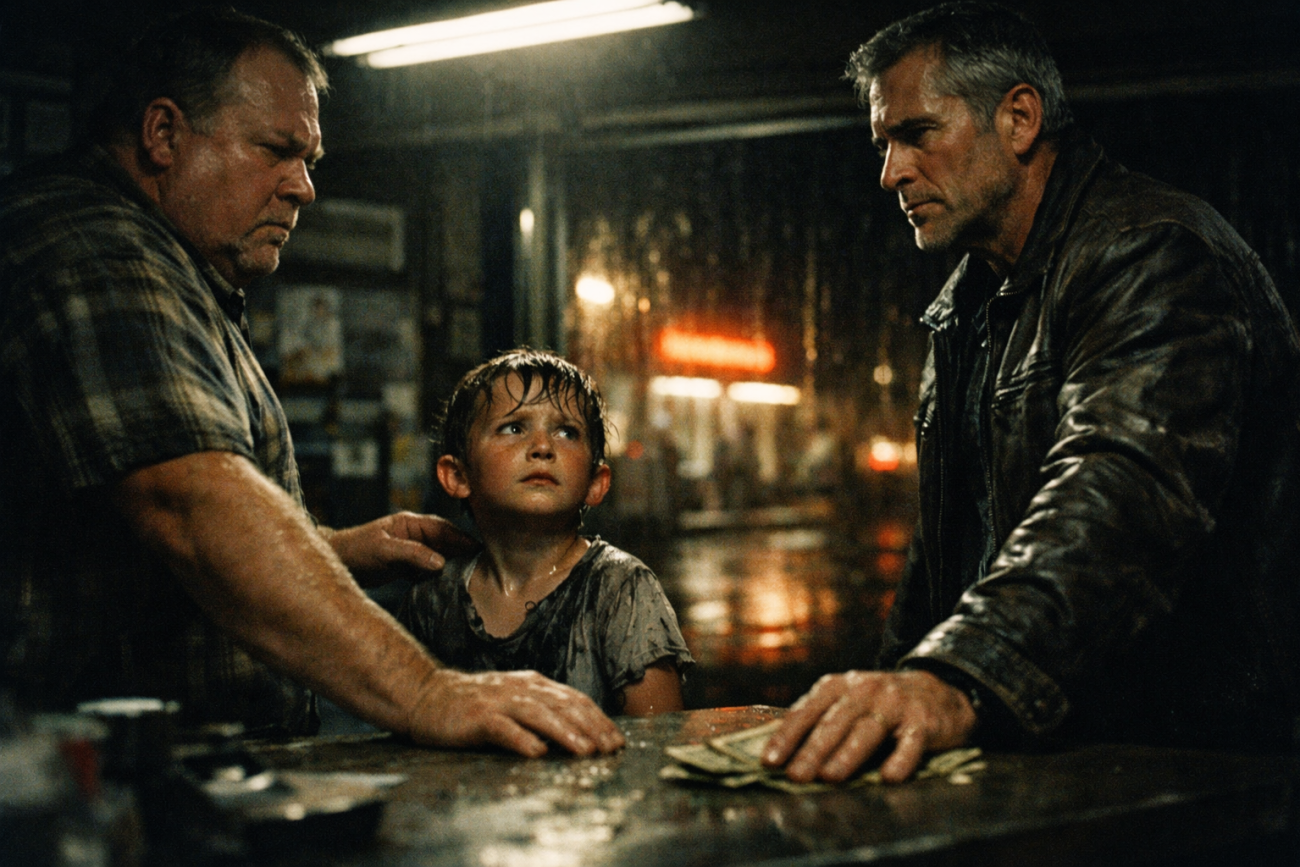
The rain didn’t fall that night — it attacked.
It hammered the gas station roof like it had a grudge against the whole highway. Inside, the air was thick with burnt coffee, gasoline, and the kind of silence that forms when men who’ve seen too much decide not to look at anything too long.
Six motorcycles sat in the lot. Their riders occupied the corner near the coffee machines — leather jackets, road dust, the particular stillness of people who don’t need to prove anything anymore.
At the counter, a little boy stood alone.
Five years old. Maybe younger. Soaked through, clothes torn, cheeks streaked with mud and dried tears. His whole body shook. Not just from cold. From the specific kind of trembling that happens when a child has been afraid for a very long time.
On the counter in front of him sat a wrapped turkey sandwich in plastic.
The boy reached for it with both hands.
The owner — a thick-necked man with a faded Marines tattoo and no discernible mercy left in his face — snatched it back without looking up from his register.
“Get out, kid.”
The boy flinched like he’d been struck. “I’m so hungry.”
“Not my problem. You got money?”
Silence. The boy’s lip trembled.
“Then you got nothing. Get out before I call someone.”
The boy didn’t move immediately. His fingers stayed on the countertop for one more second — like maybe the word please was building somewhere inside him and hadn’t found its way out yet.
In the corner, the bikers watched. Most looked away within seconds. Road-worn men develop that reflex. You can’t stop every hard thing you see, so eventually you stop seeing them.
All except one.
He was the reason the others had stayed quiet all night. Not because he demanded it — he never demanded anything — but because when he was still, the room tended to go still with him. Tall. Gray at the temples. A jaw like something carved out of a decision. His name was Rourke, and he had the eyes of a man who’d made peace with most of his regrets. Not all of them. But most.
He hadn’t moved from the coffee station in twenty minutes.
He moved now.
The boy turned toward the door, shoulders caved in, arms wrapped tight around himself. Then it happened. Something slipped from beneath his torn shirt as he moved — a thin silver chain — and a locket swung forward on it and caught the light from the overhead fluorescents.
It was going to hit the floor.
Rourke was already there.
He caught it in one palm, crouching to the boy’s level in a single smooth motion. His fingers closed around it. He looked down at the small silver oval in his hand. It was old. Worn smooth in the way jewelry gets when someone holds it every night before they sleep.
He turned it over. Found the clasp. Opened it.
And went completely still.
The noise of the rain seemed to drop. The hum of the refrigeration units, the distant truck radio from the lot — all of it fell away.
Inside the locket was a photograph. Small, faded, edges soft with age. A young woman with dark eyes and a crooked smile, standing in front of a lake he recognized immediately because he had taken that photograph himself. On a Tuesday afternoon in August. Twenty-two years ago. He remembered the exact quality of the light.
He remembered everything about that day.
He hadn’t let himself think about it in almost two decades.
His hand began to shake.
“That locket…” His voice came out wrong. Rougher than usual. Almost nothing.
The boy looked up at him through red-rimmed eyes. “Mama kept it. She never took it off.” He paused. “She said it was the last thing she had from someone she used to love.”
Rourke’s chest did something complicated.
He looked at the child again. Really looked — not with the passing glance of a man being polite, but with the focused attention of someone suddenly terrified of what they might be seeing.
Same eyes. Dark, wide-set, serious. The exact shape he’d seen in every mirror of his twenties.
Same jaw. That particular stubborn quality — not quite angry, not quite sad. Just braced. Ready.
His breathing had changed without him deciding to change it.
“What’s your name?” he asked.
“Danny.”
“Danny.” He repeated it quietly. “How old are you, Danny?”
“Five. I’ll be six in March.”
Rourke did the math. He did it twice, because the first time felt impossible and the second time felt like the ground shifting.
“Where’s your mama right now?”
Danny’s expression cracked. His chin wobbled once, hard. “She got sick. She’s at the hospital. She told me to find somewhere safe.” His voice dropped to almost nothing. “I don’t know where safe is.”
Rourke sat down on the gas station floor in his road leathers without caring about anything in the world except the small boy in front of him.
“What did your mama say my name was?” He barely recognized his own voice.
Danny stared at him. For a long moment he said nothing. Then, slowly, carefully — the way children say things they’ve been told are important — he said:
“She said if I was ever really lost, I should find a man named Rourke. She said he rode with people who wore eagles on their jackets.” Danny looked at the patch on Rourke’s shoulder. His eyes widened. “She said he’d know what to do.”
The room was completely silent.
One of the other bikers — a big man named Cole who’d been with Rourke for fifteen years — had drifted closer without realizing it. He stood two feet behind Rourke now, saying nothing.
Rourke looked at the locket one more time.
Then he looked at the boy.
“She told you right,” he said.
He stood, the boy still watching him. He turned to the counter. The owner hadn’t moved. Was watching with the particular expression of someone who wants to look uninvolved but can’t help being interested.
“That sandwich,” Rourke said. His voice was quiet. It was the kind of quiet that made people pay close attention.
“He’s got no money—”
“I’m not asking what he has.” Rourke set three twenties on the counter. “Give him the sandwich. And whatever else is hot. And a dry jacket if you have one in that back room — I saw it when you came out.” He paused. “I know you saw this kid standing here for ten minutes.”
The owner looked at the money. Looked at Rourke’s face. Made a decision.
He gave Danny the sandwich.
Then he went to the back room and came out with a gray zip-up hoodie, men’s large, and handed it over without meeting anyone’s eyes.
Danny ate standing up at the counter, both hands on the sandwich, taking bites so fast he had to slow himself down. Rourke sat on a stool beside him and didn’t say anything while he ate. Just stayed close. Like a wall between the boy and the rest of the world.
Cole appeared at his shoulder. “Hospital’s fifteen minutes north,” he said quietly. “I already looked it up.”
Rourke nodded once.
When Danny finished the sandwich, Rourke helped him into the oversized hoodie, rolling the sleeves up three times until the boy’s hands appeared. Danny stared up at him during the whole process with the cautious, evaluating look of a child who has learned not to trust too quickly.
“Are you really him?” Danny asked. “The one she meant?”
Rourke looked at him.
At those eyes.
At that jaw.
“Yeah,” he said. “I really am.”
“Are you going to take me to Mama?”
“Right now.”
The rain was still coming down hard when they walked outside. Rourke picked Danny up without asking — just lifted him in one arm, tucked him against his jacket, hunched his shoulder to block the rain. Danny went rigid for exactly two seconds. Then he grabbed Rourke’s collar with both small fists and held on.
Cole started his bike. The others formed up behind him without being told.
They rode north.
The hospital waiting room was bright and institutional and smelled like antiseptic. A nurse at the front desk started to explain visiting hours.
Rourke said a name. The name of the woman in the photograph.
The nurse looked at her screen. Looked at the boy. Looked at Rourke.
She walked them back herself.
The room was small and dim. Machines beeped with steady patience. In the bed, a woman — thinner than the photograph, but still immediately, unmistakably her — opened her eyes when the door opened.
She saw Danny first. Her whole body released something.
“Baby.”
“Mama.” Danny pulled free and climbed up beside her with the focused determination of a five-year-old who has been trying to get somewhere all night and has finally arrived.
Then she looked at the doorway.
At Rourke.
Neither of them spoke for a long time.
“You found him,” she said finally. Her voice was rough from the hospital air and something deeper. “Or he found you.”
“The locket,” Rourke said.
She nodded. “I figured it was time.”
He stepped inside and let the door close behind him. He pulled a chair to the side of the bed. He sat down in it like he planned to stay.
“You should have told me,” he said. Not angry. Just honest.
“I know.” A pause. “I was scared you’d left for a reason.”
“I left,” he said carefully, “because I thought you wanted me to.” He looked at her. “I’ve been wrong about a lot of things. That one cost me.” His jaw moved. “Cost us.”
She reached over Danny’s head and touched the back of Rourke’s hand with her fingers.
He turned his hand over and held hers.
Danny looked between them with the bright, rapidly calculating expression of a five-year-old reconfiguring his entire understanding of the world.
“Are you my dad?” he asked.
The machines beeped.
The rain hit the window.
Rourke looked at his son for the third time that night — the first time without doubt, the first time with the full weight of it sitting squarely in his chest where it belonged.
“Yeah,” he said. “I am.”
Danny considered this for approximately four seconds.
Then he climbed across the bed, grabbed Rourke’s jacket with both fists again, and pressed his face against his shoulder.
Rourke’s arms came up around him slowly — the careful movements of a man who hasn’t held something this fragile in a very long time and is terrified of getting it wrong.
He didn’t get it wrong.
Outside, Cole leaned against the hospital wall under the overhang with the others, rain dripping from the awning edge, nobody saying anything. He looked at his phone. Put it away. Looked at the entrance doors.
After a while he smiled. Just slightly.
“Boss found something he didn’t know he lost,” he said to no one in particular.
Nobody disagreed.
Three weeks later, the hospital discharged her.
Rourke was in the parking lot at seven a.m. with Danny on his shoulders and a bag in his hand and the particular expression of a man who has made a decision and is at complete peace with it.
The owner of the gas station received a visit the following Tuesday from a woman representing a health inspection board. Three violations were cited. None of them were invented. The fine was significant and the coverage was local.
Someone had filed the complaint anonymously.
The gray zip-up hoodie Danny had taken that night became his favorite thing he owned for the next three years. Long after it stopped fitting, he kept it folded on a shelf.
He never had to look for safe again.
Original fictional stories. AI-assisted creative content.
