
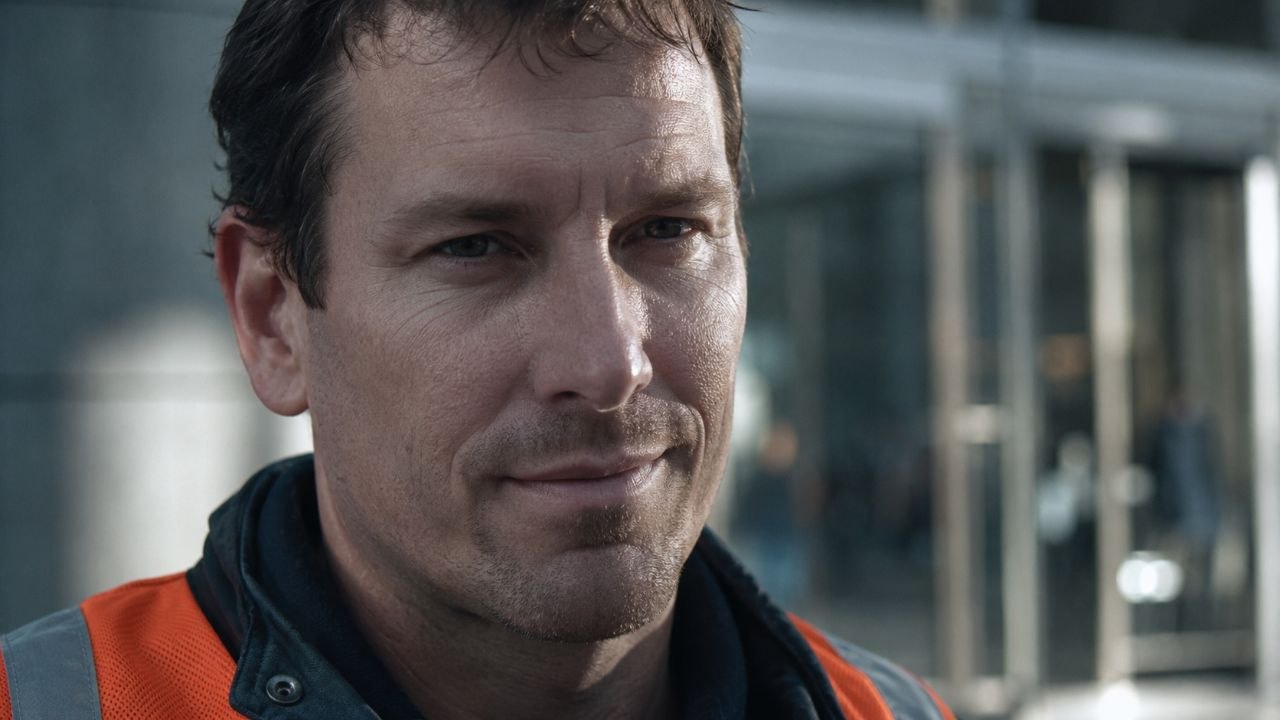
The sidewalk in front of Hartwell Tower cost more per square foot than most people’s apartments. That was intentional. Everything about this block was intentional.
Marcus pushed his broom in slow, even strokes. He’d been on this route for eleven months. Long enough to know which cracks collected bottle caps, which corner collected cigarette butts, which hours collected the men who believed they owned all of it.
He’d learned not to care.
That skill had cost him something, once. Now it was just muscle memory.
Daniel Farrell walked like a man who hadn’t been told no in years.
Forty-two. VP of Strategic Partnerships at Caldwell Group. Six hundred dollar shoes. A phone pressed to his ear that he wasn’t actually talking into — just carrying, as a kind of armor against being approached.
He stopped in front of Marcus without slowing first.
“You’re blocking the entrance,” he said.
Marcus glanced behind him. Three feet of open sidewalk. “I don’t think I am.”
“Move. I’m not going to say it twice.”
“I’m just working.”
Daniel’s eyes moved over Marcus the way they’d move over a poorly designed piece of lobby furniture. Dismissive. Faintly annoyed.
“You smell like the street.”
He said it clearly. Loud enough for the woman walking past to catch. Loud enough to land as exactly what it was.
The slap came before Marcus could register the escalation.
Not a shove. Not a push.
A full, open-palmed slap across his face.
Hard enough to turn his head.
Hard enough to draw a gasp from the woman who’d just passed.
Marcus’s grip tightened on the broom handle. His cheek burned. He stood very still and breathed through it, the way he’d learned to breathe through things that couldn’t be fixed by reacting.
Daniel straightened his jacket.
“Get out of the way,” he said, and walked through the entrance.
The lobby swallowed him.
Marcus stood on the sidewalk. A delivery driver had seen it. The woman had seen it. A security guard inside the glass doors had seen it and looked away.
He picked up the broom.
He kept working.
Because that’s what you do when the world doesn’t correct itself immediately.
You wait.
The call came eighteen minutes later.
Not a call. A sound.
A heavy, dense impact — the kind the body makes when it stops being controlled and starts being governed only by gravity.
Marcus heard it before he saw it.
He turned.
Theodore Caldwell — CEO of Caldwell Group, seventy-one years old, board member of three hospital foundations, former chairman of a cardiac health nonprofit — was on the pavement outside the main entrance.
Collapsed.
Not dramatically. Not like in movies.
Like something inside him had simply run its calculation and stopped.
His hand was pressed flat against his sternum. His face was the color of old concrete.
The crowd response was fast and useless.
Screaming. Phones. Someone saying “call 911” to someone else who was already on the phone. Three people standing in a semicircle doing nothing but witnessing.
Marcus dropped the broom.
He moved.
“Move back.”
His voice didn’t carry panic. It carried the particular authority of someone who knows what comes next when no one else does.
People stepped aside.
He knelt beside Caldwell. Two fingers to the neck, his eyes already reading the chest — not moving right. He tilted the man’s chin, felt for breath.
Nothing.
He locked his hands and started compressions.
One. Two. Three. Four.
The rhythm was automatic. Clean.
“Someone call 911,” he said, not stopping. “Tell them unresponsive male, no pulse, CPR in progress. Give them the address.”
A young woman in a blazer nodded and stepped back, already talking.
Marcus kept going.
Thirty compressions. Two breaths. Repeat.
He didn’t look up at the crowd.
He didn’t look for appreciation.
He just worked.
Daniel Farrell reappeared in the lobby doors sixty seconds into it.
He saw the body on the ground.
He saw the orange vest.
He didn’t move.
A colleague next to him said, “That’s Caldwell —” and Daniel took one step forward, then stopped, because he recognized the man doing compressions, and something in his brain misfired trying to reconcile the image.
The man he had slapped twelve minutes ago.
On his knees over his boss.
Keeping him alive.
The paramedics arrived in four minutes.
Caldwell gasped at the three-minute-and-forty-second mark.
Not a dramatic full breath. A ragged, wrenching pull of air, like someone surfacing from deep water.
His eyes opened.
Unfocused at first.
Then settling.
Settling on Marcus, who was still leaning over him, hand on his shoulder, watching his chest rise and fall.
“You’re okay,” Marcus said. “Stay still. Help is here.”
Caldwell blinked. His voice was barely sound. “You—”
“Don’t talk yet.”
“You saved me.”
Marcus sat back on his heels. “Keep breathing.”
The paramedics took over with the practiced efficiency of people who’ve done this a thousand times. They loaded Caldwell onto the stretcher.
Daniel stood off to the side, perfectly still, watching.
He hadn’t spoken since he’d come back outside. His phone was in his hand again, but this time he wasn’t using it as armor. He was just holding it.
One of the senior paramedics looked at Marcus. “You certified?”
“Used to be an EMT,” Marcus said. “Years ago.”
“Good work.”
The stretcher rolled toward the ambulance.
Caldwell raised one hand as they wheeled him past Marcus.
Not waving.
Reaching.
Marcus took his hand. Just for a second.
“Thank you,” Caldwell said.
“It’s fine.”
“Who are you?”
Marcus hesitated.
Then he reached into the front pocket of his vest.
He pulled out a small piece of folded paper — burned at one edge, stained with age, torn almost in half. He unfolded it carefully, like the creases had memory, and held it where Caldwell could see.
Caldwell’s face changed.
Recognition doesn’t always look like joy.
Sometimes it looks like a man realizing how many years he owes someone.
“Marcus,” he whispered.
“You told me if I ever needed anything,” Marcus said quietly. “Twelve years ago. The night the fire took the building on Mercer Street.”
Caldwell’s eyes didn’t leave the paper.
“I’ve been trying to find you,” Caldwell said. “We all thought—”
“I know what you thought.”
A pause.
“I never needed anything,” Marcus said. “Until about six months ago.”
Daniel Farrell had drifted close enough to hear.
Close enough that when Marcus finally glanced over at him, there was no pretending he hadn’t.
Daniel opened his mouth.
Marcus looked at him the way you look at something that used to feel dangerous and now just feels small.
“I don’t need an apology,” Marcus said.
Daniel closed his mouth.
“I need you to go inside,” Marcus said. “And I need you to understand that the reason your boss is still breathing is because the person you hit twelve minutes ago spent four years as a first responder before a fire took everything he had. And he still got on his knees in the street for a man he didn’t know, while you stood at the door and watched.”
Silence.
“You don’t have to say anything. I just wanted you to have that.”
Daniel looked at the ground. His jaw worked.
He walked back inside.
The ambulance doors closed.
One of Caldwell’s assistants — a sharp-eyed woman named Claire who’d been standing witness through all of it — walked over to Marcus.
“He’s going to want to speak with you,” she said. “When he’s stable.”
“I figured.”
“Is there a number—”
“You know where I’ll be,” Marcus said. He picked up the broom.
She watched him.
“For what it’s worth,” she said, “the whole board saw that. On the security feed.”
Marcus glanced at the building. “Didn’t do it for the board.”
“I know.” She paused. “That’s exactly why they saw it.”
Three weeks later, Daniel Farrell was placed on administrative leave pending an HR investigation. Two employees had come forward, and the delivery driver had submitted a written account.
The company didn’t announce it.
These things rarely get announced.
They just quietly become fact.
Marcus met Caldwell in a private room on the eighth floor of St. Ambrose Hospital, nine days after the sidewalk.
Caldwell was upright. Color back in his face. An IV still in his arm, more out of caution than necessity.
He had the original documents waiting on the table beside him. The restoration of a contract that should never have been voided. A settlement figure that had been prepared, his assistant said, six months ago — just waiting to be found.
“You never filed,” Caldwell said.
“Didn’t think I had standing anymore,” Marcus said. “After the fire and the legal mess. I let it go. Figured some things just—”
“Don’t let go,” Caldwell said.
“No.”
“I’m sorry it took this long.”
“You didn’t know where I was.”
“I should have looked harder.”
Marcus sat down across from him.
“You looked,” Marcus said. “You found me. This is the part after that.”
Caldwell pushed the documents across the table.
Marcus looked at them for a moment — the numbers, the dates, the name printed at the top that was his.
He picked up the pen.
And signed.
Outside the window, twelve floors below, the sidewalk was clean.
It had been cleaned that morning by someone who knew that the work was the work, regardless of what the world thought of the person doing it.
Marcus had learned that in a firehouse.
He’d kept it on a sidewalk.
Now he carried it into a room where, for the first time in years, the weight of what he was owed finally sat level with what he’d always been.
Not luck.
Not charity.
Proof — held in the hands of someone who had been there when everything burned, and had been standing by the right building on the right morning to close the debt.
The pen scratched across the paper.
Done.
Original fictional stories. AI-assisted creative content.
