
The rooftop party was Margaret Calloway’s idea of power made visible.
City lights blinked thirty floors below. White-gloved servers moved between clusters of guests. Champagne arrived in crystal that cost more than most people’s rent. This was her world—every inch of it curated to remind people exactly who she was.
Nobody told her what was already standing in it.
Nora came in through the service entrance. That had been deliberate.
She hadn’t dressed to impress Margaret. She’d dressed to survive the night—navy wrap dress, low heels, hair pulled back. Simple. Forgettable. She’d been forgettable in this family’s eyes for three years. She’d learned to use that.
Beside her, holding her hand with both of his, was Eli.
Five years old. White button-down shirt already rumpled from the car ride. Dark hair that curled at his temples the same way his father’s had. He looked at the city lights with enormous eyes, and Nora bent down to his level.
“Stay close, okay?”
“Okay,” he whispered.
She straightened, picked up her clutch, and walked into the light.
She spotted Margaret before Margaret spotted her.
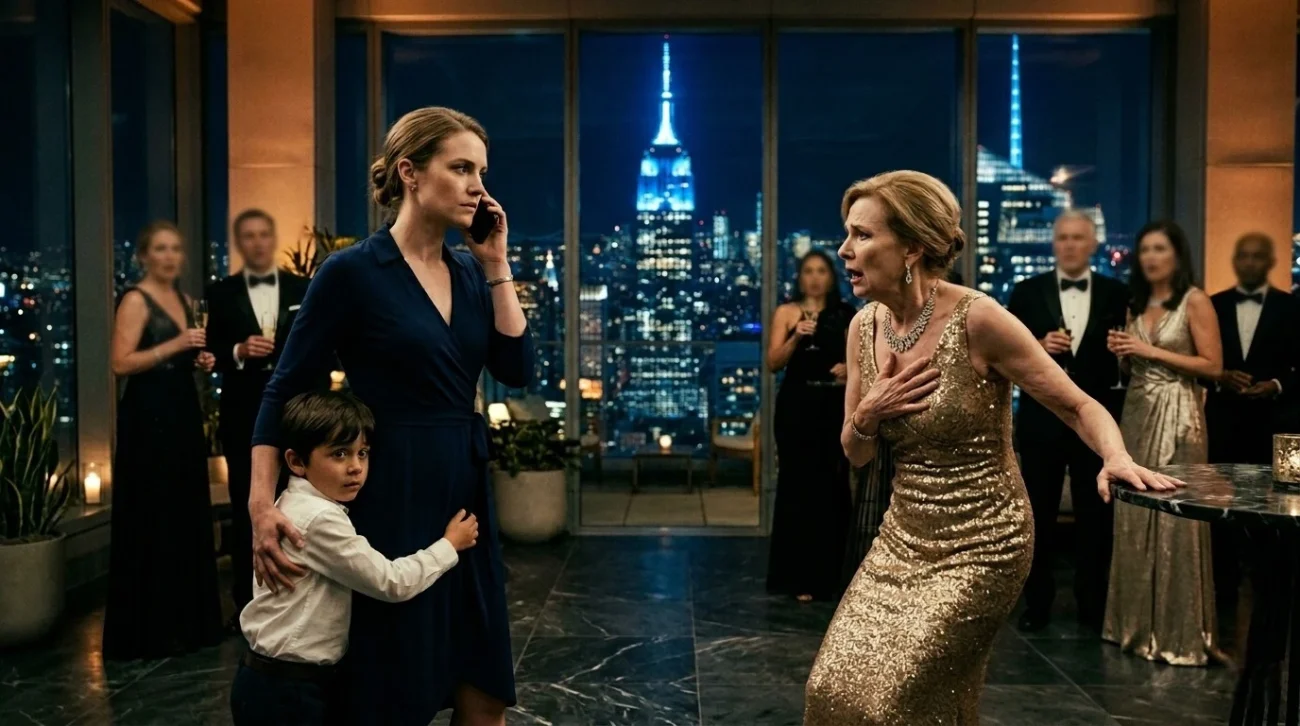
The older woman stood at the center of the terrace like a fixture—gold gown, diamonds at her throat and wrists, silver hair set with architectural precision. She was sixty-two and spent considerable energy making sure no one forgot she was also formidable. Her wealth, her board seats, her name on three buildings in this city. She used all of it like a weapon.
Nora had felt that weapon for years.
But three years ago, she’d stopped flinching from it. Margaret just didn’t know that yet.
The moment Margaret turned and saw them, her expression didn’t change. That was the tell. A woman who felt nothing wouldn’t have controlled her face so fast.
She crossed the terrace in long, measured strides. Guests stepped aside without thinking. That was what money and age did—it parted rooms.
She stopped six feet from Nora and looked at Eli the way you look at something you want to disappear.
“What are you doing here?”
Nora kept her voice even. “We need to talk, Margaret.”
“No.” The word landed like a door slamming. “We don’t. You were asked to leave this city six months ago. I made that very clear.”
“You made a lot of things clear,” Nora said. “That’s actually why I came.”
Around them, guests had noticed. Not obviously—they were too trained for that. But conversations faltered. Heads angled. The polite social machine of the Calloway world had picked up the frequency of conflict and tuned in without appearing to.
Margaret lowered her voice, but it didn’t get warmer. “You are embarrassing yourself.”
“I’m not embarrassed,” Nora said.
“You should be.” Margaret’s eyes flicked to Eli—cold, clinical. “Take the boy. Leave the party. I will have security escort you out if you force me to.”
Eli pressed closer to Nora’s leg. He’d heard that word—security—and he knew what it meant. His hand tightened around her fingers.
Nora looked down at him. Just for a second. Just long enough to pull something steady up from somewhere deep.
Then she looked back at Margaret.
“Okay,” she said softly.
Margaret’s chin lifted, satisfied.
Nora bent down and pulled Eli into her arms. His small legs wrapped around her. His face found her shoulder. The guests watched. Someone laughed at something else entirely, filling the silence.
And then Nora, kneeling on the polished marble in front of everyone, with the city glittering behind her and Margaret Calloway standing over her in triumph, opened her clutch one-handed.
She lifted the black phone.
Margaret frowned. “What are you—”
“Calloway Retail,” Nora said into the phone. Her voice had changed. It was quiet. Precise. The voice of someone who had rehearsed this exactly zero times because she didn’t need to.
The frown deepened. “What are you doing?”
“Close every store,” Nora said. “All locations. Emergency protocol. Five-minute execution.”
The silence on the terrace was sudden and total.
Margaret blinked. “Excuse me?”
Nora stood slowly, Eli still on her hip, the phone still at her ear. She didn’t look at Margaret until she was fully upright. Then she did.
“And freeze her access,” she said into the phone. “All levels.”
Margaret’s face went the color of old ash.
“That’s—” Her voice cracked for the first time in Nora’s memory. “That’s not—you can’t—”
From the phone, a voice came through calm and clear. Professional.
“Understood, Ms. Voss. All locations are now in emergency lockdown. Executive access for Margaret Calloway has been suspended pending board review.”
Somewhere to Nora’s left, a champagne flute hit the marble. The sound broke across the terrace like a gunshot.
Margaret’s hand went to her throat. Her diamonds caught the light but her face looked stripped of everything.
“Voss,” she said. She said it like a word she’d forgotten. Like something that had been buried and just crawled out of the ground.
“That’s my name,” Nora said. “My mother’s name. The name I stopped using when I was nineteen because it scared people like you.”
“You’re—” Margaret’s jaw worked. “You’re not—”
“Helena Voss was my mother. She built the company you tried to acquire in 2019. The board she assembled voted you down, and she died before she could restructure the trust.” Nora’s voice didn’t shake. “I inherited the controlling stake eight months ago. I’ve been quiet about it because I was watching.”
The guests had stopped pretending entirely. No one moved.
Margaret gripped the cocktail table behind her.
“You were watching,” she repeated. It wasn’t a question. It was someone trying to understand how the ground had moved.
“I was watching what you would do,” Nora said, “when you found out your son had a child with the woman you hated most.”
The word landed differently than everything else.
Son.
Margaret’s composure, which had been fracturing in slow motion, simply broke.
“David,” she whispered.
“David,” Nora said quietly. “Your son. Who died fourteen months ago in a car accident in Portland. Who left behind a child he’d been raising with me for two years before that.”
She adjusted Eli on her hip. The boy had gone very still, listening to things he was too young to understand and old enough to feel.
“You knew,” Margaret said. It wasn’t quite an accusation. It was more like recognition—like finally seeing the shape of something that had always been in the room.
“I knew you’d try to take him,” Nora said. “And I knew if I walked in here with lawyers, you’d bury it for a decade. So I waited until you did exactly what I knew you’d do.” She looked around the terrace—at every frozen, watching face. “In public.”
Margaret’s hand trembled against the table.
“He’s—” Her eyes dropped to Eli. To the dark hair. To the jaw that was, unmistakably, the same jaw as in every portrait in her house. “He’s David’s.”
“His name is Eli,” Nora said. “He’s five. He likes dinosaurs and hates the dark and he asks about his father every single night.”
A sound came out of Margaret that no one in that circle had ever heard from her before. Short. Broken. Like something structural giving way.
“You wanted me to disappear,” Nora said. Her voice was steady but her eyes were wet. She didn’t hide it. “You’ve wanted me gone since the first time David brought me to dinner. I wasn’t the right kind of woman. I wasn’t from the right family. I didn’t have the right name.”
“You had your mother’s name,” Margaret said, very quietly. “And I knew what that meant.”
“You were afraid of it.”
“Yes.” The word came out raw and unguarded. Margaret hadn’t meant to say it that way.
“You tried to threaten me into leaving the city. You cut off the accounts David set up for Eli. You told your lawyers I was unstable.” Nora took one step forward. “You tried to make me invisible so that no one would ever know your grandchild existed, because admitting he existed meant admitting David loved someone you disapproved of.”
She stopped.
“And then you stood in front of a hundred people tonight and told me to take him and leave.”
Eli lifted his head from her shoulder. He looked at Margaret—this woman in gold he didn’t recognize—with wide dark eyes that were entirely his father’s.
Margaret looked back at him.
For a moment, nothing moved.
“What do you want?” Margaret said. Her voice had no architecture left in it. Just the question, hollow and direct.
“I want you to say his name,” Nora said.
Margaret’s lips pressed together.
“Say his name,” Nora said again. “Out loud. In front of everyone here. Because the moment you do, it can’t be erased. There’s no legal strategy for what you just said to us in front of these witnesses. There’s no PR fix for a grandmother who tried to throw her own grandchild off a rooftop.”
A murmur moved through the crowd. Not horror this time. Agreement. The particular cold agreement of people who have watched a powerful person overplay their hand and understand that what comes next is permanent.
Margaret Calloway was sixty-two years old and she had never apologized for anything in her life.
She looked at the boy on Nora’s hip.
His dark eyes looked back.
She said, quietly, “Eli.”
It wasn’t redemption.
It wasn’t even close to enough.
But it was the name spoken out loud, on record, in front of every person who mattered in Margaret Calloway’s world. It was the crack the lawyers would use. It was the moment the story became undeniable.
Nora didn’t smile. She didn’t need to.
She lifted the phone one more time.
“Record that,” she said.
The voice on the other end answered immediately.
“Already done, Ms. Voss.”
The aftermath was swift and unglamorous.
Margaret’s board received the emergency filing before the party ended. Two directors called her before she reached the elevator. Her access to Calloway Retail’s systems—the empire she’d built for forty years—was suspended pending an independent review of the trust interference and the attempted suppression of a legal heir’s documentation.
The lawyers Nora had retained for eighteen months had been waiting for exactly this night.
By morning, Margaret’s attorneys were on the phone.
By the following Thursday, Eli had a legally recognized family name—Calloway-Voss, at Nora’s insistence—and a trust that Margaret could no longer touch.
Margaret sat across from Nora in a conference room the following week. No gold. No diamonds. A gray blazer and the careful stillness of a woman who had learned in one night that the weapons she’d always relied on had been turned around.
“You could have come to me differently,” Margaret said.
“I tried,” Nora said. “Three times. Your assistant sent form letters.”
A pause.
“I would like to know him,” Margaret said. Just that. Stripped down. No demand in it.
Nora looked at her for a long moment.
“That’s up to Eli,” she said. “When he’s old enough to choose. I won’t take that from him, and I won’t force it either.”
Margaret nodded. She didn’t argue.
It was the first honest conversation they’d ever had.
Six months later, Nora moved back to the city—not because Margaret asked, but because Eli had started asking about the lights he’d seen from the rooftop that night.
He’d decided he wanted to see them again.
She let him.
They stood on a different terrace, a smaller one, the city laid out below them in its ordinary brilliant mess.
“Mom?” Eli said.
“Yeah?”
“That lady in the gold dress.” He looked up at her. “Is she my grandma?”
Nora looked at the lights for a moment.
“She is,” she said.
He thought about it. “Does she know dinosaurs?”
Nora laughed—a real one, short and unguarded.
“I have no idea,” she said. “Maybe you should ask her.”
Eli considered this with the grave seriousness of someone who had spent five years forming opinions.
“Okay,” he said. “But if she doesn’t know any, I’ll teach her the Cretaceous ones first. Those are most important.”
Nora pulled him close.
“Deal,” she said.
Below them, the city went on blazing.
It had no idea what it had witnessed. It never did.
But Nora knew. Eli would know someday. And Margaret Calloway—stripped of her armor on a marble terrace in front of everyone she’d ever impressed—knew it most of all.
Some nights you build your whole world on the certainty that you can erase someone.
And then they make one phone call.
And the world you built belongs to them.
Original fictional stories. AI-assisted creative content.
