
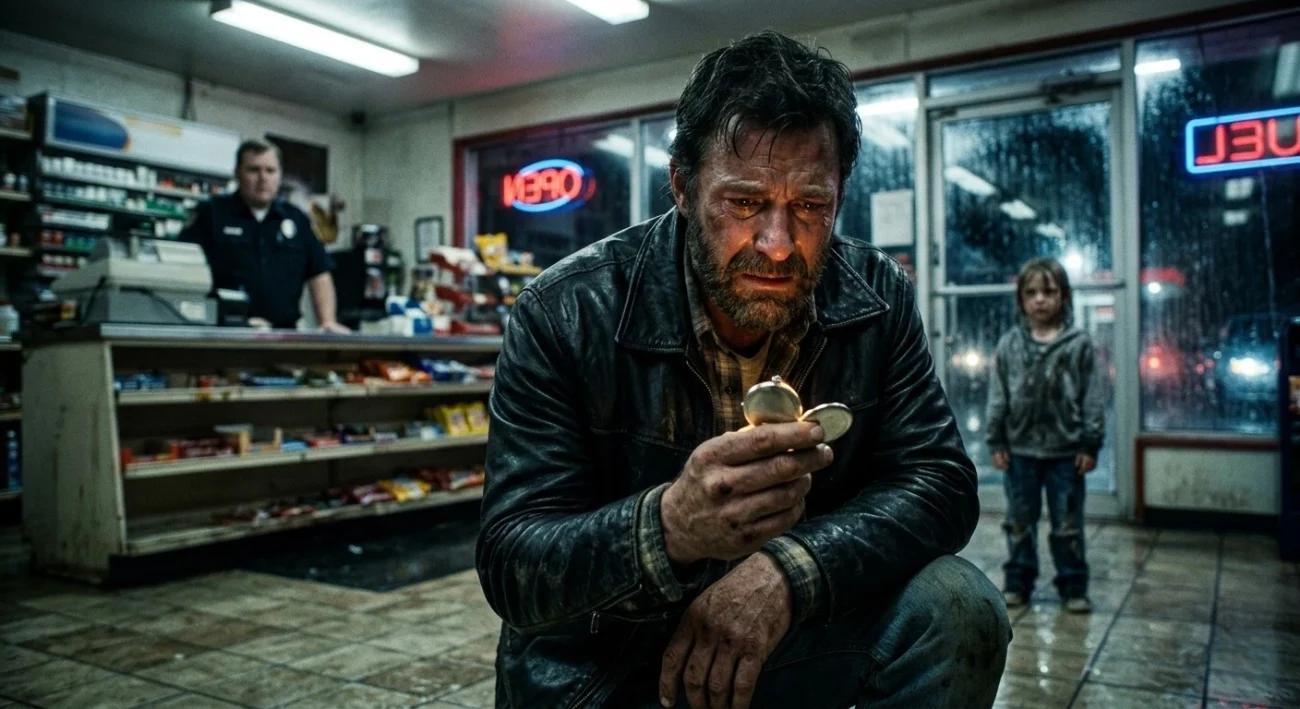
Rain hit the gas station roof like gravel thrown from the sky.
Neon signs bled red and orange across the flooded asphalt. The pumps stood dark and unattended. The highway beyond them was empty in both directions — nothing moving, nothing coming.
Inside, the smell of old coffee and motor oil hung over everything.
James Calloway stood near the back wall with a cup he hadn’t touched, watching the door the way men like him always watched doors. Force of habit. Twenty years on the road taught you to know where the exits were before you knew anything else.
His crew — nine of them, The Iron Road chapter, Texas division — spread out along the snack aisles and the coffee counter, quiet the way they got quiet when there was nowhere to be and nothing to prove.
Then the bell above the door rang.
The boy who walked in was maybe five. Maybe smaller. He was soaked down to the skin, shirt torn at the collar, shoes so wet they squelched with every step. His face was dirty. His eyes were red-rimmed and swollen from crying he must have been doing for a long time before this.
He walked straight to the front counter like he had a plan, even if his chin was trembling.
The owner — thick man, late fifties, arms like cord wood — looked up from his register.
“We’re closed to minors without an adult.”
The boy reached up and put both small hands on the counter edge.
“Please. I’m really hungry.”
There was a wrapped sandwich under the glass display. Pre-made, probably hours old. The boy’s eyes had locked onto it the moment he walked in.
The owner reached under the counter, pulled out the sandwich, set it up on top.
The boy’s face opened with relief.
Then the owner slid it to the far end, out of reach.
“I said get out, kid. Come back with a parent.”
“I don’t—” The boy’s voice cracked. “I don’t have one right now.”
“Not my problem. Out.”
The boy stood there. His hands were shaking. His bottom lip disappeared under his teeth like he was trying to hold something back that was too big for his body to hold.
Most of the crew glanced over and looked away.
Darren, the youngest of them, caught James’s eye and gave a small shrug — what are you gonna do.
James set down his cup.
He crossed the store in eight steps, reached past the owner without a word, picked up the sandwich, and put it in front of the boy.
“Eat.”
The owner turned. “Hey. That’s—”
“I’ll pay for it.” James didn’t look at him. “And a hot chocolate if you’ve got a machine that works.”
The boy looked up. He hadn’t moved yet. He was still deciding whether this was real.
“Go ahead,” James said. “It’s yours.”
The boy grabbed the sandwich with both hands and bit into it so fast it almost broke James’s chest clean open.
Behind him, Darren muttered something. A couple of the others shifted. The owner punched the register without another word.
James stood there while the boy ate. He wasn’t thinking about anything. He was just standing there the way a wall stands — because something needed to be between this kid and the rest of the world for the next five minutes.
That’s when it happened.
The boy shifted on the stool, trying to peel back the sandwich wrapper, and something slipped out from under his torn shirt.
A silver locket on a thin chain.
It swung forward and caught the fluorescent light.
James’s hand moved before his brain did. He caught it. Not grabbing — just catching, gentle, the way you catch something you already know is fragile.
He looked down at it in his palm.
The chain was old. The locket itself was scratched at the edges — worn by years of being opened and closed and held. He turned it over. No engravings on the back. Just a tiny hinge on one side.
He pressed it open.
Inside: a photograph. Small, faded, creased down the middle.
A young woman. Dark hair. Laughing at something off to the left of the camera. She was maybe twenty in the picture. She was wearing a yellow dress.
James stopped breathing.
The store didn’t get quieter. But something inside him did.
He knew that dress. He’d bought it at a market outside of Laredo on a Sunday afternoon when he was twenty-two years old and so far gone on this girl he couldn’t think straight. She’d laughed when he pulled it off the rack — James, it’s a dollar-fifty — and he’d said so what, you’ll look beautiful in it, and she had.
She always did.
Her name was Cara.
Cara Reyes. From a little town called Odell that didn’t even show up on most maps. The kind of girl who knew your name before she knew your last name and remembered your coffee order after one visit. The kind of girl who made a man want to be worth something.
He’d loved her. Completely. The way you can only love someone when you’re young enough to not know yet how bad things can get.
She’d gotten pregnant.
He’d told her to give him three months. One last job, one last run, enough money to get them somewhere real. Somewhere she could breathe.
He’d been gone two weeks when it went wrong. The job went sideways. He spent the next eight months in a county facility in New Mexico under a name that wasn’t his.
When he got out, he went back to Odell.
She was gone.
Her aunt told him there’d been complications. The baby. The mother. Neither one had made it.
He’d believed it. He didn’t know why he’d believed it. Maybe because grief will make you accept anything that gives it a shape.
He’d spent the next twenty years becoming the man he was now. Hard. Quiet. Moving. Not arriving anywhere because there was nowhere he wanted to go.
“Mister?”
The boy was looking up at him.
James realized his hand was shaking.
He closed his fingers around the locket for a second. Breathed.
Then crouched down to the boy’s level.
“What’s your name?”
“Eli.”
“How old are you, Eli?”
“Five and a half.”
James looked at him. Really looked. The shape of the eyes. The way the brow sat. The slight tilt to the chin when he held still.
He’d seen that face in mirrors his whole life.
“Where’s your mama, son?”
Eli’s expression folded.
His eyes filled immediately — the way a child’s do when they’ve been trying very hard not to think about something and someone makes them think about it again.
“She got sick,” he said. “She was cold. And then she stopped waking up.”
James stayed very still.
“When?”
“Four days ago. I tried to wake her up for a long time.” Eli wiped his nose with the back of his hand. “Then I walked. She always said if I was ever hungry and she wasn’t there, I should find the man in the locket.”
James looked at the locket still in his palm.
“She said he’d know what to do,” Eli continued. “She said he was good, even if he didn’t always look it.”
Someone behind James made a small sound. He didn’t turn around.
“Did she tell you his name?”
Eli nodded.
“James.”
The word landed like a stone dropped into still water. Every ring of it went outward.
James closed his eyes.
Just for a second. Just long enough for the whole weight of it to hit him — twenty years of a wrong answer, twenty years of empty miles, and this five-year-old boy standing in a gas station in the rain because the woman James loved had spent twenty years keeping a locket instead of burning his memory to the ground like he probably deserved.
She’d kept it.
She’d pointed this child toward him with her last breath of sense.
He opened his eyes.
Eli was watching him carefully — the way children watch adults when they’re trying to figure out if it’s safe to hope.
James reached out and touched the boy’s cheek. His fingers were rough from years of highway and metal, and the boy’s face was very cold.
“You found me,” he said.
Eli’s chin started trembling again.
“Are you him?”
“Yeah.” His voice came out wrecked. He didn’t try to fix it. “I’m him.”
Eli stared at him for another second — processing it, arranging it — and then something in his small body just gave way and he fell forward. His arms went around James’s neck and he buried his face against his shoulder and cried.
James caught him.
He held on like a man who’d been letting go of things for twenty years.
Behind them, no one moved. The owner had both hands flat on the counter and was staring at the floor. Darren had turned away, jaw working. Two of the older crew members — men who’d seen everything — stood with their arms crossed and their heads down.
“He’s gone,” Eli said into James’s shoulder. Meaning: the grief was still fresh and still enormous, but something new had arrived to sit beside it.
“I know.” James stood up slowly, the boy still in his arms. “I’m sorry I wasn’t there.”
“Mama said you didn’t know.”
“She was right.”
Eli leaned back to look at him. His eyes were wet but he’d stopped crying.
“Are you going to leave again?”
Every man in the room held still for that.
James looked at his son. This small, soaked, exhausted, impossible boy who had walked along a highway in the rain because his mother had handed him a locket and an act of faith.
“No,” he said. “I’m not going anywhere.”
He paid for the sandwich. And the hot chocolate.
Then he walked out to his bike and made three phone calls.
The first was to a lawyer he knew in San Antonio — the kind who handled situations that didn’t fit into normal paperwork.
The second was to a woman named Patty in Odell, Texas — Cara’s cousin, the only family that was ever decent to her — who confirmed between tears that yes, it was true, Cara had passed four days ago from pneumonia that got too bad too fast, and Eli had slipped out before anyone could reach anyone.
The third call was to his own chapter house. He told them to prepare the back room.
When he came back inside, Eli was sitting on the counter drinking hot chocolate, both hands wrapped around the cup. Darren was crouched in front of him describing the engine modifications on his Harley with the kind of grave technical detail you’d use to explain a moon landing, and Eli was listening with complete seriousness.
James stood at the door and watched.
The owner came up beside him. Quiet. Different now.
“He yours?”
“Yeah.”
The man said nothing for a moment.
“I didn’t know. I woulda—”
“It’s done.” James wasn’t interested in the apology, but he also wasn’t going to drag it out. “Don’t do it again.”
The owner nodded. He reached under the counter and put a bag on top — two more sandwiches, a bag of chips, a juice box.
“For the road,” he said.
James picked it up.
“Thanks.”
Getting legal guardianship wasn’t instant. It took six weeks, a DNA test, two court appearances, and a lawyer who earned every dollar James paid him. Patty helped, gave a statement, brought documents Cara had filed years ago designating James — by full name, with notarized proof of identity — as Eli’s father of record.
Cara had known. She’d known who he was, and she’d planned for this, and she’d done it alone, and James spent a lot of nights in those six weeks sitting with the weight of what she’d carried.
He also spent a lot of nights sitting outside Eli’s room, listening to him breathe.
The boy adapted the way children do — both more slowly and more completely than you’d expect. He cried at night for the first two weeks. James always heard it. He always went in. He didn’t say much. He just sat on the edge of the bed and stayed there until the crying quieted.
Darren took it upon himself to become Eli’s unofficial technical advisor on all things mechanical. Two other crew members, veterans both, started showing up to the chapter house on weekends specifically to watch cartoons with a five-year-old.
Eli started calling James “Dad” on the thirty-eighth day.
James was out in the lot working on a carburetor when it happened. He heard it and set down his wrench and didn’t move for a full minute.
Then he said, “Yeah?”
And Eli said, “Can we have pancakes?”
The court finalized the guardianship on a Tuesday morning in October.
James sat in a hard plastic chair in a San Antonio courthouse hallway while the paperwork processed, Eli asleep against his arm with his sneakers not quite reaching the floor.
He had the locket in his jacket pocket.
He’d had it cleaned. The photograph inside was now protected behind a thin piece of archival glass, the way a jeweler had shown him. It was still Cara in her yellow dress. Still laughing at something off to the left.
He didn’t open it in the courthouse. He didn’t need to.
But he kept his hand in his pocket, fingers closed around it, while he waited.
When the clerk called his name and handed him the final documents, she smiled the automatic smile of someone who’d done this a thousand times.
“Congratulations,” she said. “He’s officially yours.”
James looked down at Eli, who had woken up and was now very focused on a vending machine across the hall.
“He was always mine,” James said. “I just didn’t know it.”
They drove out of San Antonio on a clear Tuesday afternoon, Eli riding behind James in the sidecar Darren had spent two weekends welding and padding and making safe. The rest of the chapter fell in behind them on the highway like a processional.
Eli had one hand on the frame of the sidecar and his face turned toward the wind, eyes wide, absolutely delighted.
He reached up and grabbed James’s sleeve.
“Dad.”
“Yeah.”
“Can we do this every day?”
James watched the highway open up ahead of them. Texas sky. October light. Everything enormous and clean.
“Yeah,” he said. “Every day.”
He meant it.
And this time, nothing was going to stop him from keeping that word.
Original fictional stories. AI-assisted creative content.
