
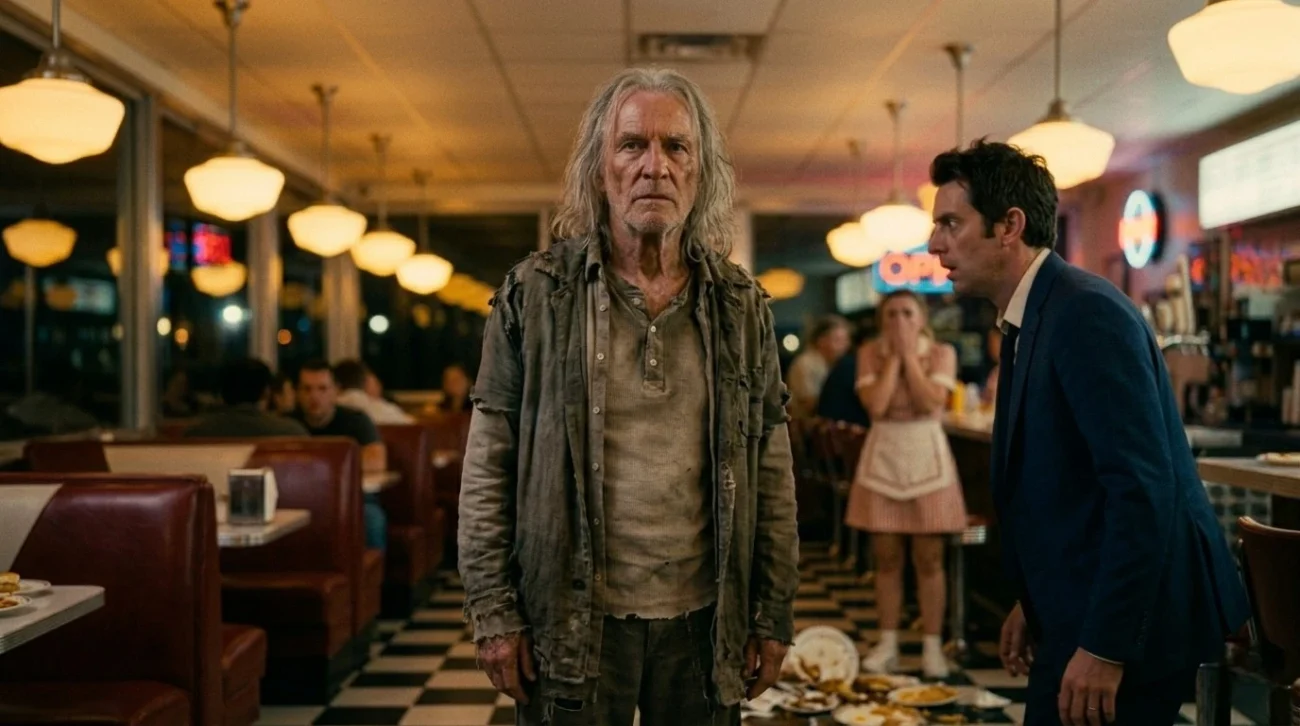
The lunch rush had thinned out by two o’clock, leaving the diner half-empty and quiet enough to hear the hiss of the griddle from the back.
Maya had been on her feet since six. Her ankles hurt. Her smile had been real at eight, fake by eleven, and somewhere around one it had just become habit—a practiced curve of the mouth she didn’t think about anymore.
She was refilling coffee at table four when she noticed him.
Corner booth. Dirty jacket, the kind that had been rained on so many times the original color was a guess. Hair unwashed and uncut, pushed back from a face that looked sixty but might’ve been forty-five. His hands were on the table, trembling slightly, and he was staring at the laminated menu like he was trying to remember how to read.
Two women at the next table shifted their chairs half an inch away from him without looking up.
The man at the counter didn’t bother hiding it—he just turned his stool the other direction.
Maya watched the hostess drift toward the corner with a glass of water, hesitate, then get distracted by a family coming through the door. She didn’t go back.
Maya set down the coffee pot.
She went to the pass-through, plucked a hot dog off the warming rack—one she’d been about to box up as a mistake order—added a small cup of mustard and a handful of fries, and carried the plate to the corner booth.
She set it down in front of him.
“Here you go, sir. I hope you enjoy it.”
He looked up.
It was the kind of look that lived in her chest for a long time afterward. Not gratitude exactly. More like a man who’d been underwater for a long time and had just broken the surface—disoriented, blinking, not entirely sure the air was real.
“I—” His voice was rough from disuse. “I didn’t order—”
“I know.” She gave him the real smile this time, the eight AM one. “It’s on me.”
She turned to go.
She’d taken two steps when she heard the footsteps behind her—quick, deliberate, the particular rhythm of someone who wanted to be loud on purpose.
“Hey.”
Derek. The manager. Thirty-four years old, assistant manager for six months, had been acting like he owned the place since the first week.
Maya turned slowly.
Derek was already at the table, staring down at the man the way you’d look at something you’d tracked in on your shoe.
“Who authorized this?”
“I did,” Maya said. “It was a mistake order from—”
“Mistake orders go in the trash.” Derek’s voice carried across the diner. He wasn’t even trying to keep it low. “Not to every bum who wanders in off the street.”
The man in the booth hadn’t moved. His eyes were on the plate.
“Derek—” Maya stepped forward.
She didn’t finish the sentence.
Derek reached out and slapped the plate off the table.
It didn’t just fall. It shattered—a hard, explosive sound that snapped through the diner like a gunshot. The hot dog hit the floor. Mustard splattered across the baseboard. A piece of ceramic skidded six feet and stopped against the counter leg.
The diner went completely silent.
Maya stood very still. Her throat had closed. She could feel tears rising—the hot, humiliating kind that come from being ambushed, not from sadness—and she pressed her tongue to the roof of her mouth and refused to let them fall.
“This trash,” Derek said, loud and even, like he was making a point to everyone in the room, “doesn’t deserve to eat.”
The man in the corner booth had gone very still.
Then, slowly, he stood up.
He wasn’t particularly tall. He wasn’t physically imposing in any way that should have mattered. But something had shifted in him—some internal architecture that had been folded away for a while was coming back into alignment. His shoulders straightened. His chin came up. His eyes, which had been tired and unfocused, were suddenly sharp and very, very calm.
He looked at Derek for a long moment.
“I’m the owner,” he said.
Three words, spoken quietly, no drama in them at all.
Derek’s face moved through several expressions in rapid succession—contempt, confusion, irritation, confusion again, and then a kind of slow-dawning horror that started somewhere behind his eyes.
“I—” Derek stopped. “What?”
“Richard Ellison.” The man’s voice was steadier now, gaining something with each sentence. “I’ve owned this location for eleven years. The Broad Street location for eight. I opened a third in Scottsdale last spring.” A pause. “I’ve been spending time at each one, unannounced, for the past month. Quality checks.”
The silence in the diner had texture now. People weren’t pretending to look at their plates anymore. They were watching openly, phones lowered, forks forgotten.
Derek’s mouth opened. Nothing came out.
“You’re—” He tried to recover. Something in his expression scrambled toward explanation, justification, damage control. “Sir, I didn’t—I didn’t recognize—”
“No,” Richard said. “You didn’t.”
He turned to Maya.
She hadn’t moved. She was standing very straight, her hands clasped in front of her, watching him with an expression that hadn’t settled on anything yet—not relief, not hope, just a careful stillness, like she was waiting to find out what kind of moment this was going to be.
“What’s your name?” he asked.
“Maya.” Her voice came out steadier than she expected. “Maya Collier. I’ve been here four years.”
Richard nodded slowly. He looked at the broken ceramic on the floor. The smear of mustard. The scattered fries.
Then he looked back at Derek.
“Clean out your locker,” he said. “HR will process the paperwork tomorrow.”
Derek’s face went gray. “Sir—please—if you’ll just let me explain—”
“You explained yourself already.” Richard didn’t raise his voice. He didn’t need to. “Everyone in this room heard exactly who you are.”
Derek looked around the diner like he was hoping for rescue. None came.
He walked to the back with the particular gait of a man whose legs had stopped working properly, and he pushed through the kitchen door, and the room exhaled.
Richard stood for a moment, looking at the floor again.
Then he reached into his jacket pocket—slowly, like the movement had some weight to it—and pulled out a photograph. Old. Folded along worn creases, the edges softened from years of handling.
He held it out to Maya.
She took it.
It was the diner—this diner, unmistakably, but years ago. Younger booths, different lighting fixtures. And standing behind the counter, one hand on the register, was a woman in her forties with dark hair and a wide, certain smile.
Maya’s chest seized.
She knew that smile. She’d grown up watching it across a kitchen table. She’d last seen it six years ago, in a hospital room, and then never again.
“That’s my mother,” she whispered.
Her voice had lost its steadiness. Her hands weren’t quite steady either.
“Ellen Collier,” Richard said. His voice had changed too. Something in it had opened up. “Nineteen ninety-eight. I had just opened this place and I was three months from losing it. A bank loan had fallen through and I couldn’t make payroll and I had a choice between shutting down or—” He stopped. Pressed his lips together. “She was waitressing here. Making eleven dollars an hour. She lent me her savings. Every dollar she had. Said she believed in the place.” A long pause. “She never let me pay her back. Said it wasn’t a loan. Said she just wanted to see the place survive.”
Maya couldn’t speak. She was looking at the photograph and she was trying very hard not to fall apart in the middle of the lunch rush and she was failing at it quietly.
“I looked for her,” Richard said. “A few years later, when things were better, I wanted to—I tried to find her, to do something. And I found out she’d moved. And then eventually I heard she’d—” He stopped again. “I heard she’d passed.”
Maya nodded, once. “Six years ago.”
“I’m sorry.”
The diner was very quiet. Someone near the window had put down their phone completely.
“When I saw you today,” Richard said, “the way you—the way you didn’t hesitate. Didn’t look around to see if anyone was watching. You just—” He let out a slow breath. “You just fed somebody who was hungry. Because it was the right thing to do.”
He took the photograph from her gently and looked at it for a moment.
“She would’ve done exactly that,” he said. “Exactly that.”
He folded the photograph back along its worn creases and put it back in his jacket pocket.
Then he looked at Maya directly.
“She saved this place once. Twenty-seven years ago, when nobody else believed in it.”
He reached into the other pocket of his jacket and set a folded envelope on the table between them.
“I had my attorney draft this last week. I wasn’t sure who I was looking for. But I knew I was looking for someone.”
Maya stared at the envelope. She didn’t reach for it.
“Open it,” Richard said quietly.
Her fingers were not completely steady. The envelope was thick, official, crisp paper inside—a document with a heading she had to read three times before it registered.
Transfer of Ownership — Partial Equity Agreement.
Forty percent of this location.
Her name, already typed where the recipient line was.
“This location is the one she saved,” Richard said. “It should belong, in some part, to her family.”
Maya put the document back in the envelope because she couldn’t look at it anymore. She stood there, in her uniform, in the middle of the quiet diner, with tears running freely down her face that she’d stopped trying to stop.
“I don’t—” She couldn’t finish.
“You don’t have to say anything,” Richard said.
A woman at table three had started crying too. Nobody seemed embarrassed by it.
The cook had come out from the back, wiping his hands on his apron, watching.
Richard bent down and picked up one of the larger pieces of broken ceramic from the floor.
He set it on the table.
“Get someone to clean this up,” he said—to the room in general, gently, as a statement of what came next. “And then get back to work. All of you.” The faintest trace of something that wasn’t quite a smile. “Lunch isn’t over.”
He walked toward the door.
At the threshold, he stopped without turning around.
“Derek’s closing shifts are open starting tonight,” he said. “Post the schedule and promote from your existing staff. You’ll know who deserves it.”
Then he walked out, and the sunlight swallowed him, and he was gone.
Maya stood at the corner booth for a long moment.
She looked at the envelope in her hands.
She looked at the counter where her mother had once stood, twenty-seven years ago, with enough faith to give away everything she had.
She folded the envelope carefully and put it in her apron pocket, next to her order pad.
Then she picked up the coffee pot, squared her shoulders, and walked to table two.
“Can I get you anything else?”
The couple at table two said they were fine.
She moved on to table three, and table four, and the woman near the window who had stopped crying and was now watching Maya with an expression like she was witnessing something she’d remember.
Maya refilled her coffee.
“Here you go,” she said.
The woman touched her hand, briefly, before she moved on.
Outside, through the plate glass window, the afternoon was ordinary and bright. Traffic moved. A bus stopped and started. Someone walked a dog.
Inside, the diner hummed back to life—voices, silverware, the hiss from the kitchen.
And behind the counter, in a frame Maya would hang there the following week, a photograph of a woman with dark hair and a wide, certain smile watched over all of it.
Just like she always had.
Original fictional stories. AI-assisted creative content.
