
The mansion had twenty-two rooms, and Elena had learned the purpose of each one within her first week. Which hallway echoed. Which bathroom door stuck. Which chandelier switch buzzed before it clicked on. She learned the house. She had not yet learned the people inside it.
Three weeks in, and she still wasn’t sure she wanted to.
Mrs. Hargrove — Vivienne — was thirty-four and ran the staff like a general running a campaign. Every instruction came with a timeline, a consequence, and a look that said she already knew if you were going to fail. She was never cruel the way cruel women in movies were cruel. She was precise. She caught you with the edges, not the blade.
Elena kept her head down. She wore her hair back. She spoke only when spoken to.
It wasn’t enough.
The evening of the dinner party, Elena was asked to bring a fresh bottle of cognac to the study, where Mr. Hargrove was finishing a call before joining his guests. She knocked. He said come in. She set the bottle on the side table, asked if he needed anything else, and he shook his head without looking up. She left.
She was in the hallway for maybe fifteen seconds before Mrs. Hargrove appeared at the end of it.
Vivienne stood very still. The kind of still that comes before something breaks.
“What were you doing in there?”
“Delivering the cognac, ma’am. You asked me to—”
“I asked the other girl.” Vivienne’s voice was flat. “I didn’t ask you.”
Elena blinked. “Mrs. Castillo asked me to take it. She had the canapés—”
“Stop.” Vivienne walked toward her. Not fast. Deliberate. “I saw the way you looked at him last Sunday. At breakfast. Don’t think I didn’t notice.”
“I don’t know what you—”
“On your knees.”
The words landed like something dropped from a height.
Elena stared. “I’m sorry?”
“You heard me.” Vivienne’s chin lifted. “On your knees. Right now. In front of every person in this house, you are going to apologize for what you’ve been doing.”
“I haven’t done anything.”
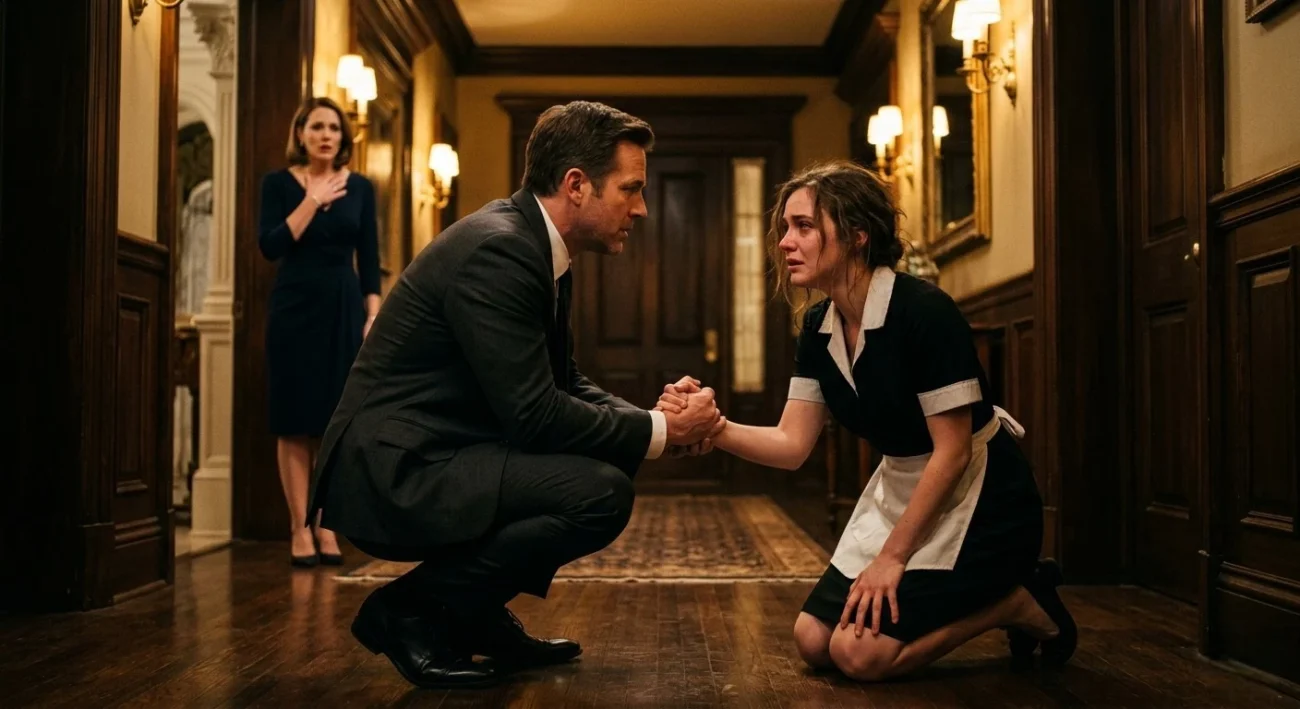
But Vivienne’s hand shot out and caught Elena’s wrist, and the grip was not a grip that permitted argument. She pulled. Elena stumbled. Her knee hit the marble floor and the sound rang through the hall like a gunshot.
The guests had come out of the dining room.
Eight people standing in the archway. Champagne flutes in hand. Watching.
“Vivienne.” One of the women said it quietly, like a warning.
Vivienne didn’t hear it. Or didn’t want to. She kept Elena’s wrist locked and raised her voice, telling the room what she’d seen, what she knew, what she was certain of. The words came out in a torrent. Calculated and humiliating and utterly, completely wrong.
Elena did not cry. She stared at the floor and breathed and did not cry.
And then the front door opened.
Marcus Hargrove did not raise his voice. He never raised his voice. That was the thing people underestimated about him — they assumed a quiet man was a weak man, and they were always surprised to discover their error.
He stepped into the hallway. Took in the scene in three seconds. His wife’s hand on the maid’s wrist. The girl on her knees. The guests watching. The marble floor.
He said, “Let go of her.”
Vivienne turned. “Marcus—”
“Let go of her. Right now.”
The tone was the kind that ended conversations. Vivienne released Elena’s wrist.
Marcus crossed the hall and crouched down in front of Elena. Not behind her. In front of her. He looked her in the face.
“Are you hurt?”
“No, sir.”
“Can you stand?”
“Yes.”
He offered his hand anyway. She took it. He helped her up, and then he turned to the room and said, calmly, to his guests: “I’m going to ask you to give us a few minutes. Maria will show you to the sitting room. There’s more champagne.”
Nobody argued. They filed out like water through a door. Maria appeared from somewhere and guided them away, her face carefully blank.
And then it was three of them in the hallway. Marcus, Vivienne, and Elena.
“Tell me what happened,” he said. To Elena.
“Marcus, I watched her go into the—”
“Vivienne.” He didn’t look at his wife. “I’m not talking to you.”
Vivienne went very still.
Elena told it simply. The canapés. Mrs. Castillo’s instruction. The bottle of cognac. The fifteen seconds in the study. She left nothing out and added nothing in.
When she finished, Marcus was quiet for a moment.
“Mrs. Castillo,” he said, “who asked you to bring the cognac to the study?”
Elena nodded. “She was carrying the tray. She said she couldn’t manage both.”
Marcus turned to his wife. “Does that align with what you told me last week? That you’d asked Castillo to handle the study?”
Vivienne’s jaw moved. “I—yes. I told her to.”
“So Elena was following your instruction. Through a chain that ran through your head of staff.” He let that sit. “And you put her on the floor in front of eight people.”
“I saw her go in—”
“You saw a woman doing her job.” His voice didn’t rise, but it got colder. “And you decided that was evidence. Because you’ve already decided something and you’re looking for proof.” He stepped closer to his wife. Not aggressive. Just close. “How long, Viv? How long have you been doing this?”
Vivienne said nothing.
“Elena.” He turned back. “I owe you an apology. This house owes you one. You’re not going to be treated this way again. I’ll make sure of it.”
“Sir, it’s—”
“Don’t tell me it’s fine. It isn’t.”
She closed her mouth.
“You can take the rest of the evening. I’ll speak to you tomorrow about making this right.” He looked at her steadily. “And I want to be clear — your position here is not in question. Not remotely.”
Elena nodded once, picked up the small dignity she had left, and walked to the staff wing.
Marcus and Vivienne stood in the hall for a long time without speaking.
Finally, Vivienne said: “I didn’t know.”
“That’s not true.” His voice was quiet. “You suspected. And suspecting felt like knowing. That’s the problem.”
“I’ve been—” She stopped. Started again. “I’ve been watching everything. Every detail. I couldn’t stop. I don’t know when it started, I just—”
“I know.” He wasn’t angry anymore. That almost made it worse. “I’ve watched you do it. For months. Every person who talks to me. Every smile I give someone at a party. You file it away and you build a case in your head.”
“Because I’m terrified,” she said. Her voice cracked on the last word.
He looked at her. “Of what?”
“Of being left.” She pressed her hand to her mouth. Took a breath. “Of being the woman who didn’t notice until it was too late. My mother didn’t notice. I watched her not notice. I swore I wouldn’t be her and instead I became something worse. I became someone who puts a frightened girl on her knees in front of a hallway full of people because of a bottle of cognac.”
She was crying now. Not performance. Something that came from a real and miserable place.
Marcus didn’t reach for her immediately. He let her say the whole thing. That was his particular quality: he made people finish. He made them hear themselves out loud, all the way to the end, before he responded.
“You need help,” he said finally. “Not from me. From someone qualified. And I think you know that.”
She wiped her eyes. “Yes.”
“And tomorrow morning, you’re going to apologize to Elena. Not with money. Not with a gesture. With words. Standing up straight, looking at her. The way she deserved to be spoken to tonight.”
Vivienne exhaled. “Yes.”
“This doesn’t fix itself overnight.”
“I know.”
“But it can’t happen again.” He looked at her plainly. “Not ever.”
“It won’t.” She met his eyes. “I’m sorry, Marcus. Not just for tonight. For all of it.”
He nodded. “I know you are.”
He wasn’t forgiving her in a single clean moment. He wasn’t warm yet. But he was still there. Still in the hallway. Still talking to her. And Vivienne understood — perhaps for the first time, in a real way — that presence was not a guarantee. It was a choice someone made. Every day. And it could stop being made.
The next morning, Elena was setting the breakfast table when Mrs. Hargrove appeared in the doorway.
Elena straightened. Waited.
Vivienne walked in, not to the table, not to the sideboard. She stopped three feet from Elena and looked at her directly.
“I put you in an impossible position last night,” she said. “What I did was wrong. It was humiliating and it was unjust, and it was based entirely on my own fear, which had nothing to do with you.” She paused. “I’m sorry. Genuinely. No qualifications.”
Elena looked back at her for a moment.
“Thank you,” she said.
Not it’s fine. Not it’s okay. Not don’t worry about it. Just: thank you. The only honest response to an honest apology.
Vivienne nodded. She turned and left.
Three months later, Vivienne had seen a therapist twelve times and begun to understand — slowly, imperfectly — the architecture of her own fear. How it had been built. What it had cost.
She did not become a different person overnight. But she stopped watching every doorway. She stopped cataloguing every glance. She stopped building cases out of nothing.
It was hard work. It did not come with applause.
And Elena, who had taken the position for the income and stayed for the quiet dignity she’d been shown when it mattered — Elena watched none of this, because it was not her story to watch. She did her work. She was treated with respect. She went home on Fridays and lived her life.
That was enough. That was, in the end, all it needed to be.
Original fictional stories. AI-assisted creative content.
