
The field smelled like cut grass and sugary juice boxes, the way it always did on Saturday mornings in Maplewood.
Forty kids ran and shouted and fell and laughed. Moms on the sideline sipped coffee from paper cups. Coaches yelled half-hearted instructions no one followed. It was the kind of morning that felt like it would never end.
Then Lucas wound up and kicked.
He was seven, small for his age, and he kicked with everything he had—left foot, wrong foot, eyes shut. The ball rocketed sideways off the side of his boot, cleared the low chain-link fence, and disappeared into the parking lot beyond.
CRACK.
Every child on the field stopped moving at once.
The sound hung in the warm air for a second too long. A car alarm chirped once, then went silent. Lucas opened his eyes. The ball had come to rest against the rear wheel of a matte-black BMW X5 parked beside the road. There was a fresh dent in the rear panel, clean and devastating.
“Lucas…” his teammate Diego said, voice already a whisper.
Lucas’s stomach dropped to the ground.
Then the car door opened.
The man who stepped out wore a charcoal suit that probably cost more than most people’s cars. He was tall—unusually tall—with the kind of build that filled a doorframe. His face was calm. Controlled. He looked at the dent with the quiet expression of someone calculating damage, not feeling it.
Kids on the field gripped each other’s arms. A few backed up without realizing it.
Coach Harmon, standing near the penalty arc, pressed his hand to his forehead and muttered something under his breath.
The man walked across the grass slowly, no hurry in any step. He stopped in front of Lucas. Looked down.
“Did you just hit my car?”
Lucas’s hands were shaking. He could feel it in his fingers, in his wrists. His voice came out as barely a sound.
“I… I’m sorry. I didn’t mean to.”
The man said nothing for a moment. He looked at the boy—just looked—the way people look when they’re deciding something. Then he glanced past Lucas at the field, at the ball still resting against his rear wheel.
“Stay here.”
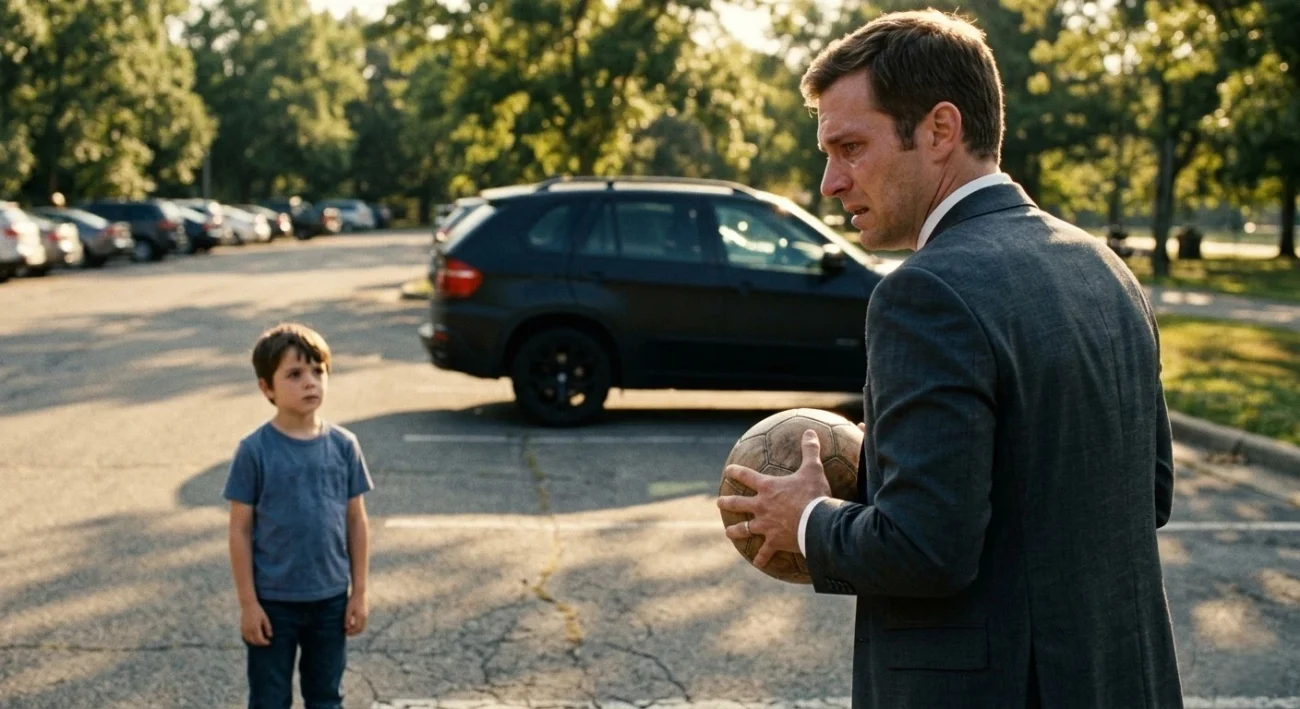
He turned and walked back to the parking lot, bent down, and picked up the ball.
He turned it in his hands once.
Then he stopped.
His entire body changed—some tension leaving his shoulders that was replaced immediately by a different kind of tension, deeper, stranger.
He looked at the ball again. Both hands now. Turning it slowly. There was writing on it, faded black marker, almost worn away to nothing. Letters only he could read.
“…this isn’t possible,” he said.
Nobody heard it except Lucas, who had followed him back to the lot.
“That’s my ball,” Lucas said.
The man looked up. He looked at the boy the way you look at something that frightens you without knowing why. His jaw moved like he was choosing words carefully.
“Where did you get it?”
“My mom gave it to me. She said it was special.” Lucas frowned. “She said to keep it with me.”
The man’s eyes were unreadable now. He turned the ball one more time, found the spot he was looking for. The initials. Old. Written years ago by a younger hand.
He swallowed.
“What’s your mother’s name?”
Lucas tilted his head. “Why?”
“Please.”
There was something in the word—an urgency that didn’t match the suit, didn’t match the calm, didn’t match anything about the man that Lucas had seen so far. Like the calmness had cracked open just a little.
Lucas looked up at him honestly, the way kids do before they understand that some information changes everything.
“She told me… if I ever met someone who recognized it…” He paused, searching for the exact words his mother had made him memorize. “She said to say: he’s my real father.”
The ball dropped.
It hit the asphalt and bounced twice before rolling under the car.
Behind them, someone on the field gasped. Someone else grabbed someone’s arm. Harmon took three steps forward and then stopped himself.
The man stood completely still.
“No,” he said. The word was almost inaudible. “She told me she lost the baby.”
Lucas frowned—the honest, confused frown of a child encountering adult pain for the first time. “She said you chose football instead.”
The man’s name was Marcus Vael, and he had been the face of three international campaigns, had scored in two World Cup semifinals, had his name known in sixty countries. None of it helped him right now. He staggered back half a step like someone had pushed him, and his driver—standing twenty feet away near the hood—moved forward immediately.
“Sir?”
Marcus held up one hand without looking away from the boy. His hand was shaking.
“What is your mother’s name?” he asked again. Lower this time. Desperate.
Lucas looked at him for a long moment—just looked—and then said:
“Elena.”
The color left Marcus Vael’s face completely.
His driver was beside him now, hand on his arm, saying something quiet. Marcus didn’t hear it. He was looking at the boy. At the shape of the boy’s face. The line of his jaw. The particular way he tilted his head slightly to the left when he was uncertain.
Marcus tilted his head the same way. He had done it in every press conference since he was nineteen. He’d been mocked for it gently in a dozen magazine profiles. He’d never known where it came from.
“She’s here?” he said.
Lucas pointed. Past the fence, past the line of parked cars, down the road to where a small white bus had pulled over to the shoulder. The door was open. A woman stood on the step, one hand on the rail, watching.
She was holding a manila folder against her chest. Even from this distance, Marcus could see the logo on the tab.
Riverside Medical Center.
And below it, in typed letters, his surname.
Elena Vael had been Elena Marsh until the courthouse paperwork eight years ago, a name she’d taken from her grandmother and kept because it was the only thing that felt like hers after everything else was gone.
She had not planned to be here today.
She had moved to Maplewood six months ago for the school, for the park, for the quiet. She had not known that the away-team sponsor event at the rec center would route a motorcade down this exact road. She had not known that Lucas would be at Saturday practice. She had not known that he would kick a ball sideways in the exact wrong direction.
But she had given him the ball.
She had given him the instructions.
Because somewhere in the back of her mind, she had known—the way you know things that scare you—that someday there would be a moment, and she needed to be ready.
She stepped off the bus onto the gravel shoulder.
Marcus walked toward her.
They met on the grass strip between the road and the fence. Lucas trailed three steps behind Marcus, uncertain, sensing that the world was reconfiguring around him in ways that would take years to fully understand.
For a long moment, neither adult said anything.
“Elena,” Marcus said. His voice was nothing like it was on television.
“Marcus,” she said.
He looked at the folder in her hands. Then at Lucas. Then back at her.
“How—” He stopped. Started again. “I was told. The hospital called me and told me—”
“I know what they told you,” she said. Her voice was steady. It had taken years to make it that steady. “My mother made that call. She didn’t think—” She stopped too. “It doesn’t matter now what she thought.”
“It matters to me,” Marcus said.
“I know.” She looked down at the folder. “I have everything. His birth certificate. DNA is already done—I had it ordered six months ago when I realized we were moving here. I didn’t want a fight. I wanted—” Her voice tightened, just slightly. “I wanted him to have the chance to know you, if you wanted that. And I wanted you to know he existed. That’s all.”
Marcus stared at her. Then he crouched down, right there on the grass, so he was eye level with Lucas.
The boy looked back at him with that tilted-head expression, steady and curious.
“Did your mom tell you about me?” Marcus asked.
“She said you were someone important,” Lucas said. “She said you used to play football.”
“I still do.”
Lucas’s eyes went wide. “For real?”
“For real.”
“Are you any good?”
Something broke open in Marcus Vael’s face then—not tears, not quite, but something adjacent to them. Something that had been sealed for eight years finally admitting air.
“I’ve been told,” he said. “But I’d like your opinion.”
Elena had requested nothing.
That was what Marcus’s lawyer confirmed when he reviewed the folder that evening in a hotel conference room with four advisors and a genetics specialist on video call.
The DNA test was real. The birth certificate listed the father’s line as blank. There were no financial demands attached, no letter from an attorney, no leverage of any kind. Just documentation. Clean, complete, undeniable.
“She’s not asking for anything,” his lawyer said, still mildly stunned. “No child support claim, no public statement, nothing.”
“She’s not asking for anything,” Marcus confirmed, “because she never needed anything. She raised him alone.”
“That’s admirable, but—”
“Set up the trust.” Marcus’s voice left no room for discussion. “Full education. Healthcare. Whatever he needs for the rest of his life. And I want a paternity announcement drafted by Monday.”
“The press alone will—”
“I know what the press will do. Draft it anyway.”
He paused at the window, looking out at the city lights. Somewhere across town, in a two-bedroom apartment he’d already asked his assistant to locate, a seven-year-old boy was probably kicking a ball against a wall the way boys do before they understand that some of their habits come from fathers they’ve never met.
Marcus thought about all the Saturday mornings he’d spent on training grounds. All the mornings some other man had spent standing on this exact sideline, pouring juice boxes and yelling half-hearted instructions.
“Also,” he said, “get me the contact for the Maplewood recreational league. I want to sponsor them. Full kit, full facility renovation. Whatever they need.”
His lawyer made a note. “Any reason?”
Marcus turned from the window.
“A kid kicked a ball into my car,” he said. “Worst shot I’ve ever seen. I want to make sure someone fixes that before he gets any older.”
The announcement went out Monday morning.
By noon it had been shared four million times.
By evening, Elena’s phone had forty-seven missed calls from numbers she didn’t recognize, and her mother had left six voicemails that she did not return.
She sat at the kitchen table with a cup of tea going cold in her hands. Lucas was in his room. She could hear him narrating something to himself—a game, probably, the way he always did before bed.
Her phone buzzed once more. A text this time, from a number she didn’t have saved but recognized immediately.
He wants to come to the next Saturday practice. If that’s alright with you. No cameras. No team. Just him.
She held the phone for a long moment.
Then she typed back:
Alright. But bring your own juice box. We don’t have extras.
Three dots appeared. Disappeared. Appeared again.
Then:
Understood. Thank you, Elena.
She set the phone down on the table. Picked up her tea. Took a sip even though it was cold.
Down the hall, Lucas was still narrating—something about a goal, a crowd, a perfect kick that went exactly where it was supposed to go.
She closed her eyes.
For the first time in eight years, she let herself exhale completely.
Three months later.
Marcus Vael stood on the Maplewood recreational field in jeans and a plain gray hoodie, anonymous enough that only two parents recognized him, and both had the grace to say nothing.
Lucas lined up a shot twenty yards out, tongue between his teeth, left foot planted.
“Keep your head down,” Marcus said. “Eyes on the ball, not the goal.”
“I know,” Lucas said, with the specific impatience of a child who knows he’s been given good advice and resents it only because it’s right.
He kicked.
The ball curved, low and hard, into the bottom-left corner of the net.
Lucas spun around, arms wide.
“TOLD you,” he shouted.
Marcus looked at the ball sitting in the net. Then at the boy with his arms spread like wings. Then at Elena on the sideline, who was watching with her coffee cup raised in a small, private toast.
He raised one hand back.
“Yeah,” Marcus said, loud enough to carry across the grass. “You told me.”
Lucas ran back to the center circle already demanding another shot, and Marcus followed, and the morning opened up around them, sunlit and ordinary and entirely new.
Original fictional stories. AI-assisted creative content.
