
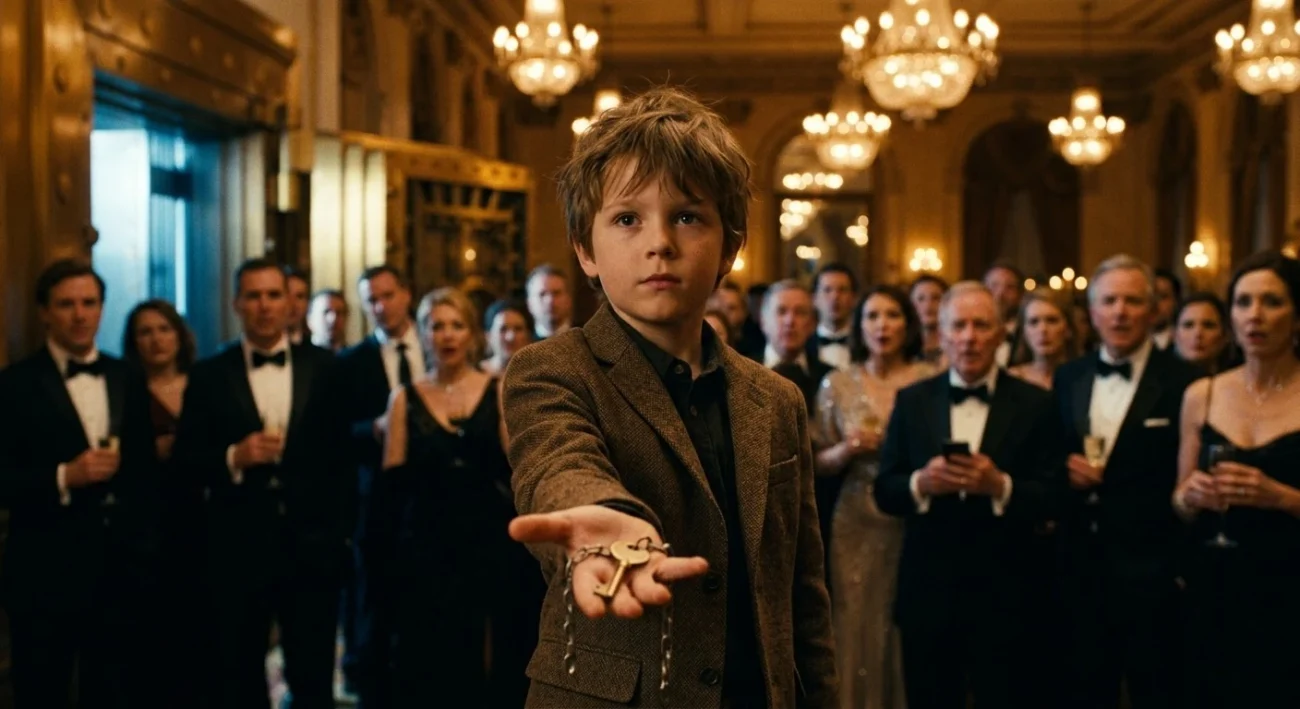
The chandeliers were blinding.
Three hundred people in evening wear, champagne flutes catching the light, a marble floor that cost more than most people’s houses—and at the center of it all, a golden vault the size of a car, bolted to a custom platform like a monument to one man’s ego.
His name was Gerald Whitmore. And he loved an audience.
“Ten thousand dollars,” Gerald announced, his voice booming across the ballroom, one hand already flat against the vault door. He shoved the boy toward it—a small kid in a brown tweed jacket, maybe eight years old, standing there like he’d wandered in from the wrong party. “Open it. You do it, the money’s yours.”
Laughter rolled through the crowd. Phones went up. Someone in the back said is this a bit?
The boy didn’t smile. Didn’t flinch. He just walked forward.
The laughter softened as he reached the vault.
He didn’t rush. He set one hand flat on the cold gold surface the way you’d greet something you recognized—not performing, not nervous. Just… present. His eyes closed slightly.
He leaned his ear against the dial and began to listen.
The crowd shifted. Gerald’s smirk held, but something moved behind his eyes.
The boy turned his head just slightly, without pulling away from the lock. “Are you sure?”
Murmurs swept the room. One woman touched her husband’s arm. Gerald forced a laugh. “Open it, kid.”
The boy gripped the wheel.
He turned it once. Slowly. Then back. Then forward again in a sequence that was too precise, too deliberate for a child who’d never seen this safe before.
CLICK.
The first tumbler fell.
The laughter died completely.
Gerald’s jaw tightened. He stepped closer, voice dropping to something almost private. “Who taught you that?”
The boy didn’t answer. He was already turning the wheel again.
A second metallic shift—deeper this time, something massive moving inside—echoed through the ballroom like a note struck in a cathedral.
Without looking up: “My father built this safe.”
The room didn’t react immediately. It took three full seconds for the words to land, and then they landed everywhere at once—whispers, gasps, two people actually stepping backward.
Gerald moved fast. He grabbed the boy’s arm. Hard. “Stop.”
The boy looked up at him for the first time. His eyes were steady. Completely steady. “Why?” A pause. “Is your name still inside?”
The color left Gerald Whitmore’s face like a tide going out.
No one in the room breathed.
Then the third tumbler fell.
CLICK.
Loud. Final. From somewhere deep in the vault’s chest.
Gerald’s grip on the boy’s arm went white-knuckled. “Don’t—”
The boy pulled free, wrapped both hands around the vault handle, and pulled.
The door opened an inch.
Cold air rolled out, slow and deliberate, like the vault had been holding its breath for years. The crowd surged forward. Someone knocked over a champagne flute and no one looked down.
“Close it!” Gerald’s voice broke on the second word. He lunged again.
The boy stepped sideways—fluid, practiced—and swung the door wide.
No cash. No gold bars. No jewels.
Inside: a single leather file folder stamped with a company crest. A silver pocket watch, ticking loud in the sudden silence. And a photograph in a simple frame, face-down against the back wall.
The boy reached for the photograph first.
He turned it around.
Close-up, if you were filming: Gerald Whitmore, younger, hair darker, standing beside another man—same jaw, same eyes as the boy—arm around a woman cradling a newborn.
“My father,” the boy said. Quietly. Just that.
A woman near the front made a sound that wasn’t quite a scream—more like the breath before one.
Gerald’s hands were shaking now. Both of them. “That’s—that’s not—”
“His name was Thomas Cole,” the boy said. “He built this safe for you in 2016. You paid him for the work. Then you paid someone else to make sure he couldn’t collect.” He picked up the leather file. “He told me: whatever you needed to hide, you’d hide it where only guilt could hear it tick.”
He opened the file.
One page. Two pages. He scanned without reading aloud, then looked up.
“You dissolved his company and filed it under yours. You filed patents on his designs. You had him deported on a visa technicality so he couldn’t fight it in court.” A beat. “And then you paid a woman named Sandra Reyes to disappear with his son.”
Someone in the back of the room said oh my God.
Gerald turned to the door. “Security—”
“Mr. Whitmore.” The voice came from a man in a dark suit standing near the ballroom entrance—not a guest, not staff. He held up a badge. “We’ve been waiting on that file for fourteen months.”
Gerald froze.
The agent walked forward slowly, unhurried, the crowd parting around him. He reached the vault, glanced inside, then looked at the boy. “You have the secondary key?”
The boy reached into his jacket pocket and held up a small brass key on a broken chain.
The room exhaled.
Gerald Whitmore took one step backward. Then another. His heel caught the edge of the platform and he sat down hard on the marble floor—three hundred dollars a square foot, custom imported from Florence—and he just sat there, in his tuxedo, among the champagne flutes and the chandeliers, looking at the boy.
“Who are you?” he whispered.
The boy looked at him for a long moment. Not angry. Not triumphant.
“My name is Daniel Cole,” he said. “And Sandra Reyes is my mother. She sent me back.”
They arrested Gerald Whitmore at 9:47 PM, in front of his guests, his business partners, and three phones still streaming live.
The federal case had been building for over a year—investigators needed the original file contracts, which Gerald had physically locked in the vault believing no one else had access. He’d been right about that. Almost.
Thomas Cole, Daniel’s father, had died in a deportation detention facility in 2019. Before he died, he’d mailed one thing to Sandra Reyes: a brass key and a handwritten note that said when he’s old enough, he’ll know what to do with this.
She’d spent four years preparing him.
The company Gerald had stolen—Cole Precision Engineering—was quietly restored to its rightful estate in the months that followed. The patents were invalidated. Three other executives entered plea agreements. Gerald Whitmore was sentenced to eleven years.
Daniel Cole attended the sentencing with his mother.
She held his hand the whole time.
When the judge read the verdict, Daniel didn’t react. He just looked at the man who had taken everything from his family—the man who had dangled ten thousand dollars as a joke in front of a boy he didn’t recognize—and said nothing.
He didn’t need to.
The vault had already spoken for him.
Original fictional stories. AI-assisted creative content.
