
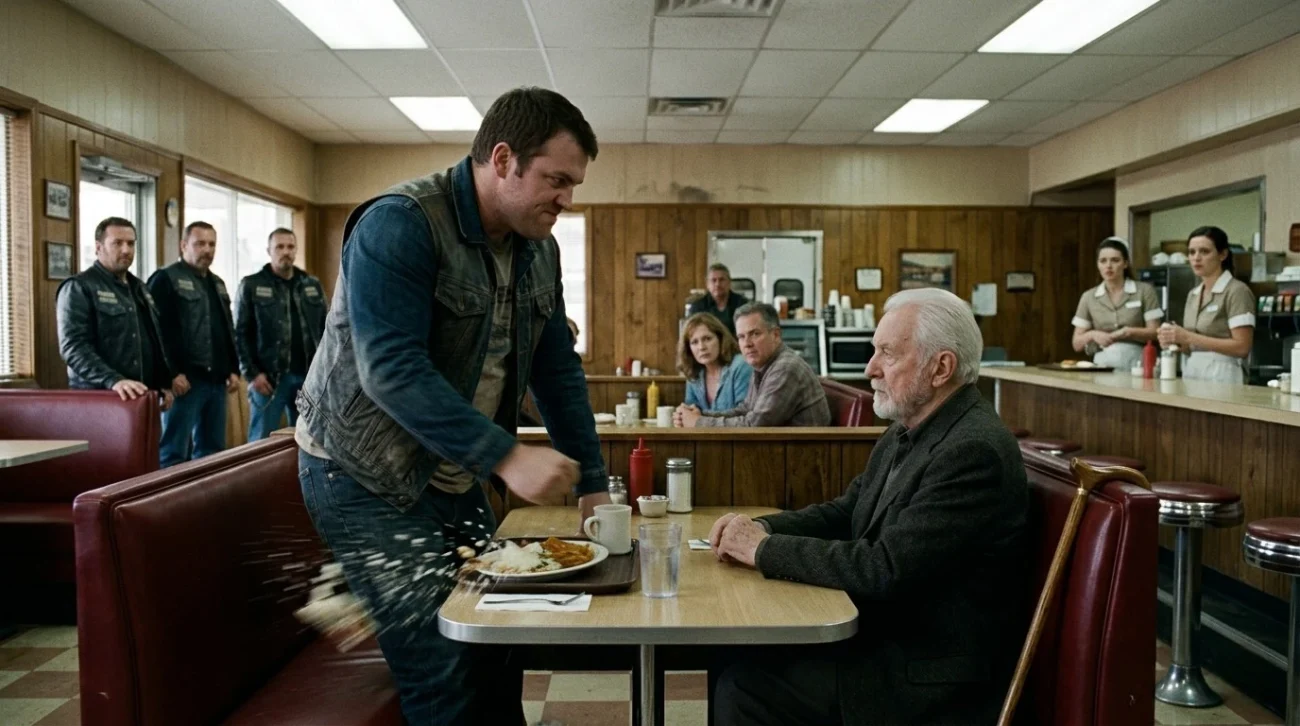
The old man always sat in Booth Seven.
Same diner. Same black coffee. Same window.
The waitresses knew him as Mr. Hale — quiet, white-haired, a trimmed beard, a worn wooden cane resting against the table every Tuesday at noon. He never caused trouble. He never stayed long. He made people lower their voices without knowing why.
That Tuesday, he had barely touched his coffee when the door swung hard.
Six bikers, loud as a storm. Leather vests, heavy boots, laughter that didn’t leave room for anyone else. Their leader was a mountain of a man named Rex — broad-shouldered, thick-necked, the kind of guy who walked like every room was already his.
Rex spotted the old man before he even reached the counter.
Something about quiet dignity always made cruel men itchy.
He smirked at his crew and made a line straight for Booth Seven.
“Well, look at this,” he said, slapping a hand on the table’s edge and leaning over Mr. Hale. “A king in a diner.”
Mr. Hale didn’t answer. He looked out the window.
“I’m talking to you, old man.”
Still nothing.
The bikers laughed. Rex’s smirk stretched wider. He looked at the cane resting against the seat like it was an invitation.
He grabbed it.
One hard yank, and the cane clattered against the floor. A glass of water toppled. It shattered loud enough to make a waitress near the counter gasp and step back.
Rex strolled down the aisle swinging the cane in lazy circles, showing it off like a trophy.
“Careful!” one of the bikers called out, already cracking up. “He might need that!”
“He can ask for it back,” Rex said, grinning.
The whole diner had gone still. Three families near the back window. An older couple by the door. Two waitresses frozen behind the counter. Nobody moved. Nobody said a word.
Mr. Hale stayed seated.
He didn’t yell. He didn’t beg. He didn’t even look at Rex.
He looked at the cane lying on the floor after Rex dropped it in the aisle.
He looked at the water dripping from the table edge.
Then — very slowly — he looked at Rex’s vest.
There, stitched on the inside of the leather collar, almost invisible unless you were standing close enough to see it, was a faded silver hawk patch. Small. Old. The thread worn soft from years of handling.
Mr. Hale’s expression changed.
Not much. Just enough.
He reached one hand into his jacket pocket and pulled out a small black key fob.
Rex caught the movement and turned, laughing. “What’s that? You gonna beep me to death, old man?”
Mr. Hale pressed one button. A soft click. Then he raised the fob slowly to his ear.
“It’s me,” he said.
The laughter in the diner thinned.
Short pause.
“Bring them.”
He lowered the fob and set it on the table.
Rex’s smirk held, but it had lost something. He glanced at the nearest biker. The biker glanced back. Neither of them spoke.
Then came the tires.
One screech. Then another. Then a third.
Three black SUVs cut hard into the parking lot outside, headlights blazing through the diner’s front glass. They didn’t park. They stopped — engines running — blocking the whole front row.
The diner went completely silent.
The bikers’ faces changed one by one.
Car doors opened. Men in dark suits stepped out quickly, moving with the focused quiet of people who didn’t need to announce themselves. They didn’t draw weapons. They didn’t run. They just walked toward the entrance with that particular calm that was worse than aggression.
Mr. Hale finally lifted his eyes to Rex.
All the humiliation that had been in them a minute ago was gone.
Only cold certainty remained.
Rex’s laugh came back, but it was thinner now. “What is this?” He looked toward the windows. “Who are those guys?”
Mr. Hale didn’t answer the question. His gaze dropped once more to the faded silver hawk on the inside of Rex’s collar.
When he spoke, his voice was quiet enough to fill the whole room.
“That patch,” he said. “Where did you get it?”
Rex’s jaw tightened. “None of your business.”
“It is,” Mr. Hale said. “Because if it came from the man I think it did—” He looked straight into Rex’s face. “—then you just stole your grandfather’s cane.”
Nobody in the diner moved.
Not the waitresses. Not the families. Not any of the bikers.
The words seemed too large for the room.
Your grandfather’s cane.
Rex stared at the old man like he’d been speaking a foreign language and Rex had only just realized he understood it.
The diner door opened.
Two of the suited men entered first. Behind them came a woman in her forties carrying a slim leather file case, calm and professional. They weren’t police. They didn’t need to be.
One of the men bent, picked up the cane from the floor, and placed it carefully back in Mr. Hale’s hands without being asked.
The old man took it without looking away from Rex.
“What game are you playing?” Rex asked. There was a crack running through his voice now that hadn’t been there a minute ago.
Mr. Hale ignored the question.
“Take off the vest,” he said.
Rex’s shoulders locked. “No.”
“Rex—” one of the bikers behind him started.
“I said no.” Rex stepped closer to the booth instead. “I don’t know who you are or what this is, but you don’t tell me what to—”
Mr. Hale gave the smallest nod to the woman with the file.
She opened it and drew out a photograph. She placed it flat on the table between them.
It showed a young man standing beside a motorcycle, one boot up on the footpeg, laughing at the camera like nothing in the world could touch him. He wore a leather vest. On the inside of the collar, barely visible at the edge of the fold, was the same faded silver hawk patch.
Rex looked down at it.
He stopped.
Because the man in the photograph had his eyes. His jawline. His exact crooked half-smile — the one Rex had seen in every mirror of his life.
His hands dropped to his sides.
“His name was Ethan Hale,” Mr. Hale said. “He was my son.”
The whole diner held its breath.
Rex didn’t blink. His voice came out lower than before. “My mother told me my father was dead.”
“He is,” Mr. Hale said. “Twenty-two years.”
Rex’s throat moved. “Then how do you know who I am?”
The old man rested both hands on the cane and answered like it cost him something just to breathe. “Because Ethan vanished before he could bring you home.”
The woman opened the file again and slid out a second photograph — older, the corners worn soft. A younger Ethan stood outside a trailer with his arm around a pregnant woman, one hand resting over her belly, protective, certain, smiling like his whole future was already decided.
Rex went pale.
He knew that woman. He knew that trailer. He knew the dented porch railing and the cracked concrete step.
That was his mother.
The air left the room.
“I hired people to search for years,” Mr. Hale said. “After Ethan was killed, your mother took you and ran. She thought I blamed her. I never did.” His voice roughened. “I just never found her in time.”
Rex stared at the second photograph for a long moment. When he finally spoke, his voice had lost every hard edge it had walked in with. “She died last winter.”
The old man closed his eyes for exactly one second.
When he opened them again, they were wet.
“She kept you from me because she was frightened,” he said. “And I stayed away too long because I was proud.” He looked at Rex with something close to brutal honesty. “We both failed you. Neither of us meant to. But we both did.”
That hit different than a shout ever could.
One of the bikers in the back silently sat down in the nearest empty booth. Another one had turned toward the window.
Rex looked down at the silver hawk on his vest. He reached up with two fingers and touched the edge of the patch — the thread worn soft, the hawk faded to almost nothing.
“My mother resewed that patch every time it tore,” he said slowly. “Every time the thread gave out, she’d sit at the kitchen table and sew it back on.” His voice dropped. “She told me it was the only thing my father left me.”
Mr. Hale reached into his coat.
He pulled out a small metal tin, old and dented, and set it on the table. He opened it carefully, like he had done it many times in private.
Inside, on a square of folded cloth, sat an identical patch. Same hawk. Same silver thread. Same size. Preserved for years — maybe decades.
“Your grandmother made them,” the old man said. “One for Ethan. One to keep at home.” He touched the edge of the tin with one finger. “I never thought I’d see the other one again in my lifetime.”
Rex’s face changed completely.
The size was still there. The width of his shoulders, the weathered jaw, the hands built for hard work. None of that went anywhere.
But the arrogance was gone. The cruelty was gone. All the borrowed confidence of a man who’d never had a real name to stand behind — gone.
He looked younger. Much younger. Like a kid who’d been wearing the wrong costume for thirty years and only just noticed.
He looked at the cane in Mr. Hale’s hands.
Then at the broken glass still on the floor.
Then at the old man’s face.
“I didn’t know,” he said.
Mr. Hale nodded. Slowly. “I know you didn’t.”
Rex took one step forward. Behind him, none of the bikers moved. The whole diner was motionless. A baby near the back started to fuss softly and its mother quieted it almost without thinking, not wanting to break whatever was happening.
Rex bent and picked up Mr. Hale’s spilled napkin from the floor beside the booth. He placed it back on the table. Then he looked at how small that gesture was — how completely, pathetically small — against what he had done.
“I’m sorry,” he said. His voice was quiet and not cocky at all. “I thought you were just some old man sitting by himself.”
Mr. Hale looked up at him for a long moment.
“I was,” he said. “Until I saw my son’s face looking back at me.”
Rex’s jaw tightened. His eyes filled. He fought it hard and lost.
He looked down at the leather vest — really looked at it, maybe for the first time — and reached up with both hands and pulled it off. He held it in front of him, the silver hawk patch facing out, and understood something that his mother had never been able to say out loud.
“My real name isn’t Rex,” he said. It wasn’t a question. Not quite.
Mr. Hale’s grip tightened on the cane.
“No,” he said softly. “Your name is Eli Hale. Your father chose it before you were born.”
Rex — Eli — let out a breath that seemed to come from somewhere deep and long-buried. His legs stopped being reliable. He sat down hard in the empty booth across from the old man, like the floor had shifted under him and he’d decided not to fight it.
Grandfather and grandson sat across the same table where humiliation had started four minutes earlier.
The suits waited outside. The bikers stood in silence. The diner held its breath.
Eli looked at the two photographs on the table — his father young and alive, his mother young and certain and carrying him — and then looked at the old man who had been searching for both of them for twenty-two years and found only one.
He asked the question that had been missing from his whole life.
“Did he want me?”
Mr. Hale answered without hesitating for even half a second.
“With everything he had.”
The silence after that was not empty. It was full — packed tight with everything that had been lost and everything that had, improbably, just been found.
Eli set the vest down on the table between them. The silver hawk faced up.
Mr. Hale reached into the tin and placed the matching patch beside it. Two halves. Same thread. Same maker. Same family.
He looked at Eli across the table with wet eyes and steady hands.
“I’m eighty-one years old,” he said. “I have good lawyers, a house in Connecticut, and no one left to give it to.” A pause. “That changes today.”
Eli stared at him.
“I don’t want your money,” he said.
“I know,” Mr. Hale said. “That’s exactly why I’m telling you.”
A waitress at the counter had started crying silently, her hand over her mouth. The older couple by the door were holding each other’s hands without having planned to. Even one of the suited men outside had turned away from the car and was just standing there, looking at the sky.
Eli looked at the cane.
Then at the old man.
“Can I — ” He stopped. Tried again. “Can I ask you something about him? About my father?”
Mr. Hale’s face opened in a way it probably hadn’t in twenty-two years. “You can ask me anything. We have time.”
Eli nodded. He pulled one of the photographs toward him — the one of his father laughing beside the motorcycle — and looked at it the way you look at something you’ve needed your whole life and didn’t know it.
“What was he like?”
The old man leaned back slowly in the booth, both hands on the cane, and a small real smile crossed his face for the first time.
“Reckless,” he said. “Generous to a fault. Terrible at saving money. He could fix any engine he touched.” He paused. “He used to do exactly what you just did — walk into a room like he already owned it.”
Eli let out a short, fractured sound that was almost a laugh.
“Yeah,” he said quietly. “I got that from somewhere.”
Mr. Hale held out his hand — not to shake, but palm up, an offering.
Eli looked at it for one beat.
Then he placed his hand in his grandfather’s.
The old man’s fingers closed around it — firm, certain, the grip of a man who had been waiting a very long time to hold on to something he thought was gone forever.
In the middle of that roadside diner, with broken glass still on the floor and black SUVs idling outside, the man who had walked in as Rex walked out as Eli Hale.
Not because he was told to.
Not because a lawyer handed him papers.
But because an old man had recognized his dead son’s face in a stranger’s cruelty — and had refused to look away.
Original fictional stories. AI-assisted creative content.
