
The bell above the door chimed softly as Harold stepped inside.
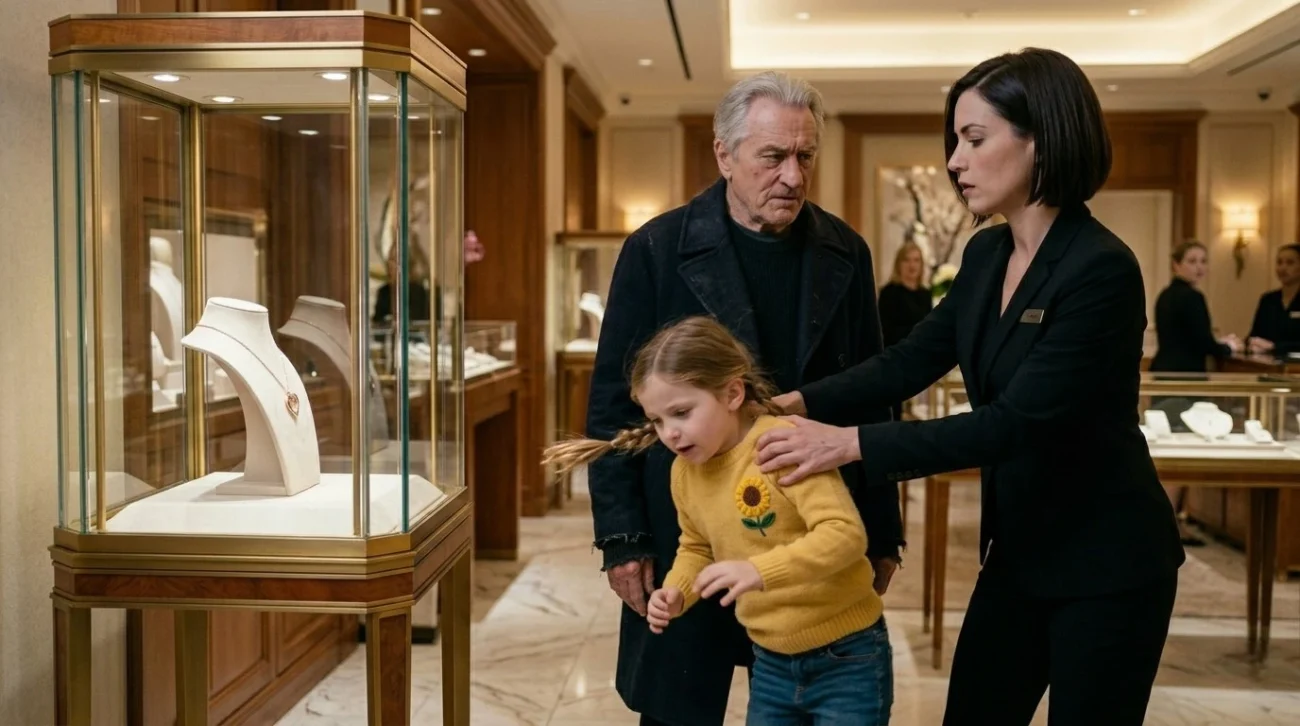
He kept one hand on his granddaughter’s shoulder. Sophie was seven, and she’d dressed herself that morning — a yellow sweater with a little sunflower on the pocket, her hair in uneven pigtails. She pressed her face close to the nearest glass case and fogged it with her breath.
“Grandpa,” she whispered, reaching back for his hand. “Look.”
It was a heart-shaped pendant. Rose gold. A small diamond at its center, catching the afternoon light and throwing it in every direction.
Harold bent down beside her. His knee clicked. His coat was old — navy wool, frayed at the cuffs, the kind of coat that had weathered twenty winters and wasn’t ready to quit.
“It’s beautiful,” he said quietly.
“If I become rich,” Sophie said, her voice certain and serious, “I’m going to come back for that one.”
Harold smiled. He put his arm around her.
That was the moment Diane chose to approach.
She was one of the floor associates — mid-thirties, sharp bob, name tag gleaming. She walked toward them with the particular stride of someone who had already decided.
She rapped her knuckles on the glass case. Hard. Right next to Sophie’s face.
Sophie flinched and stepped back behind Harold’s leg.
“You can’t just stand here,” Diane said, her voice low but cutting. “This isn’t a museum. Stop dreaming about things you’ll never be able to afford.”
The other customers in the store went still. A couple near the diamond earrings exchanged a look. The young man behind the counter stopped typing.
Harold straightened slowly. “Please,” he said. “She’s just a child.”
Diane looked at him — his coat, his worn shoes, the lines in his face — and smiled. Not kindly.
“Then do her a favor,” she said. “Teach her reality early.”
Sophie’s hand found Harold’s. She squeezed it tight. Her face was turned away, toward the floor.
Harold didn’t raise his voice. He simply looked at Diane for a long moment.
“We’ll go,” he said softly.
He turned to leave. Sophie followed, one small step, two —
“Excuse me.”
The voice came from the back.
A man in a dark blazer had appeared in the doorway of the rear office. Mid-fifties. Silver at his temples. His name tag read: MANAGER — JAMES WHITFIELD.
He had heard everything. That much was clear from how he stood — rigid, one hand still on the office doorframe, eyes moving slowly from Diane to the old man.
And then to the wall.
There was a framed photograph there, near the entrance — large, black-and-white, positioned at eye level for a reason. It showed a young man standing in an empty storefront, surrounded by half-built display cases and unfinished shelving. He was grinning. He looked proud. He looked the way a person looks when they are standing in the middle of a dream that’s just become real.
James’s eyes moved from the photo.
To the old man.
Back to the photo.
The room seemed to get quieter, if that was possible.
“Sir,” James said. He crossed the floor slowly, the way you move when you’re not entirely sure what you’re walking toward. He stopped a few feet from Harold and studied his face.
“My God,” he said quietly.
Diane looked between them. “James, these people were just —”
“Diane.” His voice was flat. “Stop.”
She stopped.
James turned back to Harold. “You’re — are you Harold Mercer?”
Harold said nothing. He looked at the photograph on the wall for a long moment, the way a person looks at something they built and then lost — not angry, just tired.
“My father talked about you,” James said. His voice had dropped. “He said the founder just — disappeared. After his wife died. Nobody knew what happened.”
“I know what happened,” Harold said.
He wasn’t speaking to James specifically. He wasn’t speaking to anyone in particular.
Sophie looked up at him. “Grandpa?”
Harold put his hand gently on the top of her head.
“I built this store,” he said. “Forty-one years ago. I laid the floors. I made the cases.” He paused. “Your grandmother chose the font for the sign outside. She spent three weeks on the font.”
The young man behind the counter had gone completely still. One of the women near the earrings had set down the pair she’d been holding.
“After she died,” Harold continued, “there were legal things. Challenges. People who had been waiting.” He exhaled slowly. “I didn’t have the energy to fight. So I walked away.”
James looked like he’d been hit.
“Sir,” he said. “I — I had no idea. My father never told me the full story. I just assumed —” He pressed his hand to his mouth for a second. “I’m sorry. I’m so sorry.”
Diane’s face had changed entirely. The certainty was gone. She looked smaller somehow, standing to the side, watching this unfold.
“She knocked on the glass,” Sophie said suddenly. She was still holding Harold’s hand but she looked directly at Diane now, her small face entirely composed. “She scared me.”
Diane opened her mouth.
“Sophie,” Harold said gently.
“I know,” Sophie said. “I know, Grandpa.”
But she didn’t look away from Diane.
James turned to his associate. “Go wait in the office.”
“James, I didn’t know who —”
“That’s exactly the problem.” His voice was very quiet. “Go.”
Diane went.
James ran a hand over his face. He looked at Harold — at his coat, his careful posture, his granddaughter in the sunflower sweater — and something in his expression shifted into something like grief.
“I can’t undo what happened with the ownership,” he said. “I know that. The lawyers — it was years ago. I don’t even know the full —” He stopped himself. “But I want to make this right. Whatever I can do.”
Harold shook his head slowly. “I didn’t come here for that.”
“Then why did you come?”
Harold looked down at Sophie. She was watching the pendant again — the heart-shaped one, the rose gold, the small stone throwing light in every direction.
“She wanted to see it,” Harold said simply.
James looked at Sophie. Then back at Harold. Then he walked behind the nearest case, unlocked it, and carefully lifted the pendant out. He set it on the velvet tray on top of the glass.
“May I?” he said to Sophie.
Sophie looked at Harold. He nodded.
She stepped forward and touched the pendant with one finger, very gently.
“It’s even prettier up close,” she said.
James looked at Harold. “Please let me give it to her.”
Harold shook his head again. “No.”
“Sir —”
“She said she’d come back for it when she’s rich.” Harold’s voice held something quiet and certain. “Let her.”
Sophie looked up at her grandfather. Her expression was very serious, the way children are serious when they’re making a decision they mean.
“I will,” she said. “I promise.”
James watched them. He didn’t speak.
Harold placed his hand on Sophie’s back and guided her gently toward the door. As they passed the framed photograph, he didn’t look at it again. He’d already said what needed saying.
The bell above the door chimed as they left.
Inside the store, no one moved for a moment.
Then James walked back toward the office. He opened the door. Diane was standing near the window, arms crossed, jaw set — but her eyes were red.
“You’re done here,” James said. “Collect your things today. HR will be in touch about your final check.”
“James, I didn’t recognize him. I genuinely had no idea —”
“I know.” He held the door open. “That’s not why.”
She looked at him.
“A seven-year-old girl,” he said. “In a sunflower sweater. That’s why.”
He closed the door behind her.
Three weeks later, James found Harold’s address through the deed archives. He sent a letter — not a legal document, not an offer, just a letter. He wrote about his father, about the founding of the store, about things he hadn’t known and wished he had. He wrote that the photograph would stay on the wall.
He also enclosed a receipt.
The heart-shaped pendant. Paid in full. Held in reserve, under the name Sophie Mercer. Available for pickup whenever she wanted it.
At the bottom of the receipt, in the notes field, James had written one line:
She’ll know where to find it.
Sophie, for her part, kept the letter folded in her desk drawer through middle school, high school, and beyond. She unfolded it sometimes, when things were hard, and read the part about her grandfather.
On her twenty-fourth birthday, she walked into the store.
She was wearing a blazer. She’d done her own hair. She looked like someone who had worked for something and arrived.
The current associate behind the counter looked up. “Can I help you?”
Sophie smiled.
“I’m here to pick something up,” she said. “It’s been waiting for me.”
Original fictional stories. AI-assisted creative content.
