
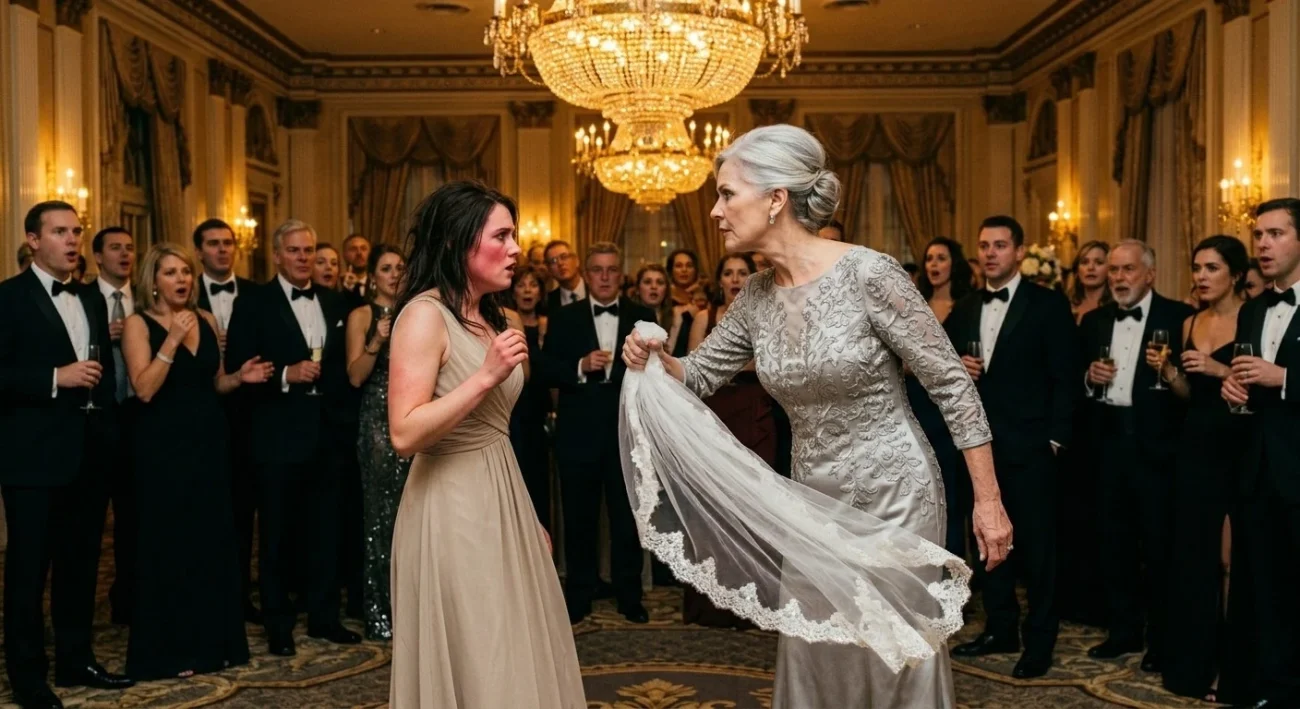
The slap echoed louder than the music ever could.
One second the wedding was perfect — string quartet, champagne towers, two hundred guests in their finest — and then the crack of a hand against a cheek silenced everything. Crystal chandeliers shimmered above a room that had stopped breathing. Champagne glasses froze mid-air. Smiles dissolved.
The torn veil hung in Margaret Holt’s hand like a trophy she hadn’t earned.
“A girl like you doesn’t deserve to look beautiful here.”
No one laughed. No one moved.
The bridesmaid — whose name was Sera — stood perfectly still. Her cheek burned. Her eyes dropped — just for a moment, just long enough to let everyone think it was over.
Then she looked up.
The pain was gone.
Replaced by something far colder. Far more calculated. The kind of look that doesn’t come from anger — it comes from having waited a very long time for exactly this moment.
Margaret Holt was the groom’s mother. Sixty-two years old, third marriage behind her, the kind of woman who used wealth like a weapon and had never once been told no without consequences. She had spent the entire reception performing — air kisses, pointed compliments, the subtle art of making everyone around her feel slightly less than.
She had pulled the veil from Sera’s hair the way you’d snatch a toy from a child you’d already decided didn’t deserve it.
“These flowers are for the bridal party,” she’d said, just before the slap. “Not the help.”
The thing was — Sera wasn’t the help. She was the maid of honor. The bride’s closest friend. The woman who’d flown in from New York, who’d spent three months planning this day, who’d quietly paid for the florist when the budget fell short.
But Margaret didn’t know that yet.
She didn’t know a lot of things yet.
Sera reached into her clutch.
No rush. No trembling hands. She moved like someone who had rehearsed this — or more accurately, like someone who had always known it would come to this eventually.
She pulled out her phone.
The sound of her dialing felt sharper than anything else in the room.
“Yes,” she said, her voice completely steady. “Do it now.”
Two words. That was all.
She ended the call and slid the phone back into her bag with the same calm she’d dialed it with.
Silence.
Then — across the ballroom — the groom stiffened.
His name was Dalton Holt. Thirty-four years old, heir to the Holt Group, a commercial real estate empire that had been quietly hemorrhaging money for two years. Standing beside the champagne tower, he’d watched his mother slap his fiancée’s maid of honor and felt nothing except mild irritation that it might cause a scene.
That irritation became something else now.
Three men near the back of the room went completely still. Dalton recognized two of them — his father’s former attorneys, men he’d seen in boardrooms but never at a wedding. The third he didn’t recognize at all.
And then — his father.
Richard Holt stood near the bar with a glass he was no longer drinking from. His face had drained of color in the time it took Sera to make that call.
“What did you just do?” Richard’s voice was quiet. Almost no register at all. But the room was so silent everyone heard it.
He wasn’t asking his wife.
He was asking Sera.
She turned toward him slowly. Her eyes found his across the room — twenty feet, a hundred guests between them — and she held his gaze with the kind of certainty that doesn’t need volume to carry weight.
“You should’ve asked that question,” she said.
She took one small step forward.
“Before you let her touch my mother’s veil.”
The room exhaled — the kind of collective breath that happens when something hidden finally surfaces.
My mother’s veil.
Margaret’s hand went slack. The torn fabric floated to the floor.
“Who… who are you?” she whispered.
Her confidence had already folded. The arrogance she’d carried all evening was collapsing in real time, because she understood now — too late, always too late — that she had fundamentally misread the room.
“Your husband knows,” Sera said.
Richard Holt set down his glass.
“We need to talk,” he said, and his voice finally cracked. “Privately.”
“No,” Sera said. Simply. Cleanly. “We don’t.”
She walked toward the center of the room.
The guests parted. Not out of politeness — out of something instinctive, the way crowds move when they sense that whatever’s coming next is going to be worth remembering.
The bride — Cara, Dalton’s fiancée, Sera’s best friend — stood at the edge of the dance floor with both hands over her mouth.
“Sera,” Dalton said. “Whatever this is—”
“Dalton.” She didn’t raise her voice. She didn’t have to. “Sit down.”
He sat.
Even he didn’t seem to understand why.
“My name is Sera Vance,” she said. Not for the room — for the Holts. “My mother was Elena Vance. She was Richard Holt’s personal assistant for eleven years.”
Richard had gone completely still.
“She died four months ago.” Sera’s voice didn’t waver. “Breast cancer. Stage four. She spent her last eighteen months fighting it, alone, because the health insurance she’d been promised — the insurance your father verbally committed to in writing, Dalton, when she signed her NDA — was quietly removed from her contract in 2019.”
The three men near the back — Sera could see now that one of them had a briefcase.
“The document my attorney just filed,” Sera continued, “is a wrongful termination and benefits fraud claim. My mother’s case. The supporting evidence includes internal emails — from Richard personally — confirming he authorized the removal of her coverage and instructed HR to deny it was ever promised.”
“Those documents are confidential,” Richard said sharply.
“They were.” Sera smiled for the first time. It didn’t reach her eyes. “Until your son’s company’s IT contractor — the one you fired in March — decided to stop sitting on them.”
Dalton stood up. “You’re lying.”
“Your legal team has the filing timestamp,” she said. “Eleven forty-seven AM today. You can check.”
Phones came out around the room — not to film. To verify.
It took less than a minute.
One of the groomsmen made a sound low in his throat.
“It’s real,” he said, half to himself. “It was filed.”
Margaret Holt had not moved from where she stood.
She was still holding the stem of her champagne glass, white-knuckled now, the knuckles of the same hand she’d used to slap Sera.
“This is a wedding,” she said. Her voice was smaller than it had ever been. “You’re ruining my son’s wedding.”
“I was a guest at this wedding,” Sera said, “until you decided I was the help.”
She looked at Cara. Her voice softened — not much, but enough.
“I’m sorry,” she said. “Not for this. For the timing.”
Cara’s eyes were wet. But she nodded. Once. Slowly.
Because she knew. She had always known something was off about the Holts. She’d brought Sera specifically because Sera was the only person in her life who never flinched.
“I’ll get your things,” Cara said quietly. “We can go.”
“No.” Sera shook her head. “You stay. This is your wedding. Don’t let them take that from you too.”
Richard Holt had crossed to the edge of the dance floor. Two of the men from the back were with him now, speaking in urgent, clipped voices. The third — the one with the briefcase — had stepped away to make a call.
Dalton stood alone between his mother and his bride.
“Dad.” His voice was different now. Younger. “Tell me this isn’t real.”
Richard didn’t answer.
“Dad.”
Still nothing.
“Is this—” Dalton’s voice broke. “Did you actually do this? Did you actually cut off a dying woman’s health coverage to avoid the payout?”
Richard turned toward him. The look on his face wasn’t guilt — it was calculation. Even now, even in front of two hundred people, he was running numbers.
That was the moment Dalton understood who his father really was.
“I’m going to need some time,” Dalton said quietly.
“Take all the time you need,” Sera said. “The filing isn’t going anywhere.”
Margaret Holt found her voice again. It came back ugly.
“You think a lawsuit changes anything?” she said. “We have lawyers. We have resources. We will bury this.”
“You’re welcome to try,” Sera said.
She reached into her clutch again. This time she produced a small USB drive and set it on the nearest table with a gentle click.
“That’s a copy of your husband’s personal correspondence from 2018 to 2021,” she said. “Including the thread where he calls your son a liability and refers to the family’s charitable foundation as ‘the best tax scheme we ever built.'”
Margaret’s glass slipped.
It didn’t shatter — caught by a server who moved fast — but the sound of it wobbling was loud in the silence.
“My mother worked for your family for eleven years,” Sera said. “She gave them everything. She believed in them. And when she got sick, your husband deleted a line from a contract and hoped she’d be too exhausted to fight it.”
Her voice remained steady.
Completely steady.
“She was. But I’m not.”
The room had shifted in that irreversible way rooms shift when power changes hands.
Two hundred guests who had arrived to celebrate the Holt family were now witnesses to something else entirely. Some pulled out phones. Some moved toward the exit. Some just stood and watched — the way people watch something unavoidable, something they’ll describe to others later.
The string quartet had stopped playing seventeen minutes ago. No one had noticed until now.
Cara stepped forward and took Sera’s hand.
“You didn’t have to come today,” she said quietly. “You could’ve filed this anywhere.”
“Your wedding was the one occasion I knew they’d all be in the same room,” Sera said. “It wasn’t about you. I need you to know that.”
Cara squeezed her hand. “I know.”
She turned to Dalton. Her voice was steady in a way that surprised even her.
“We need to talk,” she said to him. “Not here. But soon.”
He nodded. The arrogance he’d worn all evening — inherited, unearned, borrowed from his father — was gone. What was left was just a man who had just discovered the family name he’d built his identity around was built on something rotten.
“Yeah,” he said. “We do.”
Richard Holt left the ballroom before the cake was cut.
His attorneys followed. Two board members who had been seated at table nine excused themselves quietly, avoiding eye contact with anyone.
Margaret remained. Motionless near the champagne tower, still holding the torn edge of the veil she’d never returned.
A woman from table four — older, silver-haired, someone’s grandmother — walked past her and stopped.
“I knew your first husband,” the woman said pleasantly. “He always said you had no idea what real dignity looked like.”
She moved on without waiting for a response.
Outside the ballroom, in the marble-floored lobby, Sera sat on a bench near the coat check and let herself breathe.
She had been planning this for fourteen months. Since the week her mother died. Since she found the emails in a hard drive her mother had left in a shoebox beneath three years of Christmas cards and one handwritten note that said: I never wanted to make trouble. But I wrote it all down just in case.
Just in case.
Elena Vance had written it all down. Every meeting. Every broken promise. Every time she’d been told the coverage was “in process.” Every time the paperwork had been “delayed.” She’d kept receipts — digital, meticulous, the records of a woman who had survived on carefulness her whole life — because she understood instinctively that the powerful are only accountable when you make accountability impossible to avoid.
She hadn’t lived to see this day.
But she’d made it possible.
Sera pressed her thumb against the corner of her eye. Just once. Firm enough to stop anything from falling.
Then she straightened.
Her phone buzzed.
A text from her attorney: Filed. Timestamp confirmed. Media embargo lifted at midnight. You okay?
She typed back: Yeah. I’m okay.
Another buzz, this one from Cara: He just told his dad off in the parking lot. I can hear them from the window. Also the photographer is still here and I would like to actually get married today if possible. Please come back inside.
Sera laughed. It came out softer than she expected.
She stood.
She smoothed her dress.
She walked back into the ballroom — and when she entered, the string quartet started playing again, and Cara was waiting at the edge of the dance floor with a glass of champagne and the expression of someone who had chosen exactly the right person to stand beside her on the most complicated day of her life.
“You good?” Cara asked.
“Yeah,” Sera said.
She took the champagne.
“Let’s get you married.”
The wedding resumed.
Not because nothing had happened — it had. Because something had been paid back. Because a woman who had died quietly, without fanfare, without justice, without so much as an acknowledgment from the family she had served — had been seen. Finally. Fully.
The Holt Group’s stock dropped eleven percent at Monday’s opening bell.
Richard Holt’s attorneys contacted Sera’s legal team within seventy-two hours.
The settlement — confidential, but substantial — was donated in full to a nonprofit providing legal aid to workers in contract disputes.
In the acknowledgment Sera submitted with the donation, she listed one name.
Elena Vance.
Who wrote it all down, just in case.
Original fictional stories. AI-assisted creative content.
