
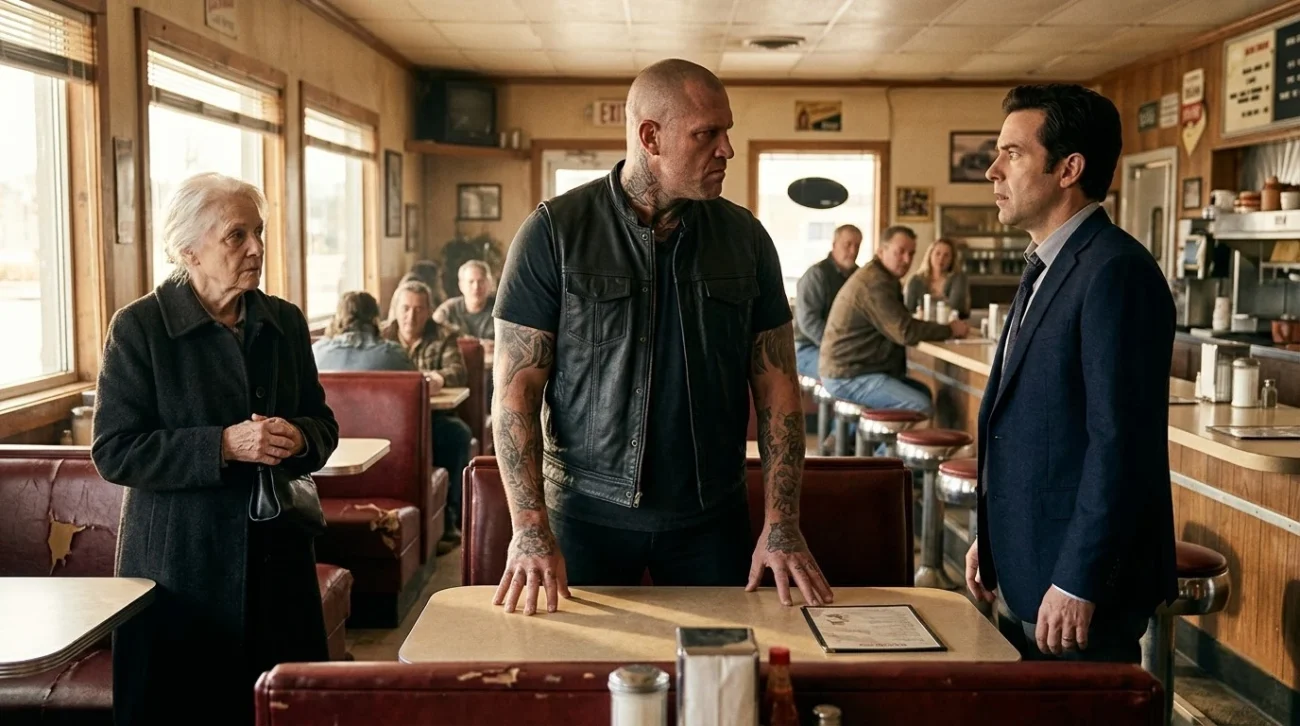
The Red Arrow Diner smelled like motor oil and burnt coffee, and Margaret liked it that way. She’d driven forty minutes to get here—past every clean, quiet chain restaurant she could have chosen—because she needed something real. She needed people who wouldn’t flinch.
The bell above the door had barely stopped ringing when the room went quiet.
Not all at once. It rippled—heads turning table by table—the way a field of grass goes still when something large moves through it.
Margaret stood at the entrance and let them look.
She was sixty-three years old. Five foot two. She wore a navy cardigan with a small pearl button missing near the collar, and she was holding her purse with both hands the way a person holds something they’re afraid to drop. Her silver hair was combed carefully. She had the look of someone’s grandmother. She had the look of someone who had driven forty minutes with no plan and was now, at last, committed.
“PLEASE.” Her voice cracked on the word. “I NEED YOUR HELP.”
It came out louder than she intended. Loud enough to clear every conversation from the room.
No one laughed.
She walked forward.
The table near the window held six of them. Big men. The kind of men who took up space without apology. Leather vests. Tattoos climbing up necks and forearms. Coffee cups that looked small in their hands. They watched her approach without moving, without any of the nervous energy most people would have shown.
The one at the center—heavy through the shoulders, gray-bearded, eyes that had the quality of something carved rather than grown—set down his cup.
Margaret stopped at the edge of the table.
“I know this is strange,” she said. Her hands shook slightly. Her voice did not. “I know you don’t know me. I know I have no right to ask.”
She paused. Swallowed. Pressed on.
“I have a stepson. He’s coming here in—” she glanced at the clock above the counter— “about twenty minutes. He thinks he’s meeting me to go over some paperwork. What he’s actually planning is to convince me to sign over my late husband’s house. Our house. The house I’ve lived in for nineteen years.” She stopped. Steadied. “He’s been doing this for eight months. Every week. A new angle, a new lawyer letter, a new version of the story where I’m confused and he’s just trying to help.”
Silence.
“I need him to think I’m not alone,” Margaret said. “I need him to see that I have—” she hesitated on the word— “people. Family. That I’m not some—” her voice caught— “some old woman with nobody in her corner.”
She looked directly at the man at the center of the table.
“Would you pretend to be my son? Just for today? Just for one hour?”
The silence that followed was different from the first kind. The first had been surprise. This one was consideration.
The big man looked at her for a long moment.
“Sit down,” he said.
His name was Dale, but everyone called him Bear, and he had been coming to this diner for eleven years. He knew the cook by name. He tipped forty percent. He had, on three separate occasions, quietly helped women in parking lots who looked like they needed escorting to their cars. He did not talk about any of this.
“Tell me about the house,” he said.
Margaret sat. One of the other men—younger, red-haired, with the kind of face that could go hard or soft depending on the moment—slid a coffee cup toward her without being asked.
She told them everything.
Her husband, Robert, had died fourteen months ago. He had two children from his first marriage: a daughter who lived in Portland and called every Sunday, and a son named Carter who had not called at all until the will was read. Carter had received a cash inheritance—substantial, Robert had insisted on equal treatment—but the house had been left to Margaret outright. Robert had been clear-eyed about this. He had known his son. He had protected his wife.
Carter had spent the last eight months trying to undo that.
“He says I can’t maintain it,” Margaret said. “He says I’m isolating myself, that I’m not thinking clearly, that his father would have wanted the property kept in the family.” She looked down at her coffee. “He’s hired an attorney who specializes in challenging estates. He’s very good at making things sound reasonable.”
“Is there any actual legal challenge?” Bear asked.
“My attorney says no. The will is solid. Robert was meticulous.” She paused. “But Carter is also very good at making me feel like I’m one signature away from making everything easier for everyone.”
Bear’s jaw shifted.
“And today?”
“Today he asked to meet to go over ‘some documents.’ His words.” She set down the cup. “Last time he used that phrase, I left the meeting having agreed to let his attorney review the deed. I didn’t realize what I’d agreed to until later.” She looked up. “I won’t make that mistake again. But I also can’t—” she stopped. “I’m not good at saying no when it’s just me. When I’m alone and he’s confident and his lawyer is on the phone and everyone in the room is acting like I’m the unreasonable one.”
Bear nodded slowly.
He looked at the men around the table.
Something passed between them—not words, not signals. Just the particular weight of shared understanding.
“What’s his name?” Bear asked.
“Carter Hale.”
“And you’re Margaret.”
“Margaret Hale.” A small, sad smile. “Yes. I kept the name.”
Bear looked at the clock.
“Seventeen minutes,” he said. “Tell us what he looks like.”
Carter Hale was forty-one, and he had the look of a man who had decided, sometime in his early thirties, that confidence was a costume anyone could wear if they committed to it hard enough.
He drove a silver sedan. He wore a sport coat over an open collar. He checked his reflection in the diner window before he pushed through the door, and he was already smiling when he stepped inside—the pre-loaded smile of a man who expects the room to cooperate.
The room did not cooperate.
He stopped.
Margaret was at the table by the window. That part was expected.
The six large men surrounding her was not.
Bear sat directly to Margaret’s left. One arm rested on the back of her chair with the casual ease of someone who had sat in that position a thousand times. The red-haired man—the one they called Rook—sat across from her, and he was in the middle of saying something that made Margaret laugh. A real laugh. The kind that changed the shape of your face.
Carter stood very still in the doorway.
Margaret looked up.
“Oh,” she said. “Carter. Good, you’re here.” Perfectly warm. Perfectly calm. “Come meet the boys.”
Carter walked forward. He walked the way people walk when they need to not look like they’re walking carefully.
“Hey, Mom.” He leaned down to kiss her cheek. His eyes moved across the table. Counting. Assessing.
“This is Dale.” Margaret touched Bear’s arm lightly. “And Rook, and Tommy, and—well, you can meet everyone properly. They came down from the lodge for the weekend. I told you I was going to their Easter thing last month, remember?”
Carter did not remember, because Carter had never been told, because Carter did not, in any real sense, pay attention to his stepmother’s life.
“Sure,” he said. “Of course.”
He pulled out the chair across from her. He sat down with the careful deliberateness of a man recalibrating.
Bear watched him the entire time.
“So,” Carter said, setting his leather portfolio on the table. “I brought those documents I mentioned.”
“Great,” Margaret said. “But first—” she folded her hands— “Dale has some questions.”
Carter looked at Bear.
Bear looked back.
The silence lasted four full seconds.
“Questions,” Carter repeated.
“About the estate,” Bear said. His voice was the same low, unhurried register it had been since Margaret sat down. “Margaret mentioned there’s been some legal activity. Letters. Attorney contacts.” He tilted his head slightly. “I wanted to understand what’s been going on.”
“I’m sorry—” Carter’s smile thinned— “and you are—?”
“Her son,” Bear said simply.
The word hit the table like something solid.
“Her—” Carter stopped. Recovered. “Her stepson.”
“Her son,” Bear said again.
Something shifted in Carter’s expression. The pre-loaded confidence flickered.
Rook leaned forward and picked up Carter’s portfolio from the table. He examined it with the polite interest of someone looking at a menu.
“Can I—” Carter reached for it.
“Sure.” Rook set it back down. He had not opened it. He did not need to. “Just making sure it wasn’t anything that needed to be handled right now.”
Carter looked at Margaret.
Margaret was sipping her coffee.
“I don’t really understand,” Carter said slowly, “what’s happening here.”
“We’re having coffee with our mother,” the man named Tommy said from the end of the table. He had a thick neck and a gentle voice that made the words stranger. “Is that a problem?”
“No,” Carter said. “No, of course not.”
He looked back at Margaret. His eyes carried a message—this changes nothing, we’ll talk later, I have other moves.
Margaret looked back at him steadily.
And for the first time in eight months, she did not feel the familiar panic. The creeping sense that the ground was tilting. That she was losing track of the handrails.
She felt, instead, very still.
“The documents,” she said pleasantly. “Go ahead.”
Carter opened the portfolio.
He had rehearsed this. She could tell. The clean presentation of the pages, the careful order of the arguments, the way he began with the maintenance cost projections—sympathetic, data-driven, not threatening.
But every thirty seconds, one of the men at the table asked a question.
Not aggressive questions. Precise ones.
“What’s the current assessed value?”
“Has this attorney handled probate challenges before? What’s his track record?”
“What’s the timeline on this review, and who initiates?”
Carter answered the first few. By the fourth, he was sweating slightly under his sport coat.
“I think,” Carter said finally, “this is really between me and Margaret.”
“Of course,” Bear said. “Margaret?”
Margaret looked at the papers in front of her. Eight months of documents. Eight months of feeling like she was underwater while Carter calmly explained how deep the water was.
She picked up the portfolio.
She squared the papers against the table—tap, tap, tap—the way Robert used to do.
She slid it back across to Carter.
“I’m not signing anything today,” she said. “And I’m not going to be signing anything in the future that my attorney hasn’t reviewed independently for a minimum of two weeks.” She held his gaze. “If there’s a legitimate legal matter, it will survive two weeks.”
Carter’s jaw tightened.
“Margaret—”
“I’ve also spoken to Robert’s estate attorney,” she continued. Her voice was very quiet now. “He reminded me that the will contains a no-contest clause, Carter. Your father put it there specifically. If you proceed with a formal challenge, you forfeit the cash inheritance.”
The table went completely silent.
Carter had known about the clause. Of course he had. His attorney had told him. What his attorney had apparently also told him was that Margaret would never invoke it—that she was too conflict-averse, too eager to smooth things over, too alone.
His attorney had been wrong.
“I—” Carter stopped. Something behind his eyes recalculated at speed.
“I think we’re done with the documents,” Bear said quietly.
Carter looked around the table. Six men who had not moved, had not raised their voices, had not done anything except sit there and ask reasonable questions and exist.
He picked up the portfolio.
He stood up.
“I’ll be in touch,” he said to Margaret.
“Through my attorney,” Margaret said. “That’s the number at the top of the last letter he sent you.”
Carter walked to the door.
He did not check his reflection in the window on the way out.
The silver sedan pulled out of the parking lot and Margaret watched it go.
She realized, with a mild surprise, that her hands were not shaking.
She looked at Bear.
“Thank you,” she said. “I don’t know how to—”
“You did that,” he said. “We just sat here.”
“That’s not—” she started.
“You drove forty minutes,” Rook said. “You walked in here and asked for what you needed.” He picked up his coffee cup. “That’s not nothing.”
Margaret looked around the table. These men she had known for sixty-three minutes. Who had eaten their eggs and drunk their coffee and rearranged, without any drama, the entire geometry of her afternoon.
“Can I at least buy everyone’s breakfast?” she asked.
Bear looked at the ceiling briefly, as if consulting something.
“You can buy the coffee,” he said. “We’ve got the food.”
Margaret laughed.
This time it went all the way to her eyes.
Two weeks later, a letter arrived from Carter’s attorney.
It was two paragraphs long. It cited the no-contest clause. It indicated that Carter Hale wished to withdraw any pending estate review inquiries and would not be pursuing the matter further.
Margaret’s attorney called her as soon as he read it.
“Whatever you did,” he said, “it worked.”
“I asked for help,” Margaret said.
She was standing in her kitchen—Robert’s kitchen, her kitchen, their kitchen—watching the morning light come through the window above the sink, the same window it had come through for nineteen years, the same light, the same house.
“Sometimes,” she said, “that’s enough.”
She hung up the phone.
She made herself a cup of coffee, sat down at the kitchen table, and was, at last, entirely at home.
Original fictional stories. AI-assisted creative content.
