
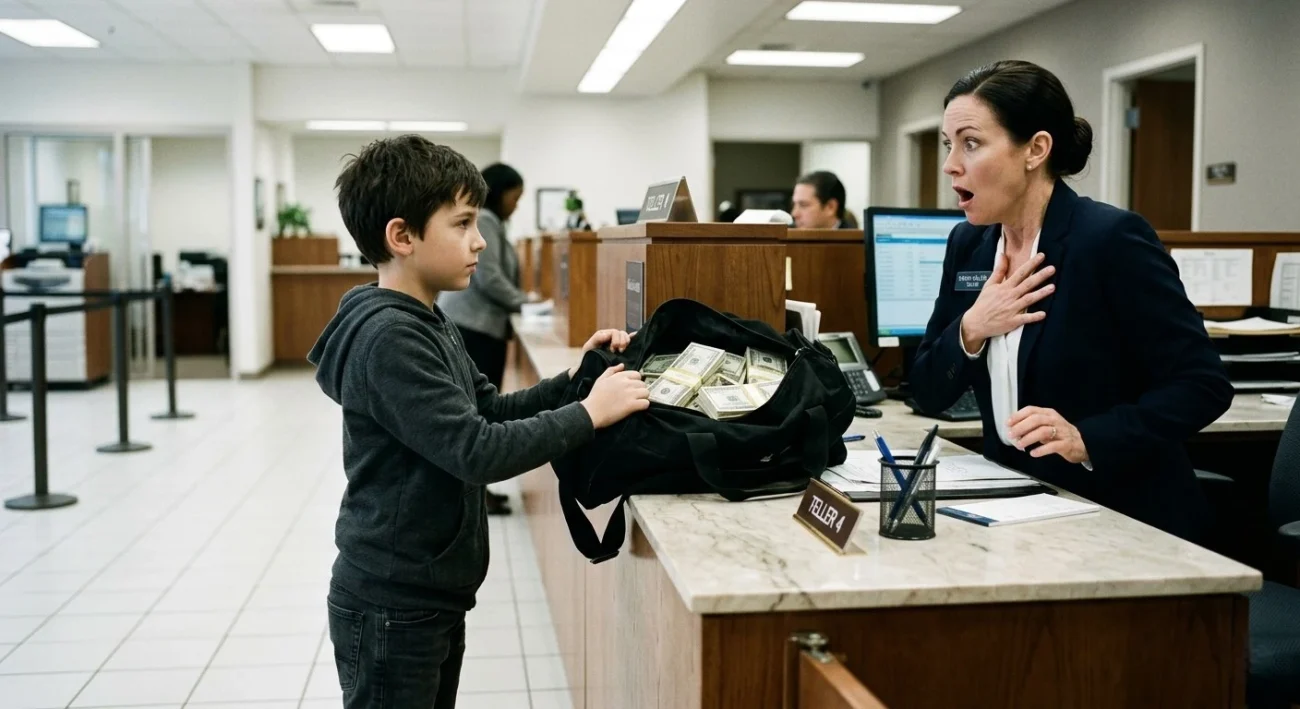
The bag hit the counter so hard the whole desk shook.
The teller—Diane, twelve years on the job, never rattled—flinched hard enough to knock her pen off the desk. She looked down. Then up.
A boy. Maybe five. Round cheeks, oversized gray hoodie, sneakers with the velcro half-undone. He was barely tall enough to see over the counter’s edge, standing on his toes to make up the difference.
He looked at her with complete calm.
“HEY—what do you think you’re doing?!” she snapped.
He didn’t answer. Didn’t even blink. He just reached up with both hands, gripped the zipper tab, and pulled.
The bag split open.
Stacks. Tightly rubber-banded stacks of cash, packed in so tight they barely shifted when the bag opened. Fifties and hundreds, from what Diane could see. A lot of them.
The bank went quiet.
Not the polite quiet of a slow Tuesday morning—this was the kind of quiet that happens when everyone in a room stops breathing at the same time. Three customers in line. Two other tellers. The loan officer through the glass partition. The security guard by the door. Every single one of them frozen, staring at a chubby kindergartener and a bag of money.
Diane’s mouth opened. Nothing came out.
“I need to open an account,” the boy said.
His voice was small and even, the way children sound when they’re repeating something they’ve memorized—practiced, careful, a little proud of themselves for getting it right.
Diane’s hands found the edge of the counter. “Okay. Okay, sweetie.” She lowered her voice, the way you do when you’re not sure if something is dangerous. “Where did you get this money?”
The boy reached into the front pocket of his hoodie.
Slowly. Deliberately. Like he’d been told exactly how to do this.
He pulled out a folded piece of paper—small, white, creased twice—and placed it on top of the cash with both hands, pressing it flat, smoothing it down like it was fragile.
“My mom told me,” he said quietly, “to bring it here. If something happened to her.”
Diane stared at him.
The loan officer—Marcus, mid-forties, perpetually unbothered—stepped out of his partition and moved toward the counter. “Everything alright up here?”
“I—” Diane’s voice caught.
She was still staring at the note.
The handwriting on the outside. Just three words in the upper left corner, block letters, neat and deliberate:
FOR DIANE COLE.
Her name.
Her full name. Not teller or manager or to whom it may concern. Her name, in handwriting she hadn’t seen in over six years, handwriting she would have recognized in a burning building.
Her fingers touched the edge of the paper.
“Ma’am?” Marcus stepped closer.
“Give me a second,” she said. Her voice didn’t sound like hers.
She unfolded the note.
Diane—
If Eli is reading this to you, or if he made it there alone, then I’m gone. Please don’t call the police yet. Please just read.
His name is Elijah. He’s five. His birthday is March 4th and he’s allergic to tree nuts and he doesn’t like loud noises but he’s brave, I promise he is.
The money is real. All of it. $48,000. Every dollar I saved in six years working two jobs because I knew one day I’d need it and I knew I couldn’t put it in a bank under my name. You know why.
You were there that day, Diane. You saw what my brother did. You signed the paperwork that locked me out of my own mother’s estate, and you never said a word. I’m not writing this to hurt you. I’m writing this because you’re the only person who knows the truth, and if I’m gone, Eli needs someone who can’t lie their way out of it.
There’s a safety deposit box at your branch. Box 1142. The key is taped to the back of this note.
Inside is everything. Bank transfers. Documents. Recordings.
My brother thinks he got away with it. He didn’t.
Please take care of my son.
— Renata
Diane read it twice.
Then she sat down. Right there, behind the counter, in full view of the lobby, she just sat down on the edge of her rolling chair and pressed both hands flat against her thighs and stared at nothing.
“Ma’am?” The boy—Eli—was watching her with those steady brown eyes. “Did you know my mom?”
Diane looked at him for a long time.
“Yes,” she said finally. “I did.”
“She said you’d be sad.”
Diane’s jaw tightened. “She was right.”
Marcus crouched down to Eli’s level, gentle, professional. “Hey buddy. Are you here by yourself?”
“I took the bus,” Eli said. “Mom showed me which one. I practiced two times.”
Marcus straightened up and looked at Diane with a question on his face. She shook her head slightly—not yet—and he held back.
“Eli,” Diane said, “can you come with me? We’re going to go sit somewhere a little more comfortable, okay? And I’m going to make you a snack while I make some phone calls.”
“Okay,” he said. Then: “Are you going to keep the money safe?”
“Yes.” She said it without hesitating. “I’m going to keep all of it safe.”
She called the number on the back of the note first.
It rang four times, then went to voicemail. The voice on the recording was male, polished, the kind of voice that belongs to someone who owns three suits and knows it.
You’ve reached Daniel Voss. Leave a message.
Diane set the phone down.
Renata Voss. Of course. She’d known the last name and never put it together—Renata had only ever come in as Renata Marsh, her married name, the one she’d taken when she left her family. The name she’d used to disappear.
Diane pulled Box 1142.
The key fit. She opened it alone, in the small back room they used for sensitive client paperwork, with the door closed and her heart going at a pace she hadn’t felt since her fifties.
The box was full.
A USB drive. A manila envelope thick with documents. Three folded bank statements with certain lines highlighted in yellow. A single photograph—Renata, young, maybe twenty-two, standing outside a brick building with a man beside her who had his arm around her shoulders and a smile that didn’t reach his eyes.
Daniel Voss. Older in the photo. Sharp-featured. The kind of handsome that reads as threatening in retrospect.
Diane opened the bank statements.
The transfers were right there. Six figures, moved from their mother’s estate account three weeks before she died, into a subsidiary LLC—DVoss Holdings—that Diane now recognized as Daniel’s. She had signed the paperwork on two of those transfers. She’d been told it was routine estate management. She’d believed it because she hadn’t looked hard enough. Because Daniel had come in wearing that suit, speaking in that voice, and she had assumed.
She’d assumed, and she’d signed, and Renata had been locked out of her own mother’s final estate.
Six years ago. And Renata had spent six years collecting every piece of evidence, working double shifts, raising her son alone, and building a case she knew she might not live to deliver herself.
Diane sat with that for a moment.
Then she picked up the phone and called the district attorney’s office.
It took three weeks.
The DA moved fast once the recordings were authenticated. Daniel Voss had been careful—careful enough to use a middleman, careful enough to falsify three signatures—but not careful enough to delete the original wire confirmations, which had been backed up by the estate attorney’s office and never purged.
Renata had found that out too. It was all on the USB.
Diane testified. She told the truth about what she’d signed and what she’d been told and what she should have asked. It cost her, professionally. Her branch manager called it a significant lapse in verification protocol. She accepted the write-up. She accepted all of it.
Daniel Voss was indicted on two counts of estate fraud and one count of forging financial documents. His attorney tried twice to get the recordings thrown out. The judge denied both motions.
On the day the verdict came in—guilty on all counts—Diane was sitting in the gallery.
She wasn’t there for Daniel.
She was there for the small boy two rows ahead of her, sitting beside a woman from child protective services who had, over the past three weeks, become something closer to a guardian. Eli had his hands in his lap and his back straight and his sneakers—new ones now, the velcro done properly—pressing flat against the floor.
When the foreman read the verdict, he turned around and looked at Diane.
She didn’t smile. Neither did he, not exactly. But he gave her a single nod—solemn, certain, the kind of nod that belongs to someone much older.
She nodded back.
The estate was unfrozen within sixty days of sentencing.
The original $48,000 Eli had carried into the bank was held as evidence for two months, then returned in full, deposited into an account Diane helped set up—a custodial account, jointly administered, protected until Eli turned twenty-one.
The full estate—Renata’s rightful share—came to just under $380,000 after legal fees and back taxes.
It was more than enough.
On the afternoon the final paperwork was processed, Eli sat across from Diane at her desk, coloring in a notebook the branch had started keeping in the back specifically for him, because he’d been there enough times during the proceedings that it seemed right to have one.
“Can I ask you something?” Diane said.
He looked up. “Yeah.”
“When you came in that day—with the bag—were you scared?”
He thought about it. Really thought about it, the way kids do when they want to give you the honest answer.
“A little,” he said. “But Mom said you’d know what to do.”
Diane looked at him.
“She was right about that too,” she said quietly.
Eli went back to his coloring.
Outside, the afternoon light was long and flat, falling across the bank floor in pale rectangles. A normal Tuesday. Clients moving through the line. Pens scratching. The low hum of the HVAC and the distant sound of traffic.
Diane opened the next piece of paperwork.
She signed her name. This time, she read every single line first.
Daniel Voss was sentenced to four years, with possibility of parole after two. He served thirty-one months.
Elijah Voss-Marsh was adopted at age six by his maternal aunt, who had come forward during the trial. He grew up in Portland, Oregon.
Diane Cole retired from banking at sixty-two. She attended Eli’s high school graduation.
He sent her a card that said: “Mom told me to find someone who couldn’t lie their way out of it. She picked right.”
She kept it in the safety deposit box where the evidence used to be.
Original fictional stories. AI-assisted creative content.
