
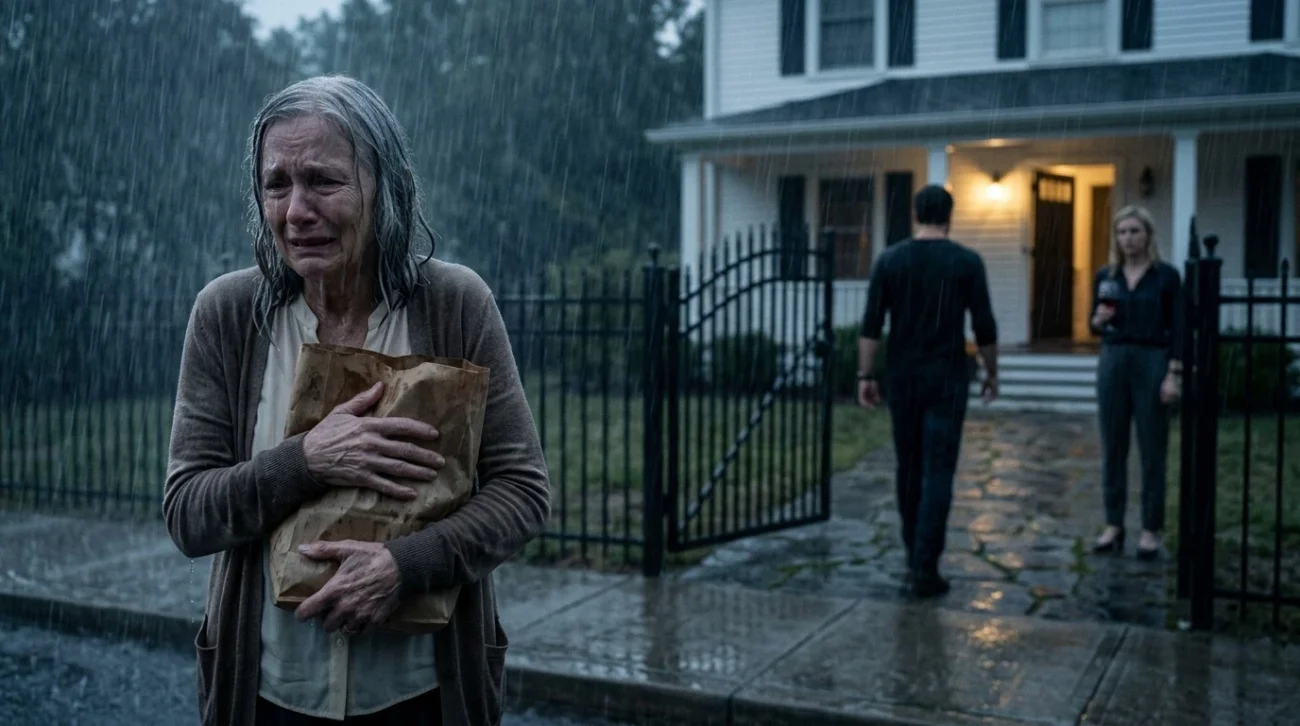
The gate slammed so hard the hinges screamed.
Margaret Rose flinched, rain dripping off her chin. Her son stood on the other side of the fence, jaw tight, eyes anywhere but on her.
“Take the rice and go, Mom.”
“Daniel—”
“Just go.”
He shoved the paper bag into her arms. Not gentle. Not rough. Just… empty.
“Honey, please. I only came to see how you were—”
“I’m fine.” His voice cracked on the word. “Go home.”
A woman’s voice sliced through the screen door behind him. Sharp. Manicured.
“Daniel? Who is it?”
“Nobody, Victoria. I’m handling it.”
Nobody.
Margaret felt the word land somewhere under her ribs.
Victoria appeared in the doorway, arms crossed, a glass of red wine balanced between two fingers like a weapon. She looked Margaret up and down the way people look at a stain on a carpet.
“Oh. Her again.” Victoria smiled, tight. “Daniel, we talked about this. I don’t want that woman on our property.”
“I’m his mother,” Margaret said quietly.
“You’re a problem,” Victoria said. “Daniel, shut the gate.”
“Vic, give me a second—”
“Now.“
Daniel turned back to his mother. For one half-second, his eyes softened. Then the mask snapped back.
“You heard her. Go.”
The gate slammed a second time. Margaret stood in the rain holding a bag of rice that suddenly felt like it weighed a hundred pounds.
She walked the six blocks home. No umbrella. No hurry.
Mrs. Patterson from next door poked her head out. “Margaret? Honey, you’re soaked. Where were you?”
“Visiting my son.”
“And he didn’t drive you home in this?”
Margaret managed a small smile. “He’s busy.”
“Busy.” Mrs. Patterson’s mouth flattened. “Come in, at least let me—”
“I’m fine, Judy. Really.”
She wasn’t.
Her little house groaned when she pushed the door open. Thirty-two years in this place. Every creak knew her name. She set the wet bag on the kitchen table and peeled off her cardigan.
“He’s just struggling,” she said out loud, to nobody. “That’s all.”
The rain answered.
She opened the bag to put the rice in the pantry. Something crinkled. Something that wasn’t rice.
An envelope. Thick. Her name written across it in her son’s handwriting — that careful, boyish slant she remembered from grocery lists and field-trip permission slips.
Her fingers shook as she slid it open.
Cash. Hundred-dollar bills. More money than she’d seen in one place in her entire life.
A note fluttered out and landed face-up on the wood.
Mom — I’m sorry. Read everything. Please.
Under the cash, folded into quarters, was a second letter. Four pages. His handwriting pressed hard into the paper, like he’d been angry at the pen.
She sat down. Her knees wouldn’t hold her anymore.
Mom,
If you’re reading this, I played my part right. Victoria was watching. She’s always watching.
I need you to listen before you come back here, because if you come back before I tell you, she’ll destroy both of us.
Six months ago I found out she’s been stealing from the company. My company. The one Dad helped me start. She’s been forging my signature on wire transfers — almost four hundred thousand so far — and routing it to an account in her sister’s name.
When I confronted her, she laughed. She said if I went to the cops she’d tell them I hit her. She already has the photos. Bruises from some “self-defense class” she took last year. She said she’d ruin me, ruin the business, and make sure you lost the house too — she knows the mortgage is in my name.
I’ve been playing dumb since August. Pretending I believe her. Pretending I’m on her side. Pretending I don’t love my own mother, because every time I’m warm to you she gets suspicious and the “accidents” start. Remember when your mailbox got smashed? That was her. The dead cat on your porch in September? Her.
I know what you’ve been thinking. I know I’ve broken your heart. I had to, Mom. I had to make her believe I’d picked her.
The money in this envelope is yours. It’s clean — I pulled it from an account she doesn’t know exists. There’s $42,000. Hide it. Don’t put it in the bank yet.
Tuesday morning at 9 a.m., a lawyer named Ellen Park is coming to your house. She has everything — the forged signatures, the bank records, a statement from the accountant. We’re going to the police Tuesday afternoon. Together.
After that, it’s going to get loud. She’s going to call you. She’s going to threaten you. Don’t answer. Don’t open the door for anyone but Ellen.
I’m sorry I let her call you “that woman.” I’m sorry I slammed the gate. I’m sorry for every cold word for six months.
You raised me better than the man I’ve been pretending to be. Two more days, Mom. Then I come home.
— Daniel
Margaret read it twice. Then a third time, because her eyes kept blurring.
She pressed the letter to her mouth and let out a sound she hadn’t made since her husband’s funeral.
Tuesday morning the doorbell rang at 8:57.
A woman in a navy suit stood on the porch, a leather folio under one arm. “Mrs. Rose? Ellen Park. Daniel sent me.”
“Come in, come in — please. Is he—”
“He’s fine. He’s meeting us at the precinct at one.”
They sat at the kitchen table where, three days earlier, the rice bag had changed everything.
Ellen opened the folio. Bank statements. Signature comparisons. A sworn affidavit from a CPA named Raymond Kohl. Screenshots of text messages between Victoria and her sister discussing — in plain English — “skimming the old lady’s retirement account too.”
Margaret touched that line with one finger. “She was going to take mine next.”
“She already started. There are two attempted transfers from your credit union last month that got flagged. Daniel caught them and killed them before they cleared.”
Margaret closed her eyes.
“Mrs. Rose, I have to ask. Are you willing to testify?”
“Yes.”
“It could get ugly.”
“She called me that woman,” Margaret said. “In my son’s house. While he bled on the inside trying to protect me.” She folded her hands. “Get the papers.”
At 1:47 p.m., Daniel walked into the detective’s office and saw his mother already sitting there, back straight, Ellen Park beside her.
He didn’t speak. He crossed the room in four steps and went to his knees in front of her chair and put his forehead against her hands.
“Mom.”
“I know, baby. I know.”
“I’m so sorry—”
“I know.“
The detective cleared his throat, then quietly left the room and closed the door.
Victoria was arrested at 6:15 that evening, coming out of a Pilates class with a green smoothie in her hand. She dropped the smoothie on the sidewalk.
She called Margaret from the county jail at 9:04 p.m.
Margaret let it ring.
She called again at 9:11.
“Mom,” Daniel said — he was sitting across from her at the little kitchen table now, his hands wrapped around a mug of tea she’d made him, his eyes still red — “you don’t have to answer.”
“I’m not going to.” She turned the phone face-down. “I just wanted to hear it ring and know it was her and not me who was alone tonight.”
He laughed, wet and broken. “Okay.”
“Daniel.”
“Yeah?”
“The mailbox. The cat.”
“I’m replacing the mailbox Saturday. And I already called the vet — Mittens is buried in their memorial garden, not a landfill. I made sure.”
Her chin trembled. “Thank you.”
“Mom, I—” He stopped. Started again. “I thought I was strong enough to carry it alone. I wasn’t. I almost lost you anyway, the real way, because you were walking home in the rain thinking your son hated you.”
“I never thought that.”
“You didn’t?”
“I thought you were struggling.” She reached across the table and covered his hand with both of hers, the way she used to when he was six and afraid of thunder. “A mother knows, Daniel. Even when she’s wrong about the details, she knows.”
Victoria pled out four months later. Embezzlement, forgery, conspiracy, witness tampering. Seven years, with restitution.
Her sister took three.
The bruise photos she’d threatened Daniel with turned out to be from a woman named Claire Bellamy — Victoria had bought them off a friend-of-a-friend in exchange for helping Claire dodge a DUI. Claire testified too. Her testimony added two years to the sentence.
Daniel moved back into the little house on Linden Street while the big one sold. He said he slept better there anyway. The creaks knew his name too.
On the first dry Sunday of spring, Margaret carried a paper bag of rice over to Mrs. Patterson’s porch.
“What’s this for?” Judy asked.
“For watching me walk home in the rain,” Margaret said, “and caring enough to ask why.”
She walked back across the lawn. Her son was waiting on the front step, sleeves rolled up, a new mailbox leaning against the railing, a screwdriver in his hand.
“Ready?” he called.
“Ready,” she said.
And this time, when the gate closed behind them, it closed softly.
Original fictional stories. AI-assisted creative content.
