
Mark Whitaker checked his Patek Philippe for the third time in ninety seconds.
“We’re on schedule,” his assistant Dana said, struggling to keep pace. “Wheels up in forty.”
“Forty is late. Forty is unacceptable.”
The private terminal gleamed like a surgical theater. Cold blue light. Polished chrome. The kind of place where the carpet cost more than Dana’s car.
“Mr. Whitaker, the Crestline team already confirmed—”
“I don’t care what they confirmed. I care about signatures on paper.”
The leather portfolio under his arm held fifty million reasons to care. The merger with Apex Airlines would make him the youngest managing partner in his firm’s history. Thirty-six years old. Untouchable.
He rounded the corner toward the VIP gate and stopped short.
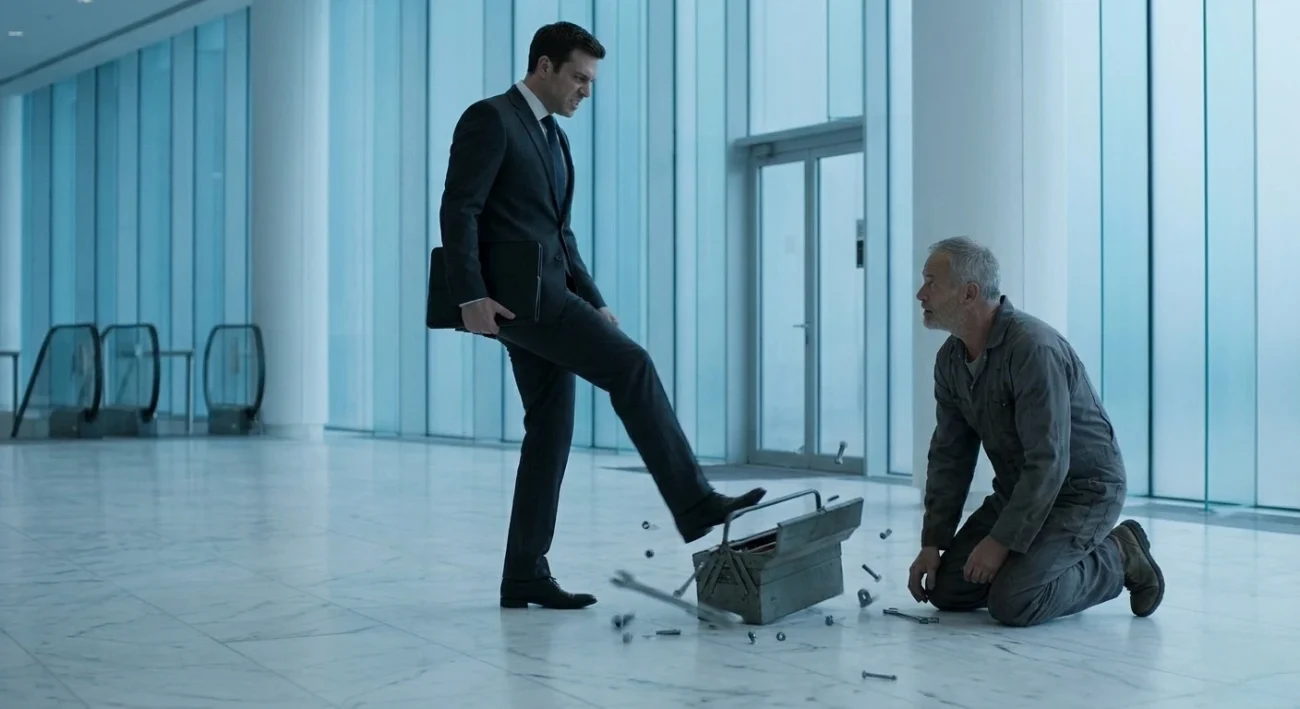
An old man in grease-stained overalls was on his knees, elbow-deep in a jammed security latch. Tools scattered around him. A rusted metal toolbox sat square in the middle of the walkway.
“You’ve got to be kidding me,” Mark muttered.
“Sir, there’s another path around—” Dana began.
“No. He moves.”
Mark walked straight up to the old man. Stood over him. Waited.
The old man didn’t look up. He just kept working, turning a wrench with steady, patient hands.
“Hey. Old-timer.”
Nothing.
“I’m talking to you.”
The wrench stopped. The old man looked up. His eyes were pale gray, unhurried, strangely calm.
“Can I help you, son?”
“You can move. That’s what you can do. You’re blocking the gate.”
“Be another ten minutes, give or take. Latch is stripped right through. I can’t leave it half—”
“Ten minutes?” Mark laughed, a short, sharp bark. “Do you have any idea what my time is worth?”
The old man blinked. “No, sir. I don’t.”
“I make more in a phone call than you’ll see in a lifetime of fixing doors. You’re a footnote in this building. Move.”
Dana winced. “Mark.”
“Stay out of it.”
“Mark, please—”
He ignored her. Planted his $2,000 Oxford against the side of the toolbox and kicked.
The box skidded across the marble. Bolts and springs scattered like buckshot. A wrench spun and clanged against the baseboard.
The old man didn’t flinch. He watched the tools go. Then he looked back up at Mark. Quiet. Observant.
“That’s a shame,” he said softly.
“What’s a shame?”
“Those are good tools.”
“Pick them up or don’t. I don’t care. Just get out of my way.”
Mark stepped around him. Dana hurried after, eyes down, cheeks burning.
“That was ugly,” she whispered.
“That was efficiency. Call the Owner’s Suite. Tell them I’m coming up.”
The Owner’s Suite sat on the top floor of the terminal. Glass walls. A view of the entire tarmac. The Crestline lawyers were already seated around a long walnut table.
Henry Voss, Crestline’s lead counsel, stood when Mark entered.
“Mark. Good. Mr. Calloway’s running a minute behind.”
“Calloway? I thought I was meeting with the owner directly.”
“You are. Mr. Calloway is the owner.”
Mark frowned. “I’ve never heard the name.”
“He keeps a low profile. Very low. He started Apex in 1978 with one cargo plane and a mechanic’s certification. Built it from the hangar floor up. Doesn’t do press. Doesn’t do photos.”
“Then how will I recognize him?”
Henry smiled thinly. “You won’t have to.”
The door opened.
Mark turned with his practiced smile, hand extended.
The smile died.
The old man from the gate stood in the doorway. Same overalls. Grease still on his knuckles. He was wiping his hands with a white silk handkerchief, slow and deliberate.
Mark’s hand hung in the air between them.
“Mr. Calloway,” Henry said. “This is Mark Whitaker, from—”
“We’ve met.”
The room went still.
Calloway walked past Mark without looking at him. Sat down in the high-backed leather chair at the head of the table. Folded the handkerchief once. Twice. Set it down.
“Sit, Mr. Whitaker.”
Mark sat.
Dana slipped in behind him, pale as drywall. In her arms was the rusted toolbox. Bolts rattled inside it. She had clearly gathered every piece she could find off the terminal floor.
She set it gently against the wall.
Calloway’s eyes flicked to the box. Then to Dana.
“Thank you, young lady. What’s your name?”
“Dana, sir. Dana Reyes.”
“Dana. You didn’t have to pick those up.”
“I wanted to, sir.”
“That matters.”
He turned back to Mark.
“Let’s talk about the deal.”
Mark cleared his throat. His collar felt two sizes too tight. “Sir. About earlier. I want to apologize. I was under enormous time pressure, and I didn’t realize—”
“You didn’t realize I was worth being polite to.”
“That’s not—sir, that’s not what I—”
“It is what you meant. It’s fine. Say what you mean.”
“I had no idea who you were.”
“I know you didn’t.” Calloway leaned back. “That’s the problem.”
Mark opened the portfolio. Slid the contract across the table. His hand was shaking and he hated that his hand was shaking.
“The terms are exactly as we discussed. Fifty million, structured over—”
“I spend my mornings fixing the small things, Mark.”
Mark stopped.
“Do you know why?”
“Sir—”
“It’s a question. Answer it.”
“Because… you enjoy it?”
“Because if the latch is broken, the whole building is insecure.”
Calloway pulled the contract toward him. Ran a finger down the first page. Didn’t read it. Just touched it.
“One bad latch. One door that doesn’t close right. That’s all it takes. A man with a grudge walks in. A kid walks out onto the tarmac and gets hit by a tug. A bag gets through that shouldn’t. Whole system fails.”
“I understand, sir.”
“I don’t think you do.”
He looked up. Those pale gray eyes again. Steady as a level.
“You, Mark, are a broken latch.”
Henry Voss didn’t move. Didn’t breathe.
“Sir, with respect—”
“I’m going to finish talking, and then you’re going to leave.”
Mark closed his mouth.
“A man who kicks a toolbox because he’s in a hurry will kick something bigger when he’s in a bigger hurry. A man who humiliates a stranger for standing in his way will humiliate a client for asking a hard question. A man who thinks his time is worth more than another man’s dignity—” Calloway picked up the contract. “That man doesn’t fly on my planes. He doesn’t merge with my company. He doesn’t shake my hand.”
He tore the contract down the middle.
The sound was enormous in the quiet room.
He tore it again. And again. Set the pieces on the walnut.
“My airline doesn’t carry cargo as heavy as your ego.”
Mark stared at the paper. At fifty million dollars in four neat quadrants.
“Sir, please. I can—we can restructure. I can have a new team in here tomorrow. A different lead. Anyone you want.”
“Your firm’s not the problem. You are.”
“If you’ll just give me one more—”
“You’re not just off the flight, Mark. You’re off the deal.”
“Mr. Calloway—”
“And out of this building.”
Mark stood up too fast. His chair scraped back.
“You’re going to regret this.”
Calloway looked up.
“Son. I’ve been regretting things for sixty years. I know the flavor. This isn’t it.”
Mark walked out of the suite on legs that didn’t feel like his own.
In the elevator, Dana stared straight ahead.
“Say something,” he snapped.
“What do you want me to say?”
“Anything. Say anything.”
“I told you there was another path.”
The elevator opened. They crossed the terminal floor. Past the gate he’d tried to storm through. The latch was fixed now. Shining. Someone else was testing the handle.
His phone buzzed.
Henry Voss. Whitaker—board of directors has been informed. Call your office.
Another buzz.
His managing partner. CALL ME NOW.
Another.
Mark, what did you DO.
By the time he reached the valet stand, his phone was a chorus.
He stood in the cold sunlight, portfolio limp at his side, and watched a black town car pull up for someone else.
Three weeks later, the business section of every paper in the country ran the same story.
Apex Airlines had signed a two-billion-dollar expansion deal.
Not with Mark’s firm.
With a smaller competitor, led by a young managing partner named Dana Reyes, who had left Whitaker & Hale the day after the terminal incident and been hired by Crestline on the spot.
The article quoted Theodore Calloway, the reclusive billionaire founder of Apex, only once.
“I hire people who pick up tools,” he said. “Not people who kick them.”
Mark read the article alone in an apartment that was no longer his, on a Tuesday that was no longer billable, and set the paper down very carefully, as if it were something that might still break.
Outside, a jet he would never board climbed into a sky he no longer owned.
And somewhere on a hangar floor across the city, an old man in grease-stained overalls tightened a bolt, wiped his hands on a white silk handkerchief, and went back to work.
Original fictional stories. AI-assisted creative content.
