
The sound came first.
Wrong for that block. Too smooth, too controlled—like something imported from a different city. Shiomara Reyes was mid-ladle when the first engine turned the corner, its purr low and liquid against the cracked concrete of West 14th.
Then the second.
Then the third.
She didn’t move. The ladle hung over the pot of yellow rice, steam curling up past her face, warm and familiar. Everything else had stopped making sense.
Three Rolls-Royces. One white, one black, one white again. They pulled up in a row and died at the same moment, like they’d rehearsed it. On West 14th. Where the bodegas had hand-painted signs and the pigeons were braver than the rats.
People stared. A man walking his dog stopped and didn’t start again.
The doors opened. Slow. Deliberate.
Two men. One woman. Their clothes didn’t move right in the wind—too well-fitted, too considered. The woman had silver hair swept back from a strong face. The man on her left wore a brown suit that probably cost more than Shiomara’s cart. The one in the middle had a deep blue tie and the posture of someone who gave speeches.
They weren’t looking at the buildings. They weren’t looking at each other.
They were looking at her.
Shiomara set the ladle down.
“Can I—” she started.
Her voice didn’t come. Just air.
The woman walked forward first. Not fast. Each step like she’d been saving it. Her eyes moved over Shiomara’s face the way you look at something you’ve been trying to remember for a long time.
“You fed us,” the woman said.
Her voice cracked on the last word like it had been held together with tape for twenty years.
Shiomara blinked. “I’m sorry?”
The man in the brown suit stepped forward. His jaw was tight, like he was keeping something down by force.
“We were the kids. Under the 9th Street bridge.” He paused. “The three of us.”
The street went quiet in Shiomara’s ears.
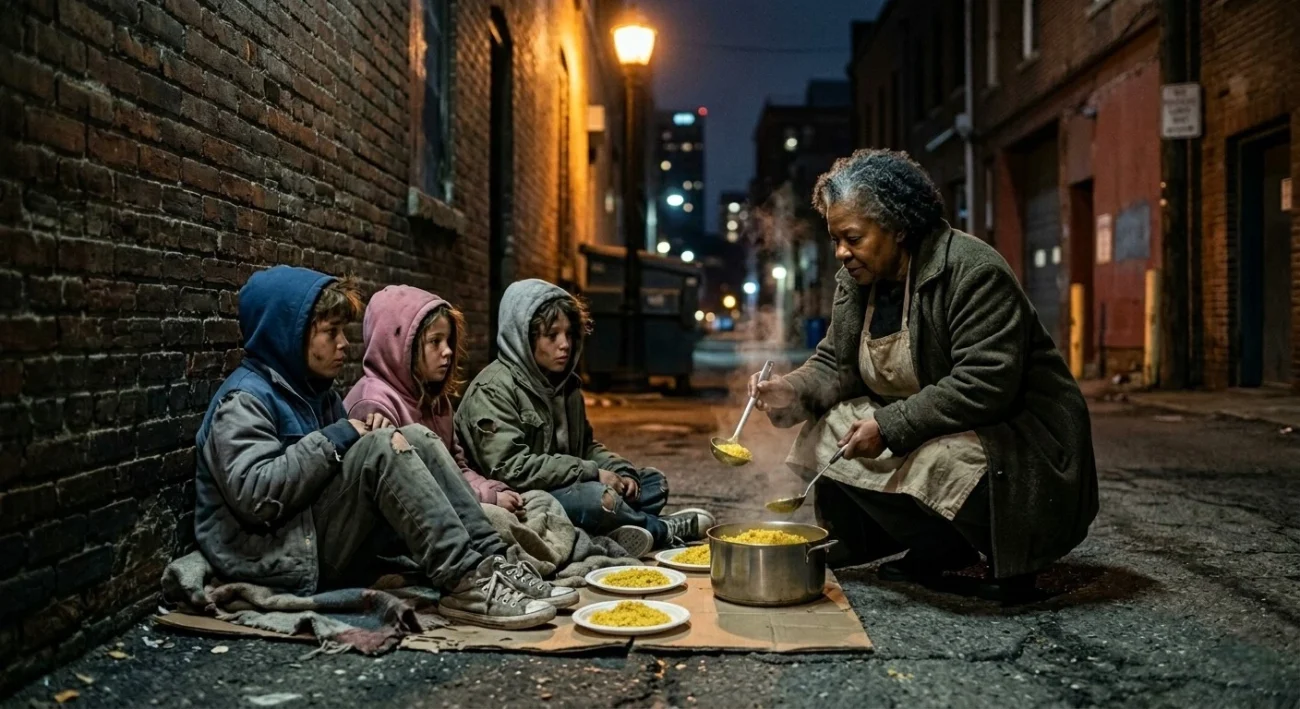
She saw it before she understood it. Three children. Rain-soaked. A November night, cold enough that her breath showed. She’d given them rice from the day’s last pot, wrapped in foil, because they were so small and the wind was coming off the river.
Triplets. She’d called them that in her head because she never learned their names.
“No,” she whispered.
“You told us something,” the man in blue said. His voice was careful. Precise. The voice of someone who had learned not to let things show—and was choosing, right now, to let something show. “‘Eat first. The world can wait.'”
Shiomara’s hands gripped the edge of the cart.
“I said that to a lot of kids.”
“You said it to us every week for four months.” The woman’s voice was steadier now. “Every Tuesday and Thursday. Even the night it snowed. You were there.”
“You brought extra foil,” the man in brown said. “Because Marcus—because he always spilled things.”
He stopped. Looked at the man in blue. Something passed between them.
“You remembered our names?” Shiomara asked.
“You didn’t know them,” the woman said. “We were just—kids at your cart. But we remembered yours. It was on the permit on the side.” She touched her chest. “Shiomara. We looked it up. We didn’t know what it meant. We just—said it sometimes. When things were bad.”
Shiomara couldn’t breathe correctly.
“What happened to you?” she managed. “After—”
“A social worker,” the man in blue said. “Three weeks after you started feeding us. She found us under the bridge and got us into a foster placement together. They kept us together.” He glanced at the woman. “That was rare.”
“We aged out at eighteen,” the man in brown said. “Marcus got a scholarship. Dani got into a nursing program. I—” He looked at his shoes for a moment. “I took a different road. But it led somewhere.”
“Tech,” the woman—Dani—said. “He built a logistics platform. Sold it at thirty-one.”
“Dani runs a pediatric clinic network,” Marcus said quietly. “Six locations.”
“And I’m a judge,” the man in blue said. He extended his hand. “Nathan. Federal circuit.”
Shiomara shook it. Her hand was trembling. She didn’t try to stop it.
“We’ve been looking for you for three years,” Dani said. “The permit was under a business that dissolved. The address was a PO box.”
“I moved the cart twice,” Shiomara said. “The city—”
“We know. A private investigator finally found you two months ago.” Nathan reached into his coat. He produced an envelope, thick and sealed, and set it on the cart beside the pot of rice. Steam touched it. “We made a promise.”
Shiomara stared at the envelope.
“Open it,” Marcus said.
Her fingers moved before she decided to let them. The seal gave. Inside—a photograph first. Old, faded at the edges, printed on consumer paper, the kind that curls at the corners. Three small children on wet concrete, holding foil plates. Behind them, a woman in a brown apron, smiling without knowing she was being photographed.
Shiomara’s vision went white at the edges.
“Where did you—”
“A man at the shelter had a camera,” Dani said. “He gave us a print when we left. We kept it.” She wiped at her eye once, quickly, like she was annoyed at herself. “We always kept it.”
Shiomara set the photograph down very carefully, like it was made of something that could shatter.
Underneath it was a document. Official. Stamped.
A property deed.
Her name on it. Her legal name—Shiomara Elena Reyes—in clean black type.
She read the address. Read it again.
“This is—this is a building,” she said.
“Four units,” Nathan said. “Fully renovated. Tenants in place. The income is in the packet, projected twelve-month. It’s managed—you don’t have to do anything you don’t want to do.” He paused. “The top unit is empty. It’s yours to live in, if you want.”
Shiomara couldn’t speak.
“We talked about this for years,” Marcus said. “About what we’d do. If we made it. If we found you.” His voice was rough now, the professional polish gone. “We didn’t want to give you money. Money feels—temporary. We wanted to give you something that would just—be there. Something that keeps paying you.”
“While you decide what comes next,” Dani said. “If you want to keep the cart, keep the cart. If you want to stop, stop. If you want to open a restaurant, there’s capital in that packet for a business plan.”
“We argued about the restaurant,” Marcus said. “Nathan thought it was too much.”
“I thought it should be her choice,” Nathan said.
“It is her choice,” Marcus said.
“I know. That’s what I just—” He stopped. Looked at Shiomara. A small smile pulled at one corner of his mouth. “We’re still like this. Sorry.”
Shiomara laughed. It came out strange, too sudden, almost like a sob. She pressed her hand over her mouth.
“You were so small,” she said.
“We were,” Dani said.
“You had a hole in your jacket. The one with the—” She gestured at her shoulder.
“The yellow stripe,” Marcus said. He pointed to the man in blue. “That was Nathan’s. He wouldn’t throw it out.”
“It still fit when I was eight,” Nathan said, with a dignity that was slightly undercut by everything.
Shiomara laughed again—actually laughed this time, eyes wet, the sound carrying out over the block. A few passersby glanced over.
She picked up the photograph again and looked at the woman in it. The woman who hadn’t known she was doing anything that mattered. Who had just shown up because she showed up every day, and the rice had been made, and the kids had been hungry.
“I didn’t do anything,” she said softly.
“You did the one thing,” Dani said.
They stood there for a moment—four people on a cracked sidewalk, three Rolls-Royces gleaming in the November light behind them, steam still rising from a pot of yellow rice.
Then Marcus picked up the ladle from where Shiomara had set it down.
“Can I?” he said.
She blinked. “Can you what?”
He nodded at the pot. “Serve. For a minute. I used to watch you do it. I always thought—” He shrugged. “I just want to do it once.”
Shiomara stared at him for a long moment.
Then she stepped aside.
Marcus filled a plate—steady hands, careful portion, the way she’d always done it—and handed it to an elderly man who had been waiting patiently through the entire conversation and had decided, with great wisdom, not to ask questions.
The man took the plate. Nodded. Walked off.
“Not bad,” Shiomara said.
“I had a good teacher,” Marcus said.
She took the ladle back. Set her shoulders. Looked at the three of them—Nathan with his perfect blue tie, Dani pressing her lips together to hold the smile in, Marcus who had just served rice from a street cart in a suit that cost more than this block earned in a day.
“Come back Thursday,” she said.
“We’ll be here,” Dani said.
She believed them.
That evening, Shiomara sat in her apartment—the small one, the one with the window that didn’t seal right—and opened the full packet. The building was real. The deed was registered. The management company had already been in contact; she found a letter with a number to call.
She sat for a long time with the photograph in her hands.
Then she picked up her phone and called her sister in Albuquerque, who had been telling her for years to get off the street, to let someone else work the cart, to rest.
“Marta,” she said, when the call connected.
“Shiomara? What happened? You sound—”
“I need to tell you something.”
She told her.
When she was done, there was silence on the other end of the line.
Then Marta said, quietly: “I always told you. I always told you it mattered.”
“I know,” Shiomara said.
“You never believed me.”
“I believe you now.”
Outside, the city went on making its noise. But for the first time in a long time, it sounded different. Less like something to endure. More like something to move through—on her own terms, with a building in her name and a photograph on the table, and three children, now grown, who had kept her face in their memory like a fixed point while the world rearranged itself around them.
She set the photograph down.
She wasn’t hungry. But she went to the kitchen anyway and made rice—old habit, good habit—and ate it standing at the counter, looking out the window at the lights.
Original fictional stories. AI-assisted creative content.
