
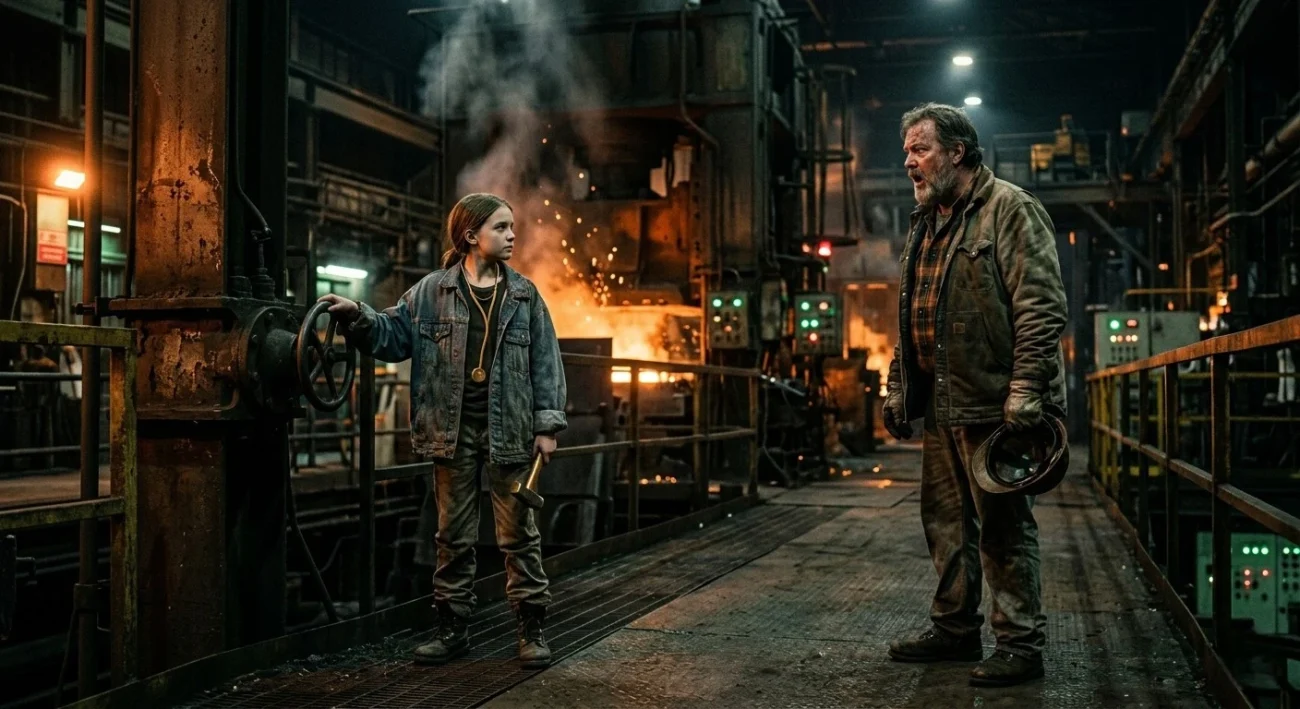
The Great Press hadn’t made a sound in eleven hours.
Elias Marsh stood in front of it like a man at a funeral — because that’s what it was. The machine was three stories of hydraulic steel, the heart of the O’Connell Mill, the only real employer left in Gary, Indiana. And it was dead.
He’d already heard the verdict. Martinez from the Chicago consulting group had been very clear, very clinical, and very expensive about it.
“Main piston’s fused to the casing,” Martinez had said, not even bothering to look up from his tablet. “Total replacement. You’re looking at eight months minimum. Maybe ten.”
“Eight months shuts us down permanently,” Elias said.
“I know.” Martinez had closed his tablet and left.
Now Elias stood in the half-dark, surrounded by men who hadn’t gone home. Hundreds of them, in hard hats and oil-streaked coveralls, standing in the orange-and-shadow glow of the emergency lights. Nobody talked much. There wasn’t much to say. Men like these didn’t do speeches. They just stood with the machine that had fed their families for thirty years and didn’t know how to leave it.
Elias didn’t know how to leave it either.
“You been staring at her for three hours.”
The voice came from behind a support column. Small. Calm.
He turned.
A kid — a girl, maybe twelve — was sitting on a wooden crate in the shadow of the Press. She wore an oversized denim jacket two sizes too big, the name SUTTON stitched above the breast pocket in faded yellow thread. She had a brass hammer resting on her knee and a stethoscope looped around her neck like a doctor who hadn’t learned yet that doctors don’t belong here.
Elias blinked. “Who let you in?”
“Side gate’s been broken for six months,” she said. “You keep saying you’ll fix it.”
A few of the older men shifted. Someone muttered “Silas’s girl” under his breath. The room got quieter.
Elias crouched down to her level. His knees ached. Everything ached. “Clara. You need to go home.”
“You need to stop looking at the piston.”
“Excuse me?”
She slid off the crate and walked — just walked — straight toward the machine, ducking under the cordon tape like it wasn’t there. One of the younger engineers, Reyes, stepped forward to stop her. Elias held up a hand. He didn’t know why. Something in the way she moved.
“My dad said the Press breathes,” Clara said, running one hand along the lower housing without touching the hot sections — she knew where those were. “He said if you treat her like a machine, you’ll fix the wrong thing every time.”
“The piston is fused,” Elias said. “Three separate engineers confirmed it.”
“The piston’s locked,” she said. “There’s a difference.” She stopped at a secondary pressure valve buried behind a crust of old grime and mineral buildup, halfway up the back panel. Nobody had touched it. Martinez’s team had walked right past it.
She pressed two fingers to the pipe. Tapped it three times with the brass hammer. Clink. Clink. Thud.
The third tap had a different sound — duller, deeper, like something hollow behind solid.
She fitted the stethoscope earpieces in and pressed the chest piece to the housing. Closed her eyes. The whole room watched a twelve-year-old girl listen to a dead machine.
“Backpressure lock,” she said quietly, like she was confirming something she already knew. “There’s trapped gas in the secondary line. It’s been pushing against the piston from behind. It’s not fused — it’s braced. She’s not broken, she’s holding her breath.”
Martinez, who had apparently not left after all, stepped forward from the edge of the group. “That bypass valve connects to the cooling overflow,” he said, with the flat patience of a man explaining gravity. “If you open it wrong, you’ll rupture the secondary seals. You’ll make this ten times worse.”
“My dad showed me the sequence.”
“Your dad is dead,” Martinez said. Not cruel. Just factual. “And I have an engineering degree from Northwestern.”
Clara looked at him. “Has your degree fixed her yet?”
Silence.
Reyes laughed — a short, involuntary sound — then covered his mouth.
Martinez’s jaw tightened. “I’m not letting a child blow the seals on a $40 million machine.”
“It’s already dead,” Clara said. “You said so yourself.” She turned back to the valve housing. “The sequence is: release the bleed pin a quarter turn, wait for pressure to equalize, then open the bypass counterclockwise three full rotations. Not two. Not four. Three.”
“Where did he teach you that?” Elias asked.
“In the garage,” she said. “Every Sunday. He called it the secret handshake.” She paused. Her hand rested on the bleed pin. “He said the mill would need it someday. He said to remember it for him.”
The room was completely still. Even the emergency lights seemed to stop buzzing.
Elias looked at the men. He looked at Martinez. He looked at the silent machine that had fed this city for thirty years.
He looked at Clara.
“Show me the sequence,” he said. “Step by step. Talk me through it.”
Martinez grabbed his arm. “Elias—”
“Step back, David.”
Martinez stepped back.
Clara’s hands were steady. She explained each step as she went, her voice small and precise in the massive dark room, and the men pressed in closer to hear her, the same men who had ignored her twenty minutes ago. She released the bleed pin. A thin hiss of gas escaped — immediately, a low-grade vibration moved through the floor, subtle but real, like something exhaling that had been holding it in for too long.
“That’s good,” she said. “That’s the gas moving.”
She waited. Thirty seconds. The hiss slowed and stopped.
Then she gripped the bypass handle and turned it counterclockwise. One rotation. Two. Three.
She let go and stepped back.
Five seconds.
Ten.
Nothing.
Elias heard someone behind him whisper “come on” under their breath. He realized it was himself.
Then the sound came.
It started in the floor — a slow, tectonic groan, the kind of sound that doesn’t come through your ears so much as through your feet and chest. The emergency lights flickered. Every man in the room grabbed something — a railing, a column, a colleague’s arm.
The Press hissed.
Not a malfunction hiss. Not a blowout. A clean, massive, rhythmic release — a shudder of steam from the primary vent stack that billowed up into the shadows above them like a held breath finally let go. The piston moved. One inch. Then a foot. Then the whole assembly dropped into place with a boom that vibrated through every bone in the building.
The lights on the main panel blinked on. Green. Green. Green. Green.
The Great Press was running.
Nobody moved for a full three seconds.
Then the room erupted. Men grabbed each other. Someone was crying and not hiding it. Reyes actually dropped to one knee. The sound of the mill coming back to life — the rhythmic, deep, powerful thoom-thoom-thoom of the piston cycling — hit every man in that room the way a heartbeat sounds to someone who thought they were about to flatline.
Martinez stood very still, staring at the panel. He didn’t say anything.
“The bypass will hold for about seventy-two hours,” Clara said, over the noise, still calm. “Then you’ll need to flush the secondary line properly. But it’ll run until then.” She picked up the brass hammer and tucked it into her jacket pocket.
Elias crossed the floor to her. He crouched down again, same as before. His knees still ached.
“What do you want?” he asked. “Name it.”
She thought about it. “My dad’s hard hat,” she said. “It’s been in a box. I want it back on the board. Where it belongs.”
Elias stood up slowly. He walked to the main board at the far wall — the one lined with hard hats going back sixty years, names painted on each one. Silas Sutton’s hat had been taken down after his accident. Quietly, without ceremony, the way people remove things they don’t know how to look at anymore.
Elias found it in the equipment room. Faded yellow. A crack on the brim from the accident. The name still clear.
He carried it back to the board and hung it in its spot.
The men saw him do it. Nobody said anything, but several of them took off their own hats for a moment.
Elias turned back to Clara. “There’s a seat at the engineering table,” he said. “It’s yours. When you’re old enough, it’s waiting.”
“I know,” she said. And for the first time, she smiled — quick, small, her father’s smile. “He told me that too.”
She walked to the side gate — the broken one — and slipped through it into the cold Indiana night.
Elias stood in the roar of the living machine and looked at the hard hat on the board.
Martinez appeared beside him, quiet for once. After a long moment he said, “I would have demolished the casing by morning.”
“I know,” Elias said.
“She knew something we didn’t.”
“She knew someone we didn’t.” Elias picked up his own hard hat and settled it back on his head. “Get Reyes on the secondary line flush schedule. Seventy-two hours, like she said.”
Martinez nodded and walked away without another word.
The mill ran all night. It ran the next day. And the day after that.
Six months later, when the formal engineering apprenticeship program launched at O’Connell Steel — the first in the mill’s history — the chair at the head of the advisory table had a small brass nameplate on it.
It read: C. SUTTON — RESERVED.
The men who’d been in that room the night of the Great Press never needed to be told to respect it.
They already did.
Original fictional stories. AI-assisted creative content.
