
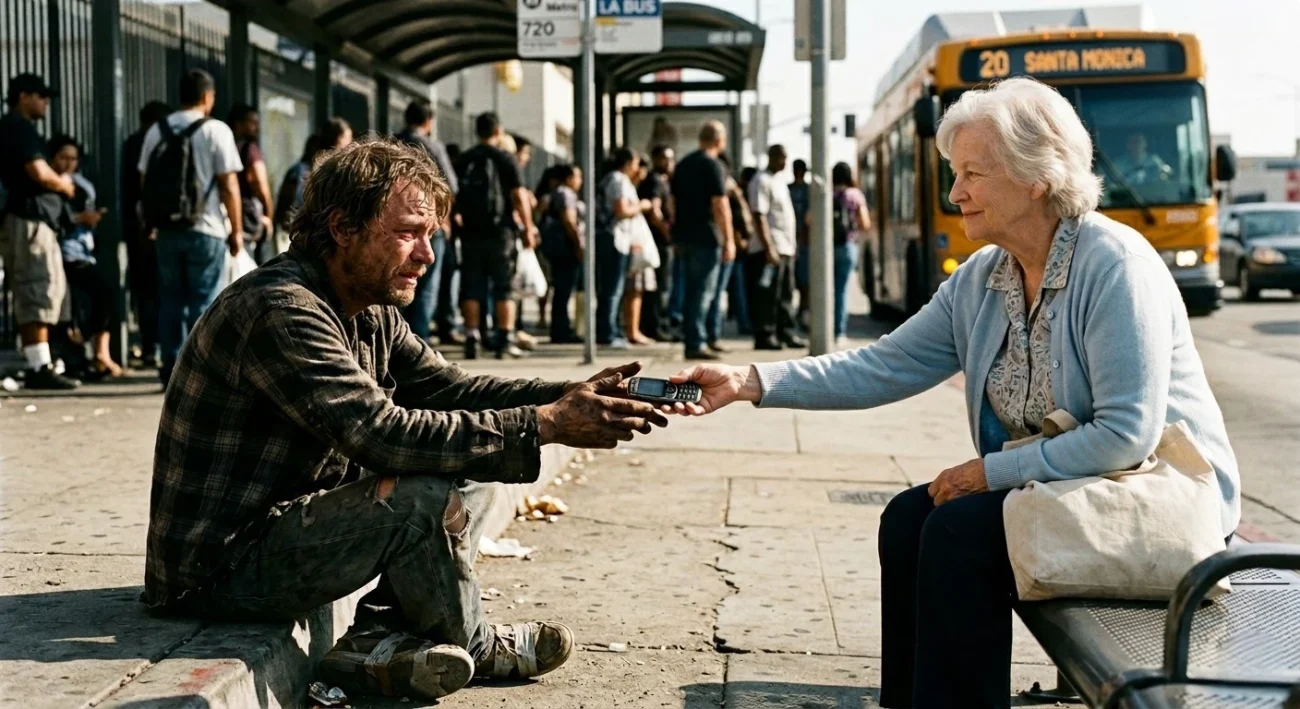
Sam hadn’t slept in two nights. Not because he couldn’t find a bench—he knew every bench in this part of Los Angeles—but because he had a deal closing at noon and his phone had died in the pocket of his torn jeans sometime around 3 a.m.
He stood at the bus stop on Wilshire, squinting into the white-hot morning glare. His shirt had a smear of motor oil across the chest from changing a tire on the shoulder of the 101 two weeks ago. He hadn’t bothered to throw it out. He hadn’t had a reason to look like anything in particular.
Not yet.
He needed one phone call. That was all. One call to his assistant to confirm the wire transfer, confirm the attorneys were in the conference room, confirm the deal that had taken fourteen months to construct was still standing.
He spotted the businessman first—mid-forties, pressed white shirt, Patek Philippe glinting at the wrist. The man was moving fast, briefcase tight to his side.
“Excuse me,” Sam said. “I just need to borrow a phone for thirty seconds. One call.”
The businessman’s eyes dropped to Sam’s shoes—cracked leather, left sole pulling away at the toe—and he physically angled his body away, accelerating.
“Sorry. Late.”
He wasn’t looking back.
Sam watched him go. No anger. Just data. He’d spent enough time on both sides of that exchange to understand exactly what the man had seen: a threat, a mess, an inconvenience wearing a human face.
He turned to a young woman sitting on the bench, earbuds in, phone face-up on her knee.
He raised a hand to get her attention. She glanced up, clocked him in under a second, and slid four inches down the bench—her entire body language a locked door.
Sam dropped his hand. He looked down the block. A food truck. A dog walker. A cyclist who blew past without slowing.
He stood still in the way that desperate people learn to stand still—not beaten, not begging, just waiting for the math to change.
“Young man.”
The voice was thin but clear. He turned.
She was maybe seventy-five. Small, dressed in a pale blue cardigan in the middle of summer, sitting at the far end of the bench with a canvas grocery bag on her lap. She was looking at him with calm, direct eyes—the kind of eyes that had stopped being surprised by the world a long time ago.
“Did you need to make a call?”
He blinked. “Yes, ma’am. Just one.”
She held out a flip phone—old, worn at the edges, but charged—without another word.
He took it carefully, like she’d handed him something fragile. “Thank you.”
He dialed from memory. It picked up on the second ring.
“Marcus.” His voice shifted. The roughness stayed, but the register dropped—the voice of a man who ran things. “Tell me the wire cleared.”
A pause. “Cleared forty minutes ago,” Marcus said. “Attorneys are in the room. We’re waiting on you.”
“I’ll be there in twenty.”
He hung up and handed the phone back.
“Thank you,” he said again, and meant it with a specificity he couldn’t fully explain.
She nodded once, like she expected nothing in return and was fine with that.
He stepped to the curb.
He didn’t wait long. He never had to wait long once he made the call. That was one of the perks—maybe the only perk—that still made him feel something.
The G-Wagon came around the corner doing exactly the speed it always did: too fast for the street, not fast enough to be stopped. Emergency Orange, which had been a joke between him and his ex-wife when he’d ordered it—You’ll never lose it in a parking lot—and which he’d kept for reasons that had less to do with practicality and more to do with not wanting to change anything she had touched.
It rolled to the curb in front of the bus stop with a sound like controlled authority.
The driver’s door opened. David—who had been Sam’s driver for eleven years and who had the particular dignity of a man who takes his job seriously—stepped out and opened the rear door. In his other hand: a suit bag.
Navy. Bespoke. Made by a tailor in Milan who Sam had seen twice a year for the last decade.
“Sir,” David said, with neither irony nor performance.
Sam unzipped the bag right there on the sidewalk. He shrugged off the oil-stained shirt. He’d done this before—not often, but when he had to. When the test required it.
He pulled on the white dress shirt. Buttoned it from the bottom up. Took the jacket. Straightened the lapels.
It took ninety seconds.
The transformation wasn’t magic. It was economics. The same face, the same hands, the same two days of unshaven jaw—but now framed in twelve thousand dollars of fabric, and that changed every calculation in every watching brain within thirty feet.
He heard it—the silence. The specific silence that falls when a crowd realizes it has made an error.
The businessman had stopped at the corner, waiting for the light. He was staring.
The woman with the earbuds had taken them out. She was staring.
A man from the food truck had leaned out his window. He was staring.
Sam didn’t look at any of them.
He turned to the elderly woman on the bench. She hadn’t moved. She was watching him with the same calm eyes, and she looked neither surprised nor unsurprised—just present.
David appeared at Sam’s elbow with a slim attaché case. Sam opened it. He did not look inside. He knew what was in it—he’d told Marcus to prepare it two days ago, when this particular idea had come to him on a long drive down Pacific Coast Highway.
He sat down beside her.
“I want to tell you something,” he said.
She looked at him.
“People stopped. This morning. I counted. Eleven people. I asked four of them directly.” He paused. “You were the only one who treated me like I was a person.”
She said nothing. She didn’t fill silences with discomfort.
“I have a foundation,” he said. “Housing-first program. We’ve put about six hundred people into permanent housing in the last three years.” He slid the attaché across the bench toward her. “I’d like to make a donation in your name. To whatever matters to you.”
She looked at the case.
“That’s a lot of money for a phone call,” she said.
“It’s not for the phone call.” He met her eyes. “It’s for the other thing.”
She was quiet for a moment. Then: “My church has a food pantry. They’re about to lose their lease.”
“Give me the address,” he said.
She opened her purse. Found a receipt and a stub of pencil. Wrote in a careful hand and passed it to him.
He looked at it. Folded it into his breast pocket.
“The lease won’t be a problem,” he said.
He stood. David was holding the car door.
Sam buttoned his jacket. He looked down the block—at the businessman still standing frozen at the corner, at the young woman on the bench with her earbuds in her lap, at the small cluster of strangers who had arranged themselves into an audience for something they hadn’t expected.
He didn’t say anything to them. There was nothing to say. They hadn’t done anything illegal. They’d just done the thing that everyone did—the fast, quiet, daily violence of making someone invisible.
He got in the car.
Three weeks later, the food pantry signed a seven-year lease on a building twice the size of the old one. The woman in the pale blue cardigan—her name was Eleanor, which Sam now knew—was quoted in the local church newsletter as saying only that a stranger had helped, and that she wasn’t surprised, because she’d always believed that treating people decently was its own kind of investment.
The businessman saw the clip on LinkedIn. Someone at the food truck had filmed it—the suit going on, the attaché sliding across the bench, the handshake that had closed the scene. It had three million views by Wednesday. The businessman watched it twice. He recognized the bus stop. He recognized the sleeve of his own white shirt leaving frame in the lower right corner.
He didn’t post anything. He sat with it.
That night, when a man outside a CVS asked him if he could spare anything, he stopped.
He didn’t give him a hundred dollars. He didn’t perform. He just stopped.
“Yeah,” he said. “Hold on.”
It was a start in the only sense that actually counted—not the kind that looks like redemption, but the kind that begins to repay a debt you didn’t know you’d taken on.
And Sam, forty floors up in a glass tower on Bunker Hill, signed the papers that closed the deal he’d nearly missed—and thought, briefly, about how close it all comes down to a single person willing to say yes.
He picked up his phone and called Marcus.
“The church on Hooper,” he said. “Make sure they have a functioning kitchen. Full equipment, commercial grade.” A pause. “Eleanor deserves to feed people right.”
“Yes, sir,” Marcus said.
Sam set the phone down and looked at the city through the glass—all that light and grit and indifference—and felt, for the first time in a long time, exactly where he was supposed to be.
Original fictional stories. AI-assisted creative content.
