
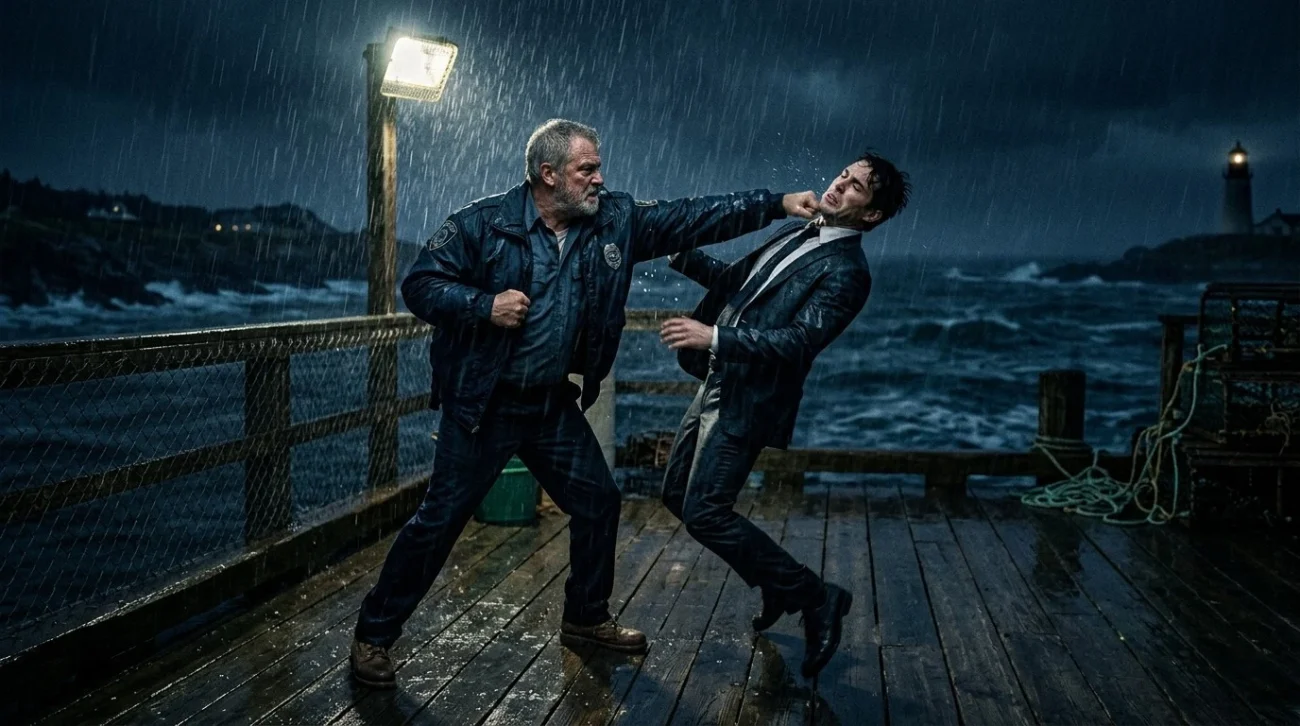
The rain hit the Blackwood Docks like it had a grudge.
Arthur Crane pulled his collar up and kept walking his route — the same quarter-mile loop he’d walked every night for thirty years. Past Vault 3. Past the rusted crane nobody had touched since ’09. Past the chain-link fence where the salt air had eaten through the steel like acid.
He didn’t need a flashlight. He knew every shadow.
The black sedan pulled in at 11:47 p.m. Arthur saw the headlights sweep across the corrugated walls of the dry dock before he heard the engine. He stopped walking and waited.
The man who stepped out was young — late twenties, maybe. A charcoal suit that didn’t belong anywhere near a shipyard. He moved like someone who had never been told no.
“Arthur Crane?” the man called out.
“Depends on who’s asking.”
“Julian Blackwood.” He held up a leather ledger, thick as a Bible and twice as old-looking. “My father died last Thursday. He said to give this to the man who never asked questions.”
Arthur looked at it but didn’t reach for it. “Gerald’s dead?”
“Heart failure.” Julian’s voice was flat. “So they’re calling it.”
Arthur took the ledger. He walked under the amber cone of the dock’s single functioning streetlamp and opened it.
The first page had a date: March 1987.
The second page had names. Dollar amounts. And next to each dollar amount, a one-line description of what was purchased.
Silence re: Pier 9 runoff. $4,200.
Medical examiner. Crane accident ruling. $11,500.
He turned the pages slowly. There were dozens. Maybe hundreds.
Then he found it.
Robert Crane. Toxic discharge, Tank 7. Witnessed full event. Relocated. $22,000. Agreed to non-disclosure. Permanent.
Arthur stared at the word. Permanent.
His father had been thirty-nine years old when he “moved to Portland.” Never called. Never wrote. Arthur’s mother said he’d just left — found a younger woman, started over. Arthur had believed that for forty-one years.
“Permanent,” Arthur said out loud.
Julian had lit a cigarette. He exhaled through his nose. “My father was not a good man. I won’t pretend otherwise.”
“What do you want from me?”
“Simple.” Julian reached into his jacket and set a white envelope on the hood of the car. “One million dollars, wired to any account you choose. You burn that ledger tonight. The lawyers are already positioned — the moment that book surfaces publicly, every active contract in Blackwood County gets frozen pending litigation. Four hundred and twelve jobs. Gone by spring.”
Arthur looked up from the page.
“Or,” Julian continued, “you do whatever you think is right, and I watch this town die. I don’t live here. I don’t care either way.”
“You came all the way from Boston to offer me a bribe.”
“My father said you were the only honest man he ever hired. He thought that made you manageable.” Julian took a long drag. “I’m starting to think he was wrong.”
Arthur closed the ledger. He held it in both hands and looked out past the security light, out past the skeleton hulls of ships that hadn’t moved in fifteen years, out toward the water. The lighthouse at the point threw its pale beam across the harbor in long, slow sweeps.
“He didn’t move to Portland,” Arthur said.
“No.”
“Where?”
Julian didn’t answer immediately. He looked at his cigarette. “My father kept records of everything, Mr. Crane. Everything.”
Arthur’s jaw tightened. “Is he alive?”
“The entry says permanent.”
The word landed like a fist.
Arthur stood completely still for ten seconds. The lighthouse swept. The rain tapped against the corrugated iron.
“The town,” Arthur finally said. “You’re saying four hundred jobs die if this comes out.”
“At minimum.”
“And if I burn it?”
“You get a million dollars and nothing changes. People keep their jobs. My father’s estate closes quietly. Everyone moves on.”
“Except my father doesn’t get justice.”
Julian dropped the cigarette and crushed it under his heel. “Your father is a line item in a ledger, Mr. Crane. There is no justice available. There is only money, and there is ruin. Pick one.”
Arthur looked at the envelope on the hood of the car.
He walked toward it.
Julian straightened up, the faintest trace of relief crossing his face.
Arthur picked up the envelope. Opened it. Looked at the account routing numbers inside. Then he folded it in half and slid it into his jacket pocket.
Julian nodded slowly. “Smart man.”
“Walk with me,” Arthur said.
“Excuse me?”
“Just walk with me a minute.”
Julian frowned but fell into step beside him. Arthur led him down the dock toward Pier 4, where the planks were wet and the ocean churned six feet below in the dark.
“The docks were everything to this town,” Arthur said. “You know that?”
“I know.”
“My father worked here before I did. His father before him.” Arthur kept walking. “When the Blackwood family started having money trouble in the nineties, the union took wage cuts. Voluntarily. You know why?”
“Mr. Crane—”
“Because they believed Gerald Blackwood when he said they were all in it together.” Arthur stopped at the end of the pier. The water below was black and cold and moving fast. “They believed him.”
Julian was quiet.
“The ledger shows he was stealing from the pension fund the same year they took those cuts.”
“I know what the ledger shows.”
Arthur turned and looked at him directly for the first time. “Then you know the million dollars isn’t for me. It’s to make sure the men your father robbed never find out they were robbed.”
“It’s to protect jobs—”
“It’s to protect your inheritance.” Arthur’s voice didn’t rise. It didn’t need to. “The estate can’t close cleanly if this comes out. The lawsuits don’t just freeze contracts — they freeze the Blackwood assets. Your assets.”
Julian’s expression shifted. Just slightly. A tightening around the eyes.
“There it is,” Arthur said.
“The offer still stands.”
“I know.”
Arthur opened the ledger one more time. He read his father’s entry again. Permanent. He looked at the account numbers in the envelope. He stood there for a long moment in the rain, the lighthouse throwing white light across his face every few seconds.
Then he walked to the edge of the pier and dropped the ledger into the Atlantic.
It hit the water and was swallowed immediately, the current pulling it under and south.
Julian exhaled sharply. “Good. Then we have a deal—”
Arthur turned around and hit him.
One punch. Clean. The kind that comes from a man who spent his twenties loading cargo by hand.
Julian went down hard on the wet planks, one hand splashing into a puddle, the other grabbing at nothing.
He looked up at Arthur with blood on his lip and genuine shock on his face. “What the hell—”
“The ledger’s gone,” Arthur said. “The town’s safe. The money—” He reached into his jacket and tossed the envelope down onto Julian’s chest. “Goes to the pension fund. Anonymously. You’ll arrange that, or I’ll spend the rest of my life making sure every journalist in New England knows Gerald Blackwood’s boy came to a Maine shipyard on a Tuesday night to pay a night watchman to cover a murder.”
Julian stared up at him. “You have no proof. The ledger is gone.”
“I have thirty years on this dock. I know every man who worked here, and I know who’s still owed.” Arthur looked down at him. “You want to test whether my word or your money carries more weight in this county?”
Julian said nothing.
“The pension fund,” Arthur repeated. “All of it. One month.”
He turned and walked back up the dock, his boots steady on the wet planks.
Behind him, he heard Julian slowly get to his feet.
He heard the car door open.
He heard the engine start.
He didn’t look back.
Arthur filed no reports that night. He said nothing to the morning shift. He walked his route until 6 a.m., when the sky above the Atlantic went from black to dark grey to the color of cold iron.
Three weeks later, an anonymous wire transfer landed in the Blackwood County Dockworkers Pension Account. The amount — $1,000,000 — was logged by the fund administrator as a charitable contribution from an unnamed estate.
The union rep called it a miracle.
Arthur said nothing. He poured his coffee, checked the gate log, and started his route.
Some debts aren’t paid with money. Some are paid in silence, and some in salt water. And some — the ones that have been owed the longest — are paid the only way the sea will accept: completely, and without ceremony.
The lighthouse kept turning. The docks kept rusting. And Arthur Crane kept walking.
Every night. Until the day he didn’t.
Original fictional stories. AI-assisted creative content.
