
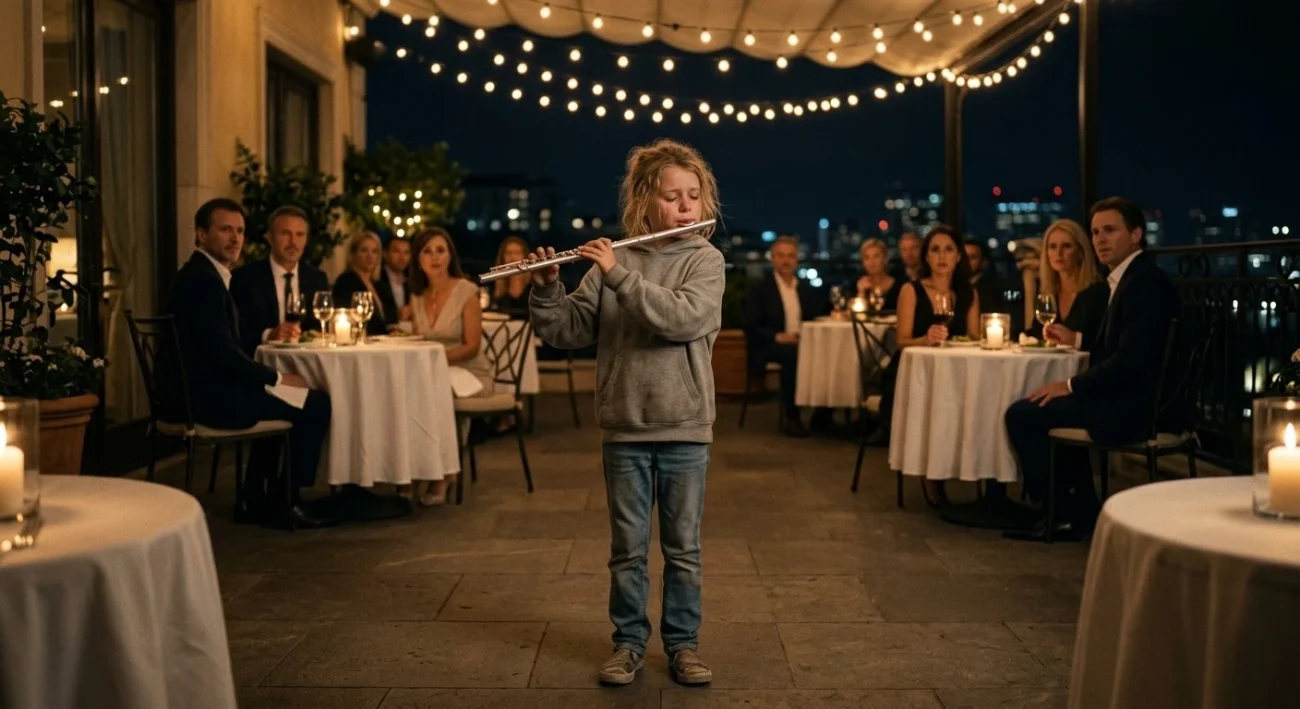
The terrace of Elara, one of downtown’s most exclusive restaurants, glittered on a warm Friday evening. Candles. Crystal. The quiet murmur of money.
Nobody noticed the girl until she screamed.
“PLEASE—I JUST NEED MONEY FOR FOOD—PLEASE!!”
The cry ripped through the ambient jazz like a blade. Heads turned. Forks froze mid-air. A child—eight, maybe nine—stood at the edge of the patio near the marble planter wall. Her clothes were dirty. Her sneakers had a split sole taped shut with electrical tape. Her hair was half-tied, like someone had started fixing it and then stopped forever.
She clutched a small silver flute against her chest like a shield.
A man at the nearest table—Victor Crane, hedge fund, six-figure watch, the kind of tan that costs money—leaned back in his chair and looked her over the way he’d assess a parking inconvenience.
“If you want money,” he said, loud enough for his table to hear, “impress us.”
A few people laughed. Politely. The performative kind.
Phones lifted. Recording.
The girl’s lower lip trembled. She looked down at the ground. For a second—genuinely—it seemed like she might bolt. Run back to wherever she’d come from and never look back.
Then she raised the flute.
She played.
The first note was soft. Almost apologetic. A thin, fragile sound that seemed like it might break. Victor’s tablemate—a woman in a yellow blazer—actually smirked.
But the second phrase came, and something shifted.
The melody moved the way grief moves—slowly, then all at once. It wasn’t polished. There were unsteady breaths between phrases. A slight tremor in the sustained notes. But it was real in a way that nothing else on that terrace was real.
The yellow blazer woman’s smirk dissolved.
Forks went down.
Conversations died.
A waiter carrying a dessert tray stopped walking and just stood there.
The girl played. Tears cut clean lines through the grime on her cheeks, but her eyes stayed open. She played like she was talking to someone who wasn’t there. Like the song was the last thread of a conversation she wasn’t ready to end.
At a corner table near the low hedge partition, a woman named Margaret Solis sat with her business partner, two glasses of untouched Chablis between them. Margaret was sixty-three. Elegant in the specific way of someone who had earned it slowly. Silver hair. Posture like architecture.
She had stopped talking mid-sentence.
Her eyes locked on the girl.
Her face changed.
Not dramatically. Not the way faces change in movies, with gasping and trembling chins. Just—quietly. Like a door somewhere deep inside her had swung open into a room she’d boarded shut.
“…that melody,” she said.
Her business partner frowned. “Margaret?”
She didn’t answer. She was already standing. Moving toward the girl with the careful, deliberate steps of someone trying not to startle a bird.
The girl finished the last phrase. Lowered the flute slowly. Looked up. She was exhausted in a bone-deep way that had nothing to do with tonight.
Margaret stopped two feet away.
“Where did you learn that?” Her voice was barely above a breath.
The girl blinked. Used to being yelled at. Not used to this. “My mom taught me. Before she got sick.”
Margaret’s throat moved. “What’s her name?”
“Anna.” The girl’s voice was flat now. Careful. “Anna Reyes.”
The name hit Margaret like a physical thing.
Her wineglass slipped. Shattered on the marble. She didn’t flinch. Didn’t look down.
“That’s impossible,” she whispered.
Victor, who’d been watching this unexpected theater with the air of mild amusement, leaned forward. “Someone you know?”
Margaret didn’t hear him.
“Anna Reyes,” she repeated. Slower. Testing whether the name still meant what she thought it meant. “From Providence? She had a sister—Elena—”
“Elena was my aunt,” the girl said. “She died two years ago.”
Margaret pressed one hand flat against her sternum.
“I went to school with your mother,” she said. “Twenty-five years ago. She disappeared. We thought—” Her voice cracked clean in half. “We thought something terrible had happened to her.”
The girl stared. “She’s in the hospital. She’s been there three months. They say she needs a surgery but we don’t—we can’t—” She stopped. Pressed her lips together. She was trying extremely hard not to cry again. “That’s why I’m here. I didn’t know where else to go.”
Margaret turned to her partner. “Call Daniel. Now.” Her tone had transformed entirely. This was not a woman at dinner. This was a woman executing a decision she’d already fully made. “Tell him I need the St. Laurent Foundation authorization before midnight.”
Her partner stood immediately. Phone out. Moving.
Victor cleared his throat from his table. “Well. That’s—”
“You.” Margaret looked at him directly. Steady. Quiet. Devastating. “You told a hungry child to perform for your entertainment. I’ll let you sit with that.”
The people around them had stopped pretending not to listen. A few had already put their phones away.
Margaret crouched down to the girl’s eye level. “What’s your name?”
“Lily.”
“Lily. I’m Margaret. I knew your mother when she was not much older than you.” She paused. “I’ve been looking for her for a long time. A very long time.” Her voice broke on the last word, and she let it. “I’m going to help you. Is that okay?”
Lily looked at her for a long moment. The evaluation of a child who’d been disappointed many times.
Then she nodded.
Margaret’s foundation—the St. Laurent Medical Relief Fund, endowed with thirty-eight million dollars specifically for emergency surgical intervention cases—had a same-day authorization protocol that almost never got used.
It got used that night.
At 11:47 PM, Lily sat in a hospital waiting room with a sandwich from the vending machine that Margaret had bought her, watching the door to the surgical prep unit. Margaret sat beside her. Neither of them spoke much.
At 12:10 AM, a nurse came through the door.
“Family of Anna Reyes?”
Lily shot to her feet.
“Surgery’s been approved and scheduled for tomorrow morning,” the nurse said. “We’ve received the funding authorization and the surgical team has been assembled. She’s stable.”
Lily stood completely still.
Then she sat back down and put her face in her hands.
Margaret put a hand on her back and said nothing. Some moments don’t need words.
The next morning, Victor Crane posted a carefully worded caption about the “moving experience” at Elara, and how it had “reminded him of what truly matters.” He did not mention that he had told the child to perform.
Three hundred people in the comments reminded him.
He deleted the post by noon.
Anna Reyes came out of surgery at 2:17 PM. Successful.
The first thing she said, when Lily rushed into the recovery room and grabbed her hand, was: “You still have your flute.”
“I played it,” Lily said. “Like you taught me.”
Anna closed her eyes.
“I heard it,” she said softly. “I swear I heard it.”
Margaret stood in the doorway and didn’t say anything. She didn’t need to. Twenty-five years is a long time to search for someone. But when you find them—really find them—it doesn’t feel like closure.
It feels like something finally beginning.
END
Original fictional stories. AI-assisted creative content.
