
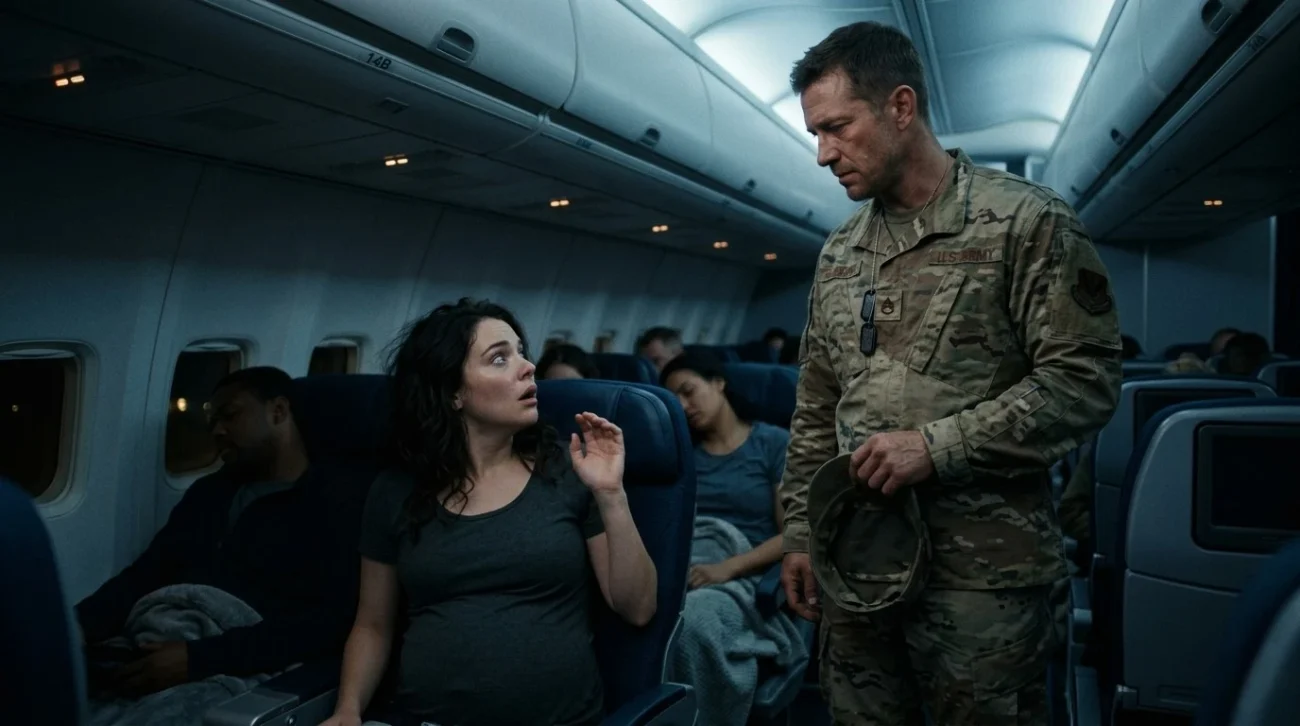
Elena had been awake for twenty-two hours when she buckled herself into seat 14C.
Her back throbbed. Her ankles were swollen tight against her compression socks. The doctor had cleared her to fly — barely — and only because her mother was already in the ICU in Boston and there was no more waiting. She pressed both palms against her belly, feeling the slow, reassuring roll of the baby shifting inside her. Seven months. Seven months alone, and twenty-two more hours until she was finally not.
“You doing okay?” the woman in 14B asked.
Elena managed a smile. “First time flying this far alone.”
“You want the aisle? I don’t mind.”
“I’m fine. Thank you.”
She wasn’t fine. But she’d been saying that for fourteen months.
The plane lifted off from Heathrow at 11:47 PM. Elena adjusted her travel pillow, tucked her feet under the seat, and tried to let the engine hum pull her under. Sleep had been elusive since the pregnancy hit the high-risk category. Since the ultrasound tech got quiet at week twenty-two. Since the NICU consultation she’d sat through alone with a clipboard and a box of tissues the nurse had slid across the table without a word.
She was almost asleep when the seat behind her lurched.
She opened her eyes.
The seat lurched again. A dull, heavy thud from behind, like someone shifting and catching the headrest with a knee.
She adjusted her pillow. Closed her eyes.
Thud.
She exhaled slowly.
Thud.
She pressed the call button.
The flight attendant — young, brunette, practiced smile — appeared within sixty seconds. Her name tag read CARRIE.
“Can I help you?”
“The person behind me,” Elena said quietly. “They keep kicking my seat. I wouldn’t normally say anything, but I’m—” She gestured to her stomach. “It’s uncomfortable. I’ve been awake since yesterday.”
Carrie nodded, composed and neutral. “Of course. I’ll speak with them.”
Elena watched her lean over the seat behind her and say something in a low voice. There was a pause. Then nothing.
Carrie straightened. “He apologizes. He says he’ll be more careful.”
“Thank you.”
Silence for eleven minutes.
Then: thud.
Elena’s jaw tightened. She pulled out her phone and checked the time. Four hours and forty minutes to landing. She tried to read. She tried the breathing exercises from the prenatal app on her phone. She counted ceiling panels. She watched the map on the seat-back screen crawl across the dark Atlantic.
Thud.
The baby kicked back — hard, toward her spine — as if reacting to the percussion of it, and Elena made a sound that wasn’t quite a gasp and wasn’t quite a cry, and the woman in 14B turned and looked at her with real concern.
“You okay?”
“He keeps—” Elena stopped. “I’m going to say something.”
“Want me to—”
“No. I’ve got it.”
She turned in her seat as far as her belly allowed. The overhead reading light in row fifteen was off. The man was in shadow — a large shape in desert camouflage, a cap pulled low. Military. She could see the worn bulk of combat boots on his feet. He was looking out the window, his face turned completely away from her.
“Excuse me,” she said.
Nothing.
“Excuse me.” Louder.
He didn’t turn.
“I don’t know if you can hear me, but you have been kicking my seat for the last hour. I’m seven months pregnant. I’m exhausted. I am flying home alone because my mother is in the hospital and I would really, really appreciate it if you could just — stop.”
The boots shifted.
“Please,” she added, and her voice cracked on the word, and she hated it.
The man said nothing. Didn’t move. Didn’t look at her.
Elena turned back around. She pressed her fingers against her eyes and breathed through her nose and told herself she would not cry in front of a cabin full of strangers.
She was still telling herself that when the boot hit her seat again.
Something broke loose.
She pressed the call button twice. When Carrie arrived, Elena’s voice was steady in the way that voices get when someone is past trembling and into something colder.
“I need you to move me, or move him, or do something. I asked him to stop and he ignored me. I have a high-risk pregnancy, I have a note from my OB, and I cannot sit in front of this person for the next four hours.”
“Ma’am, I understand—”
“He won’t even look at me.” She pointed. “He just — sat there. Like I wasn’t talking.”
Carrie glanced over Elena’s shoulder, and something flickered across her face — not alarm, exactly, but a shift. A small recalibration.
“Let me speak with him again,” Carrie said carefully.
“Carrie.” Elena’s voice dropped. “Please. I’m not — I’m not a difficult person. I don’t complain. But I am seven months pregnant, I haven’t slept in a day and a half, I am flying home to see my mother before she — I just need someone to help me.”
The woman in 14B had stopped pretending to read.
Carrie nodded. “Give me one moment.”
She heard Carrie lean over the seat behind her again. A low exchange. A pause. Then Carrie said, quietly: “Sir. If you could please stand up.”
Elena frowned and turned.
The man in 15C reached up and turned on his reading light.
He was in his mid-thirties. His face was angular, weathered — not weathered the way city-tired people got, but weathered the way soldiers got, the kind of erosion that happened in the sun and the dust and the particular silence of places where silence meant something was wrong. There were lines around his eyes that hadn’t been there fourteen months ago. His jaw was thicker with stubble than she’d ever seen it. His knuckles, resting on the armrest, had a scar across the first two knuckles that she didn’t recognize.
She recognized everything else.
“Thomas.”
The word came out as barely a sound.
He pulled off his cap. He looked at her — directly, steadily, with an expression she had never seen on him before, something compounded out of guilt and longing and the particular grief of someone who has been outside a life for a very long time and has just been let back in.
“Hey, El.”
She couldn’t speak.
“I know,” he said. “I’m sorry. I know.”
“You’re — you’re supposed to be—”
“I got back six days ago. I was going to — I had this whole plan—” He stopped. Pressed his mouth together. “Your flight was rerouted. The original was canceled. I was already at Logan and I — I got on the next flight to Heathrow so I could fly back with you.”
“You flew to London.”
“I flew to London,” he confirmed.
“And then you sat behind me and kicked my seat for an hour.”
He exhaled. “I know how that sounds.”
“Thomas.”
“I couldn’t figure out how to — I didn’t want to just tap you on the shoulder. I didn’t know if—” He stopped again. The composed soldier face cracked, just slightly. “I didn’t know if you’d be angry. You had every right to be angry. I was gone for fourteen months and I missed — I missed everything and I just — I kept thinking if I was close to you, close to—” His eyes dropped to her stomach, briefly, then back to her face. “I panicked. I’m sorry. It was the stupidest thing I’ve ever done and I’ve done some genuinely stupid things in war zones.”
The woman in 14B made a very small sound and looked out her window.
Elena stared at him. Her chest felt enormous, stretched too tight, like the feeling that comes right before you either laugh or come apart completely.
“You kicked my seat,” she said again, “because you didn’t know how to say hello.”
“When you put it like that—”
“Thomas.”
“Yes.”
“I’ve been doing this alone for fourteen months.”
“I know.”
“Every appointment. Every ultrasound. Every time they said ‘high risk’ and looked at me like I was supposed to absorb that by myself—”
“Elena—”
“I named her,” she said. “While you were gone, I named her. I didn’t tell you in the emails because I wanted to tell you in person but I didn’t think—I thought we were going to do that together and you were—” Her voice broke. “You were gone.”
He was standing now, halfway into the aisle, his frame too large for the space, the overhead light catching the lines in his face.
“What’s her name?” he asked quietly.
She looked at him for a long moment.
“Clara,” she said. “After your grandmother.”
Something moved across his face that she had no name for. He stepped the rest of the way into the aisle and she tried to turn, to stand, and he said “don’t—” and reached over the headrest and put both arms around her from behind, his chin dropping to the top of her head, and she grabbed his forearms and pressed them against herself and felt him exhale — a full, shuddering, fourteen-months-long exhale — against her hair.
The cabin was very quiet.
Someone two rows up was definitely crying. Neither of them mentioned it.
“You could have just called me,” she said into his arm. “When the flight got rerouted.”
“I wanted to be there. Not on a phone.”
“So your brilliant solution was to hide behind me and kick the seat.”
“I told you, I panicked.”
“You flew across the Atlantic.”
“That part wasn’t the panic. That part was — that was the plan.”
She laughed. It came out as something between a laugh and a sob and she pressed her hand over her mouth. “Thomas.”
“Yeah.”
“Don’t you ever—” She stopped. Started again. “Don’t you ever do something like this again without telling me first.”
“Agreed. Completely agreed.”
“The kicking. Not the flying. The flying I—” She exhaled. “The flying was — okay, fine. The flying was—”
“I know,” he said. “I know.”
Carrie appeared at the end of the aisle, clipboard in hand, and assessed the situation with the particular professional calm of someone who has seen everything in thirty thousand feet of airspace.
“Is everything alright?” she asked.
“Yes,” Thomas said. “We’re — yes. I’m sorry for the disturbance. My wife. I’ve been deployed. I wanted to surprise her.”
Carrie looked at Elena, who was still gripping Thomas’s forearms like he might disappear again.
“Can we move him to 14A?” Elena asked. “The aisle seat. I need him where I can see him.”
“The passenger in 14A is asleep.”
“14A two rows up?”
“Let me check.” A pause. “Yes. That one’s open.”
“Thank you, Carrie.”
Carrie nodded, professional mask back in place. But as she turned to leave, Elena caught the corner of a smile she wasn’t quite fast enough to hide.
Thomas folded himself into 14A, the aisle seat two rows ahead, and immediately turned sideways so he was facing her.
“You look exhausted,” he said.
“I look exhausted?”
“You look beautiful. You look exhausted and beautiful.”
“You look like you haven’t slept in a week.”
“Six days.” A beat. “I was trying to get home faster. It got complicated.”
“It always gets complicated.”
“Elena.” He reached across the aisle and put his hand out, palm up.
She looked at it for a moment. Then she put her hand in his.
“I missed four ultrasounds,” he said. “I know. I know I can’t — I’m not going to try to explain that away. I just—”
“I saved them,” she said. “The printouts. I kept every single one.”
He was quiet.
“All four. They’re in the folder in my carry-on.”
He squeezed her hand. His voice, when he spoke, was rough. “Can I see them?”
“When we land.”
“Yeah.”
“Thomas.”
“Yeah.”
“She moves all the time. All the time, you can feel her from the outside. She’s—” She stopped. “She’s going to be a lot. I can already tell. She’s going to be exactly like you.”
He looked at her. “Good,” he said. “Good.”
Somewhere over the middle of the Atlantic, the indigo cabin darkened further and the passengers around them slowly dropped back into sleep. The woman in 14B had surrendered to her headphones and was smiling faintly at her screen. The man in the window seat across the aisle was snoring softly.
Elena rested her head against her travel pillow. Thomas kept his hand extended across the aisle, and she kept hers in it, and the engine hum was constant and low and the dark outside the oval windows was absolute.
“I have a list,” she said quietly.
“Of what?”
“Things I need you to do when we get home. The list is very long.”
“How long?”
“Fourteen months long.”
He nodded seriously. “I’ll clear my schedule.”
“The nursery isn’t finished.”
“I’ll finish it.”
“The rocking chair came in three pieces and I couldn’t figure out the instructions.”
“I’ll put it together.”
“The car seat base. I watched four videos and I still don’t trust it.”
“I’ll do it again. Correctly.”
She closed her eyes. His thumb moved slowly across the back of her hand, and she felt the calluses on it, new ones she didn’t recognize, evidence of the fourteen months she hadn’t been there for.
“There’s also the matter,” she said, “of the fact that you made me spill water all over myself at thirty-seven thousand feet.”
He winced. “The kick was an accident. That specific one.”
“It was cold.”
“I’ll buy you a new dress.”
“You’ll buy me two dresses.”
“Two dresses. Noted.”
She was asleep before the hour was out.
Thomas didn’t sleep. He sat sideways in 14A, her hand still resting in his, and watched her breathe in the bruised blue light of the cabin. He watched her hand rise slightly when the baby moved — once, twice — and both times his own hand tightened reflexively, as if he could feel it through her.
He thought about fourteen months of satellite calls with three-second delays. He thought about the email where she wrote, casually, between logistics and medication updates: the doctor says if I were a different kind of person I’d be on bed rest, but apparently I’m stubborn. He thought about how he’d read that sentence six times and then stared at the wall of his quarters for a long time.
He thought about landing at Logan six days ago and checking his phone and seeing that her flight had been canceled, and the strange, lunatic clarity of that moment — the only decision that made sense — standing at the ticket counter and saying next flight to Heathrow, please.
He thought about sitting down in 15C and realizing he didn’t know how to do this. Fourteen months in a conflict zone and he didn’t know how to tap his own wife on the shoulder. So he’d sat there, and then the boot had caught the seat by accident, and he’d felt her shift, and something had seized up in his chest — she was close, she was right there, and he had done the most idiotic thing imaginable and simply done it again, and again, trying to close some distance he couldn’t name.
Not his finest strategic decision.
He looked at her sleeping face and thought: I will not miss another one.
The engine hummed. The dark outside held. Logan in three hours.
He held her hand and did not sleep and would not have traded it for anything.
They landed at 6:14 AM, Boston time. Silver morning light, the harbor a flat grey-green through the terminal windows, the city waking up slowly under a low-slung overcast sky.
Elena called her sister from the gate. “Mom’s stable,” Dana said. “She had a good night. The doctors moved her out of the ICU at four.”
Elena exhaled against the phone. Her free hand pressed against her sternum.
“She’s asking for you,” Dana said. “Are you close?”
“I’m at Logan. I’ll be there in forty minutes.”
A pause. “Are you okay? You sound—”
“I’m good,” Elena said. “I’m better than good. I’ll explain when I get there.”
She hung up and turned. Thomas was standing three feet away with both their carry-on bags, watching her.
“She’s out of the ICU,” Elena said.
“Good.” He held out her bag. “Ready?”
She took it, and then she took his hand, and they walked out through the gate together into the pale Boston morning.
At the hospital, her mother was awake, propped against pillows, color returning to her face. When Elena came through the door she held out both hands, and Elena sat on the edge of the bed and let herself be held like a child for a moment, the baby pressing between them.
Then her mother looked up.
Thomas stood in the doorway, bag at his feet, cap in his hands.
“Tom,” her mother said.
“Hi, Ruth.”
A pause. Ruth looked at her daughter. Then back at him.
“You took long enough,” Ruth said.
“Yes, ma’am,” Thomas said. “I know.”
He pulled a chair to the side of the bed, and Elena leaned into him, and her mother held her hand, and outside the hospital window the Boston morning was going gold.
Three weeks later, Clara Ruth arrived at 6:08 AM — seven pounds, two ounces, absolutely furious about everything, exactly as predicted.
Thomas was there. He had been there for every appointment since the plane, for the car seat installation (twice), for the rocking chair assembly (the instructions were, objectively, terrible), for the three false alarms and the one real alarm, for the four hours of labor and the moment the doctor said one more push and everything went very loud and then very quiet and then loud again in an entirely different way.
He was the one who carried her to Elena afterward — small, red, inconveniently perfect — and set her down with the careful terror of someone handling something irreplaceable.
“Hi, Clara,” he said.
Clara blinked at him.
“I know,” he said. “I’m late. I’m sorry. I’m not going to be late again.”
Clara appeared to consider this.
Then she grabbed his finger, and that was that.
In the weeks that followed, Elena sometimes caught him standing in the doorway of the nursery — the finished one, with the chair assembled correctly and the mobile he’d installed slightly off-center and refused to adjust because Clara seemed to like it — just watching her sleep. Not doing anything. Just watching.
She knew that look. She’d seen it at thirty-seven thousand feet, through the gap between the headrests, while she was pretending to sleep over the Atlantic.
“You know she can’t go anywhere,” Elena said from behind him one night. “She’s in a crib.”
“I know.”
“You don’t have to watch her every second.”
“I know that too.”
She leaned in the doorway beside him. “She’s not going to disappear.”
He was quiet for a moment. “I know,” he said again, softer. “I just—” He stopped.
“I know,” Elena said.
She took his hand.
They stood in the doorway together until Clara made a small, sleepy sound and shifted, and the mobile turned slowly, and the nightlight made everything warm and gold.
“We need a baby monitor,” Thomas said.
“We have a baby monitor.”
“A better one. One with—”
“Thomas.”
“Yeah.”
“Come to bed.”
“Yeah,” he said. “Okay.”
He took one more look at Clara. Then he followed Elena down the hall, and turned off the light, and closed the door gently behind him.
Original fictional stories. AI-assisted creative content.
