
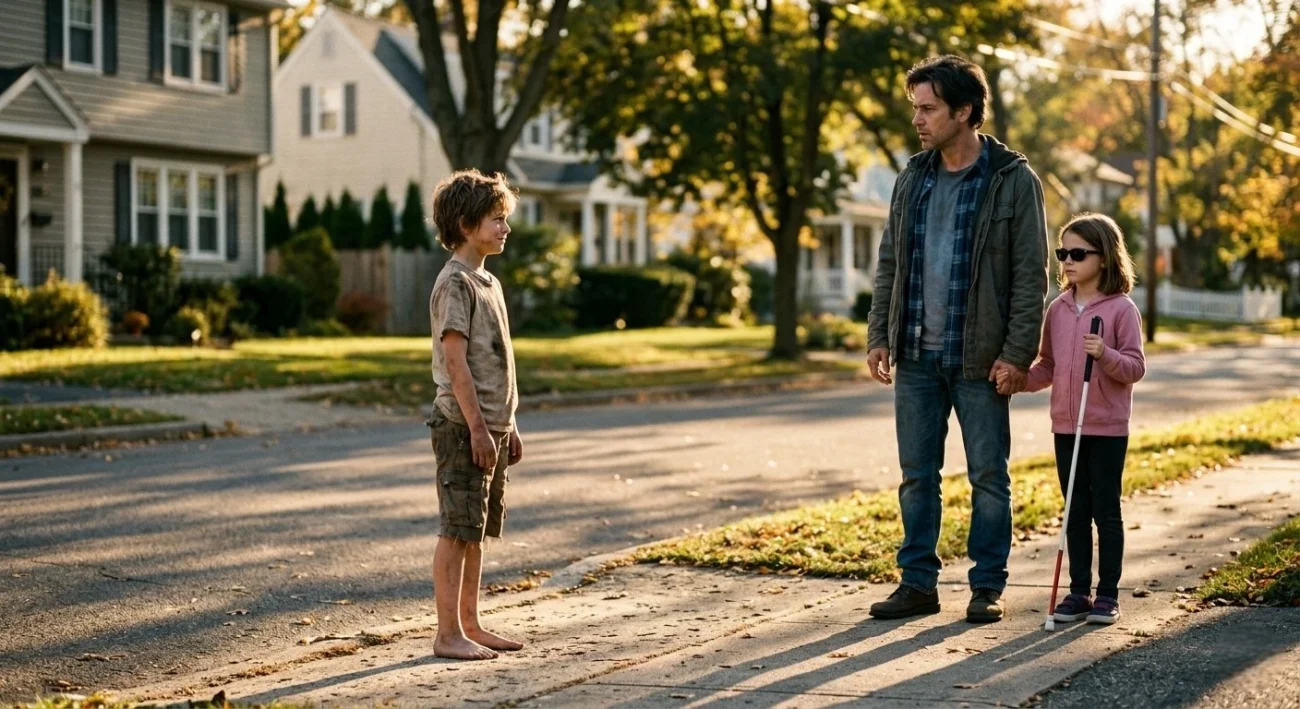
The afternoon Daniel Carter’s life cracked open, he was just trying to take his daughter for a walk.
Emily held his hand, tapping her white cane in that careful, practiced rhythm she’d developed over the past eight months. She wore dark glasses even in the shade. The doctors said the light bothered her — residual sensitivity from the condition that had taken her sight so suddenly, so inexplicably, at age nine.
“You tired, sweetheart?”
“No, Daddy.” She tilted her face up toward the sun. “I can feel it. It’s warm today.”
Daniel managed a smile. He always managed a smile for her.
That’s when the boy appeared.
He was standing maybe ten feet ahead on the sidewalk — ten years old at most, his clothes torn and dirty, hair unwashed. He looked like someone’s forgotten kid. But the way he was looking at Emily wasn’t the way a kid looks at a blind girl. There was no pity in it. No awkwardness.
There was certainty.
“Your daughter is not blind,” the boy said.
Daniel stopped walking.
“Daddy?” Emily pressed closer to him. “Who’s that?”
“Stay close.” He stepped forward, keeping his voice level. “What did you just say?”
“I said she isn’t blind.” The boy didn’t move, didn’t flinch. “Someone is doing this to her. And it’s your wife.”
Daniel felt something cold move through him — not anger yet, just shock. The clean, white shock of a sentence that doesn’t compute.
“That is enough.” His voice came out harder than he meant. “You don’t know what you’re talking about. She has a medical condition. We have reports, tests, specialists—”
“Ask yourself,” the boy interrupted quietly, “why she never bumps into things she shouldn’t.”
The words landed differently than Daniel expected. Because — now that it was said out loud — he had a sudden, vivid memory of Emily catching a glass that was falling off the counter last week. Not fumbling for it. Catching it. Clean.
He’d thought nothing of it.
“Who are you?” Daniel demanded. “Who sent you? Who—”
But the boy was already walking away.
“Watch her,” he said over his shoulder, “when she thinks no one is looking.”
And then he turned a corner, and he was gone.
That night, Daniel couldn’t sleep.
He lay in the dark beside Laura, who breathed slow and even in the way she always did — effortlessly, peacefully, like a woman with nothing on her conscience. He watched the ceiling. The boy’s voice kept replaying, and with it, the memory of that falling glass, and the way Emily had caught it without looking, without reaching, without even pausing in the middle of whatever she’d been saying.
At 2:17 AM, he got up.
Emily’s room door was slightly open, her nightlight glowing soft orange through the gap. He eased it open and looked in.
She was asleep, or appeared to be. Her cane leaned against the wall. Her glasses were folded on the nightstand. He watched for a moment, feeling like an idiot, feeling like a man who’d let a dirty-faced kid on a street corner burrow into his head and nest there.
He turned to leave.
And then he stopped.
Emily reached up in her sleep — not groggy, not fumbling — and adjusted the blanket over her shoulder. Her hand went exactly where it needed to go. No searching. No grazing the air for it. The precise, unconscious movement of someone who can see exactly what they’re doing.
“Emily,” he whispered.
A beat. Then her eyes opened.
For one second — maybe two — she looked directly at him. Not toward his voice. Not in his general direction. At him. At his face. The way a person who can see looks at a person they can see.
Then her expression shifted.
“Daddy?” Her voice was soft, blurred with sleep. “Is that you?”
“Yes, sweetheart.” He kept his voice steady through the effort of keeping it steady. “Bad dream?”
“Mm.” She smiled faintly and closed her eyes. “I’m okay.”
He stood there for a long time after her breathing evened out again.
Not moving.
Not trusting himself to move.
Breakfast the next morning was an exercise in watching his wife watch his daughter and telling himself he was imagining the rhythm of it — the way Laura anticipated Emily’s needs a half-second before Emily expressed them, the way she never seemed surprised by anything Emily reached for.
“Can you pass me the juice?” Emily asked.
Daniel had placed the glass slightly to her left. He didn’t reach for it. He waited. Laura was busy at the stove — her back turned.
Emily’s hand hovered for exactly one second. Then it moved left and closed around the glass without knocking it.
Smooth. Natural. Unerring.
Laura came to the table and set down a plate. She looked at Emily with the easy warmth of a devoted mother. She didn’t look at the glass.
That evening, after dinner, while Laura was outside on the phone, Daniel went to Emily’s room. He knelt down in front of her, the way you do when you’re about to say something that requires looking someone in the eye.
“Hey. I need you to tell me something honestly, and I need you to know that whatever you say, I’m not angry. Okay?”
She nodded.
“Can you see, Emily?”
Silence.
For five seconds, maybe ten, she didn’t move. Then — slowly, like she was lifting something heavy — she reached up and removed her glasses.
Her eyes met his.
Clear. Focused. Seeing him entirely.
“Daddy.” Her voice broke on the word.
“It’s okay.” He reached for her hands. “You’re not in trouble. I promise. But I need to understand.”
“I didn’t want to lie.” Tears ran down her face. “I kept trying to tell you but Mommy said — she said I couldn’t. She said if I told anyone something bad would happen.”
“What did she tell you exactly?” His voice was very quiet now. “Her exact words, if you can remember.”
“She said she needed me to be sick for a while. She said it was to keep us safe.” Emily looked up at him. “She said Daddy had done something wrong and if people knew I could see, you’d get taken away. She said she was protecting me.” A small, wretched pause. “But it didn’t feel like protecting.”
Daniel sat back on his heels. The room felt very still. Very small.
He thought about the past eight months. The specialists. The insurance claims. The family who’d rallied around them — Laura’s family, mostly. The fundraiser Laura’s sister had organized. The disability paperwork. The way Laura had quit her job to “care for Emily full-time,” which had required Daniel to take on an extra contract, which had meant working late, which had meant being home less.
He thought about the life insurance policy Laura had encouraged him to update six months ago.
“Daddy?”
“I’m here.” He stood up. “I need you to do something for me. I need you to keep your glasses on tonight, and I need you to stay in your room. Can you do that?”
“Are you going to talk to Mommy?”
“Not yet.” He smoothed her hair back from her face. “Are you scared?”
Emily looked at him — actually looked at him, with those clear, bright eyes she’d been hiding for eight months.
“A little,” she said honestly. “But I’m glad you know.”
Daniel went directly to his office and called a private investigator he’d used once years ago for a business matter. He gave her the bare facts — a wife, a child faking disability, insurance claims, life insurance, eight months of it — and listened to a long silence on the other end.
“That’s not a small thing,” the investigator said carefully.
“No,” Daniel agreed. “It isn’t.”
The investigator, a woman named Greer, asked him to send whatever financial documents he could access and promised results within seventy-two hours.
She came back in forty-eight.
The disability claims totaled nearly eighty thousand dollars across two insurance providers. There were payments to a neurologist — a real one, with a real practice — who had, it turned out, no memory of ever treating a patient named Emily Carter. The signature on the reports matched his, but the reports had never passed through his office. When Greer confronted him, he was horrified. Someone had forged them using a template stolen from his old practice website.
There was also the life insurance policy on Daniel — one point two million, taken out nine months ago, one month before Emily’s “diagnosis.”
And there were the wire transfers. Small ones, consistent, going to an account in a name Daniel didn’t recognize. He recognized the address, though, when Greer pulled it: forty minutes south of the city. He’d driven past it once when they’d been considering buying a place in that area.
He recognized the car in the driveway in the photo Greer sent him. It was a car he’d never seen before. But the man leaning against it, keys in hand — that man he recognized.
Laura’s college boyfriend. The one she’d told Daniel she hadn’t spoken to in years.
Daniel felt something that wasn’t quite anger and wasn’t quite grief — something colder than either.
He called his attorney.
Three days later, on a Saturday morning, Laura came downstairs to find the kitchen unusually quiet. Emily was at Daniel’s sister’s house. Daniel was sitting at the table with his coffee, and across from him sat a woman Laura didn’t know and a man she did — their family lawyer, Marcus.
“What’s this?” Laura asked. She said it lightly, the way someone says it when they already feel the ground shifting under them and are hoping lightness will steady it.
“Sit down, Laura.”
She didn’t sit. She looked at Marcus, who looked back at her with an expression that contained no comfort whatsoever.
“Daniel—”
“Emily can see.” He kept his voice completely even. “She’s been able to see this whole time. She told me herself. And she told me who told her to pretend.”
Laura’s face went through several things in quick succession — surprise, calculation, and then something that might have been relief, or might have been the look of someone who’s been carrying something very heavy and has finally put it down, even if putting it down means being caught with it.
“I can explain—”
“The investigator’s report is already with the DA’s office,” Daniel said. “The forged medical documents, the fraudulent insurance claims, the policy on my life. All of it.” A pause. “Sit down, Laura.”
This time, she sat.
The woman Daniel had brought turned out to be a family law attorney. She slid a folder across the table. Laura opened it with hands that didn’t quite hold steady.
Inside were divorce papers, full custody filing, and a document from the DA’s office confirming an ongoing fraud investigation.
“You’ll want your own lawyer,” Daniel said. “Marcus is here as a witness only. I’m not here to negotiate — I’m here to tell you what happens next. The insurance companies have already been notified. The DA will be in contact with you directly.” He stood. “Don’t contact Emily. Not until this is resolved, and maybe not after.”
“Daniel.” Laura’s voice cracked. “She’s my daughter.”
“She’s a nine-year-old who spent eight months pretending to be blind because her mother told her something bad would happen if she didn’t.” He picked up his coffee cup. “You made her carry that. Whatever comes next, you made her carry that.”
He left the room.
Laura was arrested four days later. The charges included insurance fraud, forgery of medical documents, and filing a fraudulent disability claim — a total exposure, her attorney told her, of up to twelve years. She pled down to four with restitution, the insurance companies having both agreed to cooperate in exchange for full repayment. Her boyfriend was charged separately for wire fraud.
Emily went back to school the following Monday. She walked in without her cane, without her glasses, and sat down at a desk near the window where the light came in. Her teacher, who had known her since before, looked at her for a long moment and then, quietly, without making anything of it, moved her to a seat closer to the board.
“Better?” she asked.
“Better,” Emily said.
Daniel never found the boy again. He went back to that street three times, asked at the houses nearby, described him to the neighbors. Nobody knew him. Nobody had seen a child matching that description in the area. The police — when he mentioned it peripherally during the investigation — suggested he’d probably been a runaway, passing through.
Daniel wasn’t sure he believed that. He wasn’t sure he needed to.
On Emily’s first night back in her room, glasses off, nightlight on, she looked around at her walls — the posters, the books, the small things she’d kept in place for eight months by memory and touch — and said nothing for a while.
Then she looked at her father, who was standing in the doorway the way he always had.
“Daddy,” she said. “You look tired.”
He laughed. He hadn’t laughed in weeks, and it surprised him — the way it came out of him, real and sudden and unguarded.
“Yeah,” he said. “I am.”
“Go to sleep.” She pulled her blanket up — easily, precisely, like someone who’s been seeing the whole time. “I’ll still be here in the morning.”
He turned off the light and stood in the dark hallway for a moment, and it occurred to him, quietly, that this was the first night in eight months that felt like it might actually end.
Original fictional stories. AI-assisted creative content.
