
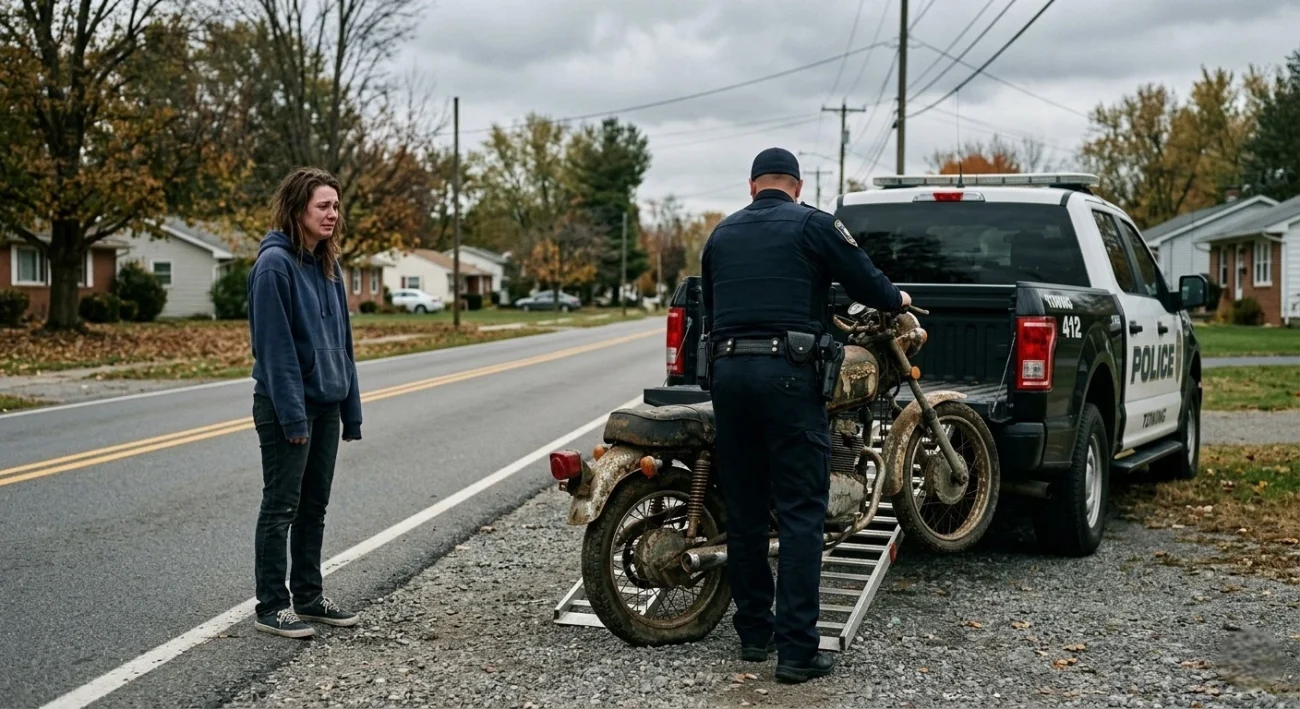
Sarah heard the engine start to die about a block from the intersection of Maple and Route 9, the same block it always chose.
She coasted to the curb, stomach already sinking.
The sputtering deepened — that particular wet, rattling cough that meant the carburetor was flooding again. She pumped the throttle twice, got nothing, and let it go.
“Come on,” she whispered. “Come on, come on—”
The engine quit completely.
She sat there a second, helmet on, hands still on the grips, staring at a Honda Civic parked in front of her with a bumper sticker that read BLESSED. Then the blue and red lights swept across it from behind.
Sarah closed her eyes.
She pulled the helmet off slowly. The patrol car had already stopped, engine running, lights still going. She watched the cruiser’s door in her sideview mirror.
Officer came out tall. Pressed uniform, silver badge catching the afternoon sun. Didn’t wave. Didn’t smile. He walked straight toward the bike like she wasn’t even on it yet, eyes scanning the frame, the tires, the exhaust pipe trailing rust.
Sarah swung off the seat and stood on the pavement.
“License and registration,” she said before he could speak, trying to take some control.
He didn’t respond to that. He was crouched now, looking at the front fork. He stood back up and shook the handlebar. The whole bike wobbled.
“This vehicle registered?” he asked.
“Yes.”
“Current inspection sticker?”
She hesitated. “It expired. I know. I’ve been—”
“Step back from the bike.”
“Sir, I—”
“Step back, please.”
She stepped back.
He spent four minutes on that bike. She counted. He checked the brake lines, the tire tread — almost none on the rear — the cracked taillight she’d been meaning to tape. He tested the horn. Nothing came out.
She stood on the sidewalk with her arms crossed, watching him like she was watching someone go through her mail.
“Where are you headed?” he asked, not looking up.
“Work. I’m a server at Dunmore’s on Fifth. I have a shift in forty-five minutes.”
“How long have you been riding this?”
“Three years.”
He straightened up and looked at her directly for the first time. His expression wasn’t cruel. It wasn’t anything, really. Just flat and decided, the way faces look when a choice has already been made somewhere behind the eyes.
“I’m going to need you to step further back,” he said.
“What are you—”
He was already moving. He gripped the handlebars, walked the bike off the curb, and pushed it down the sidewalk toward the building on the corner. Sarah watched, mouth open, not fully registering what was happening until he stopped in front of the dumpster behind Martinez Dry Cleaning.
“Wait—” She started moving. “Wait, that’s my—”
He lifted the front wheel. The whole bike tipped, balanced a second on the dumpster’s edge, and then went over with a crash that echoed off the brick wall. Metal hit metal. Something shattered. The sound rolled down the empty block and came back smaller.
She stood completely still.
He walked back past her without making eye contact, got in the cruiser, and pulled away.
The silence after was total.
Sarah stood on the sidewalk for what felt like a long time, staring at the dumpster. The green paint on the rim. The rust on the hinge. Her bike somewhere inside it, underneath coffee grounds and cardboard.
Then her legs stopped working and she sat down on the curb.
She didn’t cry right away. There was a few minutes first where she just stared at the asphalt between her boots and breathed. She thought about calling her manager, Marcus, and what she would say. She thought about the bus route — forty-two minutes with a transfer, and she’d already missed the 2:15. She thought about the next two weeks of bills.
Then she cried. Sitting on the curb on a Tuesday afternoon in front of Martinez Dry Cleaning, with a car passing every minute or so, she put her face in her hands and cried the ugly kind, the kind that’s more like choking than weeping.
She heard somebody’s sprinkler system kick on across the street.
She heard a dog bark twice, then stop.
She heard nothing for a while.
Then she heard an engine.
Not a car engine. Something lower, smoother. A sound with weight to it — not loud, just present, the way thunder is present when it’s still three miles off.
She didn’t look up. She didn’t want to look up. She didn’t have anything left for whoever was about to drive by and witness her sitting on this curb looking like this.
The engine slowed. Stopped.
She heard the kickstand go down.
“Hey.”
She looked up.
It was him. Same uniform. Same badge catching the light. He was standing beside a motorcycle she had never seen before — low, clean, black and chrome, the kind of machine that looked engineered rather than assembled. Not showy. Just exact.
He was holding out a key.
She stared at the key.
“I couldn’t watch you ride that death trap another day,” he said. His voice was different now — quieter, without the official flatness. “I’ve been behind you on Route 9 three times this month. Last Tuesday your rear tire almost let go on the overpass.”
She didn’t say anything.
“That’s mine,” he said, nodding at the bike. “Or was. I bought a truck last fall and it’s been sitting in my garage. Had it serviced two weeks ago. Full tune-up, new rear brake pads, both tires.” He set the key on the curb next to her. “It’s registered. Inspection’s good through March. Insurance is paid to the end of the year.”
Sarah looked at the key on the pavement. She looked at the bike. She looked at him.
“You threw my bike in a dumpster,” she said.
“Yes.”
“You didn’t ask me. You didn’t say anything. You just—”
“I know.”
“That’s not—” She stopped. She pressed her palms flat on the warm asphalt and made herself breathe. “You can’t just do that. You can’t just make a decision about somebody’s property without—”
“You’re right,” he said. “I should have explained first. I’ve been driving past you for weeks trying to figure out how to have this conversation, and I handled it wrong.”
She stared at him.
“My name is Daniel Reyes,” he said. “I’ve been riding since I was sixteen. I know what a bike looks like when it’s going to kill somebody. Yours was two bad mornings away from going out from under you at forty miles an hour.”
Sarah picked up the key.
She turned it over in her fingers. It was warm from his pocket.
“What am I supposed to do with this?” she asked. Not rhetorical. Genuinely asking.
“Ride it to work,” he said. “You said you have a shift in forty-five minutes.”
She sat on it first without starting it. Just sat there with her hands on the grips, feeling how solid it was under her — how nothing wobbled, nothing rattled, nothing felt provisional or held together with the mechanical equivalent of a promise.
Officer Reyes was standing a few feet back, helmet in his hand.
“I don’t know how to pay you back for this,” Sarah said.
“You don’t,” he said simply. “I’m not giving it to you because I expect something. I’m giving it to you because it was doing nothing in my garage and you were doing everything on something that should’ve been retired six months ago.”
She started the engine.
The sound was clean and even. It vibrated through the frame, through the seat, through her hands on the grips, but in a controlled way — controlled by engineering, not barely contained by wire and will. She felt the difference immediately.
She looked over her shoulder at him.
“You could have just knocked on my window,” she said. “Any of those three times on Route 9. You could have just knocked on my window and said something.”
“I know,” he said.
“Why didn’t you?”
He thought about it. “I think I was afraid you’d say no.”
She put it in gear.
She made her shift with eleven minutes to spare. Locked the bike at the rack out front, walked in still wearing her jacket, and Marcus looked up from the host stand and opened his mouth.
“Don’t,” she said.
He closed it.
She tied her apron on, pocketed her notepad, and got to work.
It was a full house that night. Table six had a large family with three kids. Table eleven had a couple arguing about something and trying to pretend they weren’t. Bar seating was packed by seven.
Around eight, during a lull between the dinner rush and the late crowd, Sarah stepped outside for two minutes. She stood next to the bike in the streetlight.
She thought about the way the afternoon had started — the engine dying, the lights behind her, the sound of metal hitting metal in the dumpster. She thought about sitting on that curb with nothing.
Then she thought about the key, warm from his pocket, sitting on the pavement beside her.
She went back inside and finished her shift.
Three days later she found Officer Reyes’s card tucked under her windshield at the apartment complex — not her bike, her car, which meant he’d tracked down her address through the registration. Under his name and number, in plain handwriting:
Gear is in the saddlebag if you need it.
She checked. There was a helmet in the saddlebag, well-worn but solid, and a pair of riding gloves folded inside it.
She stood in the parking lot holding the gloves for a moment. Then she pulled out her phone and typed a text:
This is Sarah. The curb. Thank you for the gear. Also you have terrible timing and excellent intentions and I don’t know what to do with either.
Three dots appeared. Then:
That seems like a fair assessment. Glad you made your shift.
She put the phone away and went upstairs.
Six weeks later, Sarah passed her state safety certification on the first try. The examiner — a thin man named Gerald who had clearly seen every possible way to fail a motorcycle test — watched her complete the obstacle course, made a note on his clipboard, and said: “You’ve ridden before.”
“A little,” she said.
She drove home on the bike, in the gear, in weather that was finally turning from summer to something cooler, and she thought about the strange math of how things change. How a day that starts with loss can end with something you didn’t know to ask for. How the person you’re certain is against you sometimes turns out to be the one paying attention.
She thought about the word intervention — how it usually means something dramatic, something unwanted. How sometimes it’s just a key on a curb and someone walking away without waiting to be thanked.
She took Route 9 home. The overpass where her rear tire had almost gone was just a stretch of road now. She crossed it without thinking about it.
That was the whole point, maybe. That one day it would just be a road.
She rode the rest of the way home with both hands steady on the grips and the engine running clean under her, and she didn’t look back once.
Two months after that, Sarah started volunteering on Saturday mornings at a community center two miles from her apartment, teaching basic motorcycle maintenance to teenagers who couldn’t afford lessons. She didn’t advertise it. She just showed up with tools.
Officer Reyes found out about it the way he found out about most things — too late, and from someone else.
He donated a second bike to the program.
She texted him: “Still terrible timing.”
He texted back: “Still excellent intentions.”
Neither of them mentioned the dumpster again. They didn’t need to.
Original fictional stories. AI-assisted creative content.
