
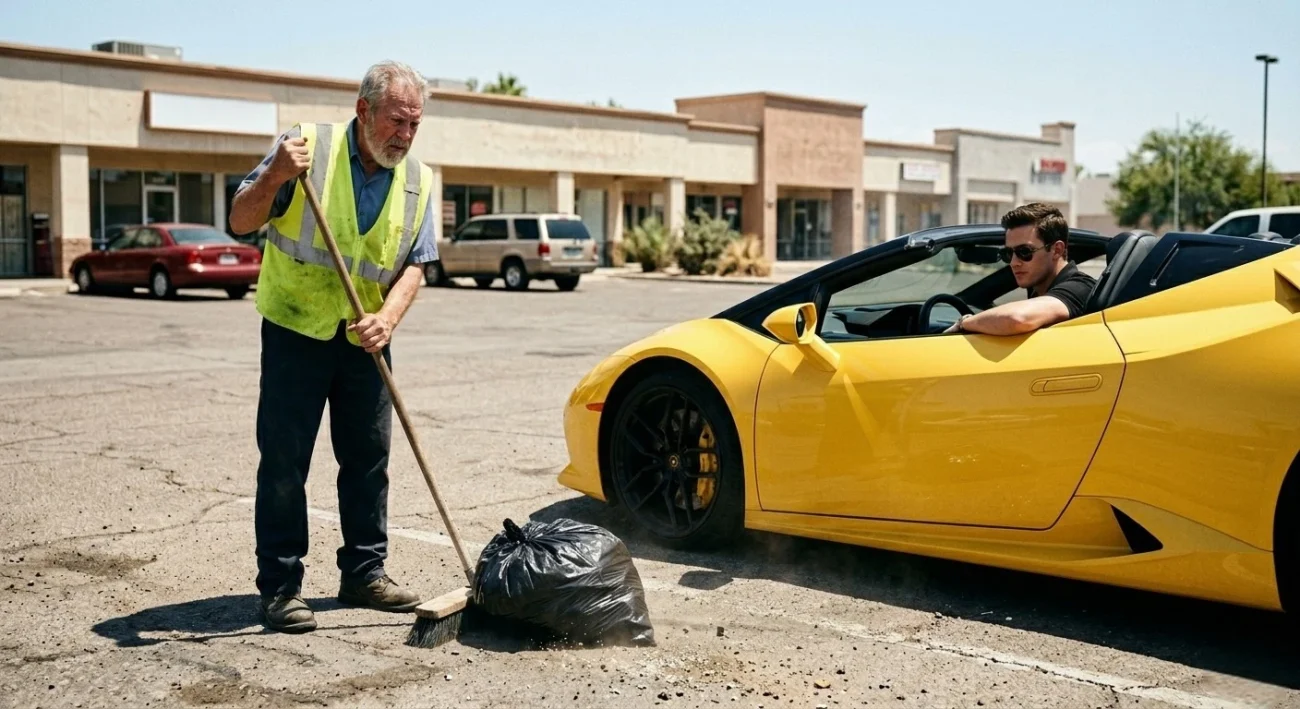
Silas had been sweeping the same strip mall for twenty years. Same cracked asphalt. Same bleached storefronts. Same tide of coffee cups and cigarette butts rolling back every morning like the sun itself owed him nothing.
He didn’t mind. The work was honest. That was enough.
It was a Tuesday, mid-afternoon, the kind of heat that makes Pennsylvania feel like a punishment. Silas was finishing a long stretch of sidewalk near the end of the lot—the cleanest section he’d done all week—when he heard it.
The engine first. Low and surgical, like a growl that had been to college.
Then it appeared: a metallic blue Lamborghini, low to the ground, sliding into the lot like it had been dropped from a different planet.
Silas leaned on his broom and watched it park. Not because he envied it. He’d stopped envying things around the same time his first marriage ended. He watched it the way you watch weather—because it changes what happens next.
The door lifted, not swung. Lifted.
The driver stepped out. Young. Maybe twenty-five. Built like someone who had never missed a gym day or paid a parking fine. Expensive sunglasses. White teeth. A gray t-shirt that cost more than Silas made in a day.
He had a trash bag in his hand.
Silas watched, broom still, as the young man walked—unhurried, deliberate—toward the freshly swept section of sidewalk. He set the bag down right in the center of it. Not near the bin. Not beside the curb. On the clean section. Then he looked up at Silas.
And smirked.
Not the smirk of someone who’d made a mistake. The smirk of someone who knew exactly what they were doing and found it amusing.
Silas felt the heat move from the pavement into his chest. Twenty years of it. Twenty years of being invisible to people like this. He stepped forward, arm swinging toward the bag, toward the car, toward the kid.
“Hey.” His voice came out harder than he intended. “What do you think you’re doing?”
The young man tilted his sunglasses down. His eyes were flat and unbothered.
“Relax, old-timer.”
“I just swept that. There’s a bin—” Silas pointed. “Right there. Forty feet.”
“Yep.” The kid pushed his sunglasses back up. “Looks like you got more work to do.”
He turned, got back in the car, and the door lowered like a curtain dropping on a stage. The engine growled once—a sound designed to humiliate—and the Lamborghini rolled forward, heading for a far corner of the lot where it idled in the shade.
Silas stood with his broom.
The burn was familiar. That particular shame that isn’t really shame at all—it’s the rage of the unseen, the fury of someone who has been looked through so many times they’ve started to wonder if they’re still there. He breathed through it. Picked up the bag. He’d throw it in the bin, sweep again, and move on. That was the job.
He lifted the bag.
It was heavier than it should have been.
He set it on the curb and opened it.
His hands froze.
The bag was stuffed with cash. Bundled hundreds, thick as a fist, stacked and rubber-banded and real. He pulled one bundle free like he was defusing something. His thumb riffled the edges.
Hundreds. All of them.
He sat down on the curb.
His brain tried to make sense of it—trash bag, Lamborghini, the smirk—and couldn’t. His hands were shaking. Not from fear. From something he hadn’t felt in so long he’d almost forgotten what it was called: relief. The kind that lives below the chest, in the place where all the years pile up.
He laughed. Short and choked and entirely involuntary.
“What in the—” He stopped. Pressed his palm flat against the bundles. Real. It was real.
He looked up. The Lamborghini was still in the corner of the lot, engine off now.
Silas stood slowly. His knees ached, because they always did. He walked across the lot, each step deliberate, the bag in one hand and his broom in the other, because he wasn’t putting the broom down—not for this, not for anything.
He stopped at the driver’s door.
The window lowered.
The young man looked at him. The smirk was gone.
“That yours?” Silas said. His voice was level. He didn’t know how.
The young man looked at the bag, then back at Silas. “Saw you working.”
“I work every day.”
“I know.” He paused. “My dad used to do this. Same job. Different lot. Thirty years.”
Silas said nothing. He waited.
“He died in March.” The young man looked out through the windshield at nothing. “I’ve been driving around with that bag for six weeks trying to figure out what to do with it.”
“So you dumped it in my clean section.”
“Yeah.” Something pulled at the corner of his mouth—not a smirk this time. More like a wince. “Wasn’t sure how to just—hand it to someone.”
“Could’ve tried the bin.”
“That’s fair.”
They held the silence between them. A car passed at the edge of the lot. Somewhere in the strip mall, a door chimed.
Silas looked down at the bag. Then back at the young man.
“What was his name?”
The young man’s jaw moved. “Gene.”
“Gene.” Silas repeated it like it meant something, because it did. “He know you had this?”
“No. He wouldn’t have let me keep it in the first place.” A breath. “He was…” He stopped. “He was like you.”
Silas felt his throat tighten.
“I don’t need your charity,” he said. But his hands didn’t let go of the bag.
“It’s not charity.” The young man’s voice was quiet but clear. “It’s twenty years too late, and it’s for the wrong man, and I know that. But I needed someone like him to have it.”
Silas looked at him for a long time.
The young man got out of the car.
He was taller standing up than Silas had registered—but without the sunglasses now, and without the smirk, he just looked like someone young and lost and carrying something too heavy for one person.
He reached out his hand. Not for a handshake. Just—open. Waiting.
Silas looked at it. Looked at the bag. Looked at the lot he’d swept for two decades, the same clean concrete, the same invisible labor, the same dignity no one had ever thought to name.
He took the hand.
The young man gripped it firmly. Then, without warning and without asking, he stepped in and wrapped both arms around the older man, briefly and completely, the way sons do when they’ve run out of words.
Silas stood still. Then, slowly, one hand still holding the bag, he brought his other arm up.
They stayed like that for three seconds. No longer. The parking lot went on around them, indifferent, baking in the sun.
When they stepped back, the young man’s eyes were wet. He didn’t hide it.
“Your dad would’ve liked knowing this happened,” Silas said.
“Yeah.” He nodded, once. “I think so too.”
He got back in the car. The door lifted. The engine started—same growl, but it sounded different now. It sounded like something leaving instead of arriving.
Silas watched the Lamborghini pull out of the lot and disappear into traffic.
He stood alone in the sun.
He looked down at the bag in his hand. Then at the broom in the other.
He walked to the bin—the one forty feet away, the right bin—and he set the trash bag down beside it, not inside it, because it wasn’t trash.
Then he picked his broom back up.
And he finished sweeping the lot.
Not because anyone was watching. Not because anyone would notice.
Because it was his work. And it was honest. And for the first time in a long time, someone had seen that, and said so, in the only way they knew how.
That was enough.
That was more than enough.
Original fictional stories. AI-assisted creative content.
