
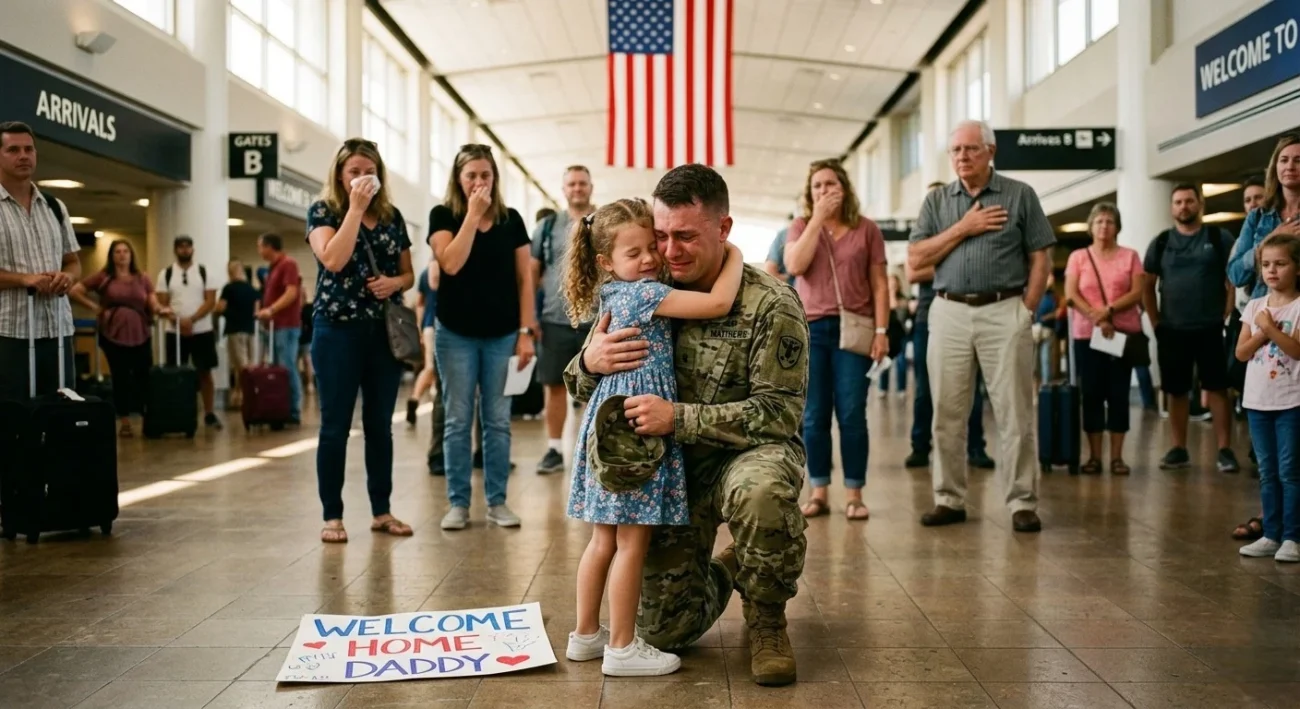
The Dallas arrivals terminal smelled like bad coffee and anticipation.
Emily Carter gripped her poster with both hands. The red crayon letters were already starting to smear at the edges. She’d made it herself, three nights in a row, pressing down so hard the crayon had snapped twice.
WELCOME HOME DADDY ❤️
“Mom.” She tugged her mother’s sleeve. “Is that his flight?”
Rachel Carter looked at the board. Her eyes were dry now — she’d run out of tears somewhere around day four of not sleeping.
“Any minute,” she said.
She had been saying that for six weeks. She just hadn’t told Emily what kind of minute it was going to be.
Three weeks earlier, two officers had shown up at the door. Rachel had seen them coming up the walk and sat down on the porch steps before they even reached her. She hadn’t wanted to fall.
Sergeant Daniel Carter. Killed in action.
Emily had been at school. Rachel had driven to pick her up that afternoon, sat in the parking lot for forty minutes, and driven home without going inside.
She still hadn’t found the words.
Daniel had sent a video message three hours before his last mission. His face was sunburned and tired and still somehow the most beautiful thing she had ever seen.
“If anything happens to me,” he said, “tell Emily I’m coming home.”
He’d paused.
“She’s too young to understand goodbye.”
Rachel had watched it sixty-three times. She knew, because she’d counted.
The loudspeaker crackled overhead.
“Flight 782 from Kuwait has arrived at Gate C17.”
The terminal erupted. Someone behind Rachel started clapping. A man in a VFW hat wiped his face with the back of his hand. Two kids down the barricade screamed DADDY in unison and dissolved into laughter.
Emily went rigid with excitement.
“HE’S HERE!” She bounced on her toes. “Mom, he’s HERE!”
“I know, sweetheart.”
Rachel pressed her fingers against her sternum. Breathed.
Just a few more minutes, she told herself. Let her have this.
The glass doors slid open.
Soldiers came through in ones and twos. A woman in ACUs dropped her bag and ran straight into a man’s arms. A young guy with a crew cut stood scanning the crowd until a woman pushing a stroller broke from the barricade and he crumpled completely.
Emily’s head swiveled left to right, searching every face.
Then she saw the camouflage.
A tall soldier had stopped near the edge of the arrivals hall. He wasn’t moving toward anyone. He was just standing there under the giant flag, helmet still on, a duffel at his feet, like he’d forgotten what he was supposed to do next.
Emily didn’t see the stillness. She didn’t see the hesitation.
She saw boots. She saw the uniform.
She saw home.
Her poster hit the floor.
“DADDYYYYY!”
She was through the barricade before Rachel could grab her, a brown blur of curls and sneakers, arms spread wide open.
The crowd parted. Some people smiled. An older veteran put his hand over his heart. Applause rippled out from somewhere near the windows.
The soldier looked up one second before impact.
He caught her — reflex, pure reflex — one hand under her arms, the other steadying her weight against his chest. For a moment they just stood there while the terminal cheered around them.
Then Emily leaned back to look at his face.
The laughter stopped.
Her smile went very still.
“You’re not my dad,” she said.
Four words. Barely a whisper. Loud enough to stop the world.
The applause died in stages — first the people closest, then spreading outward like a wave reversing. The veterans near the flag went quiet. Someone cut off mid-sentence.
Rachel’s knees buckled. She caught the barricade with both hands.
The soldier lowered himself slowly until he was crouching — one knee on the polished floor, eye level with a six-year-old. He took his helmet off.
He was young. Maybe twenty-eight. His face was the kind of lean that came from months of not eating enough, and his eyes carried something old and heavy that didn’t belong on a face that young.
“You’re right,” he said quietly. “I’m not.”
Emily’s lip began to tremble. She gripped the straps of her backpack with both hands.
“Where is he?”
He didn’t look away from her.
“He was my best friend,” he said. “Your dad.”
Rachel pressed both hands over her mouth.
“On our last mission, we got hit.” His voice was steady, careful, like he’d practiced this and then practiced it again. “An IED. The vehicle rolled. I was pinned under the chassis — couldn’t move, couldn’t barely breathe.”
He reached up and unclipped the dog tags from around his neck. Two worn rectangles of metal on a beaded chain.
“Your dad came back for me.” He turned the tags over in his palm. “Everyone else was pulling back. He came back. Dragged me out from under that thing and carried me — almost a half mile — while they were still shooting.”
A murmur moved through the crowd. Not words. Just breath.
“He talked about you the whole time,” the soldier said. “The whole half mile.”
Emily’s eyes were filling up. She didn’t blink.
“He said you hate broccoli.” A small, broken almost-smile crossed his face. “Said you make him read you the same astronaut book every single night and you always catch him if he tries to skip pages.”
A sound came out of Emily that wasn’t quite crying yet. More like the moment just before.
“He made me promise something.” He held out the dog tags. “He said if he didn’t make it home — I had to come home for him. Find you. Tell you in person.”
His hand was shaking slightly.
“He said to tell you that he thought about you every single day. That you were the bravest thing he knew. That being your dad was the best thing he ever did.”
Emily stared at the dog tags.
Then she stepped forward and put her arms around his neck.
He went still for a half second — like he hadn’t expected it, like nothing had prepared him for it — and then his arms came up around her and his head dropped and his shoulders shook once, silently.
The terminal was perfectly quiet.
It wasn’t the reunion they’d come to see. It was something older and harder and more real than that.
Rachel walked to them slowly. She didn’t trust her legs. She knelt on the floor beside her daughter and the soldier and she put her arms around both of them and held on.
Nobody clapped this time.
Some things are too big for applause.
His name was Marcus Webb. He stayed for four days.
He sat at their kitchen table and ate the dinners Rachel made and answered every question Emily asked, and there were a lot of them. He told her about the desert — the parts she could hear. He told her about her father laughing at his own jokes. He told her Daniel had kept a photo of the two of them — Emily and Rachel at the beach, Emily’s hair soaked flat, both of them grinning — folded in the front pocket of his vest, and that he’d looked at it every morning.
On the second night, Emily brought the astronaut book downstairs and handed it to Marcus without a word.
He read the whole thing. He didn’t skip any pages.
On the last morning, before he left for the airport, Emily pressed the dog tags back into his hand.
“Dad gave those to you,” she said. “You should keep them.”
Marcus looked down at them for a long time.
“You sure?”
“He saved you,” Emily said. “So you have to be around. So I can talk to you sometimes.”
He closed his fingers around the tags.
“Deal,” he said.
Six months later, Marcus drove back down for Emily’s birthday. He brought a cake with an astronaut on it and stayed for the whole weekend and fixed the porch step that had been crooked since March.
Rachel watched him help Emily with her telescope in the backyard that evening, the two of them arguing cheerfully about which smudge was Jupiter, and thought: This is what Daniel meant.
Not a replacement. Not a substitute.
A promise, made in the dark, half a mile from the end — and kept.
Original fictional stories. AI-assisted creative content.
