
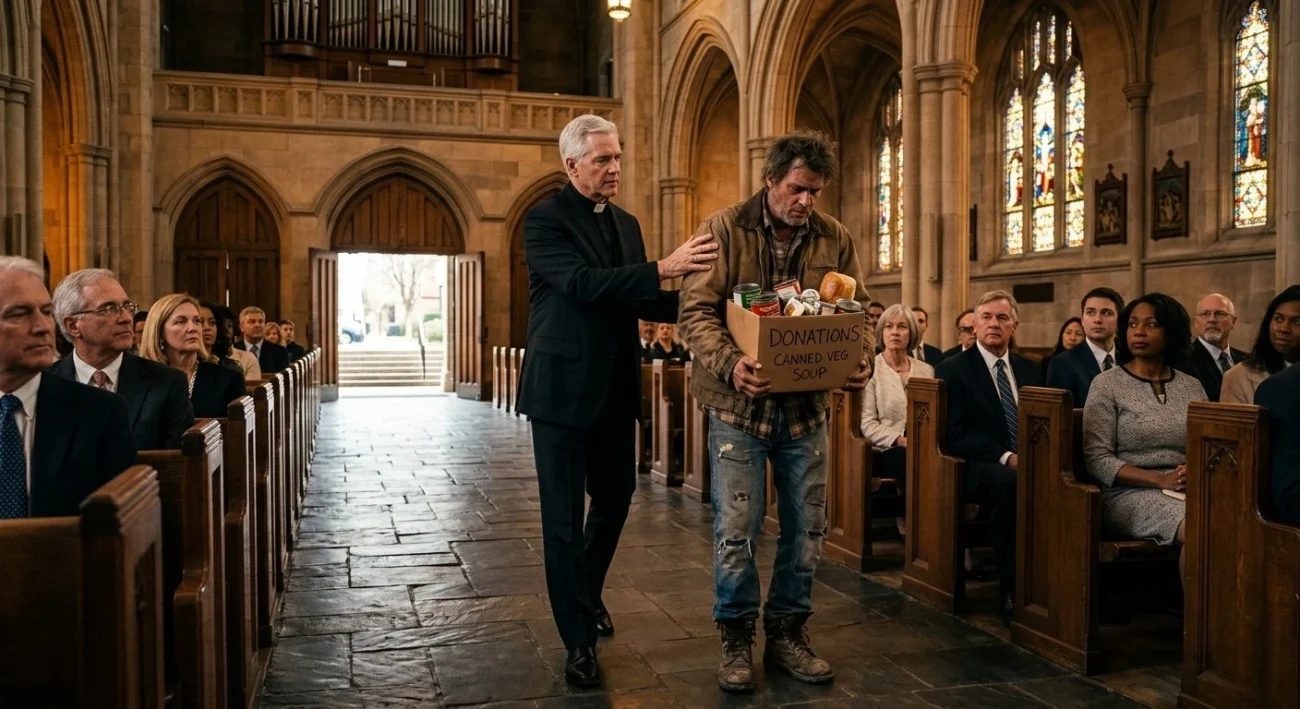
The doors of Saint Jude’s swung open and Elias walked in.
He didn’t announce himself. His boots did that — each step a heavy crack against the stone floor, echoing up through the vaulted ceiling like a stone dropped in still water.
He was fifty-three years old, though he looked older. His face was weathered and creased, skin the color of dried clay. His work shirt hadn’t been washed in days. His jeans were torn at both knees, caked with a rim of dark mud. He smelled like the street — engine grease, sweat, rain-damp concrete — and he carried that smell with him the way a storm carries pressure.
The sanctuary was full.
It was the eleven o’clock service, the good one, the one with the choir and the light streaming gold through Saint Jude’s famous stained glass windows. Pews packed. Women in silk blouses and pumps. Men in blazers with lapel pins and fresh haircuts. Children in pressed collars sitting very still.
Elias moved down the center aisle.
He wasn’t looking for trouble. His eyes moved across the pews slowly, like a man searching for a familiar face in a crowd he already knew he didn’t belong to. His hands hung loose at his sides. His jaw was set — not aggressive, just tired.
The reaction was immediate.
A woman in the third row — pink dress, pearl earrings, silver cross at her throat — brought her hand up to cover her nose. She didn’t do it quietly. She turned to the man beside her with wide eyes.
“What on earth,” she breathed.
The man straightened in his pew, putting distance between himself and the aisle without standing up. Someone three rows back shifted loudly. A child leaned over to her mother and whispered something. The mother pressed her lips together and pulled the child close without looking at Elias directly.
The choir faltered — just one beat, one missed note — before recovering.
Elias kept walking.
He didn’t have a destination, exactly. The front pew was empty, the way it always is in churches, that strip of space nobody takes because it’s too close to the pulpit, too exposed. He moved toward it.
“Excuse me.”
The voice came from his left — a deacon in a gray suit, stepping smoothly into the aisle. Young man, maybe thirty, with the particular confidence of someone who volunteers because it gives him authority.
“Can I help you find something?”
Elias stopped. He looked at the deacon. He looked at the pew. He looked back at the deacon.
“Just looking for a seat,” he said. His voice was low and even, roughened by years of outdoor work and not enough sleep.
“Of course.” The deacon smiled — the professional kind, the kind that means the opposite of warmth. “Are you a member of our congregation?”
“No.”
“Well, you’re welcome to visit.” The deacon’s hand moved to Elias’s shoulder, barely touching. “But I wonder if we could step outside for just a moment. Pastor Whittaker would love to connect with you personally.”
Elias looked at the hand on his shoulder. He looked at the packed pews. He looked at the woman in the pink dress, who had not lowered her hand from her nose.
“Sure,” he said quietly.
He turned and walked back toward the entrance. The deacon followed close behind.
No one in the pews said a word. But the collective exhale was audible — a long, slow breath released, the room regaining its order. A woman near the aisle smoothed her skirt. The choir found its footing again.
Inside the church offices, the pastor’s assistant found Reverend Whittaker at his desk reviewing Sunday’s bulletin.
“There’s a — situation,” she said, leaning in and dropping her voice. “A man came into the sanctuary. He’s — he’s not in good shape. Daniel took him outside.”
Whittaker set down the bulletin. He had been the senior pastor of Saint Jude’s for twenty-two years. He was sixty-one, trim, with silver hair parted cleanly on the left side and a collar so white it seemed to generate its own light. He had built this congregation from four hundred to over two thousand. He had shaken hands with the mayor, the city councilwoman, the dean of the university. He was, by every measure, a man who had made something of himself.
He knew, before anyone said another word, what kind of situation this was.
“Where is he now?”
“Outside. By the east steps.”
He nodded once. Folded his hands on the desk for a moment. Stood up.
He walked to the supply room off the hallway — a long, narrow room stacked with canned goods, blankets, first aid kits. Saint Jude’s ran a food pantry on the third Saturday of every month. It was one of their signature programs, mentioned in every fundraising brochure, printed at the top of their website’s homepage alongside a photograph of smiling volunteers in matching aprons.
Whittaker took a cardboard box from the shelf. He placed four cans of soup inside. A loaf of store-brand bread. A packet of crackers. He picked up the box and carried it to the back exit.
The door opened onto a narrow alley along the east side of the building. Elias was there, leaning against the stone wall with his arms crossed, looking at nothing in particular.
Whittaker walked toward him with the box already extended.
“Brother, I’m glad we got a chance to speak.” He set the box down on the step between them. His voice was warm and practiced. The same voice he used for eulogies, for hospital visits, for the camera when the local news came. “Saint Jude’s has a heart for our neighbors in need. I hope this can be a blessing to you today.”
Elias looked at the box. He looked at Whittaker.
“I wasn’t asking for food,” he said.
Whittaker’s expression didn’t change. “Of course. But the pantry is something we offer—”
“I wanted to sit in a pew,” Elias said. “I wanted to hear the service. That’s it.”
A pause. Just a second.
“You’re absolutely welcome to join us,” Whittaker said smoothly. “We have a service at one o’clock that might be—”
“The one o’clock is the small one,” Elias said. “I know your schedule. I’ve been to this church before.” He paused. “My mother’s funeral was here. Seventeen years ago. She was a member.”
Something shifted in Whittaker’s face. A micro-flinch, quickly controlled.
“I’m sorry for your loss,” he said. “I wasn’t the pastor here seventeen years ago, so I—”
“I know who you are,” Elias said. “I’ve seen your sermons online. You talk a lot about the open door. About the church being a place for everyone.” He looked at the box of canned goods. “That what you mean by open door?”
Whittaker pulled himself straighter. “We serve our community in many ways—”
“You had a man escort me out of the building,” Elias said. “Didn’t say it that way, but that’s what it was. Because of how I look. Because of how I smell.” He said it flatly, without drama. “I’ve been sleeping rough for four months. Lost my job in April. I’m not — I’m not asking you to fix that. I just wanted to sit somewhere quiet for an hour.”
A long silence.
Elias reached down and picked up one of the cans of soup. He turned it over in his hands. Set it back down.
“You keep this,” he said. “Give it to someone who needs it.”
He turned to go.
“Wait.”
Elias stopped.
It wasn’t Whittaker’s voice. It was a woman’s — coming from just behind Whittaker’s left shoulder. Both men turned.
She was maybe forty, dark hair, wearing a blazer over a simple blouse. She had a phone in her hand. She had, apparently, followed Whittaker from the building at some point during the conversation — her heels were on the stone step, and she’d made no sound coming out.
She wasn’t holding the phone up. It was angled down, at her side.
But it was recording.
Whittaker’s eyes went to the phone. Back to her face. “Margaret—”
“I heard it,” she said. She wasn’t looking at him. She was looking at Elias. “I heard all of it.”
“Margaret, this isn’t—”
“His mother was a member,” she said, still to Elias. “What was her name?”
Elias blinked. “Ruth,” he said. “Ruth Cain.”
Margaret looked at Whittaker. Her expression was perfectly level. “I knew Ruth Cain,” she said. “She ran the Wednesday Bible study for eleven years. She donated the tapestry in the east wing. She was in this church every Sunday for thirty years.”
Whittaker said nothing.
“And her son,” Margaret continued, “came looking for somewhere to sit on a Sunday morning, and we handed him a box of soup and showed him the back door.”
“The congregation—” Whittaker began.
“The congregation took their cue from the man at the pulpit,” she said. “You walked away. They watched you walk away and they followed.”
Her phone was still recording. She wasn’t pretending otherwise.
Whittaker straightened. “I’ll ask you to put that away.”
“I’ll ask you to invite this man inside,” she said simply.
A long silence. The faint sound of the choir drifted through the stone wall — warm, harmonized, perfect.
Whittaker looked at Elias. At Margaret. At the phone.
When he spoke again, his voice had dropped the pastoral warmth. What was left underneath was smaller, tighter.
“This is a private matter,” he said. “Church property. Whatever you think you recorded—”
“I recorded you handing a grieving man a box of crackers and calling it charity,” she said. “That’s what I recorded.”
The video went up on a Sunday afternoon and by Monday morning it had been viewed four hundred thousand times.
The clip was forty-seven seconds. It showed Whittaker extending the cardboard box. Elias’s voice saying, I wasn’t asking for food. The exchange about the one o’clock service. Elias’s voice again: I just wanted to sit somewhere quiet for an hour. Then the silence. Then the pastor’s back as he started to leave.
The clip did not show everything. It did not show what happened next.
What happened next: Margaret put her phone in her jacket pocket, stepped past Whittaker, and held the back door open.
“Come in,” she said to Elias.
Whittaker said, “Margaret—”
“He’s a guest of mine,” she said. “That’s how it works, isn’t it? A member can bring a guest.”
She held the door.
Elias looked at her. He had the expression of a man who has stopped expecting things to turn around.
“You don’t have to,” he said.
“I know,” she said.
He went in.
Margaret walked him to the sanctuary herself. She sat beside him in a pew — not in the back, not in the overflow seats behind the pillar. She sat him in the seventh row, center section, the one with the best sightline to the altar and the full view of the stained glass windows his mother had loved.
Whittaker entered from the side door five minutes later, crossed to the pulpit, and finished the service.
He did not look at the seventh row.
After the service, three congregation members came to introduce themselves to Elias. Not many. But three.
On Monday, three things happened before noon.
The clip crossed one million views.
A journalist from the city paper left a voicemail for Saint Jude’s director of communications asking for comment.
And one of the two dissenting board members — a man named Gerald Foss, a real estate attorney who had been on the board for eleven years and who had voted alongside Whittaker on every contentious decision since 2016 — sent an email to the full board that said only: I think we need to talk about this before it gets worse.
The board met in emergency session on Wednesday evening.
The room was the conference room on the second floor of the annex — a long table, eight chairs, water pitchers, an overhead projector that no one ever used. Seven of the eight board seats were filled. The eighth, Whittaker’s own seat, sat empty.
Margaret had been asked to present.
She sat at the end of the table and opened her laptop. She played the video once without commentary. Forty-seven seconds. She let the silence sit after it.
Then she placed a folder in front of each board member.
“The first document,” she said, “is the church’s original charter. The language about nondiscrimination is on page four, paragraph two. It’s not ambiguous.”
The board member to her left, a woman named Harriet who managed a chain of dental practices, flipped to page four. She read it twice. She set it down without expression.
“The second document is our 501(c)(3) filing renewal from two years ago. Specifically the attestation on the final page, which Reverend Whittaker signed.” Margaret kept her voice level. She wasn’t performing indignation. She was presenting facts. “The attestation confirms that Saint Jude’s operates in accordance with its stated nondiscriminatory mission. He signed it.”
Gerald Foss cleared his throat. “Margaret. A man came to Sunday service without appropriate—”
“There is no dress code in our charter,” she said.
“There’s a standard of—”
“Gerald.” She looked at him. “I need you to say out loud what standard you’re referring to. For the record.”
A pause.
He didn’t say it.
Harriet set her folder down. “What happened after the video ends?”
“I brought him inside,” Margaret said. “I sat with him during the service. He stayed for the whole thing. He didn’t cause any disruption. He left when the service ended.” She paused. “His name is Elias Cain. His mother, Ruth Cain, was a member of this congregation for thirty years. She ran the Wednesday Bible study. She donated the east tapestry. She’s buried in the cemetery two blocks from here.”
The room was quiet.
“He wasn’t a stranger who wandered in off the street,” Margaret said. “He was a member’s son, coming to sit in the church where his mother worshipped. And we handed him a box of generic crackers and told him to try the one o’clock service.”
A board member named Phil, who coached youth baseball on weekends and rarely spoke at meetings, said quietly: “What does Reverend Whittaker say?”
“He says it was a pastoral decision made in the moment,” Margaret said. “He says he was trying to serve the man’s immediate needs.”
“And?” Phil said.
“And his immediate need was a seat in a pew,” she said. “Which we did not give him.”
The vote was four to two.
Whittaker was placed on administrative leave effective immediately, pending a formal review process that the board estimated would take sixty to ninety days.
Gerald Foss voted against it. A board member named Frank, who had brought his checkbook to the past three capital campaigns, voted against it. The other four voted for it.
After the meeting, Frank found Margaret in the hallway.
“You know what this is going to cost us,” he said. His voice was low and careful. “Whittaker has relationships. Donors. People who have written very large checks because of him specifically.”
“I know,” she said.
“Some of those people are going to walk.”
“Some of them might,” she agreed. “And some of them might not, once they understand what happened.”
He studied her. “You really think this was worth it? Over one man?”
She looked at him for a long moment.
“He was Ruth Cain’s son,” she said. “And yes.”
She walked past him toward the stairs.
In the statement released Thursday, the board wrote that Saint Jude’s remained committed to its founding mission of being a church “open to all, in word and in deed.” They announced the formation of a new outreach committee charged with reviewing and rebuilding the church’s practices around community access and service.
They asked Margaret to chair it.
She accepted on the condition that Elias Cain be invited to serve as an advisor.
The board agreed.
Three weeks later, Elias sat in that same conference room for the first outreach committee meeting. He was the only person at the table who wasn’t wearing a blazer. No one mentioned it.
Margaret opened with a question she directed to him: “What would have made Sunday different?”
He thought about it.
“If anyone had looked at me,” he said. “Not away from me. Just — looked.”
She wrote it at the top of the whiteboard.
Look at the person.
It wasn’t much of a policy. But it was a start — the kind of start that actually holds.
Elias heard about the vote secondhand — from a woman named Donna, who had been in the pink dress in the third row, and who had since called the church office twice to ask how she could be more involved in the new outreach committee.
She found Elias on a Tuesday, outside the drop-in center four blocks from Saint Jude’s. She was carrying two paper cups of coffee. She offered him one.
He took it.
They stood in the thin November sun and drank the coffee and didn’t say much.
“I’m sorry,” Donna said finally. “For Sunday. For — covering my face.” She said it the way people say the true thing when they’ve run out of ways not to. “That was wrong.”
“Yeah,” Elias said. “It was.”
She nodded. She didn’t try to soften it or explain it or make it into something else.
“My name’s Donna,” she said.
“Elias,” he said.
They shook hands.
He finished the coffee. She took the empty cup. She walked back toward Saint Jude’s and he watched her go and then he went inside the drop-in center, because they had a job board, and there was a listing he’d seen last week for a grounds crew position that he hadn’t yet applied for, and he was going to apply for it today.
He did.
He got the job the following week.
The Sunday after the board vote, the eleven o’clock service was standing room only.
Whittaker’s interim replacement — a young associate pastor named Gaines who had been quietly furious about Sunday for four days — opened with a reading from Matthew. The one about the sheep and the goats. The one about what happens to the people who see someone hungry and give them food, someone naked and give them clothes, someone a stranger and take them in.
Inasmuch as ye have done it unto one of the least of these my brethren, ye have done it unto me.
He read it slowly. He did not explain it.
He didn’t have to.
In the seventh row, center section, with the full view of the stained glass windows, there was a man in a clean shirt. Not new — clean. His boots were still worn through. But his face was rested.
He sat still and listened to the whole service.
Nobody moved away from him.
Nobody covered their nose.
He didn’t look like he was waiting for something to go wrong.
He looked like a man in a church on a Sunday morning.
That’s all.
Original fictional stories. AI-assisted creative content.
