
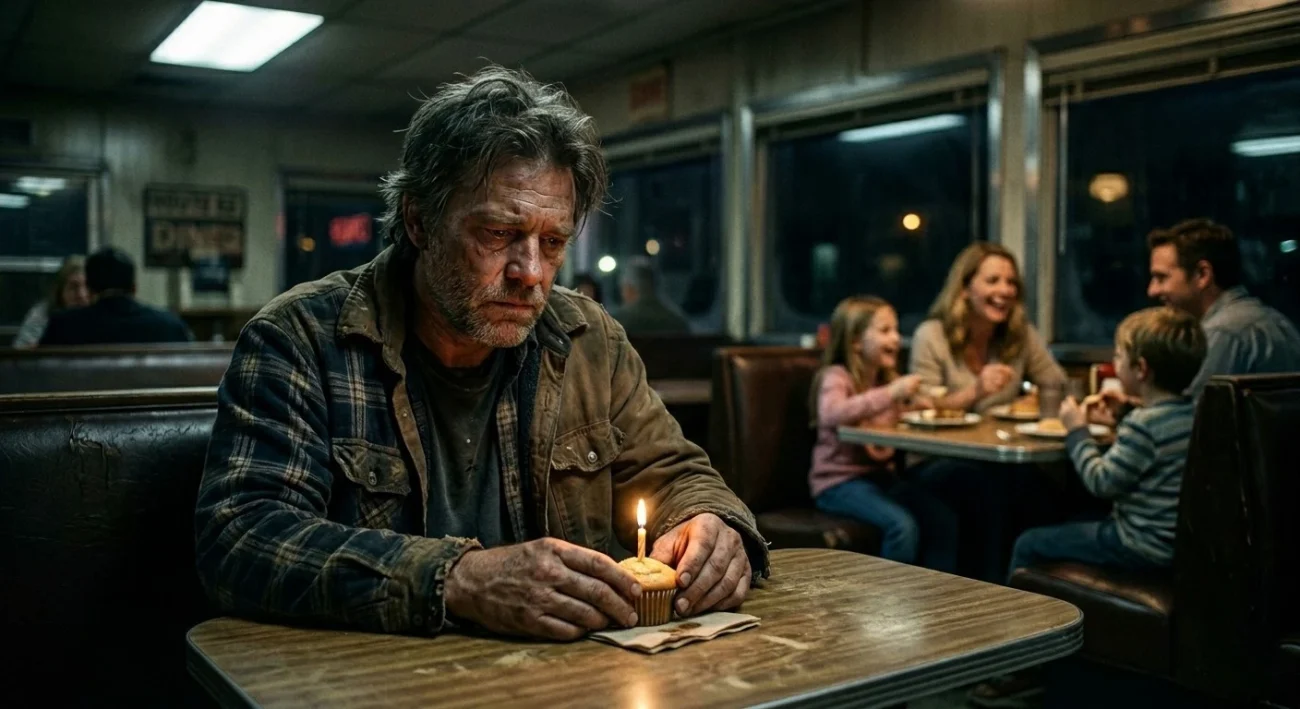
The neon sign outside Betty’s Diner had been flickering for three years. Nobody fixed it. Nobody really fixed anything around here anymore.
Elias slid into the corner booth just after noon. The red vinyl seat let out a slow hiss as he settled in, like even the furniture was tired. He set his work jacket on the bench beside him—grime-dark at the cuffs, stiff at the collar—and pulled a small paper bag from his pocket.
Inside was a single chocolate cupcake. Drugstore candle stuck in the top.
He stared at it for a moment. Then he pulled out a lighter.
The flame caught on the third try.
Three booths down, the Harmon family was doing a birthday the right way. Balloons tied to the seat back. A sheet cake from the bakery on Route 9. The grandmother was laughing so hard she had to cover her mouth with her napkin.
Their waitress, Sarah, moved between tables with the steady rhythm of someone who’d been doing this for fifteen years and had made peace with every part of it—almost. She refilled the Harmons’ coffee, smiled at the grandmother’s joke, and turned toward the back.
That’s when she noticed him.
Corner booth. Alone. Cupcake with a tiny candle. His hands curled around the flame like he was protecting it from something.
She slowed down.
Elias didn’t make a wish. He hadn’t wished for anything in about two years—not since the plant closed, not since Karen left, not since the VA appointment he kept rescheduling because going felt like admitting something permanent.
He just watched the flame.
It was small. It swayed. The air conditioning unit above him rattled and breathed cold air down the back of his neck, and the flame bent sideways and nearly went out.
He moved his hands closer.
The candle sputtered. A thin thread of smoke curled up toward the fluorescent light.
At the next table, a kid around six years old was watching him with wide, unblinking eyes. The mother reached over and gently turned the boy’s head back toward his grilled cheese.
Elias looked back at his candle.
It was still going.
Sarah went to the kitchen counter and stood there a moment.
Dale, the cook, was scraping the griddle. He glanced up.
“What?”
“The guy in the corner booth,” she said. “He’s alone. It’s his birthday.”
Dale didn’t say anything.
“We’ve got that extra cake from the Mendoza order. They called it off this morning.”
Dale scraped the griddle again. “That’s a twelve-dollar cake.”
“I know what it costs, Dale.”
A long pause.
“Take it,” he said. “Just take it.”
Sarah picked up the cake—white frosting, blue trim, plastic roses along the edge. She grabbed two candles from the supply drawer and went back out.
She didn’t overthink it. She’d learned a long time ago that overthinking was how you talked yourself out of every good thing you almost did.
She walked up to the corner booth and set the cake down on the table.
Elias looked up. His face was hard to read—not unfriendly, just sealed. Like a house where all the windows were closed.
“What’s this?” he said.
“Birthday cake.” She lit both new candles with his lighter. “You looked like you could use an upgrade.”
He stared at the cake. “You don’t know it’s my birthday.”
“The cupcake and the look on your face kind of gave it away.”
He didn’t say anything for a moment. His jaw worked. His eyes went somewhere else briefly, then came back.
“I don’t—” he started.
“You don’t have to do anything,” she said. “Just blow them out.”
She didn’t walk away. She stood there, and something about the way she stood—not hovering, not pitying, just present—made it feel less like charity and more like company.
He looked at the two candles on the big cake. At his little cupcake candle, still somehow burning.
He closed his eyes.
He blew them all out.
From the Harmon booth, the grandmother had been watching. She was eighty-one years old and had grown up in a coal town in West Virginia, and she had seen enough of the world to know when something mattered.
She leaned over to her son, Mike. “Go over there.”
“Mom—”
“Go over there, Michael.”
Mike Harmon was forty-four years old and managed a hardware distribution center and had not, in recent memory, walked up to a stranger in a diner for any reason. He picked up his coffee cup and went anyway.
He stopped at the corner booth. Elias looked up at him, wary.
“Mind if I sit?” Mike said.
“It’s a free country.”
Mike sat down across from him. He put his coffee cup on the table. “Mike Harmon.”
“Elias.”
“Happy birthday, Elias.”
Elias looked at him. “You don’t have to do this.”
“My mother told me to,” Mike said. “And honestly, at my age, you just do what your mother says.”
Something shifted in Elias’s face. Not a smile—not quite—but a crack. The smallest fissure in the wall.
“She sounds like a smart woman.”
“She’s a pain in my ass,” Mike said. “But yeah.”
Sarah reappeared with two more coffee cups. She set them down and pulled up a chair from the empty table nearby, sitting sideways in it like she’d done this a hundred times before—which, in a way, she had.
At the Harmon table, the grandmother was pushing herself out of the booth.
“Oh, Mom, you don’t—” Mike’s wife started.
“I’m eighty-one, not dead,” the grandmother said, and walked over.
She stood at the edge of the corner booth. She looked down at Elias, who was now flanked by Mike on one side and Sarah on the other, and she said, “Scoot over.”
He scooted over.
She sat down next to him and folded her hands on the table like she was exactly where she was supposed to be.
“I’m Norma,” she said. “My grandson is over there—the loud one—and he’s turning seven today. We’ve got cake.”
“I’ve got cake,” Elias said.
“You’ve got more cake now,” Norma said. “That’s allowed.”
By the time the Harmon kids came over—pulled by pure curiosity the way children always are toward any table that seems more interesting than their own—the corner booth had expanded.
Mike’s wife, Jennifer, brought the balloon bouquet. Their oldest daughter, who was twelve and going through a phase of pretending she didn’t care about anything, was the one who actually started singing first. Quiet at first. Then louder.
The couple two booths over picked it up. Then the trucker at the counter.
Sarah sang from her spot by the table. Dale stuck his head out from the kitchen window and sang the last four words.
Elias sat very still in the middle of all of it.
At some point his hands, which had been flat on the table, had moved. Norma had placed her small, papery hand over his left one at some point, and he hadn’t moved it away. Mike had his arm loosely around Elias’s shoulders in the way men do when they’re trying to be warm without making a big deal out of it.
When the song ended, there was a small, genuine moment of silence.
Then the six-year-old from the next table—the one who’d been staring earlier—walked over holding a crayon drawing he’d been working on during the song. He held it out to Elias.
It was a birthday cake. Lopsided. Green candles. Stick figure next to it.
“That’s you,” the boy said seriously. “I gave you a lot of candles.”
Elias took the drawing with both hands. He looked at it for a long time.
“Thank you,” he said. His voice was rough. “I’ll keep this.”
The boy nodded like this was the appropriate response and went back to his grilled cheese.
Jennifer cut the Harmon birthday cake—the real one, with the frosting roses—and Sarah plated up two slices: one for the kid whose birthday it actually was, and one she put directly in front of Elias.
He looked at it.
“I haven’t had real birthday cake in—” He stopped.
“Don’t count back,” Norma said. “Just eat it.”
He picked up the fork.
It was a good cake. White cake with real buttercream, not the grocery store kind that tasted like sweetened Crisco. The kind somebody made with intention.
He ate the whole slice.
After a while, things began to settle into something more ordinary. The kids drifted back. Jennifer and Mike’s daughter actually talked to him for a few minutes about the kind of work he’d done at the plant—she was studying engineering, she said, and was curious about the mechanical side of things. He found himself explaining how the line worked with his hands moving, sketching invisible diagrams on the laminate tabletop.
He hadn’t talked about the work in two years. It felt strange. It felt good.
“You should look at the vocational retraining program,” Jennifer said. “They’re opening a new CNC facility in Greenfield. Mike’s company does work with them.”
Mike nodded. “It’s real work. Good pay. They’re hungry for guys who actually know how machines work.”
Elias looked at him. “You serious?”
“I can make a call,” Mike said. “No guarantees. But I can make a call.”
Sarah was clearing the adjacent table when Elias flagged her down.
“Can I get the check?”
“For what?”
“The coffee. The cupcake.”
“The cupcake was yours when you walked in,” she said. “The coffee’s on me. The cake was Dale’s call.” She paused. “It’s your birthday. Let it be your birthday.”
He held her gaze for a moment.
“Why’d you do this?” he asked.
She thought about it. Not performing the answer—actually thinking about it.
“Because you were sitting there protecting that little candle like it was the most important thing in the room,” she said. “And it kind of was.”
He left an hour later.
He shook Mike’s hand at the door. Norma made him write down her phone number—”For when you need someone to tell you you’re being an idiot”—and tucked a folded piece of paper into his jacket pocket. He didn’t look at it until he got to the parking lot.
It was her number. And below it, in handwriting that slanted like it always had something better to do: You were seen today. Don’t forget it.
He stood in the parking lot for a minute, the paper in his hand, the flicker of the diner’s neon sign behind him.
He folded it carefully and put it back in his pocket.
He had the crayon drawing in the other pocket. The boy had signed it: TOMMY, in capital letters, because that’s how you signed something important.
Three weeks later, Mike made the call.
It wasn’t a favor. It was a referral—Mike told them Elias knew machines the way some people knew languages, intuitive and deep, and that they’d be making a mistake not to at least sit down with him.
They sat down with him.
They offered him a position the same afternoon.
He called Sarah to tell her. He’d gotten her number from the diner’s posted staff directory online, which had felt slightly absurd, but here they were.
“I got the job,” he said.
“Of course you did,” she said.
“You don’t sound surprised.”
“I’m not.” A pause. “Dale’s going to be insufferable about this.”
“Tell him I said thank you.”
“Tell him yourself,” she said. “Come in for coffee sometime. It’s on the house.”
He did.
He came in on a Tuesday, and Norma was there—coincidence, or maybe not, given that she apparently came in every Tuesday for the soup. She made room for him in the booth like he’d been sitting there for years.
He ordered coffee. He brought Tommy a pack of colored pencils he’d picked up at the drugstore on a hunch.
Tommy took them with the gravity of someone receiving a meaningful gift, which is exactly what it was.
Outside, the neon sign still flickered. Nobody had fixed it.
But inside, the coffee was hot, and the booth was warm, and Elias sat in it like a man who had somewhere to be—which, for the first time in longer than he could say, was exactly what he was.
Original fictional stories. AI-assisted creative content.
