
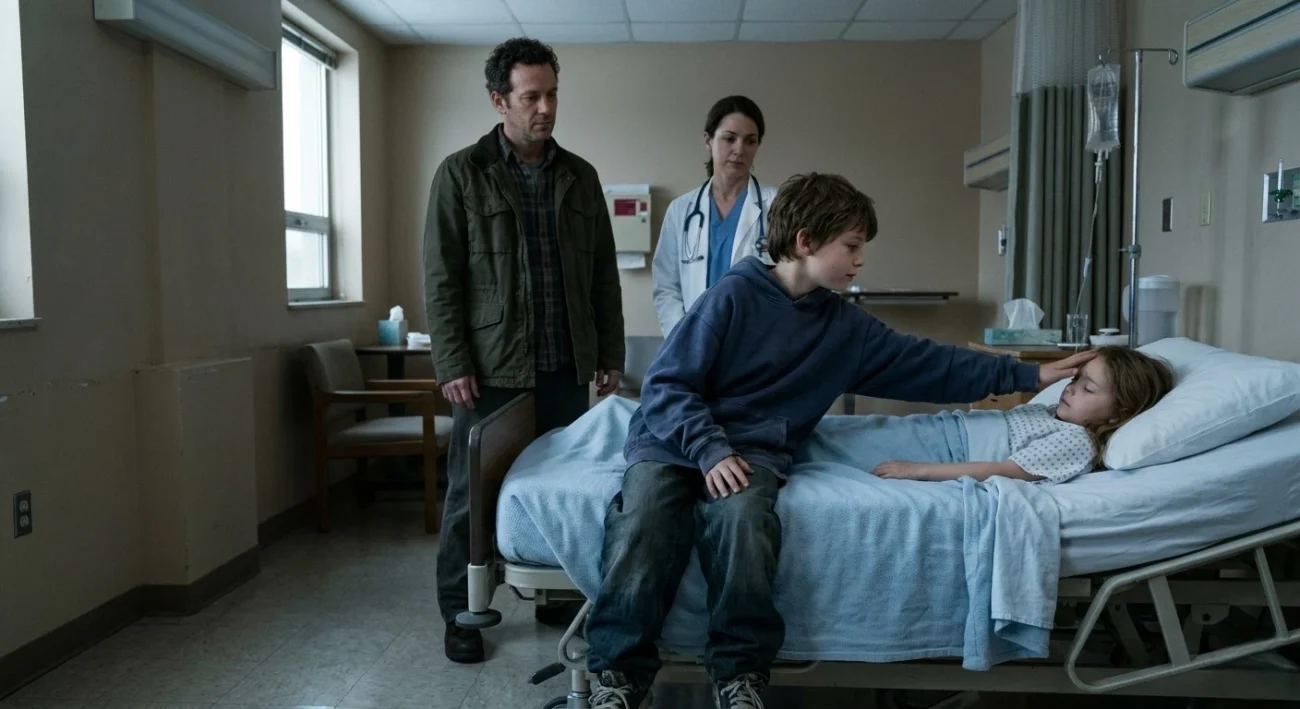
The heart monitor never changed its rhythm.
Beep. Beep. Beep.
Three years of that sound, and Ethan Walker still couldn’t tune it out. He sat in the vinyl chair beside his daughter’s bed, tie loosened, jacket draped over the armrest, eyes fixed on a face that hadn’t changed since she was six.
Olivia. Nine years old now, but frozen. As if time had looked at her and decided: not yet.
The accident played on a loop in his mind whether he wanted it to or not. Rain hammering the windshield. Headlights spinning. The sound of metal folding. He’d walked out of the wreckage with a sprained wrist and a gash above his brow. Olivia had not walked out at all.
Dr. Harmon knocked twice before entering.
“Mr. Walker. We need to speak in the corridor.”
Ethan recognized the tone. He’d been dreading it for months.
In the hallway, under the hum of fluorescent lights, the senior neurologist laid out the reality with careful, practiced compassion.
“Her vital indicators have been declining for six weeks,” Dr. Harmon said. “Continuing life support at this stage isn’t treatment. Medically speaking, we’re prolonging a process rather than reversing it.”
Ethan stared at the floor. “There has to be something else.”
“We’ve run every protocol available. There’s nothing left to try.”
“Then I’ll fund something. I’ll bring in specialists from Europe, Japan — anywhere.”
“Mr. Walker.” Dr. Harmon’s voice was gentle but final. “We’ve had five of the top neurologists in the country review her case. The consensus is unanimous.”
The silence stretched out between them.
“You’re asking me to sign away my daughter’s life,” Ethan said quietly.
“I’m asking you to consider what she would want. And what’s humane.”
He stood there for a long time after the doctor walked away. The corridor felt narrower than it had been. The air thinner.
Eventually, he turned back toward Room 512.
His hand found the door handle.
“Don’t go in there to say goodbye.”
The voice came from his left — calm, unhurried, certain in a way that didn’t belong to a child.
Ethan turned.
A boy stood against the corridor wall. Ten years old, maybe. His jeans were dusty at the knees, his sneakers held together by worn laces, his jacket two sizes too large. He looked like someone who had been walking a long time without a destination. But his eyes — dark, steady, older than the rest of him — were fixed on Ethan without a trace of hesitation.
“Excuse me?” Ethan said.
“She isn’t gone,” the boy said. “She’s just lost. I can help her find her way back.”
Under any other circumstances, Ethan would have called a nurse and asked security to walk the kid to the lobby. But grief has a way of clearing out the rational mind and leaving only the raw, exposed nerve of hope. And he had run out of rational options hours ago.
“What’s your name?” Ethan asked.
“Gabriel.”
Ethan looked at him for a long moment.
Then he pushed open the door.
Gabriel walked to the bedside quietly, as though he’d been in this room before.
He studied Olivia’s face. Her pale hands. The thin tube running to her arm.
“Has she been alone much?” he asked.
“Never,” Ethan said. “I come every day. I read to her. I talk to her.”
“She knows,” Gabriel said simply. He looked up. “Do you believe it’s possible? That she could come back?”
Ethan’s knees gave. He didn’t fight it. He went down onto the linoleum floor, hands pressed together, eyes burning.
“Yes,” he said. “Please.”
Gabriel placed one small hand on Olivia’s forehead. He closed his eyes.
The room didn’t change — not visibly. The lights didn’t flicker. The machines didn’t sing. But something shifted in the air, the way a barometric pressure drops before a storm. A warmth that had no source. A stillness with weight to it.
The heart monitor quickened — just slightly. Three beats faster. Then four.
Olivia’s fingers moved.
Not a reflex. Not a tremor. A curl — slow and deliberate, like a hand reaching for something in the dark.
“Gabriel—” Ethan’s voice broke.
The boy stepped back. His face had gone pale, shadows deepening under his eyes.
“Why did you stop?”
“It’s enough for today,” Gabriel said quietly. “She heard the call. Tomorrow morning she’ll wake up.”
He moved toward the door.
“Wait — where are you going? Who are you? How did you get in here?”
But Gabriel was already in the hallway.
By the time Ethan reached the door, the corridor was empty in both directions.
That night, Ethan didn’t sleep.
He sat beside Olivia’s bed with her hand between both of his, watching for any movement, any sign. He replayed what had happened, turned it over, tried to find the rational edge of it. A troubled kid who’d wandered into the wrong wing. A grief-induced hallucination. A coincidence that meant nothing.
Her fingers had moved.
The monitor had quickened.
He watched the clock turn from midnight to two, from two to five. As gray predawn light began to seep beneath the blinds, he heard the door open behind him.
“It’s time,” Gabriel said.
He was back in the same dusty clothes, eyes carrying the same unnerving calm.
Ethan shot to his feet. “How did you get past the nurses’ station?”
“I just walked.”
No time to argue. Gabriel moved to the bedside again. This time both hands on Olivia’s forehead.
The warmth came faster — fuller, more insistent. Ethan could feel it from where he stood, three feet back. The monitor spiked. Alarms triggered. The door burst open as two nurses ran in, then a third, then Dr. Harmon in street clothes, coffee still in hand.
“Mr. Walker, what’s—”
“Daddy.”
The word came out hoarse, barely louder than a breath. But it was unmistakable. Real. Present.
Olivia’s eyes were open.
Not glassy. Not reflexive. Open — blinking against the light, dark irises contracting, focusing, finding the face of the man kneeling beside her bed with tears streaming down his face and both hands gripping hers.
“Daddy, you’re crying,” she said. Her voice was raw, barely above a whisper, but there was wonder in it. “Why are you crying?”
“Because you’re back,” he said. “Because you came back.”
Dr. Harmon stood frozen in the doorway, coffee tilting in his hand. Behind him, nurses crowded the frame. No one moved. No one spoke.
“This isn’t — ” the doctor started.
“I know,” Ethan said without looking up.
He turned. Gabriel was already gone.
The following weeks were documented in the medical literature as an anomaly without clinical explanation. Olivia’s neurological recovery was complete — no cognitive deficits, no motor impairment, no memory gaps beyond the three lost years. Her brain activity was, by every measurable standard, that of a healthy nine-year-old.
Reporters called it a medical miracle.
Ethan called it something else, though he didn’t have the word for it yet.
He reviewed security footage with the hospital administrator three days after Olivia’s awakening. The hallway camera outside Room 512 was clear and high-resolution. It showed Ethan standing at the door the first evening, head turned, speaking to empty air. No boy in dusty clothes. No ten-year-old with steady eyes.
Nothing.
The footage from the morning of Olivia’s awakening showed the same: Ethan alone in the room, standing at the bedside as the alarms triggered.
The administrator cleared his throat. “Mr. Walker, is there anything you’d like to report to—”
“No,” Ethan said. “Thank you.”
Olivia recovered quickly — almost impatiently, the nurses joked. Within a week she was sitting up, demanding real food, asking about her school friends. Within two, she was walking the corridor with a physical therapist, peering into other rooms and asking questions about everyone she passed.
One afternoon, she sat cross-legged on her hospital bed with a coloring book in her lap and looked up at her father with the particular thoughtfulness she’d always had, even at six.
“The boy from my dream came, didn’t he?” she said.
Ethan went still. “What?”
“While I was sleeping. There was a boy. He kept walking toward me and calling my name. He said I needed to follow him back.” She tilted her head. “He had nice eyes.”
“What was his name?” Ethan asked carefully.
“Gabriel,” she said. “Gabriel Hayes.”
The last name hit like a closed fist.
Ethan had never heard it before.
That night, in the family waiting lounge down the hall, he opened his phone.
Gabriel Hayes. Seattle. Car accident.
The first result loaded slowly. A local news archive. The headline was plain and merciless:
10-Year-Old Boy Dies in Chain-Reaction Crash on I-90 — Family Survives
The date: three years earlier. The same night as Olivia’s accident. The same storm.
Ethan’s hands were shaking by the third paragraph.
A vehicle had hydroplaned on the westbound lane and triggered a multi-car collision. The family in a compact sedan — a mother, a father, two daughters — had been transported with non-life-threatening injuries. Their youngest child, a boy, had not survived.
Gabriel Hayes. Age 10. Fourth grade at Franklin Elementary. Survived by his parents and two older sisters.
There was a photo. A school portrait. A boy in a collared shirt, a slightly crooked smile, and eyes that were dark and deep and entirely, unmistakably familiar.
The same eyes.
Ethan read the accident report three times. The vehicle that had triggered the chain collision — the car that had hydroplaned first, that had spun into the oncoming lane and caused everything that followed — had never been identified in the original investigation. The storm had been severe. Witnesses were few. The case had been closed as an unresolved multi-vehicle incident.
He knew.
He had known for years, in the part of himself he never looked at directly. The storm had taken his control of the car before he’d registered it was happening. He’d come to rest on the shoulder, shaken but intact. He’d never looked back. He’d never asked what happened to the cars behind him.
He had never known about the boy.
Ethan set his phone face-down on the table and sat for a long time in the humming quiet of the waiting lounge.
The boy whose life he had taken had come back.
Not to accuse him. Not to take anything. Not to demand the reckoning that three years of guilt had been quietly building toward in the back of Ethan’s chest.
He had come back to give something.
Ethan contacted Gabriel’s family the following week.
He didn’t send a lawyer. He didn’t call. He drove to a small house in South Seattle on a Tuesday morning, stood on the front porch, and rang the bell.
The woman who opened the door recognized his face from the news coverage of Olivia’s recovery. Her expression tightened immediately.
“Mr. Walker.”
“Mrs. Hayes.” He held her gaze. “I owe you the truth about what happened three years ago. And I owe you a great deal more than truth.”
She stared at him for a long moment.
Then she stepped back and held the door open.
They sat at the kitchen table for two hours. He told her everything — the hydroplane, the spin, the impact he’d heard but hadn’t stayed to understand. He didn’t qualify it or explain it away. He said it plainly.
She cried. He let her. He didn’t try to fill the silence.
When she finally looked up, her voice was exhausted and exact. “Why are you here now? After three years?”
“Because your son came to my daughter’s hospital room,” Ethan said. “And he saved her life.”
The silence that followed was different — longer, heavier, with something in it that wasn’t grief.
“That sounds like him,” she said finally.
Ethan reached into his jacket and placed a document on the table between them. “This is the trust I’ve established in Gabriel’s name. It funds a scholarship program at his elementary school — every year, permanently, for students who need it.” He paused. “I’ve also transferred a separate endowment to your family directly. It isn’t restitution. Nothing is. But it’s what I can do.”
Mrs. Hayes looked at the document for a long time without touching it.
“He wouldn’t have wanted you punished,” she said at last. “He would have wanted you to do something with it.”
“I know,” Ethan said. “I’m starting to understand that.”
She picked up the document.
Olivia was discharged on a bright Thursday morning in late October.
She walked out of Seattle Grace Medical Center holding her father’s hand, squinting against the sunlight, cataloguing everything with the intent curiosity of a child seeing the world fresh. She stopped to watch a pigeon on the sidewalk. She asked about a food truck two blocks away. She asked if they could get a dog.
Ethan laughed — a real laugh, the first one in three years that didn’t feel borrowed.
“We can get a dog,” he said.
“And can I pick it?”
“You can pick it.”
She looked up at him with that same quiet thoughtfulness.
“I had the dream again last night,” she said. “Gabriel was smiling. Like he already knew everything was going to be okay.”
Ethan tightened his hand around hers.
“It is,” he said.
And he meant it with the full weight of everything he had lost and found and been given by a boy with steady eyes and dusty sneakers who had asked for nothing in return.
They walked toward the car together. The city was loud and ordinary and fully, overwhelmingly alive around them.
For the first time in three years, Ethan Walker didn’t need it to be anything else.
The Gabriel Hayes Memorial Scholarship awarded its first grants six months later. Twenty-two students. Twenty-two futures. The plaque on the wall of Franklin Elementary read simply: “He found his way back so others could find theirs.”
Olivia picked a golden retriever. She named him Gabe.
Original fictional stories. AI-assisted creative content.
