
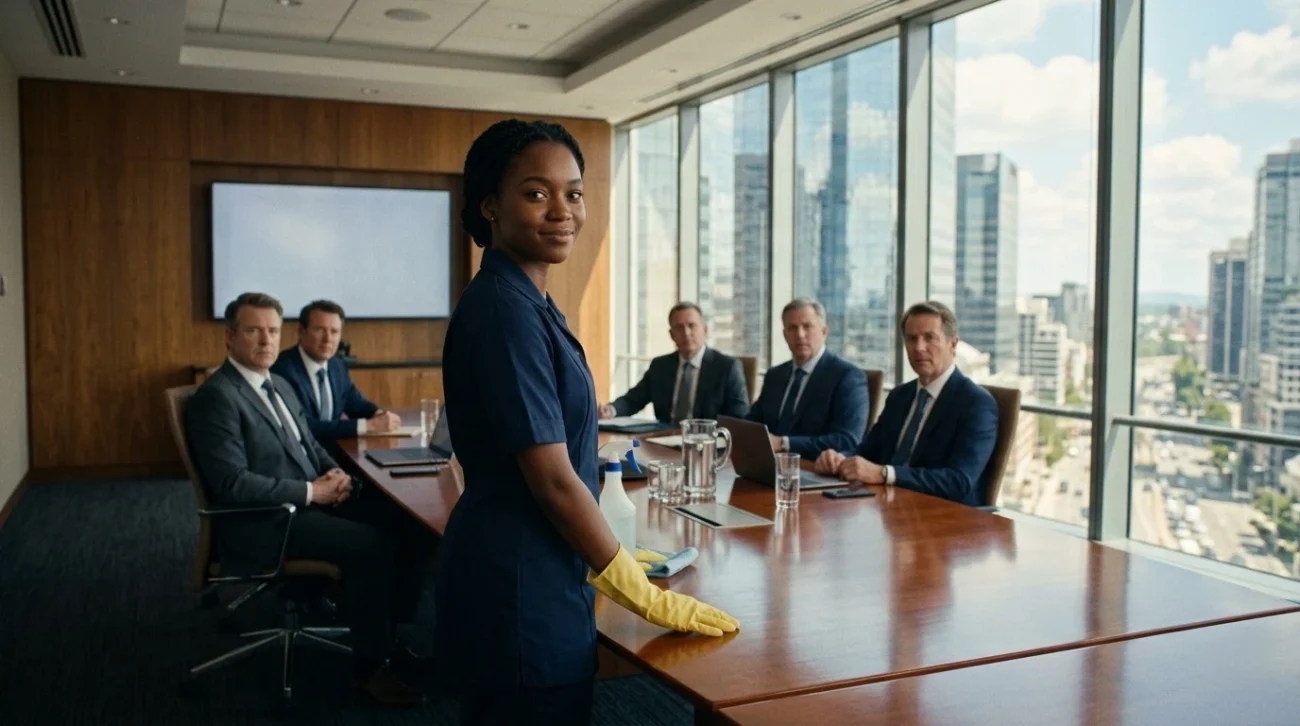
Evelyn arrived at Hawthorne & Beck every morning at 5:47 a.m.
Not because she had to. Because she wanted to see the building before anyone else did—before the masks went on.
She pushed her gray cart through the marble lobby, nodding at the overnight security guard, a soft-spoken man named Doug who always had a thermos of coffee and never once looked through her. Most people did. Looked through her, that is. It was a skill she had cultivated over four years. Invisibility, it turned out, was the most powerful tool in any room.
“Morning, Evelyn.” Doug lifted his thermos. “Cold one today.”
“Always is in January.” She smiled. “Save me some of that?”
“Already did.”
That was the whole of it. Two sentences. More human contact than she’d get from the next forty people to walk through those doors.
Hawthorne & Beck occupied thirty-two floors of glass and steel in downtown Dallas. From the outside, it gleamed. Financial press called it a model of modern enterprise. Inside, it ran on fear.
The fear had a name: Alan Greaves.
Evelyn had watched him for four years. She had learned him the way you learn a weather system—reading the pressure changes, knowing when to get out of the way. When his voice dropped to a murmur in the hallway, someone was about to be destroyed quietly. When it rose, he wanted an audience.
He wanted an audience now.
“Where is the Henderson file?” His voice carried from the glass-walled conference room on the fourteenth floor, cutting through the low hum of the building’s morning start-up. “I asked for it at eight. It is eight-seventeen. Someone in this room apparently does not understand how clocks work.”
Evelyn kept her eyes on the window she was cleaning. She had long since learned not to react.
A young analyst named Priya—twenty-four, first real job, still believed in things—stepped forward with the file. Her hand trembled slightly. “Here, Mr. Greaves. I’m sorry, the printer on this floor—”
“I don’t care about the printer.” He took the folder without looking at her. “I care about results. If you can’t manage a printer, what exactly are you managing?”
The room went silent.
Priya pressed her lips together. Evelyn, three feet away, caught her eye for exactly one second. Just enough to say: You are not what he says you are.
Priya gave the smallest nod. She understood.
Alan didn’t notice. He never did.
What Alan Greaves did not know about Evelyn could fill the folder he’d just grabbed from Priya’s hands.
Her full name was Evelyn Rose Vance. She had a master’s degree in finance from UT Austin. She had spent twelve years working in corporate investment before her husband, Martin, got sick. She had spent the three years after his death figuring out what to do with the company he’d left her.
Martin Vance had been one of Hawthorne & Beck’s original investors. Not a flashy man—he’d have hated being called a visionary—but a patient one. He had watched the company grow from a two-room office with secondhand furniture into the glass tower Evelyn now cleaned. He had accumulated shares quietly, methodically, the way he did everything. When he died, those shares came to Evelyn.
Fifty-one percent of Hawthorne & Beck.
She had sat with that fact for months. She could have walked in on day one, announced herself, taken the corner office. She’d imagined it. The looks on their faces.
But she’d also imagined something else: what she might learn if she didn’t.
So she’d taken a job as part of the cleaning crew. She told herself it would be three months. Three months became four years, because every time she thought she’d seen enough, Alan Greaves found a new way to be worse.
The breaking point came on a Tuesday.
Evelyn was cleaning the executive lounge on the twenty-eighth floor—a room of leather chairs and expensive whiskey that smelled like old money and newer entitlement—when she heard voices through the half-open door to the adjoining boardroom.
She recognized both of them. CFO Dennis Holt and VP of Operations Craig Mercer. Two men who had never once acknowledged her existence.
“Numbers are clean,” Dennis was saying. “Auditors won’t catch it. We’ve done this before.”
“And the headcount?” Craig asked.
“Greaves wants 15% gone before Q1. Rank and file. We protect the bonus pool, take the press hit in February when nobody’s paying attention, and by March it’s yesterday’s news.”
A pause. Ice clinked in a glass.
“Two hundred people,” Craig said. Not like it troubled him. Like he was confirming a lunch order.
“Give or take. Look, they’re not shareholders. They don’t vote. They don’t matter.”
Evelyn set down her cloth.
She stood very still for a moment. Through the narrow gap in the doorway she could see the edge of the table, Dennis Holt’s manicured hand wrapped around a glass of scotch.
They don’t matter.
She thought of Doug at the front desk with his thermos. She thought of the maintenance crew who ate lunch together in the basement and looked out for each other. She thought of Priya, who still believed in things.
She picked up her cloth and finished the room in silence.
That night she called her lawyer.
His name was Raymond Chu, and he had handled Martin’s estate and her legal affairs for eleven years. When Evelyn called him at nine-thirty on a Tuesday evening, he answered on the second ring.
“Evelyn. Everything okay?”
“I need to move,” she said. “The shareholders’ meeting is in six days.”
A beat. “How much do you have?”
“Enough.” She looked at the notebook on her kitchen table—four years of dates, names, overheard conversations, cross-referenced with public filings she’d pulled herself over late-night cups of tea. “I have a lot, Raymond. I’ve been saving it.”
“Are we talking termination, or—”
“Full removal. Criminal referral if the evidence supports it.” She paused. “It supports it.”
Raymond was quiet for a moment. When he spoke, his voice carried the particular weight of a man recalibrating. “I’ll call the independent auditors tonight. We’ll need everything organized by Friday.”
“It already is.”
“Evelyn.” Another pause. “You’ve been sitting on this for four years.”
“I wanted to be sure.” She closed the notebook. “I’m sure.”
The next five days had a strange double quality—outwardly identical to every other week, inwardly electric.
She pushed her cart. She cleaned windows. She refilled coffee stations. She listened.
She heard Alan rehearsing his shareholder address in his office—she caught fragments through the door while she cleaned the corridor outside. Record year. Strategic restructuring. Leaner, stronger, better positioned. The language of men who had decided that people were overhead.
She heard Dennis Holt on a phone call, his voice just low enough that he thought no one could catch it: “Make sure the version that goes to the board is the revised one. Not the original. The original doesn’t leave this office.”
She noted the time. She noted the date. She wrote it down that evening.
On Thursday, she met Raymond at a coffee shop six blocks from the tower. He slid a folder across the table. “Auditors finished the preliminary. It’s bad, Evelyn. Expense fraud going back three years. The harassment complaint suppression is documented. And there are two instances of the financial reports being altered before board distribution.”
“I know.” She’d suspected the last one for over a year.
“This is not a slap on the wrist situation. This is potential criminal exposure for at least three executives.”
“Good.” She put the folder in her bag. “I’ll see you Monday morning.”
The morning of the shareholders’ meeting, Hawthorne & Beck crackled with the specific nervous energy of people who thought they were about to win.
Alan was in early. Evelyn saw him in the lobby at seven-fifteen, moving fast, jacket perfect, already performing. He passed within two feet of her without a glance.
She watched him step into the executive elevator.
She went back to her cart. She had one more thing to do.
At nine-fifty, Evelyn walked into the women’s restroom on the fourth floor. She changed out of her green uniform in one of the stalls—folded it carefully, set it in her bag—and put on the navy suit she’d carried in the bottom of her cart for three days, waiting for this moment.
She looked at herself in the mirror.
Same face. Same hands. Same woman who had emptied Alan Greaves’s trash bin four hundred times.
She picked up the folder Raymond had prepared—thick, tabbed, organized—and took the stairs to the lobby.
Doug looked up from the security desk as she crossed toward the executive elevator. His expression shifted through three distinct phases: recognition, confusion, and then something that looked a lot like satisfaction.
“Mrs. Vance,” he said quietly.
She stopped. “You knew?”
“Martin used to come in sometimes, late nights, after hours.” He smiled. “He talked about you.”
She held his gaze for a moment. “Watch the desk, Doug.”
“Yes, ma’am.”
The executive elevator opened directly onto the thirty-second floor.
The boardroom was visible through glass walls—a long table, ten board members, two finance executives, Alan at the head, already mid-sentence in what appeared to be a pre-meeting warm-up designed to establish that he was in command.
The door to the boardroom was heavy. Evelyn pushed it open.
The sound of rubber soles on polished floor was quiet, but in the way that small sounds become large when a room changes. Heads turned. The conversation stopped mid-word.
Alan looked up.
Something crossed his face that Evelyn hadn’t seen there before. Just for a fraction of a second, before contempt closed over it like a shutter.
“What is this?” He said it to the room, not to her. “Can someone explain why the cleaning staff has access to—”
“I’m not here to clean.” Evelyn set the folder on the table. It landed with a sound that was heavier than its weight. She slid copies—Raymond had prepared ten—across to each board member with the quiet efficiency of a woman who had spent four years learning how this building worked. “My name is Evelyn Vance. I’m the widow of Martin Vance, and I hold 51% of the outstanding shares in this company.”
Silence.
Not the polite silence of a pause. The silence of a room full of people trying to recalculate everything simultaneously.
“That is—” Alan stood. He was taller than her by a foot, and he used it. “That is absolutely absurd. Security—”
“Sit down, Alan.” Her voice was level. Not loud. She didn’t need loud. “You’ve called security twice in four years when you wanted someone removed. Both times it was a woman. Both times the complaint was filed and buried. The documentation is on page eleven.”
The board member at the far end of the table—gray-haired, seventy, a man named Gerald Park who had co-founded the firm thirty years ago and watched it become something he barely recognized—opened the folder.
He began to read.
Alan’s voice went up. “This is a performance. This is some kind of—she’s the cleaning woman, she doesn’t have—Gerald, don’t—”
“Alan.” Gerald didn’t look up. “Be quiet.”
The two words landed like a verdict.
Alan Greaves tried four more times in the next ten minutes to reassert control of the room.
“This woman has no credentials here—”
“Page four,” Evelyn said. “Share transfer documentation filed with the SEC fourteen months after Martin’s death. It’s public record.”
“The audit is fabricated—”
“The auditing firm is Kellerman & Associates. They’ve been independent of this company for eleven years. Their full methodology is in the appendix.”
“I want a lawyer present before any—”
“You’re welcome to call one.” Evelyn pulled out a chair and sat. “We’ll wait.”
He didn’t call one. He knew what a lawyer would tell him.
Gerald Park finished the first section of the report, set it down, and looked at Evelyn across the table with an expression that carried years of complicated weight. “Mrs. Vance. How long have you known about the financial irregularities?”
“I’ve had evidence of the expense fraud for two years. The altered reports—” she paused, “—eight months.”
“And you waited.”
“I needed it to be complete.” She met his eyes. “I needed there to be no way out.”
Gerald nodded slowly. He looked at the other board members. “I think we need to proceed to a formal vote.”
Alan’s voice cracked. “Gerald. Gerald, we built this—you can’t let a—”
“Alan.” Gerald’s voice was very tired. “I’ve watched you run this place for six years. I told myself the results justified it. The results didn’t justify it. Nothing justifies page eleven.”
The vote was eight to zero. Two board members abstained—both of them members of Alan’s executive circle who understood that abstaining was the best outcome available to them.
Evelyn didn’t say anything theatrical. She had thought, over the years, about what she might say in this moment. She’d drafted speeches in her head during night shifts, elaborate takedowns, perfect sentences. She’d discarded all of them.
In the end she said: “Alan. Your access cards will be deactivated at noon. Security will assist you with your personal belongings. I’d like the process to be orderly.”
He stared at her. The contempt was gone. What was left was something more naked—a man whose entire self-conception had just been surgically removed.
“You’ve been here,” he said. His voice was different now. Smaller. “This whole time. Cleaning. Watching.”
“Yes.”
“Why? If you had the shares, why would you—”
“Because I wanted to know what it looked like,” she said. “From the ground. Without the filter.” She paused. “Now I know.”
He left without another word. His assistant met him at the elevator with a cardboard box that had been quietly prepared—someone in the building had clearly been waiting for this day for a long time.
The elevator doors closed.
Evelyn looked at the ten remaining people in the room.
“I’d like to talk about the 200 people scheduled for termination,” she said. “Specifically, I’d like to talk about not doing that.”
Gerald Park stayed late that evening.
He found Evelyn in the boardroom after the others had gone, standing at the window, looking at the Dallas skyline that Martin had loved. Gerald had known Martin. Not well, but enough to know the kind of man he was—the kind who built things carefully and meant them to last.
“You could have come in on day one,” Gerald said. “Announced yourself. Saved yourself four years of pushing a cart.”
“I know.”
“Why didn’t you?”
Evelyn was quiet for a moment. “Martin always said the most important thing about a company isn’t what it says about itself. It’s what it does when it thinks no one important is watching.” She turned from the window. “He was right.”
Gerald looked at the folder on the table—the evidence she’d spent four years assembling, methodical as Martin himself. “What do you need from the board?”
“Cooperation. Transparency. And someone to help me rebuild the HR department from scratch, because the current one is—”
“Compromised. Yes.” He exhaled. “I know. I should have—”
“Gerald.” She stopped him. “What you should have done doesn’t change what we do next.” She picked up the folder. “I have a list.”
He looked at her for a moment with the expression of a man who has watched a building he thought he understood reveal a completely different architecture. Then he nodded. “I’d like to see it.”
The news moved through Hawthorne & Beck the way news always moved—faster than it had any right to, in pieces that were each partially wrong but cumulatively true.
By three o’clock, every person in the building knew that Alan Greaves had left in a cardboard box. By four, they knew why. By five, the version that was closest to true had settled: the cleaning lady owns the company. She’s been here the whole time. She has everything.
Priya, the analyst with the trembling hands, found out from a colleague and stood at her desk for a long moment processing it. Then she sat down and, for the first time in eight months at Hawthorne & Beck, felt the particular relief of a room where the temperature has finally dropped to something survivable.
Doug, at the security desk, heard the news from three different people in the span of twenty minutes, each one slightly more astonished than the last. He accepted all three versions with a nod and said the same thing each time: “Not surprised.” Because he wasn’t.
Evelyn came back the next morning at 7 a.m.
Not with the cart. With a leather portfolio and flat shoes and the kind of calm that comes from four years of knowing exactly what you’re walking into.
She went to the basement break room first.
The morning cleaning crew was there—six people, three of whom she’d worked alongside for over a year. When she walked in, the room went quiet. Then Maria, who had the locker next to Evelyn’s and made spectacular tamales at Christmas, said: “So. You’re the boss.”
“I’m the owner,” Evelyn said. “There’s a difference. Can I sit?”
She sat. She had coffee with them. She listened to them—really listened, the way she’d been listening for four years—and she asked what would make their work easier, safer, more fairly compensated. She wrote things down.
She spent the rest of that first day doing the same thing on every floor.
In the weeks that followed, Evelyn moved fast.
Wages for support staff went up across the board—cleaning, maintenance, reception, security. Not token amounts. Meaningful ones. She had run the numbers; the company could absorb it comfortably and had been choosing not to.
The planned layoffs were cancelled. The budget they would have freed up went into the training program she built with input from the people who actually did the jobs.
The HR department was dissolved and rebuilt from scratch. The new director came from outside the company and reported directly to the board, not to the CEO’s office.
She promoted Priya to a role that matched what Priya had actually been doing for the past eight months—which was, it turned out, considerably more than her job description.
“You don’t have to do this,” Priya told her, the day the new title came through. They were standing in the hallway outside the fourteenth-floor conference room—the same hallway where Alan had asked Priya what she was managing.
“I know I don’t,” Evelyn said. “That’s rather the point.”
Six weeks after the shareholders’ meeting, Evelyn received a letter from the district attorney’s office informing her that the evidence she’d submitted had resulted in a formal investigation into Alan Greaves and Dennis Holt. The letter used careful legal language, but its meaning was clear: the trap had been complete. There were no gaps to slip through.
She read it twice at her desk—Martin’s old desk, which she had moved back into the corner office it had originally occupied before Alan had it removed to make room for a larger conference table.
Then she put it in the folder with everything else and locked the drawer.
Three months later, a young man knocked on her open office door.
She recognized him immediately. The intern Alan had made cry over a spilled glass of water. He’d grown since then—not just taller, something in his bearing. He introduced himself as James.
“I wanted to say thank you,” he said. “Not for the promotion—though, genuinely, thank you for that too. For—” He stopped. Found the words. “When you looked at me. That day in the hallway. You were the only person in the building who looked at me like I was a person.”
Evelyn was quiet for a moment.
“You were the easiest person in the building to look at like a person,” she said. “Because you clearly were one.” She tilted her head. “How do you like the new role?”
He smiled—fully, without the anxiety behind it. “It’s good. It’s really good.”
“Good.” She picked up her pen. “Close the door on your way out. And James—if something’s wrong in this company, my door is open. That’s not a figure of speech.”
“I know,” he said. “Everyone knows.”
He left. Evelyn looked out the window at the Dallas skyline.
She thought of Martin, who had built something and trusted her to protect it.
She thought of four years of early mornings and gray carts and conversations no one thought she was listening to.
She thought of Alan Greaves in a cardboard box, and felt no cruelty about it—only the clean, settled feeling of a thing correctly resolved.
Then she picked up the folder on her desk—the next item on the list—and got back to work.
Original fictional stories. AI-assisted creative content.
