
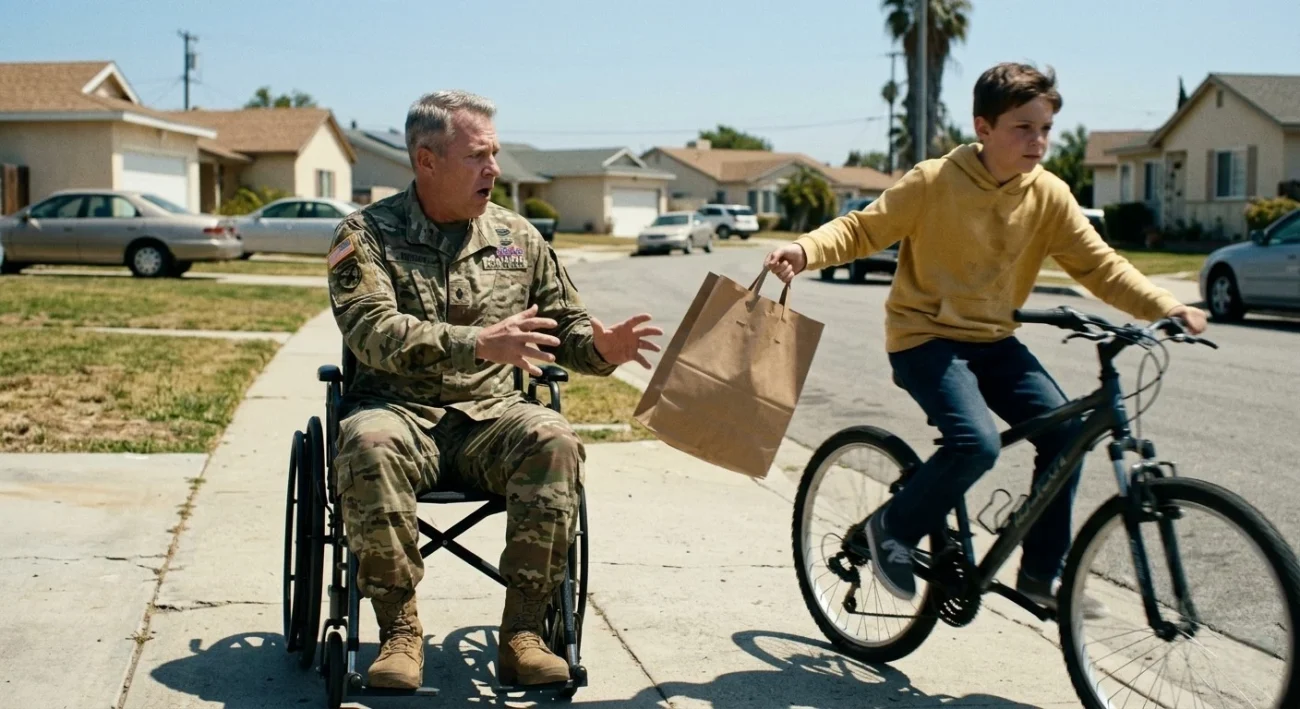
Marcus Reed hadn’t asked for much when he came home.
A roof. A routine. Maybe a little quiet.
What he got was a pension that laughed at the cost of groceries and a body that didn’t work the way it used to.
He pushed the wheelchair himself. Always. Even when his shoulders burned and the cracked California pavement fought him every foot of the way. Accepting help felt like the last piece of himself he wasn’t willing to give up.
It was barely noon, but the sun was already punishing. White and flat and relentless, the kind of light that stripped everything to its bones.
Marcus squinted at the sidewalk ahead, the familiar squeak of his left wheel keeping time. In his lap: a brown paper bag from the corner store. Instant ramen. Two packs. A can of soup. Seventeen dollars and change, which was most of what he had until Friday.
He’d been a staff sergeant. He’d run logistics for a forward operating base in Kandahar. He’d once coordinated the resupply of forty-six soldiers under fire.
Now he was rationing ramen.
He heard them before he saw them.
The clicking of bike chains. The sudden rush of wind. A yellow blur at the edge of his vision.
A hand shot out — quick, practiced, clean.
The bag was gone.
Marcus spun the chair with one hard push, his jaw locking. “Hey! That’s mine! Stop!”
His voice came out bigger than he expected. Parade-ground loud. The kind of shout that had once frozen privates in their tracks.
The kids didn’t freeze.
Three of them — yellow hoodie, green jacket, a girl in a red cap — were already pedaling hard, weaving between parked cars. Their backpacks bounced. One of them laughed, but it was the high, nervous kind of laugh. Not cruel. Startled.
“Stop!” Marcus shouted again, already pushing after them.
His arms churned. The wheels scraped. The paper bag and everything in it got smaller and smaller until it vanished around the corner.
He sat there a moment, breathing hard.
The empty space in his lap felt enormous.
It’s not about the ramen, something in him said. It’s never about the ramen.
He pushed anyway.
He didn’t know why. There was nowhere productive to push to. He wasn’t going to catch three kids on bikes. He wasn’t going to recover seventeen dollars worth of soup and noodles. He wasn’t going to undo whatever that moment had just done to him.
But stopping felt worse.
So he pushed.
Around the corner. Down the block. Left at the dead end sign into the cul-de-sac at the bottom of the hill.
He expected them to be gone.
They weren’t.
All three bikes were dropped on the grass at the edge of the sidewalk. The kids were huddled in a circle on the concrete, heads bent over something. The brown paper bag sat in the center of their circle like a campfire.
Marcus slowed.
None of them were laughing now.
The girl in the red cap had her phone out. Not filming. Typing, fast, with both thumbs.
The boy in the yellow hoodie — the one who’d taken the bag — was unzipping his backpack. He reached in and pulled out something wrapped in foil. A whole slice of pizza, still in the tinfoil from his lunch. He set it carefully in the bag.
Marcus stopped moving.
The kid in the green jacket pulled out a loaf of bread. Actual bread, the kind with a twist tie at the top. He set it in the bag, then reached in again and produced three bananas in a bunch.
The girl looked up from her phone, saw the bag wasn’t big enough, and took off her own backpack. She pulled out a Ziploc bag of apple slices and a container of baby carrots and a small bunch of grapes. She arranged them next to the bread like she was stocking a shelf.
None of them spoke.
None of them looked at each other for approval.
They just kept adding.
Marcus watched from ten feet away and didn’t make a sound.
The boy in yellow reached into the bag now, shifting things around to make room. He was frowning with concentration, the way Marcus had seen good privates look when they were solving a packing problem under pressure. Not panicking. Thinking.
“It’s not enough,” the boy in green said quietly.
“It’s what we have,” the girl said.
“We should’ve gotten more.”
“We didn’t know.” She paused. “We know now.”
The boy in yellow sat back on his heels. He stared at the bag for a second, then looked up and saw Marcus.
All three of them froze.
For a long beat, nobody moved. Nobody spoke.
Then the girl grabbed her backpack. “Go,” she said, the word barely above a whisper.
They were on their bikes in four seconds. No eye contact. No explanation. No waiting to see his face.
They pedaled out of the cul-de-sac and disappeared around the corner, the clicking of their chains fading until the street was completely silent.
Marcus sat with the bag for a moment before he moved.
The harsh midday light had shifted while he wasn’t paying attention. The sun had crossed behind a cloud — just briefly, just enough — and the bleached whiteness of everything had gone slightly golden. Not warm, exactly. Just less brutal.
He wheeled forward slowly.
Looked down at the bag.
It was overflowing.
The ramen was still in there, pushed to the side. But on top of it: the pizza slice in foil, the loaf of bread, the bananas, the apple slices, the carrots, the grapes. A granola bar — the fancy kind, dark chocolate chip — that he hadn’t even seen one of them put in. A water bottle.
These kids hadn’t gone home and raided their pantries. They hadn’t had time. This was their lunch. The food they’d packed this morning, the food their parents had sent them to school with, the food they were supposed to eat themselves.
And they’d emptied it all into a bag for a stranger.
Marcus reached out one hand.
He didn’t pick anything up. He just pressed his palm flat against the side of the bag, his fingers curling around the rough paper edge.
The bag crinkled under his grip.
“Sergeant Reed.”
He hadn’t heard anyone come up behind him. He turned, expecting — he didn’t know what. But the cul-de-sac was still empty. The voice had been his own. Old habit. The way he used to report to himself before a difficult task.
He cleared his throat.
“You have a resupply,” he said, to no one. To himself. To the empty street.
He sat there a moment longer. The cloud passed. The harsh white light came back.
But it felt different now. Like the same light hitting a different man.
He was three blocks from home when the car slowed down beside him.
A silver sedan. A woman in her forties, her window already down, her expression creased with the specific concern of someone who wasn’t sure if she was overstepping.
“Sir?” she said. “Are you — I’m sorry, I just — I live on Magnolia. I saw what happened.”
Marcus looked at her.
“My son,” she said carefully, “is the one in the yellow hoodie.”
He waited.
“He called me when they were biking back. He was crying.” She exhaled. “He said — he said they grabbed your bag because they thought it would be funny. And then they looked inside and realized what was in it, and —” She stopped. “He’s eleven. He doesn’t always think before he does things. But when he figures out he’s wrong, he—”
“Ma’am,” Marcus said.
She stopped talking.
“Your son did fine,” he said.
She blinked rapidly. Pressed her lips together. Nodded a few times, the way people do when they’re trying not to cry in front of strangers.
“Can I — is there anything you need?” she asked. “I could—”
“I’ve got groceries,” Marcus said. He looked down at the overflowing bag in his lap. “I’m good.”
She looked at the bag. She looked at him.
“Okay,” she said softly.
She drove away.
Marcus sat in front of his building for a few minutes before going inside.
He wasn’t sure what to do with what had just happened. There was no field manual for this. No debrief format. No after-action report that would make sense of three kids on bikes emptying their lunch bags into a paper bag for a man they’d just robbed.
He’d been thanked for his service a thousand times in the six years since he’d been home. At the airport, at the grocery store, by people at restaurants who’d covered his check without asking. Every time it landed the same way: like a hand patting the glass over a framed photo. Respectful. Distant. Gone before it settled.
This had not been that.
Those kids hadn’t known he was a veteran. They hadn’t seen the uniform — he wasn’t wearing it today, just jeans and a gray t-shirt. They hadn’t done it for credit, or because they were supposed to, or because some authority figure was watching.
They’d done it because they’d looked in the bag and done the math and decided, quietly and without fanfare, that it wasn’t right.
And then they’d fixed it with what they had.
He pulled out his phone.
Opened a new message to his sister in Sacramento.
“I’m good,” he typed. “Had a weird day. Good weird. Tell the kids I said hi.”
He hadn’t messaged her in six weeks. She’d been leaving voicemails.
He put the phone back in his pocket, picked up the grocery bag, and wheeled himself through the front door.
That evening, he made actual food for the first time in weeks.
He sliced the bread. Laid out the fruit. Heated soup on the small stove in his one-bedroom apartment and ate it at the table, not on the couch, not with the TV on.
Just at the table. With food that someone had given him.
Not as pity.
As proof.
Three days later, he called the VA.
He’d been putting off the appointment for four months — a benefits review, the kind that required paperwork and waiting rooms and explaining yourself to someone with a clipboard. Every time he’d almost called, something had stopped him. Pride, maybe. Or exhaustion. Or the vague, corrosive belief that whatever he asked for, he’d get less.
The woman who answered had a Midwest accent and a no-nonsense manner that he liked immediately.
“Staff Sergeant Marcus Reed,” he said. “I need to reschedule my benefits review. I keep canceling. I’d like to stop doing that.”
“Good,” she said, without missing a beat. “How’s Thursday at two?”
“Thursday at two works.”
“We’ll see you then, Sergeant Reed.”
He hung up. Sat with the phone in his hand.
Outside his window, the late afternoon light was coming in at a low angle, catching the dust motes in the air and turning them gold. The kind of light that made a one-bedroom apartment look, for just a moment, like somewhere worth being.
Marcus Reed was fifty-one years old. He had two Purple Hearts, a titanium rod in his left femur, and a pension that still didn’t cover rent and groceries both.
He also had a Thursday appointment.
He also had a sister in Sacramento who picked up on the second ring.
He also knew, now — had it confirmed in the most unexpected way possible — that the world still contained eleven-year-olds who would empty their lunch bags on a sidewalk for a stranger, and then pedal away before anyone could say thank you.
That was not nothing.
That was, he decided, quite a lot.
He washed the dishes. He went to bed before midnight. In the morning, he opened the blinds.
For the first time in a long time, the light didn’t feel like something to survive.
It just felt like morning.
Original fictional stories. AI-assisted creative content.
