
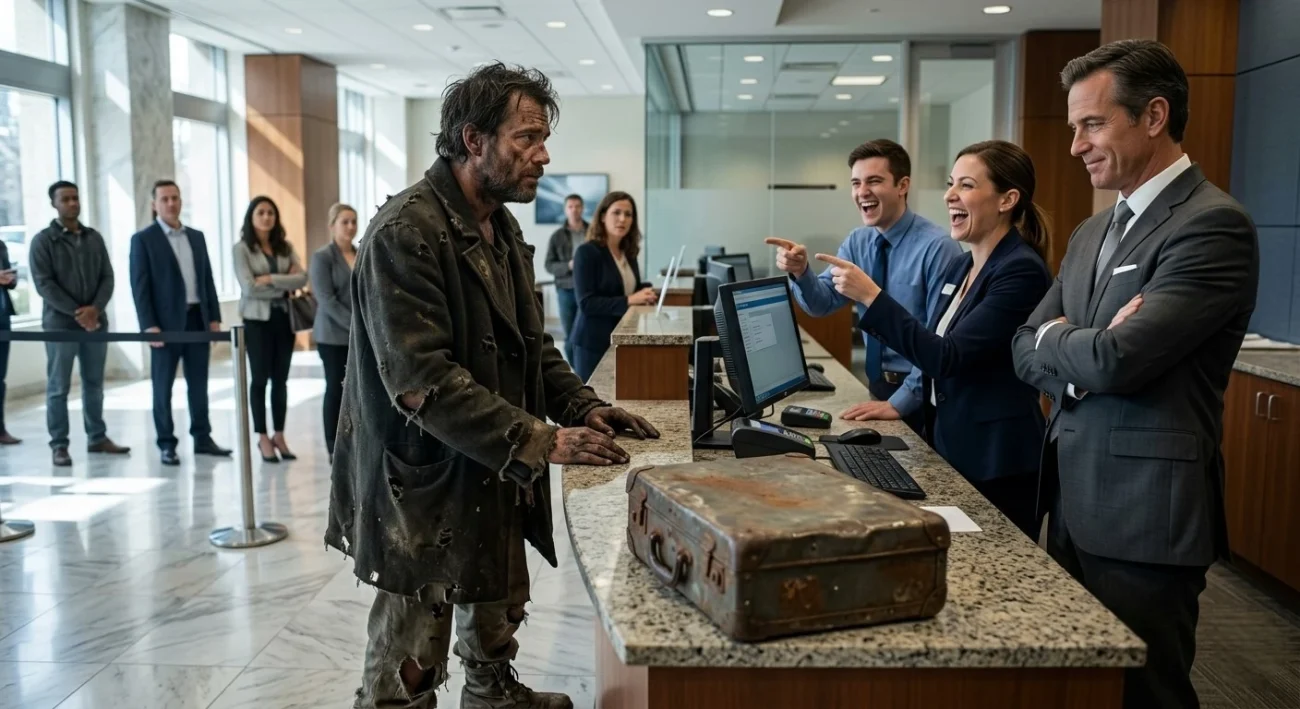
The First National Bank of Crestfield smelled like recycled air and someone else’s money.
Elias Crane walked in at 11:47 a.m. on a Tuesday. He wore a faded teal work shirt, collar frayed at one edge. His joggers had a smear of engine grease near the left knee. His boots had seen mud that morning and hadn’t been wiped.
He was carrying a suitcase. Old. Rusted at the hinges. The kind of thing you’d expect to find in a condemned building, not a bank lobby.
He got in line.
The woman ahead of him glanced back. Then glanced again. She shifted her purse to her other shoulder and took a half-step forward.
Elias didn’t notice, or if he did, he didn’t care.
He stepped up to Service Desk 3.
Derek Whittaker, branch manager, was already watching from the moment Elias walked through the doors. He had a gift—he called it situational awareness, his staff called it something less flattering—for reading who belonged and who didn’t.
This man did not belong.
Whittaker smoothed his silk tie, a reflex, and walked over.
“Sir.” He didn’t say it warmly. “Can I help you?”
“I’d like to make a deposit,” Elias said.
“A deposit.”
“Yes.”
Whittaker looked at the suitcase the way a man looks at something he doesn’t want to touch. “We have… specific procedures for large cash deposits. Compliance requirements. Pre-scheduled appointments. Documentation.”
“I’ve got documentation,” Elias said. He patted his shirt pocket.
“I’m sure you do.” Whittaker kept his voice smooth. Practiced. The voice of a man who had spent twenty years politely removing inconveniences. “But I’m afraid this branch isn’t equipped to handle this type of… collection today.”
“Collection,” Elias repeated. Flat. No inflection.
“We have regular clients waiting. I’m sure you understand.”
Elias looked around the lobby. Two elderly women at a teller window. A young couple at a desk in the corner, signing paperwork. A man in a gray suit reading his phone.
The lobby was not busy.
“I can wait,” Elias said.
Whittaker’s jaw tightened. He turned his head slightly and nodded once—a small, practiced gesture—toward the security desk.
Officer Dale Miller, thirty-two, two years with the bank, caught the signal and started moving.
“Let’s go, pal.” Miller’s hand landed on Elias’s shoulder. Firm. Not violent, but not asking either. “You’re making people uncomfortable.”
“I haven’t done anything,” Elias said.
“I know, I know.” Miller kept his voice low, the way you talk to someone you’re not quite sure about. “But the manager’s asked you to leave, so we’re gonna do this the easy way, okay?”
“I just want to make a deposit.”
“Sir—”
“That’s all I want to do.”
“Sir.” Miller’s grip tightened. “Let’s move.”
The tellers were watching now. The couple at the desk in the corner had stopped signing. One of the elderly women at the window had turned completely around, clutching her handbag with both hands.
Elias didn’t resist. He picked up the suitcase and walked with Miller toward the door.
Whittaker held the glass door open himself—a theatrical gesture, the kind that said I am gracious even when removing you.
The midday sun hit hard.
The door hissed shut behind them.
“And stay out.” Whittaker said it through the glass, voice muffled but the words clear enough from his expression. He straightened his jacket. Behind him, Miller crossed his arms and planted himself at the entrance like a period at the end of a sentence.
Elias stood on the sidewalk.
He didn’t look angry. He didn’t look humiliated. He looked like a man calculating something.
He walked ten steps to the curb.
Parked at the meter—legally, two minutes left on the ticket—was a Lamborghini Gallardo. It was painted Arancio Borealis, a shade of orange so vivid it looked like it had been lit from inside. It sat low against the asphalt, crouched like something about to sprint.
Several people had already slowed down to look at it.
Elias reached into his pocket. A key fob. The car chirped once and blinked its lights.
He set the rusted suitcase on the hood.
The latches clicked open.
He swung the lid.
Inside the suitcase, stacked in clean, tight bricks, was cash. Not rolled bills, not loose money—stacked, banded, organized. Hundreds of thousands of dollars. The kind of liquidity that doesn’t come from an ATM or a lucky weekend. The kind that comes from years of work, or a very good investment, or both.
Elias didn’t count it in front of them. Didn’t fan it. Didn’t perform.
He just stood there, lid open, one hand resting on the edge of the suitcase, looking back at the bank.
The bank looked back.
Whittaker had moved to the window. He was standing very still. Miller was beside him. Both of them stared at the orange car, the rusted suitcase, and the man they’d just shoved out the door.
A woman on the sidewalk took out her phone.
A delivery driver slowed his bike to a stop and stared.
Whittaker stepped outside.
His tie was still straight. His jacket was still smooth. But something had shifted in his posture—the small, almost invisible collapse of a man who has just understood something terrible.
“Mr.—” He stopped. He didn’t know the man’s name. He hadn’t asked. “Sir. If you’d like to come back inside, we can absolutely—”
“I’m good,” Elias said.
“I want to apologize for the confusion earlier. There was a miscommunication, and I—”
“There wasn’t a miscommunication,” Elias said. He wasn’t loud. He wasn’t heated. He was very, very calm. “You looked at my boots and made a decision. That’s not a miscommunication. That’s a decision.”
Whittaker opened his mouth. Closed it.
“I’ve been banking with Meridian Trust for eleven years,” Elias said. “My accountant has been after me to diversify. I thought I’d try somewhere local.” He looked at the bank’s signage above the door. “I guess I got my answer.”
“Sir, I assure you—”
“My name is Elias Crane.” He let that sit for a second. “You can look that up.”
Whittaker looked like he already knew what he’d find. The color had drained from his face in the specific way it drains from someone who has just realized the size of the mistake they’ve made.
Elias closed the suitcase.
He moved it from the hood to the passenger seat, set it down gently, and walked around to the driver’s side.
Miller had followed Whittaker out. He was standing a few feet back, arms no longer crossed, hands loose at his sides. He looked like a man who wished he was somewhere else.
“I—I’m sorry,” Miller said. Quietly. Like he actually meant it. “I was doing my job, but I—that doesn’t make it right.”
Elias looked at him for a moment.
“I know,” he said. Not warmly. Not coldly. Just true.
He got in the car.
The V10 engine caught with a sound like controlled thunder.
Whittaker stood on the sidewalk and watched. He was still standing there as the Gallardo pulled away from the curb, the engine note dropping as Elias shifted gears and eased into traffic. No tire spin. No show. Just the car moving, unhurried, through the midday city.
The woman with her phone was still recording.
Whittaker turned around and walked back into the bank. The glass door closed behind him.
Miller stayed outside for another thirty seconds. He looked at the empty parking spot. The faint smell of exhaust. The scuff mark the suitcase had left on the hood of a car worth more than his yearly salary.
Then he went back inside too.
Forty-five minutes later, in the office of the regional director, Whittaker’s phone rang.
He let it go to voicemail.
It rang again.
“Derek.” The regional director’s voice was careful in that way voices get when something has gone wrong at a level that involves lawyers. “I need you to tell me what happened today.”
“It was a misunderstanding,” Whittaker said. “A walk-in, no appointment, unusual presentation—”
“Elias Crane.”
Whittaker stopped.
“You know that name,” the director said.
“I… looked him up after—”
“He’s been flagged as a potential high-net-worth acquisition target for six months. His account at Meridian Trust has a nine-figure balance, Derek. Nine figures. And he walked into your branch today.”
Whittaker said nothing.
“And you had security remove him.”
The silence on Whittaker’s end was not the silence of a man thinking. It was the silence of a man watching something collapse.
“I’m going to need you to write a full incident report,” the director said. “And then I’m going to need you to come see me. Today.”
“Yes sir.”
“And Derek.”
“Yes.”
“Don’t call him. Don’t email him. Don’t send a gift basket. Don’t do anything.” A pause. “You don’t get to fix this.”
The line went quiet.
Elias pulled into the underground parking garage of a glass tower on the east side of the financial district.
He rode the elevator to the twenty-third floor.
His accountant, a compact woman named Sandra, was waiting at a round table with two cups of coffee and a folder.
“How’d it go?” she asked.
“Cross them off the list,” Elias said.
She made a note. “Meridian it is, then.”
“Meridian it is.”
He sat down. Took the coffee. Looked out at the city through the floor-to-ceiling windows.
“You want to hear something funny?” he said.
“Always.”
“The guy who threw me out—I could see it the second I walked in. The look. I’ve gotten that look my whole life.” He turned the coffee cup slowly in his hands. “Shipyard, warehouse, job sites. Walk in dirty and they decide who you are before you open your mouth.”
“And?”
“And it used to bother me.” He set the cup down. “Now I almost feel sorry for them. They never find out what they just lost. They just go home thinking they did the right thing.”
Sandra looked at him.
“Almost feel sorry,” she said.
“Almost,” Elias confirmed.
The next morning, a local financial reporter posted a three-minute video. She’d been on the street corner for a different story—a segment on small business parking regulations, utterly unglamorous—when the orange Lamborghini pulled up and the rusted suitcase came out.
She’d filmed the whole thing.
The caption read: When the bank judges the cover, not the book.
By noon it had two million views.
By four p.m. the bank’s regional communications team had issued a statement about their “commitment to respectful service for all clients.”
By six p.m., Whittaker had been placed on “administrative review.”
His photo wasn’t in the statement.
His name wasn’t in the statement.
But three people who’d been in the lobby that day had already commented on the video. And the internet, when it decides to find something, is thorough.
Elias saw the video that evening, sitting in his home in the quiet neighborhood on the city’s west side. A three-bedroom house with a workshop in the back where he still spent most of his weekends. The Gallardo was in the driveway because he hadn’t yet built a garage big enough for it and that still made him smile.
His phone was blowing up. Friends, old coworkers, his nephew.
He watched the video once. Then he put his phone face-down on the table.
There was a bowl of soup on the stove that needed his attention.
He ate it at the kitchen counter, looking out the window at the street.
He wasn’t angry. He hadn’t been angry at the bank, not really. Anger was for people who were surprised. Elias had stopped being surprised by that particular look a long time ago.
What he felt was something closer to tired.
Tired of the test. Tired of having to pass it. Tired of the fact that the test existed at all—that a man still had to drive a quarter-million-dollar car and open a suitcase full of cash before certain rooms would take him seriously.
He rinsed the bowl. Dried it. Placed it back in the cabinet.
He thought about the security officer—Miller. The apology on the sidewalk. That doesn’t make it right. He’d meant it.
That mattered. A little.
Two weeks later, Elias finalized his relationship with Meridian Trust—three new accounts, structured investment portfolio, formal private client onboarding. His contact there was a woman named Carol Hastings. She’d been at Meridian for twenty-two years. On their first call, she’d asked about his work, his background, what he was hoping to build.
She’d listened before she’d talked.
“I like this bank,” he told Sandra afterward.
“I know,” Sandra said. “I picked it.”
Three months after the incident, First National’s regional director announced a “comprehensive client experience review,” which was corporate language for: we are trying to make sure this never happens again on camera.
Whittaker was reassigned to a non-client-facing compliance role in a satellite office forty miles from the city.
He did not issue a public statement.
He did not reach out to Elias.
He sat in his new office, in a building with fluorescent lighting and no marble floors, and did his work, and tried not to think about the rusted suitcase or the orange car or the long, quiet look a man had given him from the curb.
He mostly failed.
Officer Dale Miller requested a transfer eight weeks after the incident.
He moved to a community liaison position with a nonprofit that worked with housing-insecure residents in the city’s north neighborhoods. The pay was lower. The hours were longer.
He slept better.
The rusted suitcase sat in the corner of Elias’s workshop.
He kept it. Not as a trophy. Not as a symbol.
He kept it because it had belonged to his father, and his father had carried it for thirty years on job sites across four states, and the money inside had been Elias’s father’s savings—accumulated in cash over a lifetime, handed to his son six months before he died, with a note that said: Don’t let anyone tell you what you’re worth.
Elias had meant to deposit it that day. A kind of memorial, he thought. Put the old man’s money somewhere official. Give it a home.
He hadn’t gotten the chance.
He didn’t mind anymore.
The money was at Meridian now, working quietly in the background of Elias’s life. But the suitcase stayed in the workshop, rusted and battered, sitting next to a shelf of tools that still got used every weekend.
Some things you don’t upgrade.
Some things you keep exactly as they are.
Original fictional stories. AI-assisted creative content.
