
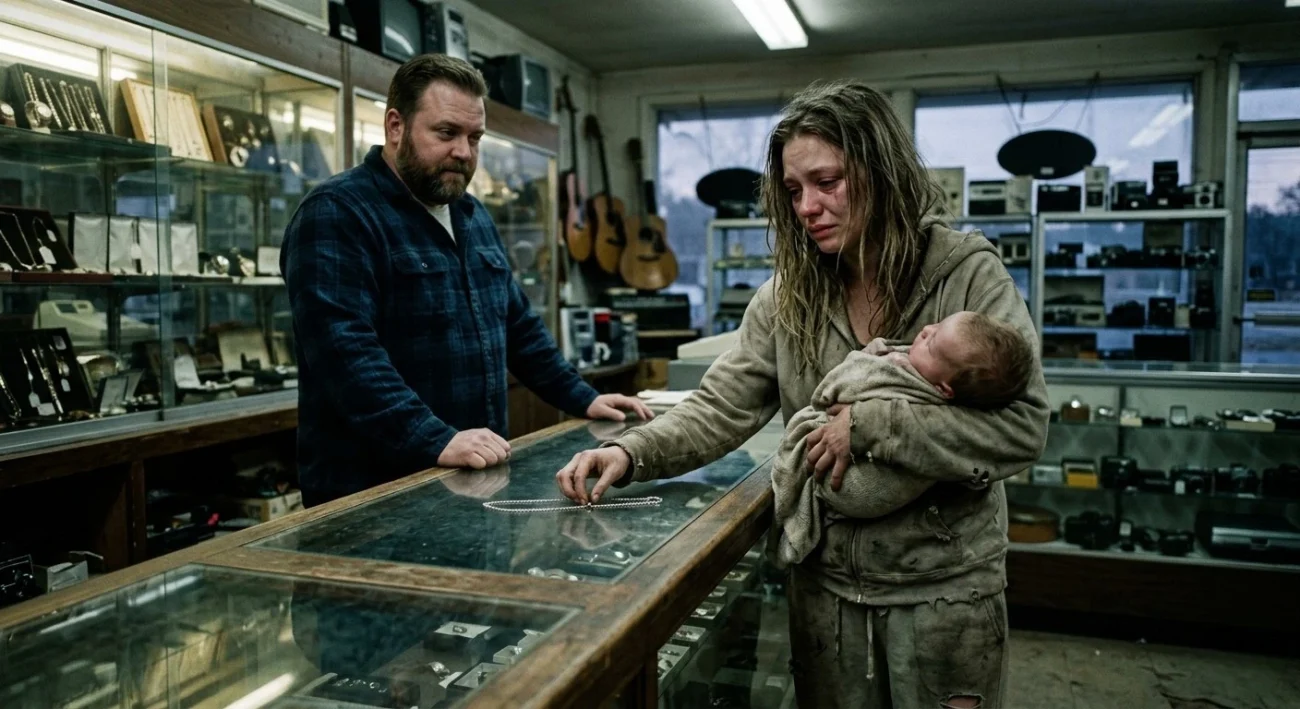
The bell above the door of Miller’s Pawn & Loan hadn’t surprised Mark in twenty years.
He knew every sound this shop made. The groan of the glass counter when someone leaned too hard. The rattle of the security door when the latch caught wrong. The particular hollow chime of that bell—sometimes sharp and hopeful, more often slow and defeated.
This one was slow.
She came in wearing a yellow sundress that had been through too many wash cycles. She was young—mid-twenties, maybe—with the kind of tired that sleep couldn’t fix. She was carrying a baby on her hip, a girl barely a year old, and the baby had her mother’s eyes: wide, watchful, already too old for her age.
Mark didn’t look up from the display case he was cleaning.
“Help you?” he said.
“I—yeah.” She shifted the baby to her other hip and approached the counter with the slow walk of someone preparing for rejection. “I have something I need to pawn.”
She set a silver Cuban-link chain on the glass. Heavy. Solid. The kind of chain that meant something to somebody once.
Mark picked it up. Felt the weight. Checked the clasp for a hallmark.
“Sterling,” he said. “Nice craftsmanship.”
“My husband’s.” Her voice stayed even, but just barely. “He passed away last March.”
Mark turned the chain over once more under the light. He’d seen a thousand of these. Each one a story he didn’t ask for.
“Five hundred,” he said.
She didn’t flinch the way most people did—that quick intake of breath, that moment of silent protest. She just nodded, like she’d already done the math on her way over and had already grieved the number.
“Okay,” she said softly.
“You understand this is a pawn? You’ve got ninety days to buy it back at—”
“I won’t be able to buy it back.” She met his eyes for the first time. “Just—please. Take it.”
Mark counted out five hundreds from the drawer and slid them across the glass. She folded them without counting, pushed them into her purse, and picked her baby back up.
“Thank you,” she said.
The bell chimed again. The slow kind.
Mark dropped the chain into the scrap bin behind him, then turned to log the transaction. Date. Weight. Hallmark. Payout.
His hand stopped.
He’d already turned back to reach for the chain. He didn’t know why. Force of habit, maybe—double-checking the clasp before tagging anything.
He turned the chain over under the counter light.
There was an engraving on the back of the clasp. Tiny. Hand-stamped, not machine-printed. The kind someone paid extra for because they wanted it to mean something.
To my rock. Always beside you.
Mark stood still for a long moment.
He hadn’t thought about his father in a while. He thought about him now.
- His dad—Ray Miller, carpenter, union member, hands that could build anything except a way out of debt—walking into a place like this one. Quieter. Dirtier. The pawnbroker behind the counter hadn’t looked up from his newspaper. Ray had set down his father’s gold watch, a Hamilton railroad piece from 1952, and waited.
The guy hadn’t even held it up to the light. “Sixty bucks,” he’d said.
Ray had taken the sixty dollars without a word.
That night, Mark had found his father sitting on the back porch in the dark, not moving, not drinking, just sitting. There was a stillness about him that Mark had never seen before. Like something had been turned off.
“Dad?” he’d said.
Ray had looked up. And Mark had seen it—that specific look. Not sadness. Not anger. Something quieter and worse. The look of a man who understood, for the first time, that the world didn’t care about the things he thought were worth caring about.
Mark had never forgotten that look. In twenty years behind the glass, he’d probably put it on a hundred faces himself.
He looked at the security monitor.
She was still outside.
She’d stopped on the sidewalk ten feet from the door, baby on her hip, and she was staring out at the traffic like she was calculating something. Like five hundred dollars in her purse was both everything and nothing at the same time, and she was trying to figure out which.
Mark looked at the chain in his hand.
He looked at the five hundreds he’d already logged in the transaction book.
Then he grabbed both, came out from behind the counter, and pushed through the door.
“Hey—wait.”
She turned fast, like she’d been startled. Her free arm pulled the baby closer, protective. She thought he was taking it back. He could see it in her face: here it comes.
“Hold on,” Mark said, breathing harder than a walk across a sidewalk warranted. “Just—hold on a second.”
He reached her. Up close, she was even more exhausted than she’d looked through the glass. There were circles under her eyes that foundation hadn’t covered. Her sandal had a broken strap held together with a safety pin.
He held out the chain.
She stared at it.
“I don’t understand,” she said.
“It’s yours.” He reached forward and, carefully, set it around her neck. She was too stunned to stop him. “That’s your history. It belongs on you.”
“But—”
“And this.” He pressed the five hundreds into her free hand and folded her fingers over them. “Keep it. It’s not a loan. There’s no paperwork. Just take it.”
She pulled back half a step and looked at him like he might be dangerous. “Why are you doing this?”
Mark glanced down at the baby. The little girl had grabbed the chain with one chubby fist and was studying it with enormous seriousness, the way babies study everything that matters.
“Because I watched someone lose a piece of their life in a place like mine,” he said. “And nobody did anything. And I’ve been behind that counter for twenty years doing exactly the same thing.” He paused. “So.”
She didn’t speak for a moment. The traffic moved past them. The baby made a small sound and let go of the chain.
“Where are you going to go?” Mark asked.
“I have a sister in Tucson,” she said. Her voice was different now—steadier. “I couldn’t afford the bus.”
Mark reached into his back pocket and pulled out his billfold. He had three more fifties. He held them out.
“Bus station’s four blocks east,” he said.
She shook her head. “I can’t—”
“You can.” He kept his hand out. “It’s not charity. It’s—think of it as a debt I’ve owed for a long time. You’re just collecting it.”
She took the money. Slowly. Like she was afraid it might disappear.
Then she did something he wasn’t prepared for. She stepped forward and hugged him—one arm around him, baby pressed between them—and she held on for just a second, not long, but long enough.
“Thank you,” she said, very quietly.
Then she turned and walked east toward the bus station, her back straight, the chain catching the afternoon light with each step.
Mark went back inside.
The shop was exactly as he’d left it. Dusty. Quiet. The overhead fluorescent humming its flat note. Display cases full of other people’s former certainties—watches, rings, guitars, cameras.
He sat down on his stool behind the counter and opened the transaction log.
He drew a single line through the entry. Below it, in the margin, he wrote: Returned. No charge.
He stared at it for a moment, then closed the book.
The bell above the door hadn’t chimed.
No one had come in.
But Mark felt, for the first time in longer than he could name, like the shop was a little less full of dust.
Three weeks later, a letter arrived at Miller’s Pawn & Loan. No return address on the front, but the postmark said Tucson.
Inside was a single sheet of notebook paper, written in careful cursive.
Mr. Miller—
I don’t know if you remember me. Yellow dress. Baby named Cora. Silver chain.
We made it to my sister’s. I started a job at a dental office two days after I arrived. They’re letting me bring Cora during training. My sister watches her in the afternoons.
I wanted you to know that I told my sister what you did. She didn’t believe me at first. I don’t think she’s ever heard a story like that from a pawn shop.
I’m going to pay you back. Every dollar. I’ve already started putting some aside. I figure six months, maybe less.
But also—I wanted to tell you something. My husband used to say that people show you who they are by what they do when they think it doesn’t matter. I think he would have liked you.
The chain is around my neck right now.
Thank you.
—Rachel
Mark read the letter twice.
Then he folded it, opened the drawer under the register—the one where he kept things he didn’t want to lose—and put it inside.
He didn’t need the money back. He never had.
But he kept the letter.
Six months later, to the week, an envelope arrived with a Tucson postmark. Inside: five hundred and a hundred and fifty dollars in a money order, made out to Mark Miller, with a memo line that read: A debt repaid—with interest.
Clipped to the money order was a photograph. A woman in a dental office uniform, laughing at something off-camera. A baby on her hip, grabbing at her lanyard. A silver chain catching the light around her neck.
On the back of the photo, in the same careful cursive: She’s walking now. We’re both doing fine.
Mark set the photo on the counter where the chain had been.
He didn’t cash the money order that day.
He framed the photo instead.
It was the first thing people saw when they walked into Miller’s Pawn & Loan—a laughing woman in a dental uniform, a baby reaching for light, a chain that had found its way home.
The bell above the door still chimed the slow way most of the time.
But some mornings, just some, it rang clean and clear.
And on those mornings, Mark looked up.
Original fictional stories. AI-assisted creative content.

What a wonderful story I really enjoyed reading that thank you