
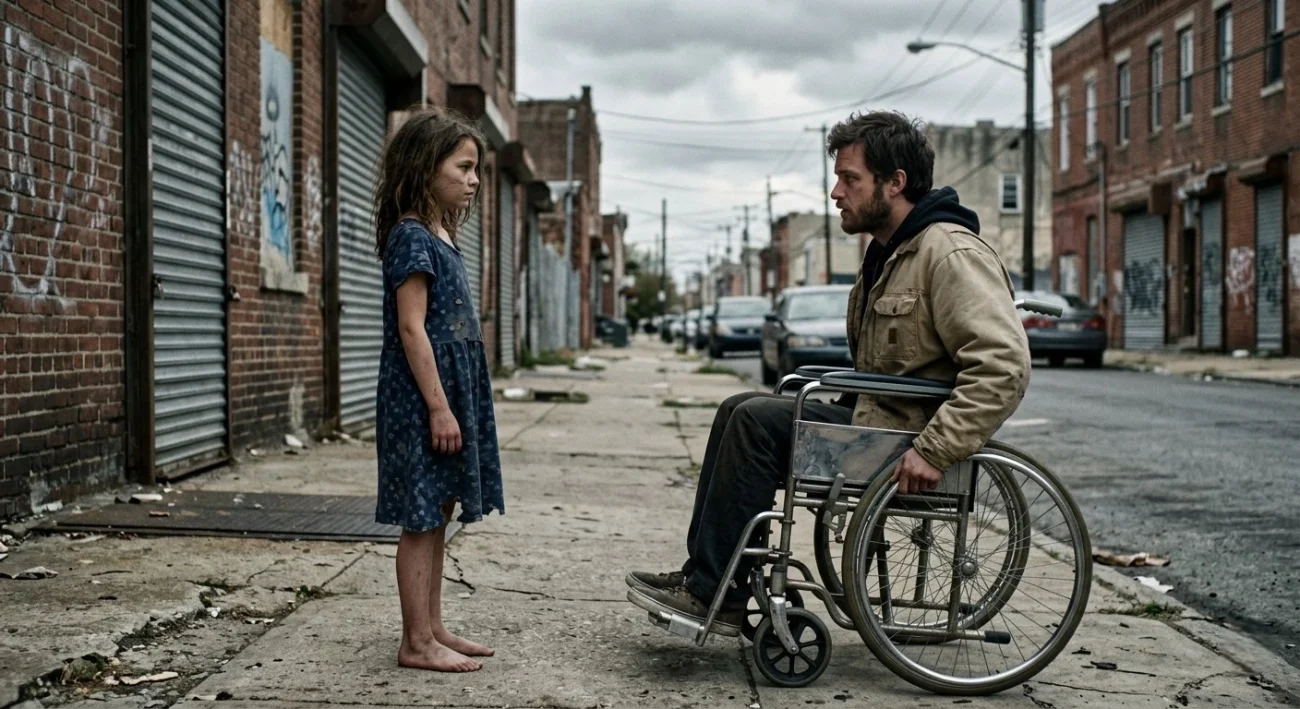
No one noticed the girl.
That was the strangest part.
She stood in the middle of a packed Chicago sidewalk on a Tuesday afternoon, and the crowd split around her like water around stone. Torn brown dress. Bare feet gray with dust. Hair a dark tangle across her forehead. She couldn’t have been more than thirteen.
She stopped in front of Daniel Carter’s wheelchair.
Daniel was twenty-nine, though the lines around his eyes belonged to someone older. He sat outside the shuttered deli on West Madison, cardboard sign propped against his left wheel: Disabled. Anything helps. He’d been at that corner for eight months. Long enough to stop hoping for eye contact.
So when the girl spoke, he almost didn’t register it.
“If you give me food,” she said, “I can help your legs work again.”
Daniel looked up.
Her eyes weren’t wild. Weren’t begging. They were steady and calm in a way that made his chest tighten—like someone who’d already seen the outcome and was just waiting for him to catch up.
“What did you say?” he asked.
“Your legs,” she repeated. “I can fix them.”
He laughed. One short, bitter sound. “Kid, surgeons at Northwestern couldn’t do that.”
“They weren’t listening,” she said simply.
Something moved in the air. Daniel couldn’t name it. A chill that didn’t belong to the warm afternoon.
He stared at her for a long moment. Then, slowly, he reached into the canvas bag hanging from his chair handle and pulled out the only thing in it—half a turkey sandwich in a gas station wrapper. His meal for the day. He’d been saving the second half for tonight.
He held it out.
She took it with both hands, the way you’d accept something precious.
“Sit straight,” she said.
“What?”
“Please.”
Against every reasonable instinct, Daniel straightened his back.
She placed one small, dirty hand flat on his knee.
The pain hit like a current.
Not a surface sting—something deep. Something surgical. Daniel’s fingers locked around the chair wheels and he pulled in a sharp breath. “Hey—what are you—”
The girl leaned forward. Her lips moved close to his ear. He heard the city. Traffic. A distant siren. But her words were swallowed by all of it.
Then the pain cut off.
Like a switch.
Daniel sat rigid. And for the first time in six years—
Warmth.
Not numbness. Not pressure. Not the phantom ache he’d learned to ignore.
Warmth.
“I—” He couldn’t finish the sentence.
The girl was already stepping back, already turning.
“I’ll come back tonight,” she said, “if you still want to walk.”
Then the crowd absorbed her.
She was gone.
Daniel sat on West Madison for forty minutes after that, not moving, not speaking, one hand pressed flat against his own knee just to feel it again.
He didn’t sleep.
Rain came after midnight, and Daniel lay on his mattress in the studio apartment on Paulina Street listening to it hit the window, staring at the water stains on the ceiling. The room had almost nothing in it. A folding table. A hotplate. A stack of library books. No TV—he’d sold it in February.
He thought about the girl.
He thought about the warmth in his knee.
He thought about what the doctors had told him six years ago: Severe spinal contusion. L1 through L3. Permanent. You’ll need to adjust your expectations, Daniel.
He had adjusted them. All the way down.
At 9:47 p.m., someone knocked.
Daniel stopped breathing.
Nobody knocked on his door. Nobody even knew which building he was in.
He rolled to the door and pulled it open.
She was standing in the hallway. Dry. Completely dry, even though the rain outside was still coming down hard. Same dress. Same bare feet. Same unhurried expression.
“You came back,” Daniel said.
“You gave me food,” she answered. “That matters.”
She stepped past him into the apartment without waiting to be invited. She looked around the empty room—at the bare walls, the single mug on the folding table, the mattress shoved into the corner.
“You lost more than your legs,” she said quietly. It wasn’t an accusation. Just an observation.
“Who are you?” Daniel asked.
She didn’t answer. She crossed to him and knelt on the linoleum floor in front of his chair, both hands resting on his knees.
“Stand,” she said.
He felt it immediately—the pressure, the heat, something moving underneath the skin of his legs like electricity through a wire that had been dead for years.
“I can’t,” he said. His voice broke on the second word.
“You can,” she said. “You’re afraid.”
“I’ve been in this chair for six years.”
“I know.”
“The doctors said—”
“Stand, Daniel.”
He closed his eyes. The fear was enormous. Not just the physical fear of falling—the deeper fear. The fear of believing something, of letting himself want it, and then losing it again. That kind of loss didn’t heal the way bones healed.
His toes moved.
He felt it. He actually felt it—his toes curling inside his shoes like they were trying to confirm they still existed.
His calves tightened. Then his thighs. Then a trembling ran up through his hips and lower back like the whole structure of him was rebooting from the ground up.
“Now,” the girl said, her voice gone flat with command. “Stand.”
Daniel put his hands on the armrests.
He pushed.
His legs shook—violent, uncontrolled shaking—and for a moment he was certain they’d buckle. But they held. They bent, and they trembled, and they held.
He was standing.
For three seconds, maybe four.
Then his knees gave and he went down hard, catching himself on his palms against the floor. He was laughing and crying at the same time, his forehead nearly touching the linoleum, his hands pressed flat like he was checking that the floor was real.
“Oh God,” he kept saying. “Oh God.”
When he looked up, she was moving toward the door.
“Wait.” He pushed himself upright, grabbing the chair to stabilize. “Please. Don’t go. I need to know who you are.”
She paused with her hand on the doorframe.
“My name doesn’t matter,” she said.
“It matters to me.”
She turned, just slightly. That small, knowing smile.
“What you do next matters more,” she said.
And then she walked out into the hallway, and by the time Daniel rolled to the door and looked out, the corridor was empty.
He walked the next morning.
Six steps. Unsteady. Holding the wall the entire time. But six steps, and he felt every single one.
He called his case worker first.
Then he called the clinic where his physical therapist—a woman he hadn’t spoken to in three years—still worked.
“Daniel?” Her voice was startled. “It’s—what’s going on?”
“I need to come in,” he said. “Something happened.”
The clinic visit lasted four hours. X-rays. Reflex tests. Grip and resistance assessments. His therapist, Dr. Reeves, sat across from him afterward with the look of someone whose entire education was quietly failing her.
“Your lower spine shows measurable improvement in signal transmission,” she said slowly. “That’s—Daniel, that’s not something that happens.”
“It happened.”
“Spontaneous spinal recovery at this level is almost unheard of. We need to document this. I want to refer you to a neurologist at—”
“Fine,” he said. “Whatever you need. But first I have to find someone.”
The story broke on a local news blog first, then got picked up by a regional affiliate, then by two national outlets. “Wheelchair-Bound Chicago Man Walks After Six-Year Paralysis—Doctors Baffled.” The comments section was chaos within hours. Skeptics and believers fighting over a story that didn’t fit neatly into either camp.
Daniel read none of it.
He was walking the streets of West Madison every day now—slowly, with a cane, never more than a few blocks before his legs demanded rest—looking for a girl in a torn brown dress.
He asked the other people who worked that stretch of sidewalk. The newspaper vendor on the corner. The woman who ran the alterations shop. The group of men who gathered most evenings in front of the parking structure on Monroe.
Nobody had seen a girl matching that description.
“Barefoot?” the newspaper vendor asked. “In this neighborhood? I’d remember barefoot.”
“Brown dress,” Daniel said. “Thirteen, maybe. Dark hair.”
The man shook his head.
Daniel tried the shelters. The youth outreach centers. The library on Congress, where the social workers sometimes tracked runaway minors.
Nothing.
Three weeks passed.
He found it by accident.
He’d been at the Harold Washington Library on a Thursday evening, using one of the computer terminals to research spinal recovery cases—partly for himself, partly because he’d been contacted by a researcher at U of I who wanted to interview him and he wanted to understand his own story before he let someone else define it.
He stepped away from the terminal to stretch his legs—his legs, the phrase still landed with a small shock of disbelief every time—and browsed the periodical archive out of habit. He’d spent a lot of hours in this section during the years he couldn’t afford much else to do.
He pulled out a bound folder of the Chicago Tribune, 2021.
And there she was.
Page 7. A photograph, small and grainy from the archived print.
A girl.
Same eyes. Same dark hair. Same small, certain expression.
The headline: LOCAL GIRL, 13, DIES SAVING CHILD IN HIT-AND-RUN INCIDENT ON WEST MADISON.
Daniel’s hand went cold.
He read the article three times.
Her name was Maya. Maya Solano. She’d been walking home from school when a car jumped the curb. A four-year-old boy, the son of a woman she didn’t know, had been directly in the path. Maya pushed him out of the way.
She had died at the scene.
The date of the accident: October 14, 2021.
Daniel’s accident—the freeway crash that had severed his spinal cord—had happened on March 3, 2023.
She had died a year and a half before he was ever injured.
He sat down on the bench beside the archive shelf. His cane clattered against the floor. He didn’t pick it up.
He stared at her photograph for a long time.
Same torn brown dress in the photo. He hadn’t noticed that detail before, hadn’t thought to look for it.
He read to the end of the article.
The last paragraph:
“Witnesses at the scene said the girl spoke briefly before losing consciousness. Several reported she whispered something, though accounts of what she said vary. One witness, a retired teacher who held her hand until paramedics arrived, said she repeated the same phrase twice. ‘You’re not done yet.'”
Daniel folded the newspaper very carefully and placed it back in the folder.
Then he sat still for a long time, in the quiet of the library, with his cane on the floor and his healed legs stretched out in front of him.
He thought about the whisper he hadn’t been able to hear on West Madison.
He thought about the words he’d heard later—somehow—in the silence of his own memory.
You’re not done yet.
He thought about the way she’d looked around his apartment. You lost more than your legs. Not the chair. Not the paralysis. More.
She’d seen all of it. The mug with no second mug beside it. The walls with no photographs. The life that had contracted, over six years, to a single mattress and a cardboard sign.
He picked up his cane.
He stood.
He walked to the exit—steadier than he’d been even yesterday, his spine carrying him like it was remembering something it had always known—and pushed through the door into the Chicago night.
The air was cold and clean.
He pulled out his phone and opened his contacts. Scrolled to a number he hadn’t called in four years. His sister, Renee, in Evanston. They’d drifted—his doing, mostly. He’d stopped answering when the pity in her voice got to be too much. Stopped returning texts. Let the silence build until it felt like a wall neither of them knew how to cross.
He called her.
It rang three times.
“Daniel?” Her voice was careful, like she was afraid to startle him.
“Hey,” he said. “I know it’s late.”
“I saw the news. I’ve been—I wanted to call but I didn’t know if—”
“I know,” he said. “I’m sorry it took me this long.”
A long pause.
“Are you really walking?” she asked.
“Yeah,” he said. “I really am.”
She made a sound that wasn’t quite a word.
“I was thinking,” Daniel said, “if you’re not doing anything Sunday, I could come out to Evanston. I haven’t been to your place since—”
“Yes,” she said immediately. “Yes. Come Sunday. Come for dinner. I’ll make that thing with the chicken, the one you used to—”
“Yeah,” he said. “That one.”
“Okay.” She laughed, a little unsteady. “Okay, Sunday.”
“Sunday,” he confirmed.
He ended the call and stood on the library steps for a moment. The city ran past him, indifferent, alive, unending. Traffic on State Street. A couple arguing two doors down. A man in a delivery vest jogging past with a bag over one shoulder.
Somewhere in it, maybe, a barefoot girl.
Walking.
Not haunting him—walking with him, the way she had since West Madison. The way she always would.
Daniel took a breath.
Then he walked down the steps, cane barely touching the ground, and moved into the current of the city.
Not done yet.
Not even close.
Two months later.
Daniel showed up at the youth outreach center on West Jackson wearing a jacket that still had the thrift store tag on it because he’d bought it that morning.
“I’d like to volunteer,” he told the woman at the front desk.
She looked at him—at the cane, at the careful way he stood.
“Do you have experience working with at-risk youth?”
“No,” he said honestly. “But I’ve been where they are. And someone who didn’t have to—someone stopped for me. I’d like to try to do the same.”
The woman studied him for a moment.
“Fill out an application,” she said. “We do orientations on the first Thursday.”
“I’ll be here,” Daniel said.
He filled out the form at a folding table by the window. When he got to the line that asked Why do you want to work with youth in crisis?, he thought about it for a moment.
Then he wrote: Because someone reminded me I wasn’t done yet.
He turned in the form and walked back out into the afternoon.
On West Madison, a cool October wind moved through the leaves that had started to fall. The corner where he used to sit was occupied by someone else now—a man about his age, a sign propped against a bicycle wheel.
Daniel stopped. He reached into his pocket. He’d started carrying extra food again—not because he needed it anymore, but because he remembered what it felt like when someone didn’t have to and did anyway.
He set a sandwich on the man’s knee.
The man looked up, surprised.
“Thank you,” he said.
“Someone did it for me once,” Daniel said.
He walked on.
And somewhere behind him—or maybe beside him, maybe in the way the light hit the sidewalk at that particular angle—he felt it.
The small, certain warmth of someone who was glad.
Original fictional stories. AI-assisted creative content.

the message was so powerful and the stofy friction so nice to follow am really blessed and encouraged