
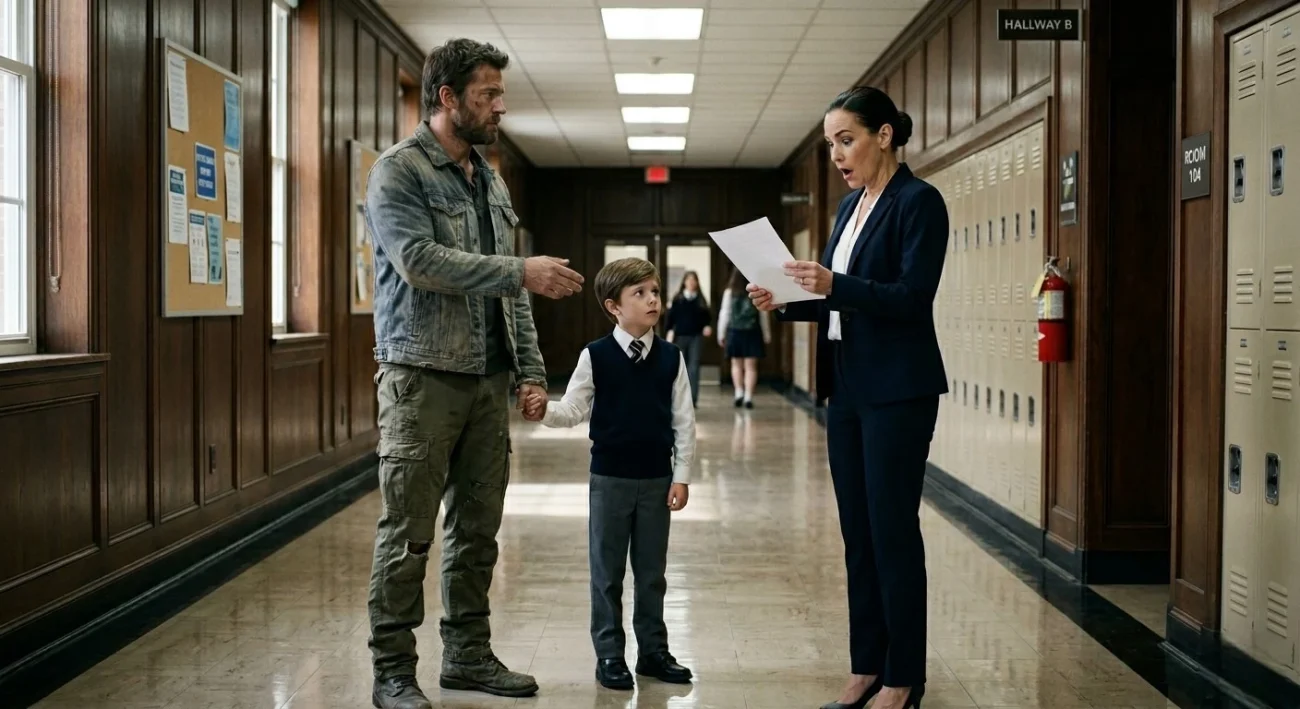
Everyone turned when the doors opened.
Not because someone famous walked in. Not because of a scene.
Because a man who looked like he’d slept on concrete had just stepped into Jefferson Ridge Elementary School—and the gap between him and everything around him was so wide it felt like a glitch in reality.
The hallway smelled of floor cleaner and fresh laminate. Motivational posters lined the walls. The distant sound of a morning assembly floated through closed classroom doors.
And in the middle of it all stood a man in torn sleeves, stained jeans, and shoes held together by stubbornness alone.
His beard was rough. His eyes were tired. His hair had gone gray too early.
But his grip on the boy beside him was steady.
That boy was the contrast no one expected.
Pressed navy uniform. White shirt, starched and clean. Polished shoes. A backpack that still smelled new. Hair combed flat with obvious care.
The boy looked like he belonged perfectly at Jefferson Ridge.
His father looked like he’d never been allowed inside a building this nice.
“Dad,” the boy whispered, eyes scanning the staring faces, “are we in the wrong place?”
The man bent slightly and forced a smile onto cracked lips. “No, son. This is exactly the right place.”
But before he could say another word, heels cracked against the tile like a gavel.
Ms. Caldwell came fast.
Beige blazer. Chin up. Mouth already forming the words she’d decided to say before she even reached them.
She stopped close enough that the man could smell her perfume—clean, expensive, deliberately so.
Her eyes moved over him the way hands move away from something dirty.
“This place is not for people like you,” she said, loud enough for the hallway to hear. “Get out. Now.”
Silence dropped like a curtain.
Children stopped mid-step. Two parents near the lockers froze. A teacher by the water fountain pretended to look at something on the wall.
The man straightened his spine. It cost him something to do it—you could see it—but he did it.
“I am paying the full fees,” he said quietly.
Ms. Caldwell laughed. Not a real laugh. The kind designed to humiliate.
“Really?” She folded her arms and looked him up and down. “Look at yourself.”
The boy’s face went red from chin to forehead.
His eyes dropped to the floor.
He pressed his lips together and held very, very still, the way children do when they’re trying not to cry in public.
A parent near the lockers muttered, “Unbelievable.”
Another: “How did he even get in here?”
The man swallowed.
He had prepared himself for this moment. He had told himself it wouldn’t matter. He had repeated, quietly, in his head during the bus ride over, that what other people thought of his clothes said nothing about his son.
What he hadn’t prepared for was watching it land on the boy’s face.
“I just want to speak with the admissions office,” the man said, still calm. “My son starts today.”
“You don’t belong here,” Ms. Caldwell said. “This school isn’t a shelter.” She turned her chin. “Security!”
The boy’s hand tightened around his father’s fingers.
“Dad,” he said, barely a sound, “please. Let’s just go.”
The man crouched down, ignoring every set of eyes on them. He waited until his son looked at him.
“You worked hard to get here,” he said. “You earned this.”
“But they’re laughing at us.” The boy’s voice cracked.
“Let them look,” the man said. “You’re not here for them.”
A security guard appeared at the far end of the hall, already moving.
Ms. Caldwell smiled—satisfied, proprietorial.
“There he is,” she said. “Escort them out.”
The guard slowed as he got close.
He looked at the boy. At the uniform. At the envelope tucked carefully under the man’s arm—folded with the kind of care that suggested it was the most important thing he owned.
“Sir,” the guard said carefully, “do you have school business?”
The man nodded. He reached into his jacket and pulled out a folded receipt. His hands were steady, but the paper had been opened and refolded so many times that the creases had gone soft.
“I paid the full semester fees last week,” he said.
Ms. Caldwell rolled her eyes. “Anyone can print a fake receipt.”
The guard looked at it anyway.
His expression changed—only slightly, but it did.
Before he could say anything, the bell rang.
Students began moving again, slow, watching. A few phones came out. Someone near the lockers started recording.
The boy noticed. His chest tightened.
“Dad,” he whispered. “They’re filming.”
“Let them,” his father said.
Ms. Caldwell crossed her arms harder. “This is embarrassing. Remove them.”
“Is there a problem here?”
The voice came from behind the crowd.
Calm. Even. The kind of voice that doesn’t need to raise itself to be heard.
The hallway parted.
A woman in a neat blazer stepped through, tablet in hand, an ID badge clipped to her lapel. Mid-fifties. Silver-streaked hair pulled back. The kind of posture that came not from discipline but from years of making hard decisions and living with them.
Mrs. Reynolds. School administrator.
Ms. Caldwell’s confidence stuttered—just for a half-second—before she recovered.
“This man is causing a disturbance,” she said quickly. “He claims his son is enrolled.”
Mrs. Reynolds looked at the boy first.
Then at the man.
Then at the receipt.
“Sir,” she said, “may I have your name?”
The man paused.
Not because he’d forgotten. But because he’d learned, over years of being turned away from restaurants and offices and emergency rooms and job sites, that saying his name sometimes made things worse.
He took a breath anyway.
“Daniel Carter.”
Mrs. Reynolds’ fingers stopped moving over her tablet.
Her eyes came up slowly.
And for the first time since Daniel Carter had walked through the front doors of Jefferson Ridge Elementary School, someone looked at him without flinching.
Not with disgust.
Not with pity.
With something that looked a great deal like recognition.
Ms. Caldwell frowned. “Is something wrong?”
“Nothing,” Mrs. Reynolds said carefully. “Nothing is wrong.”
She looked at Daniel again. “Mr. Carter. Please—come with me.”
The boy looked up, brow furrowed in confusion he didn’t have words for.
Ms. Caldwell stiffened. “Wait—what is happening?”
But Mrs. Reynolds was already walking.
Daniel squeezed his son’s hand. “Come on.”
As they moved down the hall, the whispers erupted behind them like static.
Who is he? Why did she react like that? Did you see her face?
Ms. Caldwell stood where she was, her smile entirely gone.
And for the first time that morning, Daniel Carter did not look like the weakest person in the room.
The administrator’s office was quiet in the way that expensive rooms are quiet—insulated from the noise outside, full of the soft hum of something controlled.
The boy sat on the edge of a leather chair, feet dangling, hands folded. He stared at the floor as if afraid to touch anything.
Daniel stood.
He always stood.
Sitting in chairs like this felt presumptuous. Like borrowing something he hadn’t been given permission to use.
Mrs. Reynolds sat across from him. She looked at her tablet for a long moment. Then she looked at Daniel.
Then at the tablet again.
“I didn’t expect to see you like this,” she finally said.
Daniel gave a small, tired smile. “Most people don’t.”
The boy looked up. “Dad—do you know her?”
Mrs. Reynolds leaned forward slightly until she was eye level with the boy. “Yes,” she said gently. “Your father and I have met before.”
The boy blinked. “When?”
Daniel placed a hand on his son’s shoulder. “A long time ago. Before things went wrong.”
Mrs. Reynolds straightened and took a slow breath.
“Mr. Carter,” she said, “your payment cleared. Your son is fully enrolled. There is no question about that.”
Relief moved over the boy’s face immediately—open, obvious, the kind of relief only children show.
It didn’t reach Daniel’s eyes.
“That’s good,” Daniel said. “I just want him to have a chance.”
Mrs. Reynolds nodded. She hesitated.
“Daniel,” she said, “what happened to you?”
He looked away.
Through the window, children chased each other across the playground. Their noise was muffled here. It sounded like something from a different life.
“I worked in corporate finance,” he said quietly. “Mid-level executive. Good salary. Good benefits. My wife and I—we lived well. We thought we were building something.”
The boy’s mouth opened slightly. “Dad—you never told me that.”
“Some stories are heavy, son.”
Mrs. Reynolds remembered now. The fog of recognition that had hit her in the hallway had cleared completely.
She remembered Daniel Carter. The man who attended scholarship fundraisers in tailored suits. The man who once wrote a personal check for $40,000 to the district’s after-school program. The man who shook hands with board members and spoke at college access dinners with a kind of quiet conviction that made people lean forward in their chairs.
The man who had simply vanished one year.
No announcement. No farewell. Just—gone.
“There was an investment firm,” Daniel continued. “I was mid-level, so I saw things others didn’t notice. Or didn’t want to notice.” He paused. “They were cooking the books. Moving money. Using client funds to cover executive losses and writing it up as operational costs.”
Mrs. Reynolds felt the temperature in the room drop slightly.
“When the federal investigation started,” Daniel said, “they needed someone to take the fall. Someone credible enough to be believable, low enough on the ladder that he couldn’t push back.”
“You,” Mrs. Reynolds said.
“They offered me a deal. Say I’d acted alone. Fabricated the filings. Take a reduced sentence, keep quiet.” He shook his head. “I said no.”
Mrs. Reynolds was very still. “You reported them instead.”
“Every document. Every email chain. Every offshore transfer I could prove.” He looked at his hands. “I gave the investigators six months of material.”
“And they destroyed you for it,” she said quietly.
“Blacklisted the same week the investigation went public,” Daniel said. “Every contact I had dried up overnight. No firm in the state would return my calls. Then the lawsuits started—civil suits from the firm’s lawyers, designed to drain me, not win. Just drain.” He exhaled. “By the time those settled, my savings were gone. Then my wife got sick.”
The room felt smaller.
The boy’s eyes had filled. “Mom,” he whispered.
Daniel’s hand tightened on his shoulder. “She fought hard,” he said. “For two years, she fought hard.”
Mrs. Reynolds turned away briefly, blinking.
“And now?” she asked.
“Day labor when I can find it,” Daniel said. “I sleep where I can. I save every dollar I can.” He glanced at his son. “Because he is smarter than I ever was. And he is going to have the start I can’t give him anywhere else.”
The boy looked up at his father with the particular expression of a child who is only now understanding the full weight of something he has been living inside without knowing it.
A knock broke the quiet.
“Come in,” Mrs. Reynolds said.
The door opened.
Ms. Caldwell stepped inside.
The confidence that had filled the hallway was gone. In its place was something stiffer, more defensive—the posture of someone who already knows why they’ve been called in but has decided to hold their ground anyway.
“I was told to report here,” she said.
Mrs. Reynolds did not invite her to sit.
“Ms. Caldwell,” she said, “do you understand why you’re here?”
“I enforced school policy,” Ms. Caldwell said. “There was an unidentified individual in the hall—”
“You publicly humiliated a parent and his child,” Mrs. Reynolds said. Her voice was not loud. It didn’t need to be. “In front of students, staff, and other parents.”
“I didn’t know who he was,” Ms. Caldwell said.
Daniel spoke, evenly, without turning his head: “That shouldn’t matter.”
The three words sat in the room without moving.
Ms. Caldwell’s jaw tightened. She glanced at him—quickly, almost involuntarily—then looked away.
“I was maintaining standards,” she said. “This school has a reputation—”
“Yes,” Mrs. Reynolds said. “It does. And you damaged it this morning.”
Ms. Caldwell flushed. “I was doing my job.”
“You were protecting your comfort,” Mrs. Reynolds said. “You looked at a man who didn’t fit your expectations and decided he didn’t belong—before asking a single question, checking a single record, or extending a single courtesy that you would automatically give anyone else.”
The room was very quiet.
“He has a fully paid enrollment on file,” Mrs. Reynolds continued. “His son has been registered since last month. There was nothing—not one thing—that justified what you did in that hallway.”
Ms. Caldwell opened her mouth.
“Effective immediately,” Mrs. Reynolds said, “you are suspended pending administrative review.”
The color left Ms. Caldwell’s face. “You cannot be serious.”
“I am entirely serious.”
“Over this? Over one—”
“Over a pattern,” Mrs. Reynolds said. “This is not the first complaint. It is the first one I am choosing to act on, and I should have acted sooner.” She held Ms. Caldwell’s gaze. “You may collect your things. Someone from HR will be in contact Monday.”
Ms. Caldwell looked at Daniel one more time.
Her expression was unreadable—not apologetic, not angry, just unmoored, like a person who has always assumed the floor will hold and has just felt it shift.
She left without another word.
The door closed behind her with a soft, decisive click.
The boy let out a breath he had been holding so long his ribs ached.
“Dad,” he whispered, “are we in trouble?”
Daniel crouched in front of him. “No,” he said. “You are exactly where you’re supposed to be.”
Mrs. Reynolds cleared her throat gently.
“There’s one more thing,” she said.
She turned her tablet toward Daniel.
The screen showed a testing record—rows of scores in subjects across grade levels, each line marked above the ninety-fifth percentile. One column simply read: Exceptional. Review recommended.
“These are your son’s placement results,” she said. “From his entry assessments.”
Daniel stared at the screen for a moment. “He studies by flashlight,” he said.
“It shows,” Mrs. Reynolds said.
She set the tablet down.
“We have a scholarship endowment,” she said carefully. “Full tuition. Books. Meals. Transportation. It’s awarded annually based on academic standing and financial need.”
Daniel shook his head before she finished the sentence. “No charity.”
“Daniel.” Mrs. Reynolds’ voice was firm but not unkind. “This is not charity. This fund was built by donors who believe that talent is wasted every day because it is born in the wrong zip code. Your son’s scores are exactly what this fund exists for. If you refuse it, you are refusing it for him—not for yourself.”
Silence.
The boy looked up at his father with everything he had.
“Dad,” he said.
Daniel closed his eyes.
For the first time in four years, he let himself breathe—fully, slowly, the way you can only breathe when you put something down.
“Alright,” he said quietly. “For him.”
The boy’s face broke open into the kind of smile children produce before they learn to hold things back—pure, immediate, taking up the whole room.
Later that afternoon, Daniel walked his son to class.
They moved through the same hallway.
Heads turned again.
But the whispers had changed.
A parent who had stood near the lockers that morning caught Daniel’s eye and gave a small, almost apologetic nod. A young teacher held a classroom door open and said, “Good afternoon.”
The boy walked straighter than he had that morning.
At the door to his classroom, he stopped. He looked back at his father.
“Dad,” he said, “I’m not ashamed of you.”
Daniel felt something behind his eyes that he had not allowed himself to feel in a long time.
“I was never ashamed of you,” he said.
The boy went inside.
Daniel stood in the hallway for a moment, listening to the sound of thirty children settling into desks, the shuffle of notebooks, a teacher calling attendance.
Then he turned to go.
“Mr. Carter.”
Mrs. Reynolds fell into step beside him as he reached the exit.
“One more thing,” she said.
“Yes?”
She walked with him to the front doors before she spoke.
“The school board has been contacted by a federal counsel’s office,” she said. “They asked about you. About whether you had any connection to the school.” She paused. “The investment firm you reported—the original case. It’s been reopened.”
Daniel stopped.
“A second whistleblower came forward last month,” Mrs. Reynolds continued. “Someone who worked above you. They had documentation you didn’t have access to. The FBI filed new charges last week.” She looked at him steadily. “This time, apparently, the people at the top aren’t walking away.”
Daniel stared through the glass doors at the afternoon light, at the parking lot, at the street beyond it—the same street he had walked up that morning carrying the envelope and trying not to let his hands shake.
“Good,” he said.
That evening, Daniel sat on a park bench three blocks from the school.
The light was going. The temperature was dropping. He had a sandwich from a food truck and half a cup of coffee and the particular stillness of a man who has had a very long day and is not yet sure what to do with the way it ended.
His phone buzzed.
Unknown number.
He answered.
“Mr. Carter,” the voice said, measured and professional, “this is Special Agent Torres with the State Financial Crimes Unit. We’ve been trying to reach you for three weeks. We’d like to formally reopen your case and discuss your status as a protected federal witness.”
Daniel said nothing for a moment.
He looked up at the sky. A pale strip of orange was still holding at the edge of the dark.
“I’m available,” he said.
He hung up.
He sat.
Somewhere across the city, a woman sat alone in her apartment, running the morning through her head—the hallway, the man’s face when she told him to leave, the exact moment Mrs. Reynolds had looked at her like something that needed to be corrected.
And somewhere in a warm classroom on the second floor of Jefferson Ridge Elementary School, a boy opened a brand-new notebook to the first page.
He uncapped his pen.
He wrote his name at the top—slowly, carefully, with the deliberateness of someone who understands that some acts of writing are also acts of claiming something.
Ethan Carter.
He looked at it.
Then he turned to the first problem on the page and began.
Because he had learned something this morning that no curriculum covered:
A man is not what he wears when the world decides to look at him.
He is what he refuses to become when the world decides to break him.
THE END
Original fictional stories. AI-assisted creative content.
