
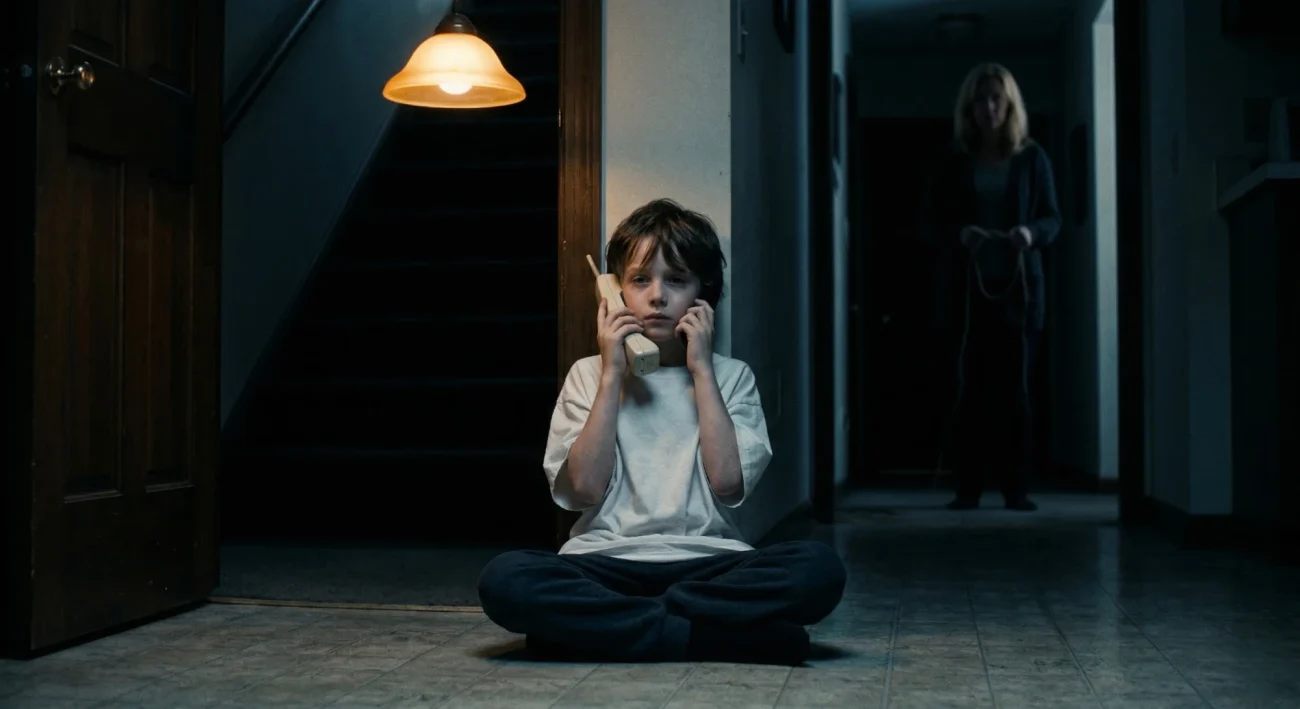
The call came in at 9:47 PM on a Tuesday.
Dispatcher Linda Oakes had been on shift for six hours. She’d handled a fender bender, two noise complaints, and a woman locked out of her car. Nothing that would keep her up at night.
Then Line 3 lit up.
“911, what’s your emergency?”
What came through the line wasn’t words. It was sobbing — raw, ragged, desperate sobbing. The kind that comes from a body too small to hold that much pain. Between the gasps, Linda could hear a child trying to form words, but they kept breaking apart.
“Hey, hey — I’m here. I’m right here. Take a breath for me, okay?”
The sobbing hitched. A wet, shuddering inhale. Then a wail — high-pitched and terrible — like an animal caught in a trap.
“It hurts — it hurts so bad—”
“I know, sweetheart. I know. Can you tell me what hurts?”
“My — my legs—” The crying swallowed his voice again. Linda could hear him gasping, choking on his own tears. Then, between sobs: “I can’t — I can’t move my legs.”
Linda’s blood went cold. The voice belonged to a child. A boy, maybe seven or eight. And beneath the crying, beneath the pain, there was something else — something that made it worse. He wasn’t screaming for his parents. He wasn’t calling for help from anyone in the house. He had called 911 by himself. A child in that much agony, and the first person he reached for was a stranger.
“Okay, sweetie. I need you to try to breathe with me. In and out. Can you do that?”
She heard him trying. The sobs slowed — not because the pain had stopped, but because he was forcing himself to push them down. Swallowing them. Like he’d been trained to.
“Good. That’s so good. Can you tell me your name?”
A hiccup. A sniffle. Then, in a small, cracked voice: “Caleb.”
“Hi, Caleb. I’m Linda. You’re doing amazing. Can you tell me what happened?”
“My back — my back hurts really bad. And I can’t — I can’t feel my legs anymore.” His voice broke again on the last word, and a fresh wave of crying poured through the line. Not screaming now — quieter, more exhausted, the kind of crying that happens when a child has been hurting for so long that even the tears are tired.
Linda signaled to her supervisor. She muted her mic for half a second. “Get a unit to trace this call. Now.”
She came back on. “Caleb, did you fall? Did something happen?”
The crying stopped. Not gradually — suddenly. Like a switch had been flipped. And when he spoke again, his voice was different. Flat. Hollow. The tears were still wet on the words, but the emotion behind them had drained away, replaced by something far worse: resignation.
“She pushed me down the stairs.”
Linda’s hand tightened around her headset. “Who pushed you, Caleb?”
“Diana.”
“Is Diana your mom?”
“She’s my stepmom.”
Linda’s training kicked in. Keep him talking. Keep him calm. Get the address. But something in Caleb’s voice told her this wasn’t a one-time thing. There was no shock in it. No confusion. Just resignation.
“Caleb, is Diana there with you right now?”
“She’s in the kitchen. She told me to stop crying or she’d give me something to really cry about.”
Linda closed her eyes. She’d heard variations of that line a hundred times. It never got easier.
“You’re being very brave, Caleb. Can you tell me your address?”
“I don’t know the number. It’s the yellow house on Maple Court. With the white fence.”
That was enough. The trace confirmed it — 14 Maple Court, in the Briarfield subdivision. A nice neighborhood. HOA-maintained lawns. Block parties in the summer. The kind of place where people said things like “that could never happen here.”
“Caleb, I’m sending people to help you right now. Can you stay on the phone with me?”
“Okay.”
“Good. You’re doing great. Can you tell me — has Diana hurt you before?”
Another pause. Longer this time.
“She says I’m not allowed to talk about house stuff.”
“You’re not in trouble, Caleb. Nothing you say to me will get you in trouble. I promise.”
“She hits me sometimes. When Dad’s at work. She says if I tell, she’ll send me away to a place where nobody wants me.”
Linda pressed her palm flat against the desk. Her supervisor was already on the phone with the responding officers, relaying every word.
“Nobody’s sending you anywhere, Caleb. You’re safe now.”
“She locked me in the closet last week. For a whole day. I peed my pants and she made me clean it up with my shirt.”
Linda’s coworker, Marcus, was listening on the shared line now. He pulled off his headset and walked to the bathroom. When he came back two minutes later, his eyes were red.
“Caleb, does your dad know about any of this?”
“Dad says Diana loves me. He says I need to try harder to be good.”
“Is your dad home right now?”
“No. He works nights. He’s never home when she does it.”
The officers were three minutes out. Linda kept Caleb talking.
“What about school, Caleb? Have you told a teacher?”
“I told Mrs. Patterson once. She called my dad. Dad came home and asked Diana. Diana said I was making stuff up for attention. Then Dad said I had to apologize to Diana for lying.”
“And then what happened?”
“Diana smiled and said ‘apology accepted.’ Then after Dad left, she grabbed my arm and twisted it behind my back. She said if I ever told anyone again, she’d make sure I never walked right.”
Linda felt the air leave her lungs.
“Caleb, you said you can’t move your legs. Can you feel anything? Can you wiggle your toes?”
“No. I tried. They won’t move.”
“Okay. The ambulance is almost there. You’re going to be okay.”
“Linda?”
“Yeah, sweetie?”
“Is she going to jail?”
Linda broke protocol. She wasn’t supposed to make promises. She wasn’t supposed to give opinions. But some rules don’t matter when a child is lying at the bottom of a staircase with a broken back.
“Yes, Caleb. She is.”
Officer Denise Cordero was the first on scene. She’d been on the force eleven years. She thought she’d seen everything.
She hadn’t.
The front door was unlocked. She stepped inside and immediately heard a woman humming in the kitchen. Humming. Like it was any other Tuesday night.
“Ma’am? Police. We got a 911 call from this address.”
Diana Weaver appeared in the kitchen doorway. Mid-thirties, blond highlights, wearing a cashmere cardigan, a length of thin rope held in both hands. She looked more annoyed than alarmed.
“I’m sorry, there must be some mistake. Nobody here called 911.”
“We traced the call to this location, ma’am. There was a child on the line.”
Diana rolled her eyes. Actually rolled them.
“That would be Caleb. He’s upstairs. He has behavioral issues. He probably got hold of my phone.”
“Can you take me to him?”
“He’s in his room. He’s fine. He does this for attention.”
Officer Cordero didn’t wait for permission. She moved past Diana and headed for the stairs. That’s when she heard it — a small voice coming from the bottom of the staircase, behind a half-closed door.
“I’m down here.”
Cordero opened the door. There was a narrow staircase leading to the basement. And at the bottom, crumpled on the concrete floor, was a boy. Small for his age. Wearing a T-shirt two sizes too big and shorts despite it being forty degrees outside. His legs were at a wrong angle. His face was pale but dry. No tears. He’d already cried them all out a long time ago.
“Hey, buddy. I’m Officer Cordero. Are you Caleb?”
“Yes, ma’am.”
“The ambulance is right behind me. We’re going to get you out of here.”
“Okay.”
Cordero knelt beside him. She could see bruises on his arms — some fresh, some yellow and fading. Layers of them. A map of months.
She looked up the stairs. Diana was standing at the top, the rope still held in both hands, barely visible in the dim hallway light.
“He fell,” Diana said. “He’s clumsy. Always has been.”
“Ma’am, step back from the stairs, please.”
“This is my house. You can’t—”
“Ma’am. Step. Back.”
Diana retreated. But the look on her face wasn’t fear. It was calculation. She was already building her story.
The paramedics arrived ninety seconds later. They stabilized Caleb’s spine and loaded him onto a stretcher. He didn’t make a sound. Not one. Even when they moved him onto the backboard, which must have been excruciating, he just stared at the ceiling.
One of the paramedics, a veteran named Ray, pulled Cordero aside.
“This kid’s been through hell. I’m seeing old fractures in his wrist. Scarring on his lower back. Ligature marks on his forearms and ankles.”
“Ligature marks?”
“Rope burns. Layers of them. He’s been tied up. Repeatedly.”
Cordero’s jaw tightened. “How long?”
“Months. Maybe over a year. Hard to say.”
She went back inside. Diana was sitting at the kitchen table, the rope nowhere in sight, scrolling through her phone like nothing had happened.
“Diana Weaver?”
“Yes?”
“You’re under arrest for the assault and battery of a minor.”
Diana’s face changed. The mask slipped, just for a second, and what was underneath was cold and hollow and completely devoid of surprise.
“You’re making a mistake. Caleb is a difficult child. He hurts himself. His therapist will confirm—”
“Save it for your lawyer.”
As Cordero cuffed her, Diana twisted around. “I want to call my husband. He’ll straighten this out. He’ll tell you.”
“Your husband can meet you at the station.”
Kevin Weaver arrived at the police station at 11:15 PM. He worked the night shift at a distribution center — loading docks, forklifts, the kind of work that left you too tired to notice what was happening in your own house.
Or at least that’s what he told himself.
Detective Amy Rosen handled the interview. She sat across from Kevin in Interview Room B, a manila folder in front of her.
“Mr. Weaver, your stepson Caleb is in the hospital right now with a spinal fracture. He can’t feel his legs.”
Kevin went white. “What? How?”
“Your wife pushed him down the basement stairs.”
“No. No, that’s — Diana wouldn’t do that. Caleb falls. He’s always falling.”
“Caleb called 911 himself, Mr. Weaver. We have the recording.”
Rosen hit play on the tablet. Caleb’s voice filled the room. Small, steady, devastating.
“She pushed me down the stairs.”
“She hits me sometimes. When Dad’s at work.”
“She locked me in the closet last week. For a whole day.”
Kevin’s hands began to shake. The color drained from his face and pooled somewhere around his shoes.
“He told Mrs. Patterson. She called my dad. Dad came home and asked Diana. Diana said I was making stuff up for attention.”
Kevin’s mouth opened. Nothing came out.
“Mr. Weaver,” Rosen said, “did you know your wife was hurting your son?”
“He’s — Caleb makes things up sometimes. Diana said—”
“Your son has burn marks on his forearms, Kevin. Old fractures. Bruises in various stages of healing. This has been going on for a long time.”
Kevin put his face in his hands. “Oh God.”
“Did you know?”
“I didn’t — I mean, Caleb would say things, but Diana always had an explanation. She said he was acting out because of his mother leaving. She said he needed discipline.”
“Did you ever see her hit him?”
Silence.
“Mr. Weaver?”
“Once. She grabbed his arm. Hard. I told her not to do it again. She said she wouldn’t.”
“And you believed her.”
“She’s my wife.”
Rosen leaned forward. “And Caleb is your son.”
Kevin broke. The sound he made wasn’t crying — it was something worse. It was the sound of a man realizing he had looked the other way while his child was tortured, and there was no version of the story where he wasn’t complicit.
“I want to see him,” Kevin choked out.
“Caleb doesn’t want to see you right now, Mr. Weaver. He was very clear about that.”
The investigation that followed ripped the lid off 14 Maple Court.
Diana’s laptop contained searches for “how to discipline a child without leaving marks” and “children lying about abuse statistics.” Her browser history showed she’d researched how long it takes bruises to heal at various stages — and planned her methods around Kevin’s work schedule.
Caleb’s school records showed six absences in the last two months — all on days Diana claimed he was “sick.” Medical records revealed two ER visits: one for a “fall off a bike,” one for “rope burn from playing in the backyard.” Both treated and released. No follow-up. No flags.
The system had failed him at every turn.
Mrs. Patterson, the teacher Caleb had confided in, was devastated. “I reported it,” she said. “I called the home. The father said everything was fine. I filed a concern with the counselor’s office. It went nowhere.”
“Did you call CPS directly?”
She looked at the floor. “I thought the school would handle it.”
Two weeks later, the medical picture became clearer. Caleb’s spinal fracture was at the T12 vertebra. The fall down the concrete stairs had caused a burst fracture, and fragments had damaged the spinal cord. The doctors were cautious.
“There’s a chance he’ll walk again,” Dr. Ellis told the case worker. “But it will take months of rehabilitation, possibly years. And there’s also a chance he won’t.”
When they told Caleb, he just nodded.
“Okay,” he said. Like someone had told him it might rain tomorrow.
It gutted everyone in the room.
The trial was held four months later. Diana Weaver was charged with aggravated assault on a minor, child abuse in the first degree, and endangerment. Her lawyer tried the predictable defense: Caleb was “a troubled child” with “a history of fabrication.”
The prosecution played the 911 call in full. Every word. Every pause. Every moment where a seven-year-old boy calmly described being beaten, locked in closets, and burned — with less emotion than most adults use ordering coffee.
The jury deliberated for forty-one minutes.
Guilty on all counts.
Diana was sentenced to eighteen years in state prison with no possibility of parole for twelve.
When the judge read the sentence, Diana didn’t flinch. She’d been performing for so long she couldn’t stop, even now.
But Caleb watched from a monitor in a separate room with his caseworker. When the word “guilty” was announced, he didn’t smile. He didn’t cheer.
He exhaled.
Like he’d been holding his breath for two years.
Kevin Weaver was not charged criminally, but the family court stripped his custody. The judge’s words were surgical:
“Mr. Weaver, you chose your comfort over your child’s safety. You heard the warnings and did nothing. This court finds you unfit to serve as a custodial parent.”
Kevin didn’t contest it. He sat there and took it because he knew it was true.
Caleb was placed with his maternal grandmother, Ruth, who had been fighting for custody since before the arrest. Ruth was sixty-four, lived in a small house in Beaumont, and had a garden full of tomatoes and a dog named Biscuit.
The first night Caleb was there, Ruth tucked him into bed — a real bed, with clean sheets and a quilt she’d made herself.
“You safe here, baby,” she said. “Nobody’s going to hurt you in this house. Not ever.”
Caleb looked up at her. For the first time in anyone’s memory, his eyes were wet.
“Promise?”
“I promise on my life.”
He reached up and hugged her. His thin arms squeezed tight, and he didn’t let go for a long time.
Six months after the sentencing, Caleb was in physical therapy three times a week. He hated it. The exercises hurt, and progress was slow. But Ruth drove him every session, sat in the waiting room with her crossword puzzle, and told him afterward that she was proud of him.
One afternoon in October, the physical therapist, a woman named Jackie, was working on Caleb’s leg exercises. She moved his right foot.
“Can you feel that?”
Caleb’s eyes went wide. “I felt it.”
Jackie looked at him. “You sure?”
“Do it again.”
She pressed her thumb against his big toe. Caleb’s face broke open. Not into a smile — into something bigger. Something that had been locked away for years.
“I felt that! I felt it!”
Jackie called Dr. Ellis. Ruth came running in from the waiting room. Caleb was laughing and crying at the same time, and Ruth grabbed his face with both hands and kissed his forehead.
“I told you, baby. I told you.”
The recovery was long. It was brutal. There were days Caleb wanted to quit, days he screamed in frustration, days he sat in his wheelchair in Ruth’s garden and didn’t say a word.
But every morning, Ruth made him breakfast. Every night, she read to him. And every single day, she said the same thing:
“You’re the bravest person I know.”
Eleven months after being placed with Ruth, Caleb stood up from his wheelchair in the physical therapy room. His legs shook. Jackie held his arm. Ruth pressed her hands over her mouth.
He took one step. Then another. Then a third.
Then his knees buckled and Jackie caught him. But he was laughing.
“I walked!” he shouted. “Grandma, I walked!”
Ruth couldn’t speak. She just pulled him into her arms and held him while he giggled against her shoulder.
By the following spring, Caleb was walking with a cane. He was enrolled in a new school. He had a therapist he actually liked, a kid named Marcus who lived three houses down and collected Pokémon cards, and a dog named Biscuit who slept at the foot of his bed every night.
His therapist asked him once, “Caleb, what do you want people to know about what happened to you?”
He thought about it for a long time.
“That if you say something and nobody listens, say it again. And if they still don’t listen, call 911. Because somebody out there is listening. You just have to find them.”
Linda Oakes, the dispatcher who took the call, received a letter in the mail eight months after the trial. It was written in careful, shaky handwriting on lined notebook paper.
“Dear Linda, thank you for listening to me. You were the first person who believed me. I can walk again now. I have a dog named Biscuit. He’s really fat. Love, Caleb.”
Linda kept that letter in her desk drawer. She looked at it on the hard days — the calls that went wrong, the ones that haunted her.
It reminded her why she picked up the phone.
Diana Weaver sits in a cell at the state women’s correctional facility. She has filed two appeals. Both were denied. She will be eligible for parole review in 2037.
Kevin Weaver moved out of state. He writes Caleb letters that Caleb, for now, does not open. Ruth keeps them in a shoebox in the closet.
“When you’re ready,” she tells him. “Not a day before.”
Caleb nods. “Maybe someday.”
But not today. Today, he’s got physical therapy at three, a math test tomorrow he hasn’t studied for, and Marcus is coming over after dinner to trade Pokémon cards.
Today, he’s just a kid.
And that’s enough.
Original fictional stories. AI-assisted creative content.
