
The medication trolley was heavier than usual that night.
I don’t know why I remember that detail—but I do. The squeak of the left wheel. The way the overhead lights in Corridor C hummed like they were thinking. The smell of antiseptic and recycled air that I’d stopped noticing years ago until that night made me notice everything.
It was 2:17 a.m.
I’d been a nurse for eleven years. I’d held a man’s hand while his wife stopped breathing. I’d told a teenager that her brother wasn’t coming home. I’d pulled a newborn from a crash cart and felt the second it came back to life under my hands.
None of that prepared me for the shoes.
Click. Click. Click.
Sharp. Expensive. Moving too fast for a hospital floor.
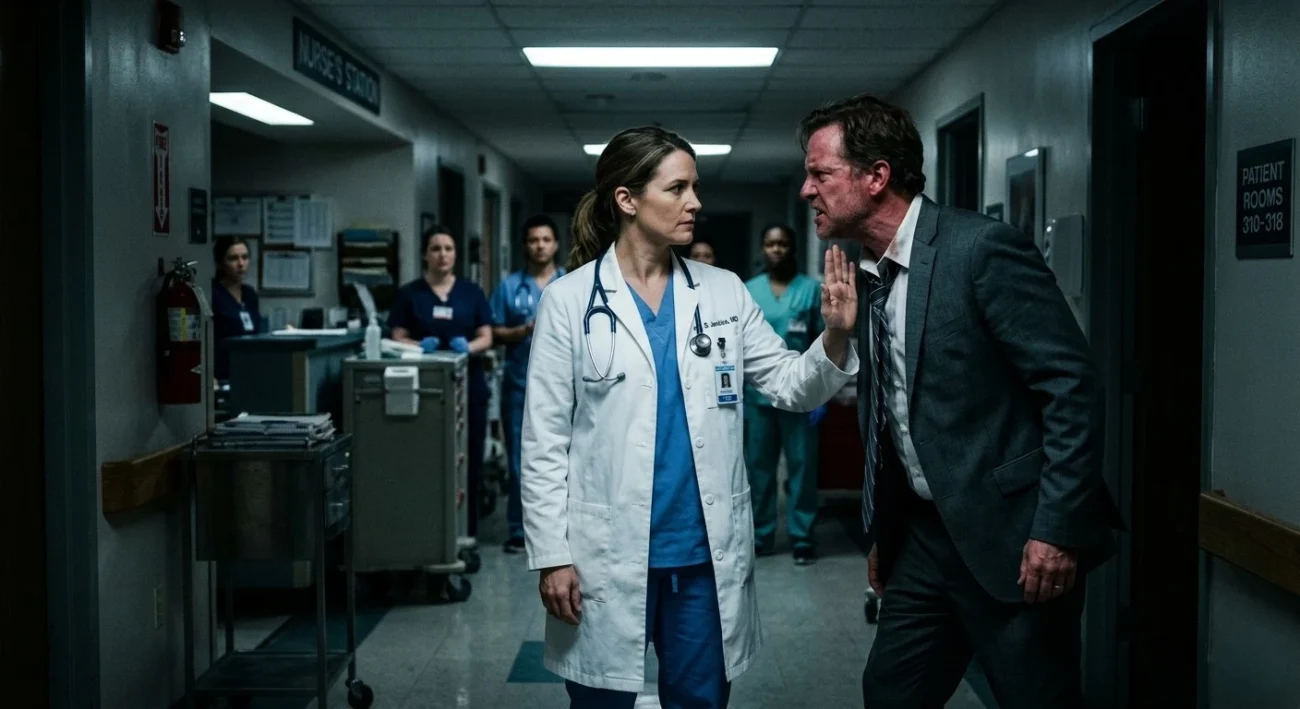
He came around the corner like someone who had never once in his life been told to slow down. Black suit, white shirt, collar open—like he’d ripped the tie off in the parking lot and thrown it somewhere expensive. His jaw was set. His eyes were moving like a scanner, pulling apart everything in the corridor, assessing, dismissing, moving on.
I stepped into his path.
Eleven years of training. Pure reflex.
“Sir.” My voice was calm, even. Practiced. “This is a restricted area.”
He didn’t slow.
“Sir—”
His hand came out.
Not wild. Not panicked. Controlled. Deliberate. His palm connected with my shoulder and pushed—hard enough to send me stumbling back, hard enough that my heel caught the edge of a tile and I grabbed the trolley to keep from going down. A clipboard hit the floor. Someone behind me gasped.
“Get out of my way.”
Four words. Flat. Quiet. More frightening than a shout.
For a second the entire corridor held still—patients, interns, a doctor mid-sentence into a phone—all of them suspended in that silence like a photograph.
Pain shot up my arm.
I straightened anyway.
“Sir.” My voice cracked on the word. I hated that. “You cannot do that.”
He turned slowly. The way people turn when they’ve decided you’re not worth urgency.
“I said move.”
It wasn’t a request. It wasn’t even a threat. It was a statement of reality from a man for whom the world had always, eventually, moved.
I looked at him.
And I don’t know what I expected to find—rage, contempt, that particular brand of cruelty that lives in people who’ve never faced consequences—but what I found was something I wasn’t ready for.
His eyes were enormous.
Not wide with anger. Wide with something that had no armor left around it.
“Step back.” A voice from behind him—loud, firm, unmistakable. “That’s enough.”
Something happened to the man in front of me.
It wasn’t sudden. That’s what got me. It was gradual—like watching a fist unclench underwater. His shoulders dropped half an inch. The hard line of his jaw released. He raised one hand, palm out, toward whoever was behind him.
“I’m fine.”
Almost gentle. Almost apologetic.
And just like that—the corridor breathed again.
Phones went back to ears. Wheels moved. The machine down the hall resumed its beeping cadence. Two security officers materialized from somewhere and flanked him quietly, professionally. He didn’t resist. He walked with them—still tall, still straight—but something had gone out of him.
I watched until he turned the corner.
Then I stood very still in the middle of Corridor C and tried to figure out why my hands were shaking.
The supervisor found me twenty minutes later in the supply room.
I was sitting on the floor between two shelving units, back against the wall, knees up, a box of nitrile gloves beside me that I hadn’t opened and didn’t need.
“Maya.” She crouched down. “Are you hurt?”
“No.” That was true. The shoulder ached, but it was nothing.
“Okay.” She didn’t push. She sat on the floor next to me, which was something Linda had never done in ten years of supervisory authority, and that kindness almost broke something open in my chest.
“They’re getting his information,” she said. “You’ll need to file.”
“I know.”
“Do you want to go home?”
“No.” I meant that too. “I want to finish my shift.”
She looked at me sideways. “You’re allowed to be rattled.”
“I’m not rattled.” I paused. “I’m trying to figure out what I saw.”
“What you saw was a man assault a nurse.”
“Yes.” I pulled at a loose thread on my scrub pants. “But why did he stop?”
She didn’t answer, because she didn’t understand the question.
The answer came three days later, from Dr. Okafor—the attending who’d been on call that night and filed an incident report on my behalf.
We were in the break room. He poured coffee with his back to me and said, without turning:
“You know who that man was.”
“No.”
“The father. Room four, surgical ICU. Amara Osei—the girl from the highway accident Tuesday night.”
I set my mug down.
“His daughter.”
“Twenty-two years old.” He turned now. His face was careful. “She’d been in surgery for forty minutes when he got here. Nobody had told him anything. He came off the elevator and started walking and when you stepped into his path—” He stopped. Shrugged. “Well.”
I thought about the open collar. The tie that must have been somewhere in a parking lot.
“Is she—”
“She’s in recovery. Third surgery tomorrow, but they’re cautiously—” He hesitated. “Cautiously hopeful.”
I nodded.
“He asked about you,” Dr. Okafor said.
I looked up.
“Through the hospital liaison. He asked if the nurse was physically injured.” He drank his coffee. “He didn’t ask for your name. Just whether you were hurt.”
I didn’t know what to do with that.
The formal complaint process took six weeks.
I showed up to every meeting they asked me to. I gave the same account each time—precise, factual, unemotional—because I’d learned that emotion in formal settings reads as instability, and I was not unstable. I was a nurse with eleven years and a clean record and a bruise on my shoulder that had faded by the time anyone photographed it.
The hospital’s patient advocate contacted me twice.
The second time, she said: “He’s requested a formal meeting with you. You are under no obligation—”
“I know,” I said.
“—and we can absolutely decline on your—”
“I’ll meet him.”
Silence on the line.
“Maya—”
“Schedule it. Please.”
They put us in a conference room on the fourth floor—neutral territory, no ICU smell, no memory of that corridor. A table between us. A patient advocate in the corner with a notepad she never opened.
He was smaller than I remembered.
That’s the first thing I thought. He’d been enormous in the corridor—filled with something that took up space beyond his actual body. Here, in a chair, with a paper cup of water in front of him and circles under his eyes deep as trenches, he was just a man.
A man who hadn’t slept properly in six weeks. Who was probably surviving on vending machine coffee and the particular desperate arithmetic of surgical recovery timelines.
He stood when I came in.
“Ms. Osei—I mean—” He stopped. Collected himself. “I don’t know your last name.”
“Chen,” I said. “Maya Chen.”
“Ms. Chen.” He didn’t extend a hand. I think he understood that would be wrong. “Thank you for agreeing to—I wasn’t sure you would.”
I sat. He sat.
The patient advocate did not sit.
“I don’t have a prepared statement,” he said. “I know that’s probably what you expected.”
“I didn’t expect anything.”
He looked at me like he was trying to decide if that was true. “What happened that night—what I did—there is no version of that story where I’m not in the wrong. I need you to know that I know that. Before anything else.”
I waited.
“Amara was—” He stopped. His jaw worked for a moment. “She’d called me that afternoon. To remind me about her graduation dinner. I told her I’d make it work, but I was in a board meeting, and—” He exhaled. “I didn’t make it work. I was still in the building when the hospital called.”
I said nothing.
“She’d been in surgery thirty-eight minutes when I got here. Nobody would tell me anything. I know that’s protocol. I know you are not the person who decides what information I receive. I knew that then.” He looked at his hands. “I shoved you anyway.”
“Yes,” I said. “You did.”
“There is no—” He stopped again. This man was not a person who stopped often, I thought. The pauses cost him. “There is no version of what I felt that justifies what I did. Fear doesn’t justify it. Grief doesn’t justify it. And I need you to decide what consequence is appropriate, because whatever it is, I’m not going to fight it.”
I looked at him for a long time.
“Why did you stop?” I asked.
He blinked.
“When security called out—you stopped immediately. Like a switch. I’ve been thinking about it for six weeks. Why did you stop so fast?”
He seemed surprised by the question. Like it hadn’t occurred to him that I’d be thinking about the same moment he was.
“Because,” he said slowly, “in that second—someone else’s voice made me hear myself.” He rubbed his face with one hand. “I heard what I sounded like. And I was—” He stopped. “I was terrified of what I was capable of.”
Silence.
Then: “I’ve never done anything like that in my life. I need you to know that’s not who I am.”
“It was who you were at 2:17 a.m. in Corridor C,” I said. “For approximately forty-five seconds.”
He flinched.
“I’m not saying that to be cruel,” I said. “I’m saying it because what I actually saw—in your face, when you turned around—wasn’t arrogance. It was someone drowning.” I paused. “I’ve seen that face before. On parents. On spouses. On anyone who has ever stood in a hallway not knowing if the person they love is going to come back.”
He didn’t say anything.
“It doesn’t excuse what you did,” I said. “But it explains it. And I’ve spent six weeks deciding whether those two things can exist at the same time.”
“Can they?”
“In my experience?” I said. “Yes. People are both of those things at once more often than anyone wants to admit.”
I filed the formal complaint.
I did not drop it, I did not soften it, and I did not amend the record. Every fact was documented: the push, the words, the physical contact, the witness statements. It existed permanently in the hospital’s system and in the incident report that went to the medical board.
Because violence in a hospital—quiet violence, controlled violence, the kind wrapped in expensive clothing—is still violence. And the next nurse in Corridor C deserved a record that said: this happened, it was wrong, it was documented.
He agreed to a mandatory anger-management assessment as part of the resolution process. He agreed to a formal letter of apology to the nursing staff. He agreed to a substantial charitable donation to the hospital’s nursing wellness fund—his idea, not the committee’s.
None of that undid it.
But it meant something.
Amara Osei went home six weeks after her third surgery.
I know because Dr. Okafor told me, in the same break room, with the same careful voice he used for information he thought I might need.
“She’s going to walk with a cane for another few months,” he said. “But she’s going to walk.”
I nodded.
“Her father,” he added, “asked me to tell you.”
I stood with that for a minute.
Then I poured my coffee, went back to Corridor C, and finished my shift.
People ask me sometimes—not about that night, but in general—why I stay.
Why any of us stay in jobs that bruise us. Jobs where the work never ends and the gratitude is rare and the hours eat through everything else you thought you were.
I stay because of what happens at 2 a.m.
Not the crisis. Not the fear.
The after.
The moment when the crisis breaks and the person underneath it emerges—blinking, raw, ashamed, human—and has to reckon with what they did when everything was stripped away.
I’ve seen the worst of people in this building.
And I’ve seen them come back from it.
That’s not a small thing.
I still hear his shoes sometimes, when the corridor is quiet and the machines are louder than the people and the building sits half-asleep between one emergency and the next.
Click. Click. Click.
And I remember: even the ones who push you away at their most broken are still trying to get somewhere that matters.
My job—our job—is to make sure they get there.
I’m still here.
Original fictional stories. AI-assisted creative content.
