
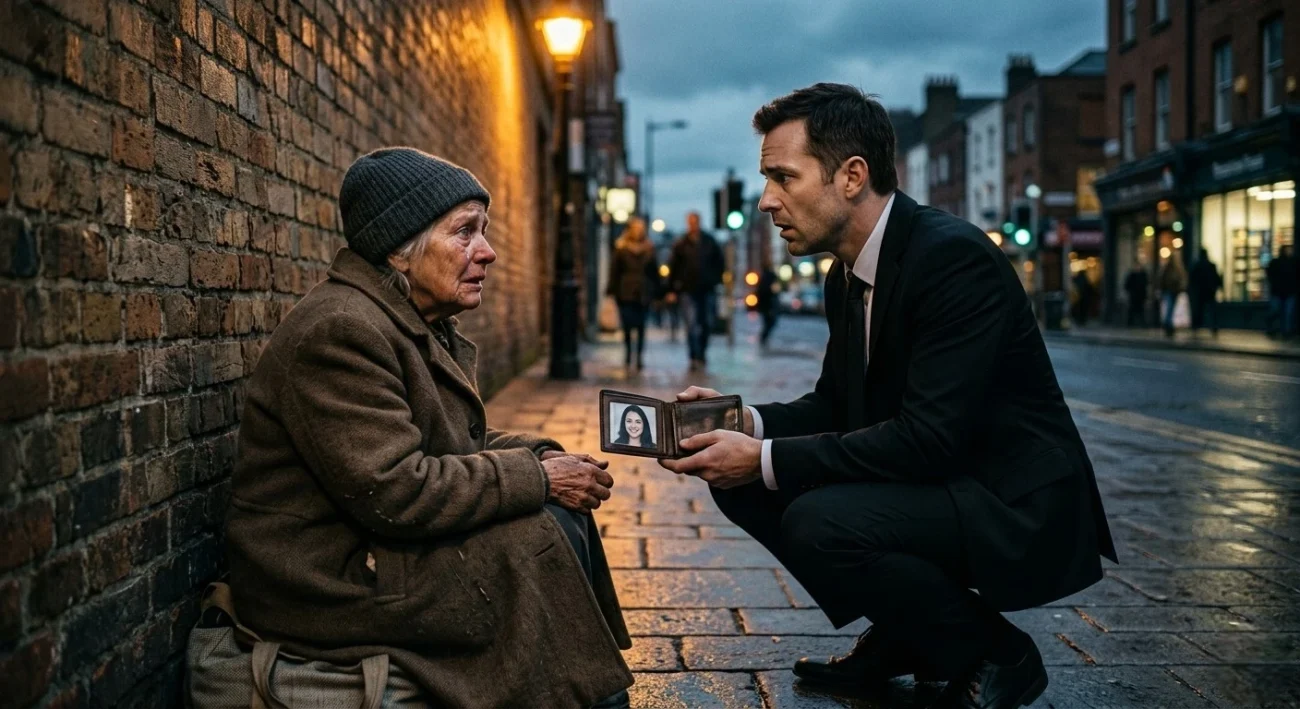
The light on Lexington Avenue had just turned gold when Daniel stopped walking.
He didn’t know why. He was already twenty minutes late to a dinner he didn’t want to attend, with people whose names he’d have to pretend to remember. But something made him stop — a figure hunched near the corner, wrapped in a coat that had lost its color years ago.
He stood there longer than he meant to.
Then he crossed the sidewalk.
“Ma’am,” he said, crouching beside her. “Have you eaten today?”
The old woman looked up. Her eyes were pale blue, sharp despite everything, and they studied him with the wariness of someone who had learned that strangers rarely came close without wanting something.
“No,” she said finally.
Daniel opened his wallet. He didn’t think about it. He pulled out a hundred and held it toward her — not extended too far, not dropped, just held. Even in that, he tried to give her dignity.
Her fingers moved toward it.
And then they stopped.
Her eyes had landed on something else.
The wallet was still open, and inside the billfold, tucked behind a metro card and a folded receipt, was a photograph. A woman in her mid-twenties. Dark hair, warm eyes, the kind of smile that felt like something you’d find at the center of a good memory.
The old woman went rigid.
“Where did you get that?” she whispered.
Daniel frowned. “Excuse me?”
“That photograph.” Her voice had dropped to almost nothing. “Where did you get it?”
“That’s my wife,” he said carefully.
Silence spread between them like something cracking underfoot.
The woman’s hand came up and covered her mouth. Her eyes flooded.
“That’s my daughter,” she said.
Daniel laughed — not cruelly, just a reflex, the kind of sound that escapes when the mind refuses what the ears just heard.
“I think you may be confused,” he said gently.
“I am not confused.” Her voice shook, but the words were firm. “A mother does not forget her child’s face. Not ever.”
Daniel looked at the photo. Same photo he’d looked at a hundred times. Emily at their first anniversary dinner, laughing at something off-camera, her hair falling over one shoulder.
“Her name is Emily,” he said.
The woman made a sound he would never forget — somewhere between a sob and a prayer.
“Her name,” she said, “is Emily.”
The traffic moved behind him. Someone’s horn blared. The city kept going, indifferent.
“What is your name?” Daniel asked.
“Margaret Sutton.”
He stared at her.
“And your daughter’s last name before she was married?”
“Sutton,” the woman said. “Emily Grace Sutton.”
Daniel sat back slightly. His knee was wet from the sidewalk, he noticed distantly. His heartbeat was loud.
“That’s not possible,” he said. “My wife’s maiden name was Cole. Emily Cole.”
Margaret reached into her coat with trembling hands and drew out a photograph of her own — small, worn soft at the edges from years of being held. She offered it to him without speaking.
He took it.
The girl was younger — maybe eighteen. Standing between two people who were clearly her parents, laughing at something just outside the frame. The same laugh. The same tilt of the head. The same exact woman.
Daniel’s hand dropped to his knee.
“She disappeared,” Margaret said. The words came out practiced, like she had said them ten thousand times and still hadn’t gotten used to them. “Five years ago. She was twenty-three. Police said she might have run. Might have been taken. No answers. No body. Nothing.”
“My wife came into my life three years ago,” Daniel said slowly.
“Then she’s alive,” Margaret said. The hope in her voice was almost unbearable to hear.
“She said she had no family.”
Margaret flinched like he’d hit her.
“She said she grew up in foster care,” Daniel continued, hearing himself as though from a distance. “That her parents died when she was young.”
A tear slid down Margaret’s cheek. Then another.
“I looked for her every single day,” she said. “I filed new reports. Walked to shelters. Hung flyers until there were no flyers left to hang.” She paused. “And here I sit.”
Daniel looked at the photograph in his hand for a long moment.
Then he looked at the woman across from him.
There was no calculation in her face. No scam being run. Just an old woman with pale blue eyes and a coat that had lost its color, telling the most painful truth she knew.
He stood up.
“I need to make a call,” he said.
He stepped back a few feet, just enough for some privacy, and found Emily’s name in his contacts. His thumb hovered.
He pressed call.
It rang four times.
“Hey, you.” Emily’s voice — warm, slightly distracted, the sound of home. “I’m just finishing up at the gallery. You still on for dinner?”
“Emily,” he said. “I need you to tell me something.”
A pause. Subtle, but there.
“Okay,” she said, lighter than it should have been.
“Your mother’s name.”
Silence.
Not confusion. Silence.
“Daniel—”
“Just tell me her name.”
Nothing.
“Em,” he said, lower now. “I’m standing on Lexington Avenue. I’m looking at a photograph that an old woman just handed me. And in that photograph, you are eighteen years old, and you are standing between your parents.” His voice cracked just slightly at the end. “So I need you to tell me the truth.”
The pause lasted so long he thought the call had dropped.
“How did you find her?” Emily’s voice had changed completely. Gone was the warmth. What was left was flat, controlled, the voice of someone calculating very fast.
“She found me,” Daniel said. “She’s been looking for you for five years.”
“She told you that.”
“Emily.”
“She’s not safe, Daniel. You don’t understand—”
“Tell me one true thing,” he said. “One. Did you walk away from her on purpose?”
The silence this time was different. Thinner.
“Yes,” Emily finally said.
Daniel closed his eyes.
“Why?”
“Because I had to.”
“That is not an answer.”
“I know,” she said quietly. “I know it isn’t.”
He turned around. Margaret was watching him from the sidewalk, holding herself perfectly still, like stillness was all she had left.
“Your mother is sitting on the street,” Daniel said into the phone. “She’s cold. She hasn’t eaten. She’s been looking for you every day for five years.” He let that breathe. “I don’t know what happened between you. I don’t know what made you leave. But whatever it was — she never stopped.”
He heard Emily exhale on the other end. Long and slow.
“I can’t,” she whispered.
“You can,” he said. “I’ll be right here.”
He walked back to Margaret and sat down beside her. He kept the phone to his ear.
Minutes passed. Cars rolled through the intersection. The streetlights fully committed to night.
Then Emily said, very quietly: “Where exactly are you?”
He told her.
Twenty-two minutes later, a cab pulled to the curb.
Daniel watched from a few feet back as the door opened and Emily stepped out. She was still in her gallery clothes — a gray blazer, dark jeans, her hair loose. She looked exactly the same as always. And also, he realized, like someone who had been terrified for a very long time.
She stood on the sidewalk.
Margaret stood up slowly.
Neither of them spoke for a moment.
“Mom,” Emily finally said, and the word came out broken open, like something that had been kept sealed too long.
Margaret crossed the distance between them and put her arms around her daughter and held on.
Emily didn’t pull away.
She buried her face in her mother’s shoulder and she cried — not gently, not quietly, but the way people cry when something buried finally surfaces. Raw and total.
Daniel looked at the sidewalk.
He wasn’t sure how long it lasted. Long enough.
When they finally separated, Emily turned to him. Her eyes were red. Her mascara was gone. She looked more like herself than he’d ever seen her.
“I left because of my stepfather,” she said. No preamble. Just the truth, finally let out. “He was hurting her. And every time I tried to help, it got worse. I thought if I disappeared, he’d lose his leverage over her. I thought she’d be safer without me to threaten.”
Margaret stiffened.
“He’s been gone three years,” Margaret said quietly. “He left. There was no reason to stay away.”
Emily looked at her.
“I didn’t know,” she whispered.
“I didn’t know how to find you.”
They stood there with that between them.
Daniel stepped forward. He took Emily’s hand and then, carefully, he took Margaret’s as well.
“Then this is where it ends,” he said. “Not on a sidewalk. Not with silence.” He looked at his wife. “You tell me the truth. All of it. Starting tonight.” He looked at Margaret. “And you come home with us.”
Margaret blinked. “I can’t—”
“You can,” Emily said. For the first time, she sounded certain. “You can.”
The three of them stood together on Lexington Avenue while the city moved around them and the streetlights held.
Two weeks later, Margaret’s spare room was painted yellow — her favorite color, Emily had remembered without being told. On the kitchen shelf sat two photographs side by side: a faded picture of a girl at eighteen, standing between her parents, and a new one taken in the apartment hallway, three people together, slightly crowded, slightly blurry, and undeniably real.
Emily came home to a door that was no longer locked.
She had knocked anyway, the first night.
Margaret had opened it before the second knock landed.
Some silences end not with a bang, but with a door swinging wide open — and someone standing in the light, finally not leaving.
Original fictional stories. AI-assisted creative content.
