
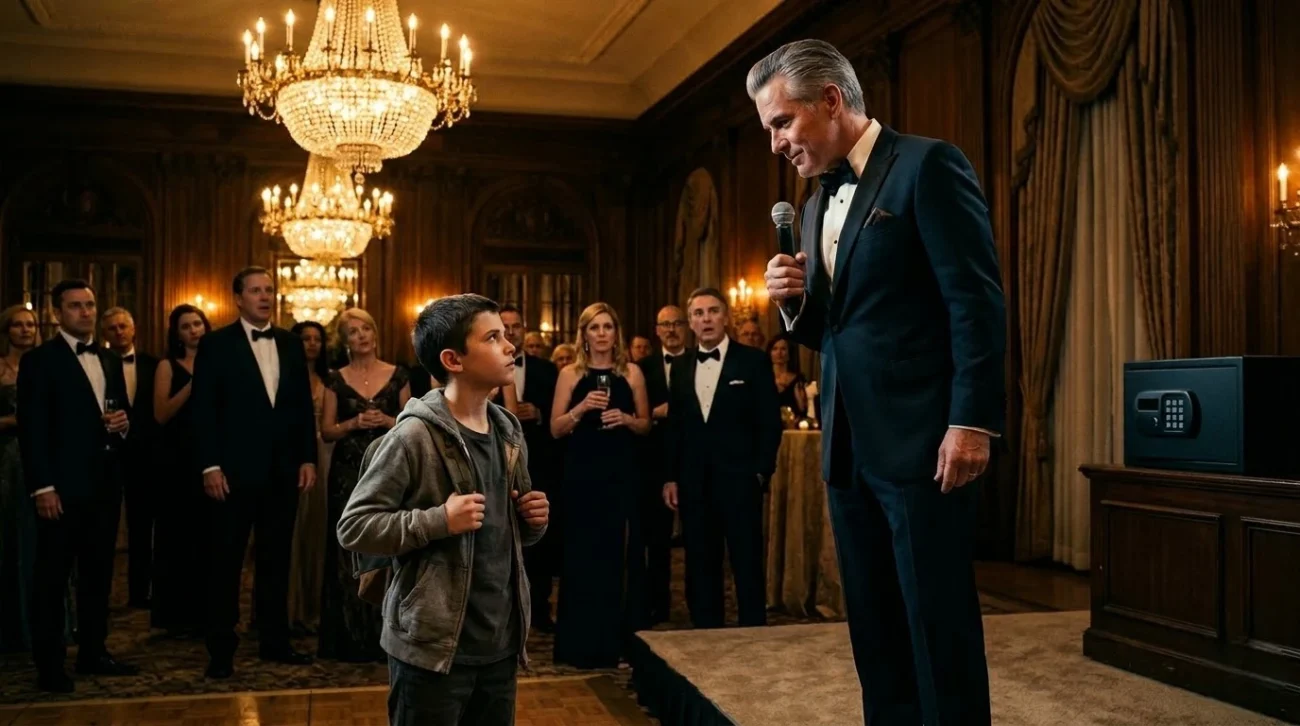
Nobody looked at Noah.
That was fine. That was the whole point.
He was fourteen, maybe fifteen—he’d stopped keeping exact track around the time counting years started to feel like counting losses. He wore a borrowed black vest two sizes too big, sleeves rolled back to expose skinny wrists, and a white shirt with a fraying collar that had been washed so many times the fabric had gone thin and soft as paper. The catering supervisor had handed it to him at the service entrance and said, “Keep your head down, stay out of the way, and you’ll get paid.”
Noah had nodded.
He was good at keeping his head down.
The estate sat outside Los Angeles, tucked behind iron gates and half a mile of private road. The kind of place that didn’t show up on maps or GPS. You had to be invited to even know the address. Inside, the ballroom stretched wide and gold, lit by crystal chandeliers that spilled light like they were trying to cover something up. Guests moved in tailored suits and gowns that cost more than most families made in a year. Waiters drifted between them with trays of champagne and small plates of food that were more art than substance.
Noah moved between them all like a ghost.
He wiped down marble tabletops. Collected abandoned cocktail napkins. Replaced candles before they burned low enough to notice. Nobody made eye contact. Nobody said his name. A few people stepped around him the way you step around furniture—automatically, without thought.
That was fine too.
He had learned early that invisibility had its uses.
He was working the east side of the room, near the tall windows that overlooked a lit garden, when the music cut.
Not gradually. Not a fade. Just—gone.
The room shifted instantly.
Richard Halston stood at the front.
Noah had heard the name before. You couldn’t be in certain circles—or certain shelters, or certain backyards where men spoke in low voices about people with too much power—without hearing it. Tech money. Old connections. The kind of wealth that didn’t just buy things, it bought outcomes. He was around fifty, broad-shouldered, with silver at his temples and eyes that were always measuring something.
“Ladies and gentlemen,” Richard said, his voice filling the room without effort. “I hope you’re all having a wonderful evening.”
Applause followed—immediate, instinctive.
“Tonight,” he continued, “I thought we’d add a little entertainment.”
Two men in matching jackets wheeled something onto the low stage behind him. It was steel—matte black, industrial, completely wrong against the silk and crystal. A locker, roughly four feet tall, solid as a vault door. No hinges visible from the front. No keypad. Just a flat biometric panel and a reinforced locking mechanism with no external keyhole.
A few guests leaned in.
“This is a custom security unit,” Richard said. “Military-grade encryption. Built to my specifications. The only way in is through biometric authentication tied to a single registered user.”
He smiled.
“That user is me.”
He let that land.
“If anyone in this room can open it without my authorization—no tools, no tricks, nothing but skill—I will wire them one million dollars before midnight.”
The laughter that followed was immediate. Warm. Familiar.
A million dollars in this room was a joke. A dinner bet. Pocket change between friends who owned jets and vacation islands. But it made a good game. A few men near the bar straightened up, suddenly interested.
“No cracks in the panel,” Richard added. “No bypasses. Just raw ability.”
A cybersecurity consultant near the front walked up first, confident and loud. He examined the panel for three minutes, tapping sequences that impressed no one, and stepped back with a shrug.
“Solid build,” he said, like that excused the failure.
A man who claimed to own a lock manufacturing company tried next. He lasted longer but came away with nothing.
Then a woman who said she’d done government contract work. She frowned at the panel, pressed both palms against it at different angles, and eventually shook her head.
“It’s not responding,” she said.
“It’s responding fine,” Richard replied, smiling. “Just not to you.”
More laughter. More drinks.
Noah stood near a table on the far edge of the room, cloth still in his hand, watching.
He wasn’t watching the guests who failed.
He was watching the locker.
Specifically, he was watching the panel—the way the scanner surface caught light, the placement of the secondary sensors above and below the primary read zone, the gap between the panel housing and the reinforced frame.
He had seen that model before.
Not in person. In a diagram, folded into quarters, tucked inside a folder that wasn’t supposed to exist anymore. A man had shown him the diagram once, years ago, in a small apartment with water-stained walls and a single working lamp. The man had said, If you understand why a lock works, you understand why it fails. He’d said it the way other people might say good morning—like it was just the start of the day, the beginning of something practical.
Noah had been eight years old.
His chest tightened now.
He told himself to stay where he was.
He told himself to finish his section and move on to the next.
He folded the cloth in his hands once, twice, three times.
Then he walked forward.
He didn’t plan it. Or maybe he had been planning it since he first saw the locker wheeled onto the stage, since the recognition clicked in his chest like a mechanism finding its notch. He didn’t fully know. His feet just moved.
The crowd noticed.
Conversation dropped in patches as he passed. Someone nudged someone else. A woman looked over her shoulder, confused. A man in a gray suit actually stepped sideways to let him pass, then did a slow double-take.
Noah stopped a few feet from the stage, in front of Richard Halston.
He looked up.
Richard looked down.
The height difference was significant. The power difference was immeasurable.
“I can open it,” Noah said.
Silence for exactly two seconds.
Then the room erupted.
Not in anger—in laughter. The sharp, reflexive kind, the kind that happened automatically when something was too unexpected. A woman near the back covered her mouth. A man snorted into his drink. Someone at the edge of the crowd pulled out his phone.
Richard blinked—genuinely caught off-guard—then recovered with a grin. “You?” He looked Noah up and down, slowly, taking in the vest, the fraying collar, the cloth still hanging from his pocket. “That’s adorable, kid.”
“I can open it,” Noah repeated.
Richard tilted his head slightly, amused. The kind of amused that had an edge to it. “You work here?”
“Yes, sir.”
“Then maybe go back to work.”
“You said anyone in the room.”
A few guests went quiet. Phones rose. This was different now—not the charming spectacle Richard had staged, but something less controlled.
Richard glanced at his guests, read the energy, and made a decision.
“Alright,” he said, lifting his voice. “If the boy can open the locker, I’ll give him the million. Cash transfer. Tonight.”
Gasps. A ripple of surprised applause.
“And if he can’t”—he looked at Noah with a pleasant smile—”I’ll fire him on the spot.”
The applause was louder this time. Stakes made things fun.
Noah nodded once.
He walked up to the locker.
Up close, the steel was heavier than it looked. His own reflection stared back at him from the surface—pale and small and out of place. He raised his hand and held it over the biometric panel without touching it. His fingers were steady.
“Whenever you’re ready,” Richard said behind him.
Noah closed his eyes.
The room faded—the music, the perfume, the two hundred phones pointing at his back.
He heard instead a different room. Smaller. Quieter. The sound of a man’s voice reading from a printed manual by lamplight. The secondary sensor is a decoy. The real read zone is six millimeters left of center. The gap in the lower housing contains a thermal bypass that the manufacturer never patched because they never expected someone to find it.
His fingers moved.
Not quickly. Not dramatically. Just—precisely.
He pressed the panel at a specific angle, applied brief pressure at the lower housing gap with the heel of his palm, and held his thumb not at the center of the scanner but at the six-millimeter offset.
A click.
Soft. Mechanical.
Then a second.
The biometric panel flashed green.
The room went utterly still.
Someone stopped mid-laugh. Glasses lowered. The woman who had laughed the loudest went quiet.
Richard said, “That’s… interesting. But it still won’t—”
The lock disengaged.
A deep metallic thud, and the door swung open.
The silence that followed was complete.
Noah stepped back.
The locker was empty.
Nothing inside but steel walls and shadow.
The crowd erupted—confused, electric, fragmented. Two people started clapping. Others just stared. A man near the back said, loudly, “How did he do that?”
Richard stared at the open door.
His face was very still.
“Well,” he said finally, finding his voice, “looks like we got excited over an empty box.”
He laughed. But it was different now—clipped, constructed.
“You didn’t say there had to be something inside,” Noah said.
A few nervous laughs from the crowd.
Richard looked at him again—not with amusement this time, but with the hard, focused attention of a man recalibrating.
“You opened it,” he said. “I’ll give you that.”
He stepped closer, dropping his voice. “But luck runs out.”
Noah held his gaze. “It wasn’t luck.”
For the first time that night, Richard Halston had nothing to say.
Behind the locker, where no one else was looking, a small red indicator light blinked once.
Then went dark.
The guards moved quietly. Not dramatically—no one was dragged or shouted at. They simply materialized on either side of Noah as the crowd regrouped, and Richard said, “Come with me,” in a tone that wasn’t an invitation.
The hallway smelled like leather and climate control and money.
They passed framed pieces of modern art—shapes and color blocks that cost fortunes and meant nothing—until Richard opened a door to a private study. Dark wood desk. City lights through the window. Books that had probably never been opened.
Richard closed the door behind them. The guards stayed outside.
“You embarrassed me,” Richard said.
His voice was still calm. That was the thing about men like him—the anger came quiet.
“I didn’t intend to,” Noah said.
“That’s worse. It means you didn’t care enough to consider it.”
Noah didn’t respond.
Richard moved to the desk, poured a drink, took his time with it. “You know how many people I said no to tonight? Men who run companies. People who write laws.” He set the glass down. “And then a kid with a cleaning cloth walks up and takes the room.”
“You made an open offer.”
“Careful,” Richard said. Soft. Specific.
Silence.
“Where did you learn that?” Richard asked.
Noah looked at the window.
“That lock design isn’t public knowledge,” Richard continued. “It’s proprietary. I personally funded the patent. There are four people in the world who understand the full build.”
“I know about the thermal bypass,” Noah said.
Richard went still.
“The secondary panel offset. The gap in the lower housing. Whoever sold you the specs left a flaw the manufacturer patched on the commercial model but not the custom order. Because they assumed the custom clients would never have it field-tested by someone who knew what to look for.”
Silence stretched between them.
“How old are you?” Richard asked.
“Old enough.”
“Where are your parents?”
Noah’s jaw tightened. “Not relevant.”
Richard nodded slowly. Like that answered something.
He sat down, not at the desk but in the chair across from it—the guest’s chair—which was either a power move or an honest moment. Noah couldn’t tell.
“Who trained you?” Richard asked.
Noah thought of a folded diagram. A man reading by lamplight. An apartment that no longer existed.
“People who understood systems,” he said.
“They gave you access to classified security specifications.”
“They gave me context. I did the rest.”
Richard studied him.
“You’re not a street kid,” he said finally. “Street kids are sloppy. You’re not sloppy.”
Noah said nothing.
“What do you actually want?” Richard asked. “And don’t say the million dollars—if you wanted money, you’d have left after opening the locker, not followed me in here.”
Noah reached into his pocket.
Richard’s posture shifted—almost imperceptibly, but it shifted. One hand moved toward the desk drawer. Outside, footsteps adjusted.
Noah set something small on the desk.
A memory card. Black, unmarked.
“What is that?” Richard asked.
“Footage.”
“From the locker.”
“Not from inside the locker,” Noah said. “From the camera behind it.”
The temperature in the room dropped.
“The red indicator light,” Noah continued, “wasn’t a status readout. It was an internal feed from a recording unit built into the locker housing itself. You use it to record challenger attempts and study the override approaches. You left it running when you rolled the unit out tonight.”
Richard didn’t move.
“It captured the full test record,” Noah said. “Every attempt. The biometric scan pattern. The override sequence I used.” He paused. “And the conversation from the previous demonstration two weeks ago. The one with the defense contractor.”
The silence was absolute.
“I uploaded a copy,” Noah said, “before I walked on stage.”
Richard breathed in slowly. Out slowly.
“You planned this,” he said.
“No. I adapted.”
“That’s worse than planning.”
“I know.”
Richard picked up his glass and set it down again without drinking. He looked at the memory card for a long moment.
“What do you want?” he said again. His voice was different now. Flat. Real.
“I want to walk out of here,” Noah said. “Tonight. Without anyone following me. And I want the people you work with to leave me and the people I care about alone.”
Richard stared at him. “You think I have a reason to pursue a fourteen-year-old cleaning boy?”
“I think you have a reason to pursue anyone who has what’s on that card.”
A long pause.
“And if I agree?”
“Then the footage stays where it is. I don’t use it. I don’t contact anyone. I disappear.”
Richard exhaled slowly.
“You’re making a threat,” he said.
“I’m making an offer,” Noah said. “You like offers.”
Something shifted in Richard’s expression—not quite respect, not quite anger. Something in between that didn’t have a clean name.
“You know what that footage is worth to certain people?” Richard said.
“Yes,” Noah said. “That’s why I’m still standing here.”
Richard stood, walked to the window, and looked out at the city. The skyline glittered below them—towers of light that people confused for permanence.
“Fine,” he said.
He didn’t turn around.
“You’ll be paid for tonight,” he added. “What you were promised. I keep my word.”
“Then keep this one too.”
Richard finally turned. He looked at Noah—really looked, for the first time since the locker opened. Not as entertainment. Not as a problem. As something he hadn’t encountered before.
“You know what bothers me most?” Richard said.
Noah waited.
“You didn’t come up here to prove something. You didn’t want the applause.” He paused. “What was it, then?”
Noah glanced at the memory card on the desk.
“I recognized the model,” he said. “And I knew what was inside that camera feed before you did.”
Richard’s eyes narrowed. “You’re protecting someone.”
Noah said nothing.
“Someone who matters to you.”
Still nothing.
Richard turned back to the window. “Go,” he said. “Before I change my mind.”
Noah picked up the memory card.
“Leave it,” Richard said.
“No,” Noah said.
A beat of silence.
“Then get out,” Richard said. Quietly. Defeated in a way he would never admit.
Noah opened the door.
Behind him, Richard Halston said one last thing.
“Locks protect secrets, boy. And secrets protect power.”
Noah paused in the doorway.
“Not forever,” he said.
He walked out into the hallway, past the guards, past the framed art that meant nothing, and back into the golden light of the ballroom.
He picked up his cloth and kept cleaning.
No one paid him much attention after that. The party resettled itself—the way money always did, closing over disruption like water over a stone. Conversations restarted. The band played louder. Glasses refilled.
But the air had changed.
Noah felt it. Not in his chest this time—in the back of his neck. The awareness of being watched by people pretending not to watch.
He finished his section, wiped down the last of his tables, and collected his cart.
The catering supervisor pressed a folded envelope into his hand at the service exit. “Good work. See you Thursday.”
Noah nodded and stepped outside.
The air was cold and honest. No perfume. No performance.
He walked two blocks, then three, then ducked into the alcove of a closed laundromat and pulled out his phone.
The upload notification was still there.
Transfer complete.
He exhaled.
He hadn’t sent the footage to Richard’s rivals. He hadn’t sent it to the press. He hadn’t sent it to anyone with an obvious angle.
He’d sent it to a woman named Claire Monroe.
Claire used to be Richard Halston’s head of digital infrastructure. She had built the frameworks that ran three of his most profitable companies. She had also, two years ago, quietly filed a complaint that disappeared before it reached any desk that mattered, been paid off, and been told never to speak publicly about the specifics of what she’d found.
She had not, in fact, stopped speaking.
She had just started speaking more carefully.
Noah had found her through a chain of introductions he wasn’t supposed to be able to make—a man who knew a woman who had worked with a journalist who trusted Claire’s technical judgment explicitly. He’d reached out three months ago. Anonymously. With enough information to prove he was real.
He hadn’t told her his plan tonight.
He hadn’t known there would be a plan.
His phone buzzed.
UNKNOWN NUMBER: You move fast.
He typed back.
NOAH: You taught me to.
A pause.
CLAIRE: You were at the party.
NOAH: You were watching.
CLAIRE: I always am.
He looked at the dark street around him. A car passed. A dog barked somewhere far away.
NOAH: Is it enough?
Three dots appeared. Disappeared. Reappeared.
CLAIRE: More than enough. But Noah—this ends things. You understand that, right? All of it. You disappear completely after this.
He stared at the words for a long time.
NOAH: That’s the idea.
Two days later, a story appeared in a mid-tier tech publication that nobody famous read and everybody serious followed.
It wasn’t sensational. It wasn’t dramatic.
It was precise.
Fourteen paragraphs. Documented technical findings about systemic vulnerabilities in a specific class of high-end biometric security units—units that had been licensed to three government contractors and one major defense firm. The article cited internal testing records. It cited a source described only as “a former member of the development team.” It cited documentation that appeared, through careful phrasing, to come from more than one direction.
No names.
No accusations.
Just facts, laid flat like cards on a table.
The tech press picked it up within the hour.
Institutional investors noticed within the day.
By evening, Richard Halston’s security licensing division had lost 11% of its value. By the following morning, one of the government contractors quietly put a hold on its contract pending internal review.
Richard sat in his office and watched the numbers.
He didn’t call anyone.
He didn’t issue a statement.
He poured a drink at eleven in the morning and didn’t bother pretending he wasn’t.
His head of security stood behind him.
“We ran the kid,” the man said. “No matching prints. No social security record. No school enrollment we can verify.”
“He’s a ghost,” Richard said.
“It looks that way.”
“What about the journalist?”
“Independent. Small outlet.”
Richard stared at his stock ticker. “The dangerous ones always are.”
He set down his glass.
“Drop it,” he said.
The man paused. “Sir?”
“Drop it.” His voice was flat. Empty of its usual edge. “All of it. Leave it alone.”
The man left without asking why.
Richard knew why.
The footage was still out there. The card Noah had taken was a copy—maybe even a copy of a copy. And somewhere, indexed in a system Richard’s people would never find in time, was a second upload with a delayed trigger.
He had been in business long enough to recognize a dead man’s switch.
He had just never expected one from a kid in a cleaning vest.
Noah didn’t go back to the catering company.
He moved to a different part of the city. A quieter neighborhood, older buildings, streets where people didn’t look twice at a teenager carrying a backpack.
He found a public library with long hours and good wifi.
He spent two weeks reading.
Not about locks. Not about security systems or biometric architecture or corporate structures.
He read about cities. About how they were built. About the invisible frameworks underneath the visible ones—water systems, power grids, zoning laws, the physical infrastructure that made everything else possible.
He was thinking about something larger.
He was also, quietly, looking for a community center that needed help.
He found one three miles west. A converted warehouse that ran after-school programs on a shoe-string budget. They had four donated computers from 2017 and a part-time coordinator who worked two other jobs.
Noah showed up on a Tuesday.
“I can teach basic coding,” he told the coordinator.
She looked at him. “How old are you?”
“Old enough,” he said.
She studied him a moment longer. “Can you show up every week?”
“Yes.”
“Don’t make promises you can’t keep. These kids have had enough of that.”
“I know,” he said. “That’s why I’m not leaving after I promise.”
She gave him a laptop and a corner of the room and didn’t ask too many questions.
He didn’t ask for payment.
Three months later, Claire Monroe appeared at the community center on a Thursday afternoon.
Noah was at the back of the room, walking a twelve-year-old girl through a simple input/output loop. The girl kept making the same error, and Noah kept letting her find it herself instead of pointing it out. He had patience for that.
Claire waited until the session ended.
They stood on the rooftop. The city spread out in every direction, buildings catching the last of the day’s light.
“You could’ve gone harder,” she said. “Richard’s stock dropped twelve percent. A full disclosure would’ve collapsed the division entirely.”
“Collapsed divisions take other people with them,” Noah said. “People who didn’t do anything.”
Claire glanced at him. “You’re still a kid.”
“I know.”
She pulled a folded document from her coat pocket and handed it to him.
He opened it slowly.
Scholarship application. Verified. Pre-approved by a review committee. Full funding for a STEM program, starting in the fall. No donor name listed. No strings in the language.
He looked at her.
“You don’t owe me anything,” she said. “But the world owes you a chance. I’m just moving the paperwork.”
He stared at the document.
“Who set this up?” he asked.
“Does it matter?”
“It matters if there are conditions I don’t know about.”
“There are no conditions,” she said. “I checked twice. It’s clean.”
He folded the papers carefully, the same way he folded everything—not to save space but out of habit, out of precision.
“Thank you,” he said.
She shrugged. “Don’t thank me. Use it.”
They stood for a while without talking.
Below, the city did what it always did—hummed and moved and piled its millions of small lives on top of each other, mostly unaware of the structures that held them up.
“What are you going to do with it?” Claire asked eventually. “The education. The access.”
Noah looked out at the skyline.
“I’m not sure yet,” he said. “But not what Richard does.”
“What’s that?”
“Use systems to close doors.”
She was quiet for a moment. “What, then?”
He thought of a man reading from a diagram by lamplight. He thought of a girl finding her own error in a loop of code. He thought of a locker opening in a room full of people who had expected it to stay shut.
“Open them,” he said.
Claire nodded.
She turned up her collar against the wind and headed for the stairs without another word.
Noah stayed on the rooftop until the sun went down.
Richard Halston sold the licensing division four months later, quietly, for far less than it was worth. The announcement was buried in a mid-week earnings release that most outlets didn’t cover until the next day.
He didn’t hold a press conference.
He didn’t make a statement.
He moved on to other ventures, other rooms, other parties—and if he was more careful now, if he thought twice before rolling out a prototype in public, if he sometimes paused before saying certain things in certain rooms, no one who hadn’t been there that night would have been able to say why.
He never found the second upload.
It was never used.
Noah had been truthful about that part.
The night of the party, Noah walked home through the city under flickering streetlights. He passed a bank. A security camera. A pawn shop with a reinforced door. A jewelry store with triple-locked cases behind polished glass.
Locks everywhere.
He had spent most of his life reading them.
Not just steel and biometrics—but the invisible ones too. The structures that told certain people you don’t belong here before anyone said a word. The systems that made some people permanently visible and others permanently forgettable.
He had learned, young, that systems weren’t destiny.
They were just engineering.
And engineering could be understood.
He stopped at an intersection and looked up at the sky—one of the rare clear nights when you could see more than three stars above the city.
He thought of the room. The open locker. The two hundred phones and the silence when the door swung wide.
He smiled.
Not because of what he’d proven.
Because of what he’d understood: the most dangerous people in the world weren’t the ones with money, or access, or power.
They were the ones who had learned to read the locks.
And had decided—deliberately, carefully, with full understanding of what they were giving up—not to build new ones.
But to open every door they found.
THE END.
Original fictional stories. AI-assisted creative content.

Great story!
Thanks for the feedback!