
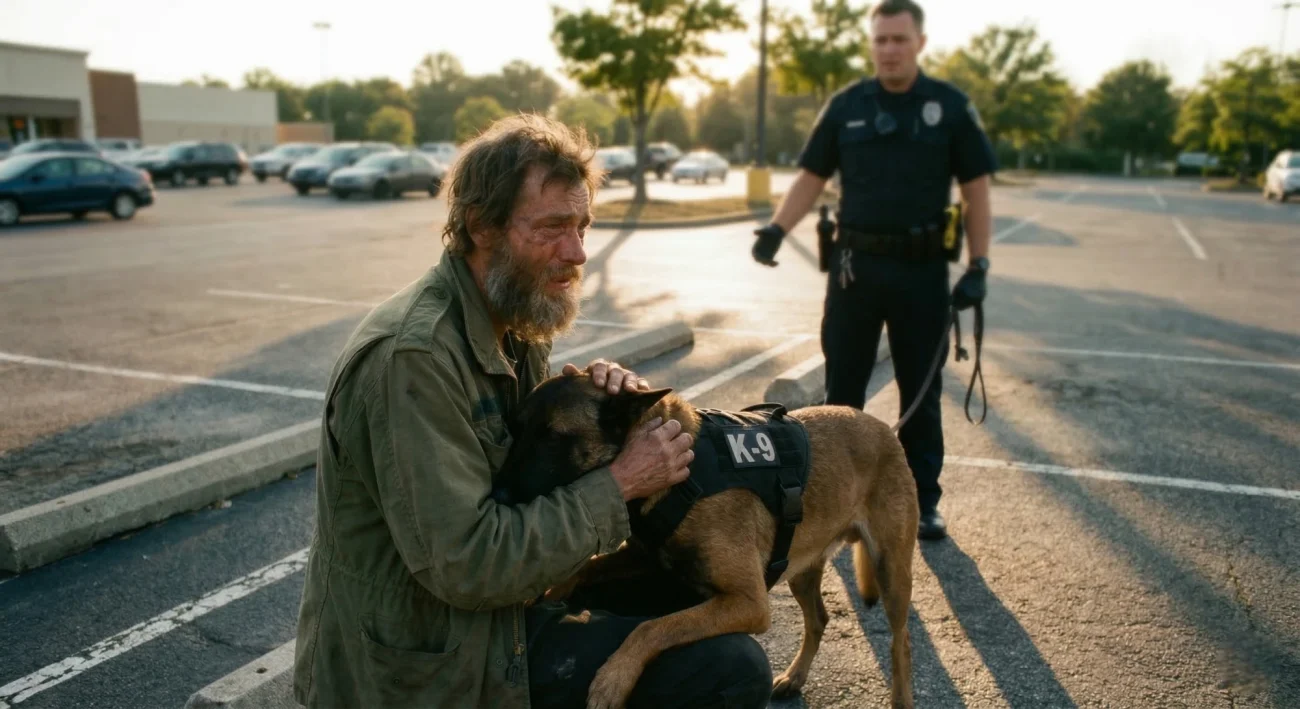
The Westfield Mall parking lot in Columbus, Ohio, was half-empty on a Tuesday afternoon. Officer Derek Haines walked his patrol K9—a Belgian Malinois named Jagger—along the perimeter near the food court entrance. Routine sweep. Nothing ever happened on Tuesdays.
Jagger pulled left.
“Easy,” Derek said. He tugged the leash. “Jagger, heel.”
Jagger didn’t heel. His ears locked forward, his body stiffened, and a sound came out of him that Derek had never heard in three years of handling the dog—a long, broken whine, high and desperate, like something cracking open inside his chest.
Then Jagger lunged.
The leash ripped through Derek’s glove. Jagger was gone—seventy pounds of trained law enforcement animal sprinting across the asphalt toward a man sitting on a concrete divider near the far end of the lot.
“Jagger! Down! Jagger!”
Nothing. No response. Three years of flawless obedience—gone in a second.
Derek ran after him, one hand on his radio. “Dispatch, this is Unit 14. My K9 just broke patrol. Westfield lot, north side. I need backup.”
“Copy, Unit 14. Advise caution. En route.”
The man on the divider didn’t move. He was sitting with a cardboard sign between his knees, a green army jacket draped over thin shoulders, a beard that hadn’t been trimmed in months. His boots were duct-taped at the soles. A backpack leaned against his leg, patched and fraying.
Jagger reached him at full speed—and stopped.
He didn’t bark. He didn’t growl. He didn’t do anything from his training. Instead, the dog sat. Pressed his body against the man’s legs. Pushed his nose under the man’s hand. And made that sound again—that cracked, keening whine.
The man flinched. He pulled his hand back like he’d been burned. His eyes—bloodshot, deep-set, hollow—went wide.
“No,” he whispered. “No, no, no.”
Jagger pushed harder. His whole body was shaking. His tail wasn’t wagging—it was trembling, low and tight against his legs. He licked the man’s wrist. His forearm. His palm.
The man stared at the dog.
And then his face broke.
“Jagger?” His voice was barely there. “Jagger, is that you, boy?”
Derek reached them, out of breath, hand still on his radio. “Sir, I’m sorry—he’s never done this. I need you to stay still while I—”
“He knows me,” the man said. He wasn’t looking at Derek. He was looking at the dog, and tears were cutting lines through the dirt on his face. “He knows me.”
Derek crouched down, one hand on his belt. “Who are you?”
The man finally looked at him. His eyes were red-rimmed, ancient, full of something that went deeper than exhaustion.
“You wouldn’t believe me,” he said quietly.
“Try me.”
“His favorite command was ‘finders keepers.’ I taught it to him when he was eleven months old. It means ‘search and retrieve, off-leash.’ Go ahead. Try it.”
Derek stared at him. The man’s hands were shaking, but not from fear. From something older than that.
“Try it,” the man said again, quieter this time.
Derek looked down at Jagger. The dog had his head in the man’s lap. His eyes were closed. His whole body had gone still, like something that had been running for years had finally stopped.
“Finders keepers,” Derek said.
Jagger’s ears twitched. His head lifted. He looked at Derek for exactly one second—then turned back to the man and pressed deeper into his lap. As if to say: I already found what I was looking for.
The hair on Derek’s arms stood up.
He pulled out his phone and called his sergeant.
“Sarge, I need you to run a handler history on K9 Jagger. Previous assignments. All the way back to military service.”
A pause. “Why? What’s going on?”
“Just run it. Please.”
Two minutes passed. Derek stood over the man and the dog, watching Jagger nuzzle the man’s wrist with the same gentle persistence a mother shows a newborn. The man was crying silently now, one hand on Jagger’s head, fingers buried in the fur behind his left ear.
His phone buzzed.
“Derek, you sitting down?” The sergeant’s voice had changed.
“What did you find?”
“Jagger was assigned to a Sergeant Michael Doan, Army Military Police, K9 Unit, stationed at Fort Moore, Georgia. Doan trained him from puppyhood—eleven months old. They did two deployments together. Afghanistan.”
“What happened to him?”
“Doan was medically discharged in 2016. PTSD. Traumatic brain injury from an IED. After discharge, he was listed as—” The sergeant stopped.
“Listed as what?”
“Missing person. Since 2016. Family filed the report. No contact, no sightings, nothing. Ten years, Derek. He’s been missing for ten years.”
Derek lowered his phone. He looked at the man on the divider. The duct-taped boots. The army jacket with a faded unit patch still stitched to the shoulder. The way his hand rested on the dog’s head like muscle memory—fingers finding the exact spot behind the left ear without thinking, without even looking.
“Michael Doan?” Derek said quietly.
The man didn’t answer for a long time. A car passed through the lot. A woman with shopping bags walked into the mall without glancing their direction.
“Nobody’s called me that in a while,” the man finally said.
Derek didn’t call for backup again. He didn’t reach for cuffs or his taser. He sat down on the concrete divider, three feet from a missing veteran, and looked out at the parking lot.
“What happened to you, Michael?”
Michael kept his eyes on Jagger. His voice came out flat, practiced, like a story he’d told himself so many times it had lost its edges.
“After they discharged me, the VA put me on a waitlist. Eight months for a psych appointment. Eight months. I couldn’t sleep. Couldn’t eat. Couldn’t be in a room with more than two people without my hands shaking so bad I’d knock things over.”
“You had family?”
“Wife. Jennifer. And my mom, Ruth. They tried. God, they tried. Jen would wake up at 3 a.m. and I’d be standing in the kitchen holding a knife, staring at the wall. Not because I wanted to hurt anyone. Because I didn’t know where I was. I thought I was back in Kandahar. I thought the refrigerator hum was a generator on the FOB.”
“Did you get any help?”
Michael laughed—bitter, hollow. “The VA sent me a pamphlet. ‘Coping Strategies for Returning Veterans.’ Sixteen pages. I threw it in the trash. I needed someone to look me in the eye and tell me I wasn’t losing my mind. Instead I got a pamphlet and a waitlist number.”
“So you left.”
“I left because I woke up one night with my hands around Jennifer’s throat. In my sleep. She was screaming and I didn’t even hear her for the first five seconds. When I came to—when I realized what I was doing—” He stopped. His jaw clenched hard enough that Derek could see the muscle jump. “The look on her face. My wife. The woman I married. She was terrified of me.”
“Michael—”
“I packed a bag that same night. Left before she woke up. Left a note that said ‘I’m sorry. Don’t look for me.’ And I walked out of my own life like it was a room I wasn’t allowed in anymore.”
Derek was quiet for a moment. A pigeon landed near the divider, pecked at a french fry wrapper, and flew off.
“Where did you go?”
“Shelters, at first. Dayton, Toledo, Cincinnati. But the shelters were too loud. Too many people in too small a space. Someone would cough in the middle of the night and I’d be right back in that convoy, waiting for the blast. So I stopped going to shelters. Started sleeping outside. Under bridges. Behind strip malls. In parking garages when it got below freezing.”
“For ten years?”
“Doesn’t feel like ten years. Feels like one long day that never ends. Summer’s hot, winter’s cold, and in between you just try not to disappear completely.”
“Your family’s been looking for you,” Derek said. “The whole time. Your mom filed the missing persons report the week you left.”
Michael’s hand stopped moving on Jagger’s fur. “I know.”
“You know?”
“I called her once. January 2019. From a payphone outside a gas station in Toledo. It was seventeen degrees and my fingers were so numb I could barely dial. She picked up on the second ring and said ‘Michael?’ before I said a single word. Like she just knew.”
“What happened?”
“I couldn’t talk. I opened my mouth and nothing came out. I listened to her cry for thirty seconds. She kept saying ‘Baby, where are you? Baby, please, just tell me where you are.’ And I hung up.”
“Why?”
Michael finally looked at Derek. His eyes were red, rimmed with a decade of road dust and sleepless nights. “Because what was I going to say? ‘Hi Mom, I live under a bridge and I tried to strangle my wife in my sleep’? She raised me to be a soldier. A protector. And I turned into someone she’d have to protect other people from.”
“That’s not what happened,” Derek said.
“That’s exactly what happened.”
“No. What happened is you got hurt serving your country and then your country left you on a waitlist. That’s not the same thing.”
Michael didn’t respond. He looked down at Jagger. The dog hadn’t moved. Hadn’t shifted an inch. Just pressed into him, breathing slowly, like his entire purpose had collapsed down to this single point of contact.
“Are you dangerous right now, Michael?” Derek asked.
Michael watched his own hand on the dog’s head. Steady. Still.
“No,” he said quietly. “I don’t think I am.”
“Then let me help you.”
“Why would you do that?”
“Because my dog just told me to. And he’s smarter than me.”
Michael almost smiled. Just a flicker.
A patrol car pulled into the lot. Sergeant Linda Vasquez stepped out, took one look at the scene, and stopped walking. She’d been on the force for twenty-two years. She’d worked homicides, domestic calls, hostage situations.
But she’d never seen a K9 curled into a man’s lap like a puppy, trembling and whining softly, while a grown man sobbed into his fur.
She walked over slowly. Took off her sunglasses.
“Officer Haines. Report.”
“Sergeant, this is Michael Doan. Former Army MP, K9 handler, two deployments to Afghanistan. He was Jagger’s original handler—trained him from a puppy at Fort Moore. Doan was medically discharged in 2016 with PTSD and TBI. He’s been listed as a missing person for ten years.”
Vasquez looked at Michael for a long moment. “Mr. Doan?”
“Ma’am.” His voice was hoarse.
“What unit?”
“551st MP Company.”
Something shifted behind Vasquez’s eyes. Her brother had served in the same company—different rotation, same war.
She pulled out her phone. Made one call. Then a second. Then a third. Each call was short, clipped, the voice of someone who knew exactly who to dial and what to say.
When she was done, she crouched down so she was at Michael’s eye level. Jagger watched her but didn’t move.
“Here’s what’s going to happen,” Vasquez said. “I just called the Franklin County Veterans Service Commission. They have a bed for you tonight. Private room. No shared space. No intake line. No waitlist.”
Michael blinked. “I didn’t ask—”
“I also called the VA crisis line. Not the general number—the direct coordinator line. They’re fast-tracking a psych intake for you this week. Wednesday morning. Not eight months from now. Wednesday.”
“How did you—”
“And I called your mother.”
The color drained from his face. “You did what?”
“Her name is Ruth Doan. She lives in Kettering, Ohio. She’s seventy-eight years old. She answered on the first ring, Michael. The first ring. On a Tuesday afternoon.”
“No. No, she can’t—I can’t—she can’t see me like this—”
“She’s been sleeping with her phone on the pillow next to her for ten years. Every single night. She told me that herself, just now, on the phone, and her voice didn’t shake once.”
Michael covered his face with both hands.
“She’s driving here now,” Vasquez said. “She told me she’d be here in an hour. Her exact words were: ‘Tell him I’m coming. And don’t you dare let him leave.'”
“I can’t—look at me—I smell like a dumpster. My boots are held together with tape. I haven’t—”
“Michael.” Vasquez’s voice was firm. Not unkind, but firm. “That woman has spent three thousand, six hundred and fifty-two nights not knowing if her son was alive or dead. She does not care what you smell like.”
Michael couldn’t speak. He sat there with his hands over his face and his shoulders shaking while Jagger pressed harder against his legs and refused to budge an inch.
Derek sat on the other side of the divider. Vasquez stood nearby, arms crossed, watching the lot entrance. A mall security guard walked over, saw the scene, opened his mouth, and Vasquez gave him one look. He turned and left.
Forty-seven minutes later, a tan Buick pulled into the parking lot going way too fast. It angled across two spaces and jerked to a stop. The driver’s door opened before the engine finished turning over.
Ruth Doan was small—five foot two, white hair pulled back in a clip, wearing a cardigan buttoned one hole off. She had her purse over one shoulder and she was moving across that parking lot at a speed that defied her seventy-eight years.
She didn’t slow down. She didn’t look at the officers. She didn’t hesitate.
She walked straight to the concrete divider, looked at the man sitting there—the beard, the dirt, the taped boots, the hollow cheeks—and said one thing.
“Michael James Doan.”
He looked up.
Ten years. Ten years of sleeping under bridges. Ten years of silence. Ten years of a phone on the pillow.
“Hi, Mom,” he said.
She grabbed him. She was five foot two and he was six foot one and she grabbed him like he was five years old and pulled him off that concrete divider and held on like the parking lot was a raft and the world was water.
“Don’t you ever,” she said into his shoulder, her voice cracking and fierce at the same time. “Don’t you ever, ever do that to me again. Do you hear me, Michael?”
“I’m sorry.” His voice broke completely. “Mom, I’m so sorry. I didn’t think I deserved to come back.”
She pulled back just far enough to hold his face in both hands. Small hands. Papery skin. Iron grip.
“You’re alive,” she said. “You’re alive and I’m touching your face and you’re real. And nothing else matters. Do you understand me, baby? Nothing else in this whole world matters.”
Jagger sat at their feet, tail finally wagging—not trembling anymore, wagging—his nose pressed against Michael’s knee.
Derek watched from ten feet away. He’d been a cop for six years. He wasn’t going to cry on duty. But he had to look at the sky for a second.
Vasquez stood next to him. Her expression was unreadable, but her jaw was tight.
“You know we can’t let him keep the dog,” she said quietly. “Jagger’s department property. Three years of training investment. Budget approved his operational use through next fiscal year.”
“I know,” Derek said.
“There’s a process. Chain of custody.”
“I know.”
Vasquez was quiet. Then: “But I do have discretion on K9 retirement recommendations. Jagger’s seven. That’s getting up there for active-duty patrol work. His hips were flagged on the last two vet checks. Mild dysplasia.”
Derek looked at her. “You’d retire him?”
“I’d recommend it to the captain. Paperwork takes about a week. Less if I push.”
“And after retirement?”
“After retirement, he’s surplus. A retired department animal. And a retired animal can be adopted by a qualified handler.” She paused. “Especially a handler who trained him from eleven months old and completed two combat deployments with him.”
Derek looked back at Michael and Ruth. She still hadn’t let go.
“Copy that, Sergeant.”
“I’ll start the paperwork tonight,” Vasquez said.
One week later, it was done. Jagger was officially retired from the Columbus Division of Police, K9 Unit, with full honors, a commendation letter signed by the police chief, and a ceramic bone from the station breakroom that someone had hand-painted with “Good boy” in blue and gold.
Michael was five days into his stay at the veterans’ housing facility on East Broad Street. He’d had his first real therapy session—not a pamphlet, not a waitlist, but a real human being who sat across from him and said, “Tell me everything.” He’d shaved. Cut his hair. Called his sister in Michigan and talked for forty minutes. Eaten three meals a day for six straight days.
He’d called Jennifer.
That call lasted four minutes. She cried. He apologized. She told him she’d remarried in 2020, she was happy, and she forgave him a long time ago. “I always knew it wasn’t you,” she said. “It was the war.” He said, “Thank you, Jen.” She said, “Take care of yourself, Michael. You deserve that.” They hung up, and that chapter closed. Not with bitterness. Just with grace.
When Derek pulled up to the facility with Jagger in the back of his cruiser, the dog knew before the door opened. He was pulling at his harness, whining, spinning in circles, nails clicking against the plastic divider.
Derek opened the back door. Jagger launched out and ran straight to Michael, who was standing on the front steps in clean jeans and a new flannel shirt.
Seventy pounds of Belgian Malinois hit him in the chest. Michael staggered back, laughing—actually laughing, a full, unguarded sound—as Jagger licked every inch of his face.
Derek walked up and held out the leash.
“He’s yours,” Derek said. “Officially. Signed, sealed, stamped by the chief. He’s retired and you’re his legal guardian. The department’s covering his vet bills for the first year.”
Michael took the leash. Looked at it like it was something impossible.
“Why?” he asked. “You don’t know me. You didn’t owe me a thing.”
“No,” Derek said. “But he does know you. I spent three years with that dog. Best partner I’ve ever had. But in three years he never—not once—looked at me the way he looked at you in that parking lot.”
Michael knelt down. Jagger climbed into his arms and pressed his head against Michael’s neck.
“Finders keepers,” Michael whispered.
Jagger barked once. Sharp. Bright. Certain.
Found.
Ruth appeared in the doorway. She had a bag of groceries in one hand and a framed photo in the other—a younger Michael in full dress uniform, grinning ear to ear, with an eleven-month-old Belgian Malinois puppy sitting on his boots and chewing his shoelace.
She set the photo on the nightstand next to his bed.
“Welcome home,” she said. “Both of you.”
Six months later, Michael Doan stood at a podium in the Columbus City Council chamber. He was clean-shaven, wearing a pressed blue shirt. He’d gained thirty-two pounds. His hands were steady and his voice carried to the back of the room without a microphone.
Jagger sat at his feet in a retired-service-dog vest, calm and watchful.
“I was gone for ten years,” Michael said. “I was invisible. I slept under bridges and in parking garages and behind dumpsters, and nobody saw me. Not a single person in ten years. I walked through crowds every day. I sat on benches in broad daylight. I was a ghost in my own country.”
He paused.
“A dog saw me. A dog I trained twelve years ago recognized my voice, my smell, the way I scratch behind his left ear. He broke every rule he’d ever been taught—three years of police training, gone in a heartbeat—because he remembered. Because loyalty doesn’t have a waitlist. Because love doesn’t need a pamphlet.”
He looked at the council members.
“There are forty thousand veterans sleeping on American streets tonight. Forty thousand men and women who served this country and then got handed a waitlist number and told to be patient. Every one of them is someone’s Michael. Someone’s son. Someone’s daughter. Someone’s soldier who came home broken and found the door locked.”
He straightened.
“The question is not whether they deserve help. The question is why we made them wait so long that a dog had to find them in a parking lot.”
He stepped back from the podium. The chamber was silent for three full seconds.
Then the applause came. Not polite, not measured—it rose from the gallery and the council floor and the press section and it filled the room and it did not stop.
Ruth sat in the front row, crying and clapping at the same time. Her phone was in her purse. She didn’t need it on the pillow anymore.
Jagger’s tail thumped steadily against the chamber floor.
Michael reached down and rested his hand on the dog’s head. Fingers behind the left ear. Muscle memory.
“Finders keepers, buddy,” he whispered.
Jagger closed his eyes and leaned into his leg.
Found. Kept. Home.
Original fictional stories. AI-assisted creative content.
