
Emily set the drinks down at table nine and forced a smile. Her feet were screaming. Eight hours in, two to go.
“Table six, extra lemon,” Marco called from the kitchen window.
“On it.”
She grabbed the plate and wove through the Friday night crowd at Harbor Street Grill. The place was packed — couples sharing desserts, a birthday group getting loud in the corner, regulars nursing their usual orders.
Emily had worked here three years. Long enough to know every crack in the floor tiles. Long enough to memorize that Mr. Denton liked his steak butterflied and Mrs. Huang always wanted more napkins before she even sat down.
Long enough to know the tips barely covered rent.
She dropped the plate at table six and caught her reflection in the window — dark circles under her eyes, hair escaping from her ponytail. Twenty-four years old and already running on fumes.
Her phone buzzed in her apron pocket. A text from her brother, Jamie.
When are you coming home?
She typed back fast: Late. There’s mac and cheese in the fridge. Don’t forget homework.
Jamie was fourteen. Their mom had left two years ago — just packed a bag one Tuesday afternoon and never came back. No note. No call. Emily had been twenty-two, just old enough to file for guardianship, just broke enough to feel the weight of it every single day.
She slipped her phone away and turned back toward the dining room.
That’s when she noticed the man near the entrance.
He’d been sitting alone at the two-top by the door for the past hour. No food. No menu. Just a glass of water he hadn’t touched. His jacket was creased and stained. His jaw was tight. His eyes moved across the room the way a dog watches traffic — fast, twitchy, looking for something to bite.
Emily had seen trouble before. She’d grown up around it. But she also believed in giving people the benefit of the doubt.
She walked over.
“Sir, can I get you anything else? Maybe a menu?”
He looked up slowly. His eyes were bloodshot.
“I said I’m fine.”
His voice was a blade — sharp and too loud. Two tables over, a woman pulled her purse closer. A man at the bar glanced sideways.
Emily kept her voice soft. “Of course. Just let me know if—”
“Are you deaf?” He stood up so fast his chair shrieked across the floor. The entire restaurant flinched. “I said I’m fine. Back off.”
Emily raised both hands. “I’m sorry, sir. I didn’t mean to—”
“Whatever.” He shoved his chair back and started walking through the restaurant — past the bar, past the couples and the birthday table, like he owned the place.
Emily turned back to her tables. She picked up her tray, loaded it with fresh drinks from the bar, and headed down the aisle between the rows of tables.
They met in the narrow gap between tables four and five.
Emily stepped to the side to let him pass. Polite. Automatic. The way she moved around people a hundred times a night.
He didn’t step aside.
He walked straight into her — shoulder-first, hard and deliberate. Not an accident. Not even close. His elbow caught the edge of the tray and his shoulder slammed into hers.
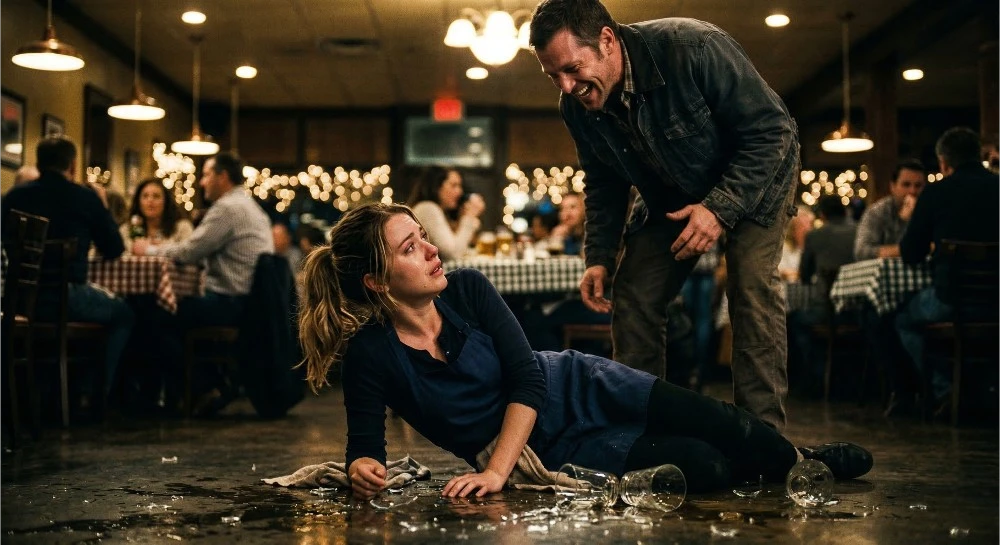
Emily spun. The tray flew out of her hands. Four glasses of water, a cranberry juice, and a gin and tonic exploded across the floor. She lost her footing on the wet tile and went down hard — hip first, then her wrist, then her elbow cracking against the base of a table leg.
Glass shattered everywhere. Silverware scattered. A plate slid off a nearby table and broke in half.
The man kept walking. Two steps. Three. Then he stopped, turned around, and looked down at her on the floor.
He smirked.
“Watch where you’re going,” he said.
Someone at a nearby table gasped. A child tugged her mother’s sleeve.
Emily lay on the wet floor, pain shooting through her wrist. Broken glass pressed into her palm. Cranberry juice soaked through her apron. The ceiling lights swam above her.
“Help,” she whispered. “Somebody. Please.”
The restaurant was silent.
Thirty people. Thirty phones. Thirty pairs of eyes.
Nobody moved.
The man stood a few feet away, smirk still plastered across his face. He swept his gaze across the room.
“What?” he said loudly. “She tripped. Not my problem.”
A mother near the window pulled her child closer. A college kid slowly lowered his phone under the table. The bartender’s hand hovered near the landline but didn’t pick it up.
Fear does that. It turns a room full of adults into statues.
Emily tried to push herself up. A shard of glass shifted under her palm and sliced deeper. She cried out and collapsed back down.
“Please,” she said again. Tears cut tracks through the dust on her face. “I just… I just work here.”
The man laughed. It was an ugly sound. “Then maybe you should watch where you walk.”
He turned and kept going through the restaurant.
And stopped.
Because someone was standing in his way.
At a corner table near the back — one Emily had barely glanced at all night — a man had been eating dinner. Quietly. Unremarkably. An expensive suit. A half-finished steak. A glass of red wine. Across from him sat a large, silent man who hadn’t touched his menu once.
Now the man in the expensive suit was on his feet. Standing directly in the aggressor’s path. Not rushing. Not shouting. Just there. Calm in a way that made the room feel smaller.
The bodyguard stood beside him. Arms at his sides. Perfectly still. Built like a wall.
The restaurant held its breath.
The aggressor’s smirk flickered. “Excuse me. You’re in my way.”
The suited man didn’t move.
His eyes moved slowly — from the shattered glass on the floor behind the aggressor, past the frozen diners, and down to Emily lying on the tiles. He looked at the blood on her wrist. At the tears on her face.
Then he looked back at the aggressor.
“You pushed her,” he said. His voice was low and steady. “Get ready to face the best lawyer in this state.”
The smirk died.
“What?” The aggressor blinked. “I didn’t touch her. She tripped.”
“Thirty people watched you walk into her.” The suited man didn’t raise his voice. Didn’t need to. “And at least five of them are recording right now.”
The aggressor’s eyes darted around the room. He was right. Phones were up. Red dots blinking. The college kid who’d hidden his phone earlier was now holding it steady, pointed straight at him.
“This is ridiculous.” The aggressor tried to step around him. “Get out of my way.”
The bodyguard shifted. One step to the side. Not aggressive. Just a wall getting wider.
The aggressor’s confidence cracked. “You can’t do this. I’ll—”
“You’ll what?” The suited man tilted his head. “You just assaulted a woman in front of a full restaurant on camera. Walk out that door and every news outlet in the city will have the footage by morning. Stay right here, and maybe — maybe — your lawyer can negotiate it down from felony assault.”
“Who the hell are you?”
“Not the question you should be asking right now.”
The aggressor lunged. Fast, sloppy, fueled by rage and nothing else.
The bodyguard moved faster.
One hand caught the aggressor’s wrist. The other pressed flat against his chest. In two seconds, the man was pinned against the wall, his feet barely touching the ground.
Chairs toppled. A woman gasped. Someone’s wine glass fell and broke.
The aggressor struggled, cursing, spitting. The bodyguard didn’t even blink. He held him the way you hold a door — casually, without effort.
“Stay,” the bodyguard said. One word. Done.
The suited man was already moving.
He crouched beside Emily, careful to place his knees away from the glass and the spilled drinks. Up close she could see him clearly — strong jaw, dark eyes, the kind of calm that doesn’t come from comfort but from having survived things that weren’t comfortable at all.
His voice was gentle.
“Stay still,” he said. “Don’t try to move. You’ve got glass in your hands.”
“I’m okay,” Emily said. She wasn’t. Her hands were trembling.
“You’re not,” he said simply. “And that’s fine. Help is coming.”
“How do you know?”
“Because my driver called 911 two minutes ago.”
Emily blinked. “Your… driver?”
He almost smiled. Almost. “Long story.”
He pulled off his suit jacket and folded it. Then he lifted her head carefully — so carefully — and placed the jacket under it like a pillow.
“What’s your name?” he asked.
“Emily.”
“Emily. I’m Daniel.”
“Daniel.” She swallowed hard. “Why are you helping me? You don’t even know me.”
He looked at her for a long moment. The noise of the restaurant — the whispers, the shuffling, the distant sound of sirens — seemed to fade around them.
“Because when I was seventeen,” he said quietly, “I was on the floor. And nobody stopped.”
Emily’s breath caught.
“I swore I’d never be the person who watched,” he said. “That’s all.”
She felt something crack inside her chest — not pain, but something releasing. Something she’d been carrying for years.
“Thank you,” she whispered.
He nodded once. “Don’t thank me. Just stay still.”
The sirens were getting louder now. Red and blue light started flickering through the windows, painting the walls in urgent color.
The front door burst open. Two officers came in fast — hands on belts, eyes scanning.
“Who’s the aggressor?” the first officer barked.
“Against the wall,” the bodyguard said calmly, still holding the man in place. “He assaulted a staff member. Shoved her deliberately while walking past. Multiple witnesses.”
The officer turned to the room. “Anyone see what happened?”
Silence.
Then a voice from the corner — an older woman with silver hair and a green scarf.
“I saw everything.” She stood up. Her voice was clear as a bell. “That man walked right into the waitress on purpose. Knocked her to the ground and smirked about it. She didn’t do a thing wrong.”
Another voice. A man at the bar.
“I saw it too. He body-checked her. Deliberate.”
Then another.
And another.
One by one, voices filled the room — people who had been frozen, now finding their courage.
“She was just doing her job.”
“He shoved her with his shoulder. I was two feet away.”
“I have video. I recorded the whole thing.”
The aggressor’s face drained of color. “They’re lying! She walked into me! I was—”
“Sir, put your hands behind your back,” the officer said.
“You can’t do this! I’ll sue every single—”
“Hands. Behind. Your back. Now.”
The handcuffs clicked shut.
The aggressor screamed profanity as they hauled him toward the door. He twisted, trying to spit at Daniel. Missed.
The bodyguard watched him go with the mildest expression — like he was watching a leaf blow past.
Paramedics came in next. Two of them, quick and professional. They knelt beside Emily, checking her wrist, cleaning glass fragments from her palms with tweezers. She winced but didn’t cry.
“We’re going to put you on a stretcher, okay?” one of them said.
“Okay.”
As they lifted her, Emily turned her head, searching the room.
Daniel was standing by his table. Jacket gone. Sleeves rolled. His bodyguard beside him. His half-finished dinner still sitting there, growing cold.
He was already becoming a stranger again.
“Wait,” Emily said.
He stopped.
“I don’t know who you are,” she said. “I don’t know why you were here tonight. But you’re the only person who moved. And I won’t forget that.”
Daniel held her gaze.
“You don’t need to remember me, Emily. Just remember that you didn’t deserve what happened. Not tonight. Not ever.”
He reached into his pocket and pulled out a business card. He handed it to the nearest paramedic.
“Make sure she gets this. She’s going to need a good lawyer for the civil suit. My firm will cover it. Pro bono.”
The paramedic looked at the card, then at Daniel, then back at the card. His eyebrows shot up.
“You’re Daniel Mercer? The Daniel Mercer? Mercer, Holt & Associates?”
Daniel didn’t answer. He just sat back down at his table, picked up his wine glass, and nodded once to Emily.
The stretcher moved. The door closed. And just like that, she was gone.
Daniel sat alone. The bodyguard across from him. The restaurant slowly coming back to life around them — whispers, nervous laughter, the clink of someone picking up a fork.
He looked down at his steak. Cold now.
He didn’t eat it.
The story spread fast. Someone uploaded the video within the hour. By midnight it had forty thousand views. By morning, it was everywhere.
The headline read: Top Lawyer Confronts Attacker in Brooklyn Restaurant — Waitress Saved, Man Arrested.
Emily watched it from her hospital bed, her wrist bandaged, her brother asleep in the chair beside her. Jamie had taken the bus to the hospital the moment she called. He hadn’t let go of her good hand for two hours.
Her phone was flooded with messages. Coworkers, old friends, strangers sending support. She ignored most of them.
There was only one thing she kept looking at.
The business card on her bedside table.
Daniel Mercer — Mercer, Holt & Associates — Civil Rights & Personal Injury Law.
Below the printed text, he’d written something by hand in small, precise letters:
You were brave. Let us handle the rest.
Two weeks later, Emily sat in a conference room on the thirty-second floor of a glass tower downtown. Her arm was in a soft cast. Jamie sat beside her in a borrowed blazer, trying very hard to look older than fourteen.
Across the table sat her attacker’s defense lawyer — a sweaty man in an expensive suit who kept shuffling papers.
And beside Emily sat Daniel Mercer.
He didn’t look at the defense lawyer. He looked at his files. Calm. Organized. Unhurried.
“My client wants to settle,” the defense lawyer said. “He’s prepared to offer five thousand dollars and a written apology.”
Daniel finally looked up.
“Five thousand dollars,” he repeated.
“And a written apology.”
“Your client deliberately body-checked a twenty-four-year-old woman into the floor. She has lacerations on both palms, a sprained wrist, a bruised elbow, three weeks of lost wages, and a fourteen-year-old brother she supports alone.” Daniel leaned forward. “And you’re offering five thousand dollars.”
The defense lawyer loosened his tie. “It’s a generous starting—”
“Here’s my counteroffer.” Daniel slid a folder across the table. “Assault in the third degree. Battery. Reckless endangerment. Eleven witness statements. Four video recordings from separate angles. One of which clearly shows your client walking into her deliberately and smirking afterward.”
He paused.
“We’re suing for four hundred and fifty thousand dollars. Medical bills. Lost income. Pain and suffering. Emotional distress. Punitive damages.”
The defense lawyer’s mouth opened. Closed. Opened again.
“That’s… that’s absurd.”
“Is it?” Daniel tilted his head. “Because the video has twenty-two million views now. The public sentiment isn’t exactly in your client’s favor. And I have three news outlets ready to cover the trial. Do you really want to take this before a jury?”
Silence.
The defense lawyer looked at his papers. Looked at Daniel. Looked at Emily.
Emily looked back at him steadily. She didn’t flinch.
“We’ll… we’ll need to discuss this with our client.”
“Take your time,” Daniel said. He leaned back in his chair. “We’re not going anywhere.”
They settled three days later. Four hundred and twenty thousand dollars. Full medical coverage. A permanent restraining order.
Emily sat in Daniel’s office after the signing, holding the settlement letter with both hands. Her good hand and her healing one.
“I can’t believe it,” she said. “I can pay off Jamie’s school fees. I can… I can actually breathe.”
“You earned it,” Daniel said from behind his desk. “Every cent.”
“No.” She shook her head. “You earned it. I was just the person it happened to.”
“Emily.” He set down his pen. “You stood in a room full of people who were too afraid to speak. You asked for help when your whole body was shaking. You showed up here today with cuts on your hands and you didn’t back down. Don’t tell me you didn’t earn this.”
Her eyes burned.
“Why do you do this?” she asked. “Pro bono. For strangers. You’re one of the most successful lawyers in the city — you don’t need this.”
Daniel was quiet for a moment.
“When I was seventeen,” he said, “a man attacked my mother in a grocery store parking lot. Broke her collarbone. I was right there. I tried to stop him and he put me on the ground too.” He looked out the window. “Nobody helped. Nobody called the police. We waited forty minutes for an ambulance.”
Emily pressed her hand over her mouth.
“She survived. Barely. But she never felt safe in public again.” He turned back to Emily. “I went to law school the next year. Worked three jobs, borrowed everything I could, and swore that I would spend my life making sure that when someone ends up on the floor, they don’t stay there alone.”
“Daniel—”
“That’s why I was at Harbor Street that night. My mother used to eat there, before she passed. I go there every year on her birthday. I sit at her favorite table and order her favorite dish and I remember her.”
Emily’s tears fell freely now.
“And then it happened right in front of you,” she said. “Again.”
“Yes.” His voice cracked, just barely. “And this time I didn’t freeze.”
They sat in silence for a long time. Not uncomfortable. Just full.
Finally, Emily stood.
“Thank you, Daniel. For everything.”
He shook her hand. Firm. Warm.
“Go take care of your brother, Emily. Go live your life. You deserve every bit of it.”
Six months later, Emily walked through the front door of the apartment she’d just signed a lease on. Three bedrooms. Big windows. A kitchen Jamie could actually cook in.
Jamie stood in the living room, turning slowly, mouth open.
“This is ours?” he said.
“This is ours.”
“Like… for real? No roommates? No broken radiator? No landlord banging on the door at midnight?”
“For real.”
He looked at her. His eyes filled up. He was fourteen but in that moment he looked like the little boy she used to carry on her hip.
“Em—”
“Come here.”
She hugged him so tight she felt her palms sting. She didn’t care.
“We made it, kid,” she whispered into his hair. “We actually made it.”
Outside, the city hummed its restless song. But inside that apartment, for the first time in a very long time, everything was still. Everything was warm. Everything was exactly where it was supposed to be.
Emily set a framed photo on the kitchen counter — her and Jamie, taken at the hospital the night of the incident. He was asleep in the chair. She was smiling, bandaged and bruised, but smiling.
Beside the photo, she placed Daniel Mercer’s business card.
She didn’t need it anymore.
But she’d keep it forever.
Original fictional stories. AI-assisted creative content.
