
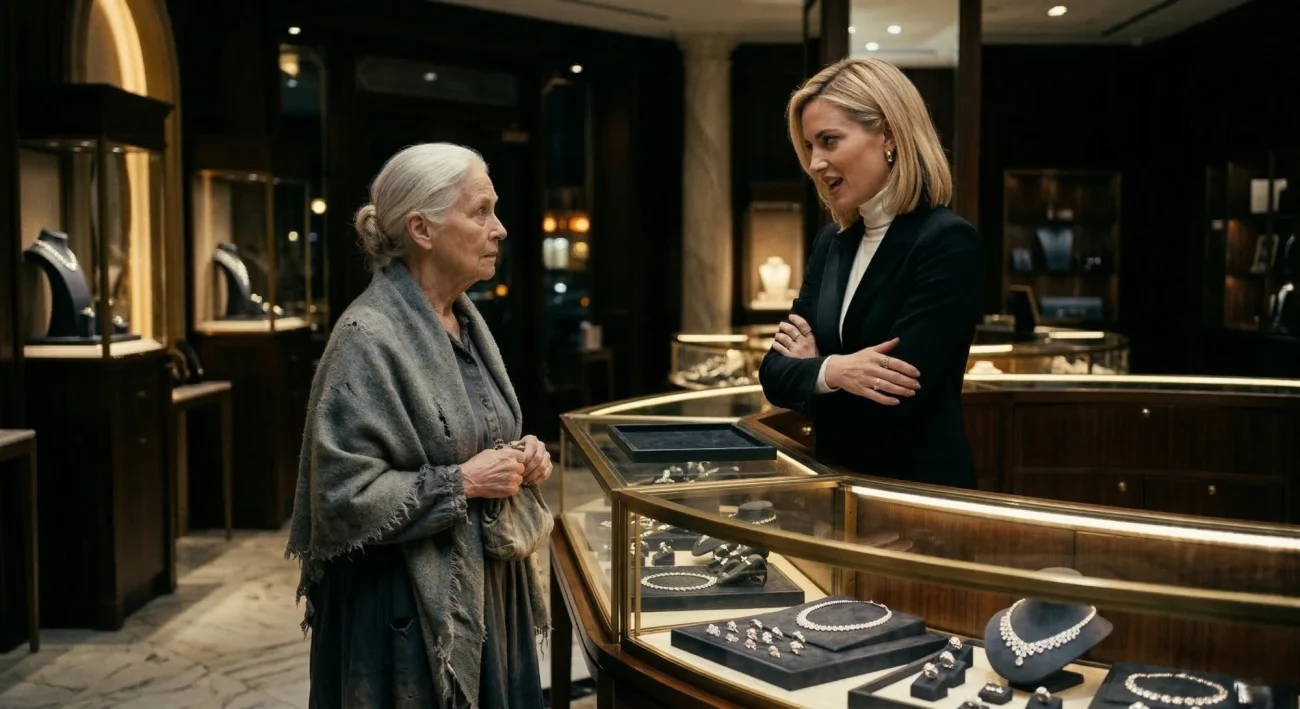
The diamonds at Aurora Crown Jewelers didn’t just sit in their cases — they glowed. Every cut stone caught the light and threw it back like a tiny, private sun. The showroom smelled of money: cool air, fresh roses, leather-bound display trays. Soft piano notes drifted from a speaker tucked near the vaulted ceiling.
Emily stood by the front counter, running one nail along the edge of her blazer sleeve. She’d been working here fourteen months. Long enough to know what a real customer looked like.
The glass doors opened.
An old woman stepped inside.
She wore a cotton dress, pale blue and slightly faded. A shawl — the kind you buy at a church rummage sale — draped around her shoulders. White hair pinned back in a tidy bun. Hands wrapped around a small cloth purse that had seen better decades.
Emily watched her the way a cat watches something it hasn’t decided to bother with yet.
The old woman walked slowly, unhurried. She paused at each display case, studying pieces the way a person reads something interesting. Not the way a buyer scans for price. Something quieter than that. Something more careful.
She stopped at the centerpiece display.
A diamond necklace — the one they kept under a separate light, on a raised velvet stand. Forty-two stones, princess cut. The tag was turned face-down because the number on it tended to make people uncomfortable.
The old woman’s hand lifted toward the glass.
Emily was already moving.
Her heels hit the marble floor in sharp, decisive clicks. She positioned herself across the case, arms crossed, smile fixed.
“Can I help you?” she said, in the tone that actually meant can I hurry you out of here.
The old woman glanced up. “Just looking, thank you.”
“Right.” Emily tilted her head. “That piece runs just under four hundred thousand. I’d hate for you to get your hopes up.”
A nearby customer — a woman in a camel coat — glanced over her shoulder.
The old woman looked back at the necklace. “It’s beautiful.”
“It is,” Emily said. “Which is why we prefer people not handle it unless they’re serious buyers.” She let the word serious hang there a moment, sharpened.
The old woman withdrew her hand.
She didn’t look hurt. She didn’t look angry. She just nodded, once, the way you nod at weather.
“Of course,” she said softly. “I understand.”
Emily turned away. She walked back to the counter, leaned toward her colleague Britt, and murmured something. Britt pressed her lips together to hold back a laugh.
The old woman found a chair near the window display and sat down. She folded her hands over her purse and looked out at the street.
She didn’t leave.
Emily noticed that. She told herself it didn’t matter.
Fifteen minutes passed.
Then the service door behind the counter opened.
Mr. Harrison came through it at something close to a jog — which no one had ever seen. The showroom manager moved like a diplomat at all times: measured, composed, never above a brisk walk. Today his jacket was half-buttoned and his face was the color of old chalk.
His eyes swept the room.
They landed on the woman by the window.
Something happened in his expression that Emily couldn’t name. A kind of controlled collapse.
He crossed the showroom floor without pausing at the counter, without acknowledging his staff, without doing any of the things he always did when he entered a room.
He walked directly to the old woman.
And he stopped.
And he bowed.
Not a polite nod. Not the slight dip he gave to VIP clients. A full, deliberate bow — shoulders down, head low, held for three full seconds.
The piano kept playing.
Nobody else moved.
“Mrs. Whitmore,” he said, straightening. His voice was careful, controlled, and completely unlike itself. “I am so sorry. I had no idea you were already here. I would have — “
“It’s fine, James.” Her voice was easy, warm even. “I didn’t announce myself.”
“Still.” He glanced at his staff. The glance was not warm. “You should have been attended to properly the moment you walked in.”
Emily felt something cold move through her chest.
James. She called him James.
“I think,” Mrs. Whitmore said, settling her purse on her lap, “that I was attended to quite thoroughly.”
Harrison’s head turned.
“Who spoke to her?” he asked. Quiet. Worse than loud.
No one answered.
Emily considered, very briefly, staying quiet. Then she thought about cameras. About Britt standing three feet away. About the customer in the camel coat who was definitely listening.
She stepped forward.
“I did.” She kept her chin level. “She was touching the Elara necklace without indicating any intent to purchase. I was following protocol.”
Harrison looked at her the way you look at something you’re trying to understand before you respond to it.
“What did you say to her?”
“I explained the price point. And that we prefer not to have merchandise handled by — “
“By what?” he said. “Finish that.”
Emily’s jaw tightened. “By customers who aren’t serious buyers.”
The room was very quiet.
Mrs. Whitmore watched this exchange without expression.
Harrison clasped his hands in front of him. “Do you know who this woman is?”
“She didn’t identify herself.”
“Her name,” he said slowly, “is Eleanor Whitmore.”
Emily waited. The name didn’t land.
“She owns this building, Emily.”
A beat.
“Not just this building,” he continued, and his voice had gone flat and precise. “She is the founding shareholder of Whitmore Holdings. Which is the parent company of Aurora Crown Group. Which is the company that owns this showroom. This counter. The chair you’re standing in front of. The blazer hanging in the back room with your name tag on it.”
Emily heard the words. She understood each one individually.
Together, they didn’t make sense yet.
“Every quarterly report this store files goes to her office,” Harrison said. “Every lease renewal. Every major hire. She has final authority over all of it.”
“I didn’t know,” Emily said. Her voice came out smaller than she intended.
“No,” he said. “You didn’t know. Which means you made a judgment about who deserved respect — and you made it based on a shawl.”
Mrs. Whitmore rose from her chair.
She didn’t rush. She moved the way she’d moved since she walked in — unhurried, sure of herself in the way that only comes from having nothing left to prove.
She walked back to the Elara display.
This time, no one moved. No heels clicked. No one cleared their throat.
She looked at the necklace. Then she reached into the case — the attendant had it open before she finished extending her hand — and she lifted it. She held it up, and the forty-two stones caught the afternoon light and scattered it across the ceiling in small bright points.
“It really is beautiful,” she said again.
She handed it back.
“I won’t be purchasing today.” She turned to Harrison. “But I’d like to speak with you about staffing. Privately.”
“Of course.” He stepped aside, gesturing toward the private consultation room.
She paused at Emily.
Their eyes met.
“I came in without telling anyone,” Mrs. Whitmore said. “I do that sometimes. Not to trap people.” She tilted her head slightly. “Just to see what a place is like when no one thinks it matters.”
Emily opened her mouth.
Nothing came out.
“Today was useful,” Mrs. Whitmore said, simply, and walked past her.
The door to the consultation room closed.
The showroom held its breath.
Britt took a very slow step away from Emily.
The customer in the camel coat set down the brooch she’d been pretending to examine, picked up her bag, and walked to the exit without buying anything. She didn’t look at Emily on the way out.
Emily stood at the counter.
She picked up the customer service tablet. Set it down. Picked up a polishing cloth. Didn’t use it.
Twenty-two minutes later, the consultation room door opened.
Harrison came out first. He walked to the counter and stood in front of Emily.
“She asked me to handle this directly,” he said. “She was — ” he paused — “more measured about it than I would have been.”
Emily looked up. “Am I fired?”
“Yes.”
She’d known. She’d known since the bow. But hearing it still hit like a step she’d missed in the dark.
“HR will process your paperwork by end of day. You’re to collect your things from the back now.”
“Harrison — “
“You can appeal through corporate,” he said. “But I’d encourage you not to. The recommendation letter situation will not improve with time.”
He walked away.
Emily stood at the counter for one more moment. She set the polishing cloth down very carefully, like it was something fragile. Then she walked to the back room.
Lily — the junior associate, six weeks in, twenty-three years old, still learning where everything was kept — was restocking a tray of earrings when Emily passed her.
Lily had smiled at every single customer who came through the door today, including the ones who were clearly just walking in out of the heat.
Emily didn’t look at her.
Back in the showroom, Mrs. Whitmore had stopped at Lily’s station on her way out.
“What’s your name?”
Lily stood up straighter. “Lily. Lily Chen.”
“How long have you been here?”
“Six weeks.”
“Do you like it?”
Lily considered being diplomatic. Then: “Some days more than others.”
Mrs. Whitmore smiled at that. It was a real smile — the kind that reached the eyes and stayed there.
She turned to Harrison, who had followed at a respectful distance. “The Elara necklace. Have it sent to her.”
Lily blinked. “I’m sorry?”
“Consider it an employment anniversary gift.” She tilted her head. “Early.”
Harrison nodded once. “Of course.”
Lily looked from him to the old woman and back again. “I — I don’t — “
“You smiled at me when I walked in,” Mrs. Whitmore said. “Before anyone else looked up. You said good afternoon and meant it.” She adjusted her shawl. “That costs nothing, and it’s everything.”
Lily didn’t have words. She stood there with her mouth slightly open and her eyes doing things she couldn’t control.
Mrs. Whitmore touched her arm briefly — just a light touch, grandmother-sure — and moved toward the exit.
At the door, she paused without turning around.
“James,” she said.
“Yes, ma’am.”
“The piano music. It’s lovely. Keep it.”
The glass doors opened and the late afternoon light fell across her like something that had been waiting.
She stepped through and was gone.
Inside the consultation room, Harrison sat back down at the desk and looked at the notes he’d taken. His handwriting had gotten worse as the conversation went on — a thing that happened when he was upset and trying not to show it.
He thought about Emily. Twenty-six years old. Trained, competent, good numbers. He’d written her a good review eight months ago.
He thought about what she’d said. I don’t care.
Not I didn’t know her. Not I made an error in judgment. Just — I don’t care.
That was the part that had done it. Not the mistake. The announcement.
He closed the notebook.
In the showroom, Lily was still standing at her station, not moving, staring at the velvet tray where the Elara necklace would arrive in a delivery box by the end of the week. A four-hundred-thousand-dollar necklace. On a salary she’d calculated could cover rent, groceries, and maybe one coffee a day.
Britt walked over. “Are you okay?”
“I don’t think so,” Lily said honestly.
“That makes two of us.”
They stood together for a moment in the quiet.
The piano kept playing.
Emily carried a cardboard box to the service exit. Inside it: a framed photo of her and a friend at a vineyard, a travel-size hand cream, and a coffee mug with a small chip in the handle that she’d never gotten around to replacing.
Fourteen months.
She’d worked hard. She’d learned the inventory. She’d memorized the clientele. She’d stayed late, come in early, covered shifts.
None of that was the problem.
She sat on the low wall outside the service exit and set the box next to her.
A faded shawl.
That was all it had taken. One woman. One shawl. One sentence — that necklace costs more than your entire village — and everything she’d spent fourteen months building had come apart in less than an hour.
She hadn’t even thought about whether the woman could afford it.
She had looked at the shawl and made the decision before she crossed the floor.
That was the part she kept running into. Not the firing. Not the humiliation of being dressed down in front of clients and colleagues and a woman who had every reason to have her blacklisted from the entire industry.
Just: she had looked at a shawl and made a decision.
She sat outside in the cooling afternoon and thought about all the other times she’d done that. How automatic it was. How she’d never once — not once, in fourteen months — wondered if she’d gotten it wrong.
Until today, when getting it wrong had a name.
And the name owned the building.
She picked up the box and walked to her car.
No tears. She was past that.
Just the weight of something she was going to have to carry now, and figure out later, and not put down.
A week later, the Elara necklace arrived at the store in a velvet case with a handwritten note inside.
For Lily Chen — Because kindness is the rarest jewel of all.
— E. Whitmore
Lily read it three times.
Then she put it in the small safe in Harrison’s office, because she was twenty-three years old and did not own a four-hundred-thousand-dollar necklace’s worth of security infrastructure.
But she kept the note.
She folded it carefully and put it in the front pocket of her bag, next to her transit card.
Every morning after that, when she walked into the showroom and the piano started and the diamond light scattered across the ceiling, she said good afternoon to every person who came through the door.
Every one.
Without exception.
And she meant it every time.
Original fictional stories. AI-assisted creative content.
