
Andrew Whitaker’s phone buzzed in his pocket at 2:14 PM. He was standing on a half-finished office complex, mid-conversation about load-bearing walls.
He answered without checking.
“Andrew Whitaker speaking.”
The voice on the other end was shaky. Rehearsed.
“Sir… I think I found someone you know. A boy. He says his name is Oliver Whitaker.”
Andrew’s chest locked.
“I’m near Cedar and Brookfield. The kid’s been hurt. I figured you’d want to know.”
He didn’t remember hanging up. Didn’t remember crossing the gravel lot. Didn’t remember starting the car. The only thing that registered was a deep crack forming somewhere inside the architecture of his life.
He arrived fifteen minutes later.
A man stood near a hedge, waving with cautious urgency. Andrew stepped out and followed his gesture.
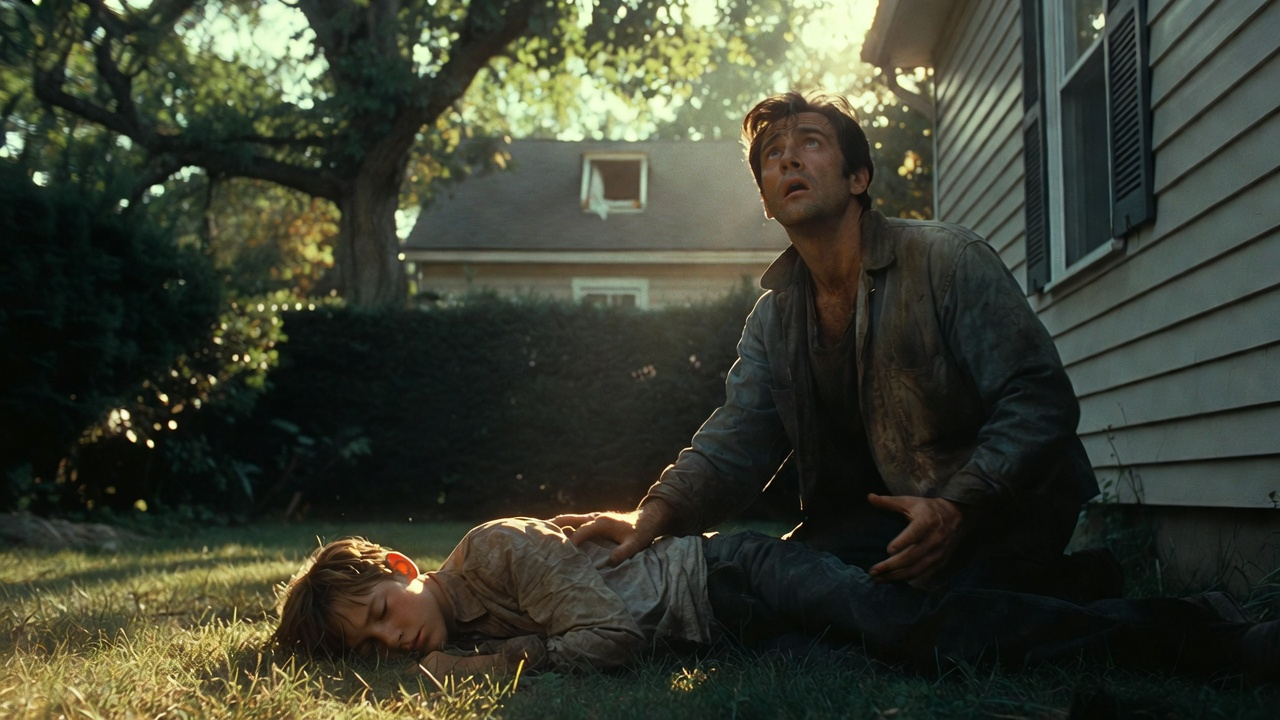
Behind the hedge, half-hidden in the shade, his ten-year-old son lay curled against the grass. Oliver’s face was pale, his breathing rough, and his left ankle was swollen at a sickening angle.
Andrew knelt down carefully.
“Oliver… hey. It’s Dad.”
Oliver’s eyes opened slowly. Relief washed across his face like something uncorked.
“Dad…”
“What happened, buddy?”
Oliver swallowed hard and pointed toward the distant rooftops.
“I had to jump.”
“Jump from where?”
“The attic window.”
Andrew’s stomach dropped through the pavement.
He gently lifted the boy’s arm to check for more damage. That’s when he saw the marks — faint red lines circling Oliver’s wrists. Not from a fall. From adult fingers gripping too tight.
“Oliver.” Andrew kept his voice steady, though something behind his ribs was starting to burn. “Who brought you up there?”
Oliver looked away.
“Mr. Garrett.”
The name hit like a sledgehammer wrapped in twenty years of trust.
Nathan Garrett. Best friend. Best man at his wedding. The man who’d held Oliver the day he was born.
“Mom said he was fixing the internet,” Oliver whispered. “I was watching a video in the living room. He told me I was being too loud.”
“Then what happened?”
Oliver’s fingers tightened on Andrew’s sleeve.
“He grabbed my arms and took me upstairs to the attic. He pushed me into the storage room and put a chair under the handle so I couldn’t get out.”
Andrew closed his eyes.
“Did he say anything?”
“He said if I made any more noise…” Oliver’s voice cracked. “He’d come back and make sure I stayed quiet forever.”
Andrew felt rage surge through him with terrifying force. But twenty-two years of designing structures had taught him one thing rage never understood — if you strike a load-bearing wall without a plan, the collapse destroys more than the problem.
He needed evidence. He needed control.
He opened the smart-home app on his phone. The activity log loaded instantly.
14:31 — Attic Storage Door Locked (Manual Latch) 14:44 — Side Yard Motion Sensor Triggered
The timestamps told the whole story. Oliver had been locked in. Oliver had escaped through the attic window. The motion sensor caught his impact when he landed.
Andrew backed up the logs to his cloud account immediately.
Then he called 911.
His voice was calm. Clinical.
“I need to report a child who was physically restrained and confined by an adult inside my home. The child escaped through a second-story window and has sustained injuries.”
He gave the address. Then he helped Oliver into the back seat and drove the short distance home.
Paramedics were already pulling into the driveway when he arrived.
After confirming Oliver was being treated — ankle stabilized, vitals checked — Andrew walked toward his own front door.
His phone was already recording.
Inside, the living room looked like a magazine ad.
Sunlight through tall windows. Soft music drifting across polished floors. A bottle of wine on the coffee table.
Rachel Whitaker sat on the couch.
Nathan Garrett sat across from her.
They both looked up.
Rachel’s expression shifted from surprise to a smile that didn’t quite land.
“Andrew? I thought you were working late today.”
Nathan leaned back, glass in hand.
“Hey, man. Didn’t expect to see you yet.”
Andrew nodded once.
“Nathan. Thanks for coming by to help with the router.”
“No problem. Took a little longer than I expected.”
Andrew glanced toward the staircase.
“I came home early to take Oliver to baseball practice. Where is he?”
Rachel took a slow sip.
“He was making too much noise while Nathan was working, so I sent him upstairs to read.”
“Upstairs?”
“He must have fallen asleep. I checked on him earlier.”
Andrew tilted his head.
“You checked on him?”
“Of course I did.”
Andrew walked to the window. The distant wail of sirens was growing louder. He turned back.
“Nathan, you’re Oliver’s godfather.”
Nathan shifted in his seat.
“Yeah. Of course.”
“Then you know he’s terrified of small dark spaces.”
Nathan’s smile evaporated.
“Sure, but—”
“So why did you drag him into the attic and lock him in a storage room?”
The silence was heavy enough to crush bone.
Rachel went white.
“Andrew… what are you talking about?”
“Our son is in an ambulance right now.” Andrew’s voice was flat, surgical. “He jumped out of the attic window because your friend locked him inside and threatened to hurt him if he made a sound.”
Rachel’s eyes darted to Nathan.
“That can’t be right. Nathan said he just sent Oliver upstairs to calm down.”
“He didn’t send him upstairs, Rachel. He grabbed him hard enough to leave marks on his wrists. He shoved him into a pitch-black room. He barricaded the door with a chair.”
Nathan stood up fast.
“Now hold on — the kid was out of control. I was just trying to—”
“To what?” Andrew stepped closer. “Threaten a ten-year-old? Lock him in the dark? So the two of you could sit here drinking wine while he broke his ankle jumping from a window to save himself?”
Nathan’s mouth opened. Nothing came out.
Red and blue lights swept across the living room walls.
Rachel’s composure crumbled.
“Andrew, tell them this is a mistake. Tell them Nathan didn’t mean—”
“Nathan didn’t mean what?” Andrew’s voice finally broke its restraint. “He didn’t mean to terrorize our child? You didn’t mean to ignore it? Which part was the accident, Rachel?”
The front door opened. Two officers stepped inside.
Andrew handed them his phone — the recording, the smart-home logs, the timestamps documenting the locked door and the motion sensor activation. He explained everything with the precision of a man who builds things that don’t fall down.
Nathan tried to protest.
The officers cuffed him before he finished his second sentence.
Rachel lunged toward Andrew.
“You can’t do this. He’s our friend. This is a misunderstanding!”
Andrew looked at her. He expected to feel fury. Instead, he felt something far worse.
Clarity.
“A misunderstanding,” he repeated. “Our son has grip marks on his wrists. A broken ankle. He told a complete stranger on the street what happened because he was too afraid to call his own mother.”
Rachel’s lips trembled.
“I didn’t know—”
“You didn’t want to know. There’s a difference.”
An officer approached Rachel.
“Ma’am, we need you to come with us for questioning.”
“Andrew, please.”
He said nothing.
She was walked toward the squad car.
Through the ambulance window, Oliver watched silently as his mother was guided into the back seat of a police cruiser.
His voice was small.
“Dad… is Mom coming with us?”
Andrew climbed in beside him and took his hand.
“No, Oliver. She’s not.”
“Why?”
Andrew squeezed gently.
“Because she made a choice today. And choices have consequences.”
Oliver looked down at the blanket over his swollen ankle.
“Are we gonna be okay?”
Andrew pulled him close.
“Yeah, buddy. We are.”
Three weeks later, Andrew filed for full custody.
The smart-home logs, the 911 recording, the paramedic report, and Oliver’s statement were entered as evidence. Nathan Garrett was charged with child endangerment, unlawful restraint, and criminal threatening. He was denied bail after the judge reviewed the audio of Oliver describing the threat.
Rachel’s attorney attempted to frame the incident as a disciplinary disagreement. The judge shut it down in four words.
“The child jumped, counselor.”
Andrew was granted sole custody. Rachel was ordered supervised visitation only, pending a psychological evaluation she never completed.
On the first morning in their new apartment, Oliver sat at the kitchen table eating cereal while Andrew taped a drawing to the refrigerator — a crayon sketch of a house with two stick figures standing in front of it.
Just two.
“Dad?”
“Yeah?”
“This house doesn’t have an attic.”
Andrew looked at the drawing. Then at his son.
“No, it doesn’t.”
Oliver smiled for the first time in a month.
Andrew smiled back.
The foundation held.
Original fictional stories. AI-assisted creative content.
