
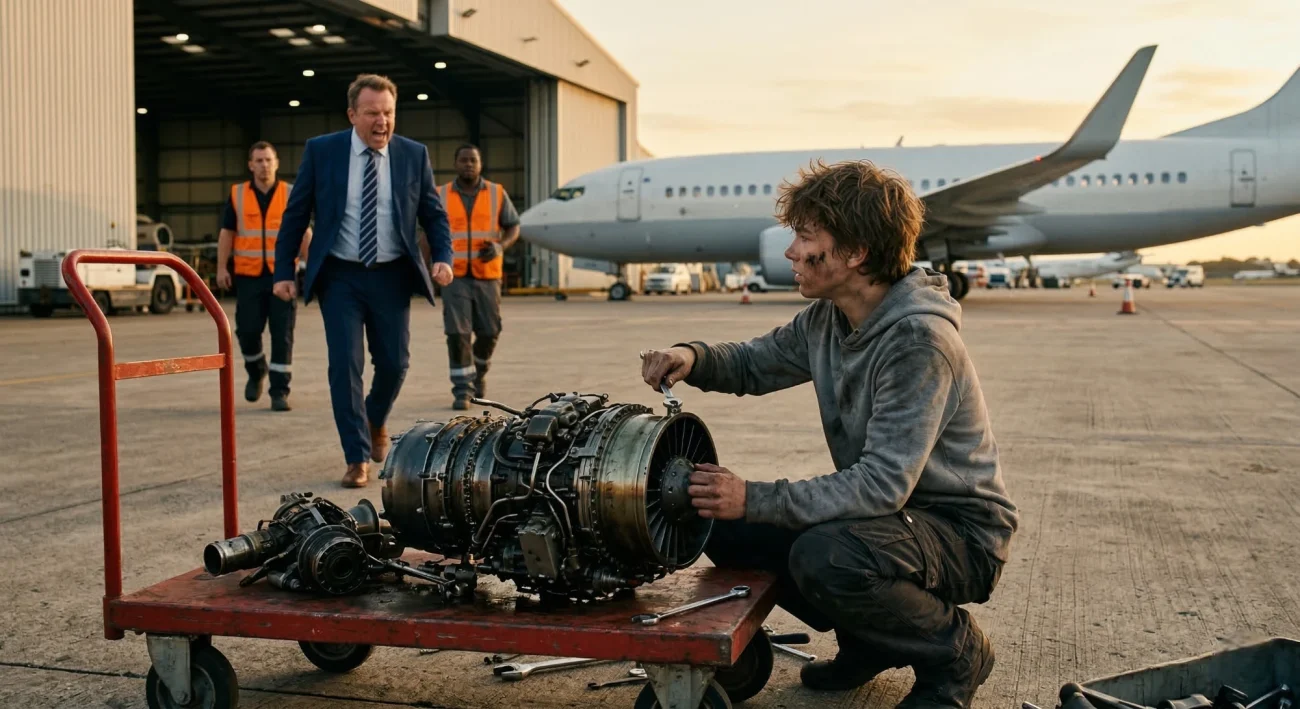
The sun had barely cracked the horizon when Daniel Carter’s phone started screaming.
He silenced it, already dressed, already exhausted.
The grounded cargo aircraft in Bay 7 had been the worst news of the quarter — a catastrophic mechanical failure that shredded the turbine assembly beyond anything his team could reverse. Replacement parts were on a slow boat from Germany. The estimate sitting on his desk said four hundred thousand dollars minimum, six weeks minimum.
He drove to the airport in silence.
The maintenance yard was still half-dark when Daniel stepped out of the black SUV. The cold bit through his jacket. Around the blocked-off zone, yellow safety tape fluttered in the early wind.
Three of his senior engineers, including Marcus Webb — fifteen years on the job — were huddled near a coffee thermos, talking quietly.
“Anything change overnight?” Daniel asked.
Marcus shook his head. “Nothing we can do on-site. I filed the procurement request for the replacement turbine shaft. Earliest arrival is—”
“Six weeks. I know.”
Daniel stared at the scattered parts on the metal tables. Heavy turbine blades, cracked housings, bundled wiring that looked like it had been through a fire.
He exhaled.
Then Marcus squinted past him.
“Sir.”
Daniel turned.
“There’s a kid over there.”
He was small — couldn’t have been older than twelve. Kneeling on the bare concrete in old jeans ripped at the knees, a stained shirt, grease up both arms to the elbows. Next to him sat a battered toolbox, the kind sold for ten dollars at a flea market twenty years ago.
The kid was tightening something inside the turbine housing with a short wrench.
His hands weren’t shaking. He wasn’t guessing. He rotated the shaft slowly, tilted his ear toward it, listened, adjusted.
“Hey!” Marcus shouted.
The boy didn’t look up.
“Hey — kid! Stop touching that!”
The boy finished tightening the bolt. Then, only then, he looked up. His face was streaked with grease. His eyes were completely calm.
Daniel broke into a jog, Marcus and two other workers right behind him.
“What the hell are you doing?” Daniel snapped when he reached the boy.
The kid set the wrench down carefully.
“Fixing it,” he said.
“Fixing it.” Daniel repeated the word like it was in a foreign language. “These components were inspected by a certified team last night. They are beyond repair. You understand what that means? Beyond. Repair.”
“I know what it means.”
“Then why are you touching them?”
The boy stood up slowly. Even standing, he barely reached Daniel’s chest.
“Because they aren’t beyond repair,” he said. “They were assembled wrong during the emergency removal. The failure cracked one bracket and burned the wiring harness. Everything else is fine.”
Marcus let out a short, disbelieving laugh. “Son, I’ve been maintaining aircraft for fifteen years. That turbine shaft was—”
“Seized because the retaining collar was installed backwards when your crew pulled it last night,” the boy said simply. “I reversed it. It spins now.”
Silence.
Marcus looked at Daniel. Daniel looked at the turbine.
“Try it,” the boy said.
Nobody moved for a second.
Then Marcus crouched down, more to disprove the kid than anything else. He wrapped his hand around the turbine shaft and rotated it.
It moved.
He frowned. Rotated it faster.
Smooth. Silent. No grind, no catch.
“What…”
He looked at the wiring next. The burned harness the team had written off was reconnected — each cable stripped back, rejoined, and wrapped cleanly. The damaged internal support bracket had a reinforcement piece bolted to it, cut from a section of scrap metal with a handsaw.
Marcus stood up slowly.
“Daniel,” he said.
His voice had changed.
“Daniel, this is… this is actually correct.”
Daniel moved past him and crouched at the motor casing. He opened it, held his phone light inside.
The internal components had been cleaned, repositioned, and secured with a precision that made his stomach drop. Every connection was right. Every adjustment was textbook — better than textbook.
He stood up and looked at the boy.
“Who helped you?”
“No one.”
“That’s not possible.”
“I’ve been here since four in the morning.”
Daniel stared at him. The grease. The toolbox. The torn jeans. A twelve-year-old who showed up at four in the morning to fix a broken airplane.
“Who are you?” Daniel asked, quieter now.
The boy wiped his hands on a rag.
“Leo.”
“Leo what?”
“Leo Rivera.”
One of the younger maintenance workers — a guy named Chris who’d been quiet the whole time — suddenly looked up from the turbine he’d been inspecting.
“Rivera?” he said.
Marcus turned.
“You know the name?” Daniel asked.
Chris nodded slowly. “Michael Rivera. He was… he was a senior engine tech here. Before my time, but I’ve heard the stories. Everyone has.”
Marcus’s face changed. “Michael Rivera. Yeah. I worked two years under him when I was starting out.” He paused. “He passed away, what — four, five years ago?”
“Four years,” Leo said.
The yard went quiet.
Wind moved across the concrete. Somewhere in the distance, a ground vehicle beeped as it reversed.
“He was your father,” Daniel said. It wasn’t a question.
Leo nodded.
“He used to bring me to the workshop after school,” Leo said. “Every day, almost. I sat on the bench and watched him work. When I was old enough he let me hand him tools. When I was eight he started explaining what he was doing.” Leo looked at the turbine. “Turbine assemblies were his favorite. He said they were the heart of the plane.”
Marcus pressed his lips together and looked away.
Daniel stood very still.
“So when you heard about the grounded aircraft—” he started.
“I saw it on the news,” Leo said. “They mentioned the airport. I recognized the type of failure from something my dad described once.” He shrugged, just slightly. “I thought I could help.”
“You thought you could help,” Daniel repeated.
“I fixed it,” Leo said. “You should run diagnostics before you trust my word on it.”
The diagnostic crew was on-site within eight minutes. They connected the sensor rig, powered the motor, and stepped back.
Everyone in the yard held their breath.
The turbine spun up.
Smooth. Stable. The readings climbed into the green.
One of the engineers — a woman named Dr. Patricia Yuen, the head of mechanical certification — pulled off her headset and stared at the readout screen for a long moment.
Then she turned to Daniel.
“It’s airworthy,” she said.
Nobody spoke.
Leo was already picking up his toolbox, latching the metal clasps with practiced clicks.
“Wait,” Daniel said.
Leo stopped.
“You just saved this airport four hundred thousand dollars and six weeks of downtime.” Daniel shook his head. “You walked in here with a flea-market toolbox at four in the morning and fixed something a certified team couldn’t.”
Leo said nothing.
“What do you need?” Daniel asked. “What can we do for you?”
“Nothing.” Leo picked up the toolbox. “I just wanted to fix it.”
“Leo.”
The boy looked at him.
“Your father was one of the best engineers this airport ever had,” Daniel said. “I know that now, and I’m sorry I didn’t know it before.” He paused. “I want to make you an offer. Not today — you’re twelve, so I’m talking about the future. But I want to put in place a formal apprenticeship here, funded by this airport, in your father’s name. The moment you turn sixteen, the position is yours. Paid. Mentored. Real training.”
Leo blinked.
“You’d have to apply through—”
“No application,” Daniel said firmly. “I’m the operations director. I’m making this call right now.” He looked at Marcus. “Back me up.”
Marcus didn’t hesitate. “Done.”
Dr. Yuen crossed her arms and nodded once.
Leo looked at the ground. His jaw moved slightly, like he was trying to decide something.
Then he looked up.
“Okay,” he said.
That was all.
But when Daniel extended his hand, Leo shook it — and his grip was steady and certain, the grip of someone who had been raised around men who meant what they said.
Later that morning, Daniel sat in his office and drafted two documents.
The first was the memo canceling the emergency parts procurement: Turbine assembly successfully repaired on-site. Aircraft cleared for return to service.
The second was a formal letter he sent to the airport’s board of directors, announcing the creation of the Michael Rivera Memorial Apprenticeship — a fully funded four-year engineering track for exceptional young candidates, starting at sixteen, culminating in a certified aircraft maintenance license.
The first recipient, he noted in the letter, had already been selected.
By noon, the cargo aircraft was being prepped for its delayed departure.
In Bay 7, someone had left a single wrench on the metal table where Leo had worked — left it like a marker, like a small monument.
Nobody moved it.
Three weeks later, a framed photograph appeared on the wall inside the main maintenance building, between the safety certifications and the shift schedules.
It showed a younger version of the airport, a wide-shouldered man in overalls crouched beside an open engine casing, smiling at whoever was behind the camera.
Underneath it, a small placard read:
Michael Rivera — Senior Aircraft Engineer, 1998–2020. “The turbine is the heart of the plane.”
Below that, in smaller text, someone had added a second line.
His son fixed one. We didn’t forget.
Original fictional stories. AI-assisted creative content.

Hello,
I’m David Limbright and was a crewchief on the CH-53E. This is an awesome story and really should be a full movie. I see the clip but I don’t think it’s a full movie just AI. Really well written I loved reading it. Would make an awesome coming of age story for more mechanics. We need more mechanics!
Regards, David Limbright USMC
Thank you very much, let’s hope there will be a film someday!
Excelente historia,gostei muito dela.
O mundo precisa de mais pessoas assim.
Nice