
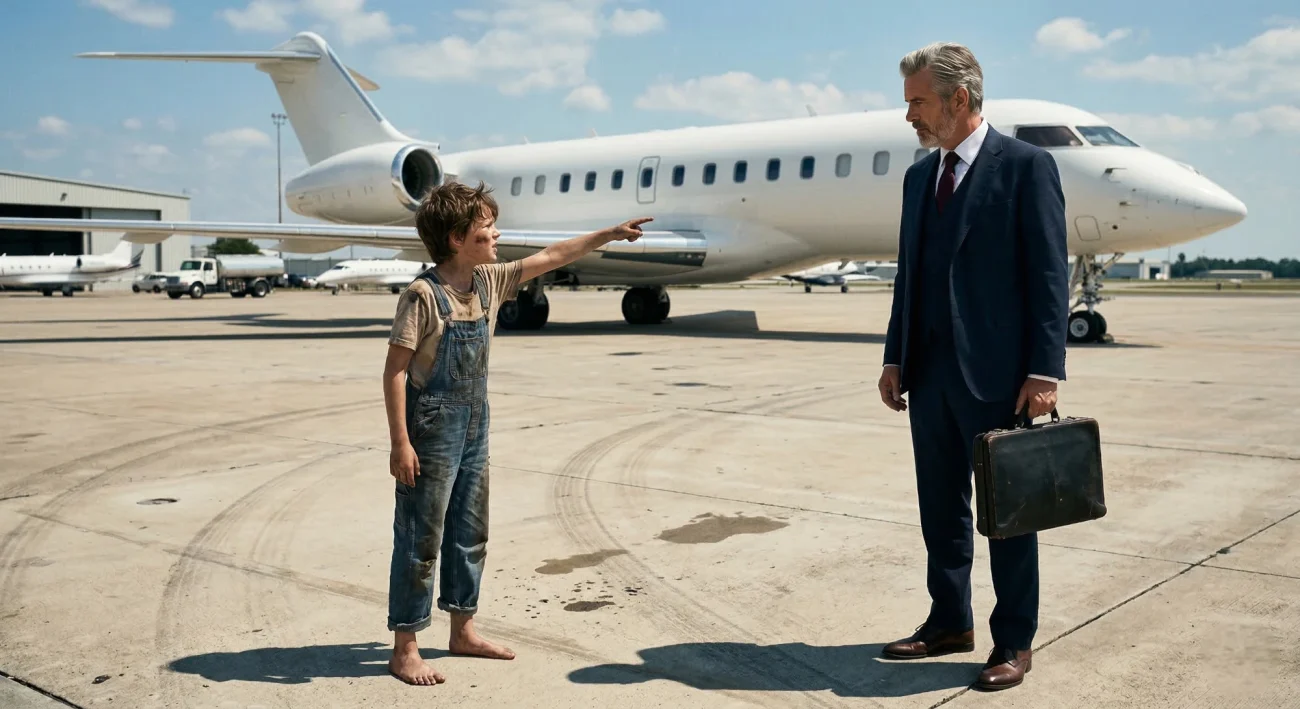
The engines were already spooling when Eli ran.
He wasn’t supposed to be anywhere near the flight line. He knew that. But knowing a rule and following it are two different things when you’ve just watched someone hide a device inside a wing panel.
His feet slapped the polished concrete, bare and stinging. He’d lost his shoes somewhere between the service tunnel and the tarmac. Didn’t matter. Nothing mattered except the man in the Italian suit walking calmly toward the stairs.
“Sir!”
The word tore out of him raw.
Victor Harlan didn’t slow down.
“Sir—please—don’t board that jet!”
That stopped him.
Victor Harlan had not been stopped by a stranger in eleven years.
He turned. Slowly. The way powerful men turn—like the world owes them the extra second.
What he saw was a kid. Maybe twelve. Barefoot. Oil smeared across one cheek. Shirt torn at the shoulder. Shaking like he’d sprinted a mile in the summer heat.
The air hostess materialized between them before Victor could speak.
“Hey.” Her voice cracked like a whip. “You cannot be here.”
She grabbed the boy’s arm.
“Let go of him,” Victor said.
She blinked. “Sir, he’s—”
“I said let go.”
She released him. Her jaw tightened, but she stepped back.
Victor crouched slightly, leveling his eyes with the boy’s.
“Talk,” he said.
Eli had rehearsed this in his head the entire sprint over.
Now, standing in front of a man whose watch cost more than most people’s cars, the words tangled.
“I clean under planes,” he said. His voice was steadier than he expected. “Every morning. I’m not supposed to—I’m not on any roster. I just show up and they let me work for cash.”
“What did you see?”
“A man. Forty, maybe. Nice shoes. He wasn’t wearing maintenance colors. He was under your jet—” Eli pointed. “—the forward panel, left side. He put something inside. Small. Wrapped in black electrical tape.”
The hostess made a short, disbelieving sound.
“This is insane,” she said. “He’s a child who snuck onto a private—”
“How long ago?” Victor asked.
“Twenty minutes.”
Victor stood up straight.
He didn’t look at the jet. He didn’t look at the hostess.
He looked at Eli.
And what he saw was a kid who wasn’t asking for anything. Wasn’t performing. Wasn’t crying or trembling or trying to be believed.
Just reporting facts.
The same way Victor’s best analysts did before a deal went sideways.
“Get maintenance,” Victor said quietly.
The hostess actually laughed.
A small, nervous sound. She pressed a hand to her collarbone.
“Mr. Harlan, we are cleared for departure. There is a weather window in—”
“Pull the crew,” Victor said. “Ground the aircraft. Get maintenance out here in the next three minutes or I’m calling the FAA myself.”
Silence.
Then controlled chaos.
Two ground crew members jogged toward the jet. A supervisor appeared from somewhere, walkie-talkie crackling. Security showed up thirty seconds later—two men in dark jackets, efficient and blank-faced.
One of them looked at Eli.
“Sir,” he said to Victor, “we’ll handle the boy.”
“You’ll handle the plane first,” Victor said. “He stays.”
Eli stood very still.
He’d expected to be dragged off. Yelled at. Maybe arrested.
He hadn’t expected to be believed.
The maintenance crew swarmed the forward section. Victor stood near the stairs, arms loose at his sides, watching. The hostess had gone quiet. A pilot appeared in the cockpit doorway, looking down at the scene below with obvious alarm.
Three minutes passed.
Four.
Then a technician backed out from under the wing on his hands and knees. He stood up. His face had gone completely white.
“Mr. Harlan.”
His voice was very careful.
“We need to clear the runway.”
They found it exactly where Eli said it would be.
Small. Wrapped in black electrical tape. Tucked behind the hydraulic line in the forward panel.
It wasn’t a bomb.
It was something quieter.
A failure trigger—a device designed to interrupt the hydraulic system at altitude. Not an explosion. Not a fireball over the city. Just a gradual, catastrophic loss of control somewhere over open water.
The kind of crash investigators call mechanical failure.
The kind that doesn’t make anyone a martyr.
Just makes everyone dead.
The runway locked down inside of eight minutes.
Federal agents. Airport security. Three vehicles with flashing lights. A woman in a gray suit who identified herself to Victor and said nothing else.
Eli sat on a concrete barrier near the hangar entrance, knees pulled to his chest, watching.
The adrenaline had drained out of him. He felt hollow. Cold despite the heat.
A water bottle appeared in front of his face.
He looked up.
Victor Harlan stood there, jacket off, sleeves rolled up, looking like a completely different man than the one who’d been walking toward the jet stairs twenty minutes ago.
“Drink,” Victor said.
Eli drank.
Victor sat down on the barrier beside him. Not beside him the way adults sat when they were about to lecture you. Beside him the way people sit when they’ve run out of words and just need to be near something real.
“You work here every morning?” Victor asked.
“Since March.”
“How old are you?”
“Thirteen.”
“Where do you sleep?”
Eli hesitated.
“Wherever,” he said.
Victor didn’t push it. He just nodded once, like he was filing the information.
“What’s your name?”
“Eli.”
“Last name?”
Eli shrugged. “Just Eli.”
The man who planted the device was identified forty-two hours later.
His name was Dale Mercer. Former corporate logistics contractor. Hired by a competitor to prevent a merger Victor was flying to finalize—a deal worth, depending on who was counting, somewhere between 800 million and a billion dollars.
No ideology. No grudge.
Just a wire transfer and a set of instructions.
Dale was arrested at his apartment. He didn’t resist. Apparently he’d been waiting for it.
Victor read the report in his office and sat with it for a long time.
Not because it surprised him.
Because it didn’t.
He’d met Eli twice more before the formal meeting.
Once at the hangar, the day after the incident, when Eli showed up for work like nothing had happened.
“They’re not going to let you keep doing this,” Victor said.
“They haven’t stopped me yet.”
“That’ll change.”
Eli shrugged. “Then I’ll find somewhere else.”
The second time was three days later. Victor had arranged it deliberately, though he hadn’t told anyone why. He’d asked his assistant to find out where Eli slept.
The answer came back: an unoccupied maintenance shed on the south edge of the airport property. A sleeping bag. A backpack with a change of clothes and a library book about aircraft engines.
Victor sat in his car for a long time after reading that.
The formal meeting happened on a Tuesday.
Eli arrived in clothes that were clean but didn’t fit—borrowed, Victor guessed, from someone taller.
He walked into the office the way someone walks into a space they expect to be asked to leave.
Victor was sitting in the chair across from his own desk.
Not behind it.
That was deliberate too.
“Sit down,” Victor said.
Eli sat.
“I want to offer you something,” Victor said. “Not charity. Something real.”
Eli’s expression didn’t change. But his hands tightened slightly on the arms of the chair.
“There’s an aviation training program at a technical college forty minutes from here,” Victor said. “Full scholarship. Housing stipend. I’ve spoken with the director. They have a slot.”
Silence.
“I didn’t save your life,” Eli said carefully. “I just reported what I saw.”
“You reported it when you could have walked away.”
“Anyone would’ve—”
“No,” Victor said. “They wouldn’t.”
That landed.
Eli looked at the floor for a moment.
“Why are you doing this?” he asked.
“Because you showed better judgment than every trained professional I had on that runway,” Victor said. “And because talent that gets ignored tends to disappear. I’d rather it didn’t.”
Another silence. Longer this time.
“I don’t want to owe you anything,” Eli said.
“You won’t. The scholarship is in your name. No conditions. You can walk away from it after a week if you want. But you’d have a real start.”
Eli looked up.
“And a job? After the program?”
“If you want one. On your terms.”
The boy sat with that.
He’d spent most of his life being told where he could and couldn’t be. What he could and couldn’t touch. Who he was and wasn’t allowed to approach.
This felt different.
“Okay,” he said.
The program took two years.
Eli finished in nineteen months.
He came back with certifications, a vocabulary that made senior mechanics pause mid-sentence, and the same quiet, watchful energy he’d always had—except now it had somewhere to go.
Victor hired him into his aviation division as a junior safety analyst.
The hostess from the runway saw him in the hangar eight months later—badge clipped to his collar, clipboard in hand, two engineers listening carefully to what he was saying.
She didn’t recognize him.
Eli saw her.
He said nothing.
Just kept talking.
Dale Mercer was convicted on federal charges: attempted murder, criminal sabotage, conspiracy. He received twenty-two years.
The competing company’s board was dissolved following a separate SEC investigation that turned up, among other things, a pattern of contracting arrangements that no one had thought to question before.
Victor testified twice.
Both times he mentioned, on the record, that a thirteen-year-old maintenance worker with no ID, no benefits, and no name on any roster had been the only person on that runway paying close enough attention to catch what everyone else had missed.
He made sure that was in the transcript.
Months later, Victor walked through the hangar on a Thursday morning.
Eli was at a workstation, talking a group of trainees through a hydraulic inspection—calm, methodical, pointing to the exact panel where the device had been found.
“If it doesn’t belong, ask why,” Eli was saying. “That’s the whole job. Not assuming. Asking.”
One of the trainees said something Victor couldn’t hear.
Eli shook his head.
“You’re not paranoid if you’re right,” he said. “You’re paying attention.”
Victor watched for a moment.
Then he kept walking.
He didn’t stop to announce himself. Didn’t interrupt. Didn’t need to.
Because the kid who’d been invisible on a runway had built himself into someone no one could overlook.
And the man rich enough to ignore a warning—
Had stayed alive long enough to see it.
Original fictional stories. AI-assisted creative content.
