
Catherine Miller’s last memory before the darkness was screaming.
Not from pain. From the feeling that something inside her had torn loose and would never go back.
Sixteen hours of labor. Emergency C-section. A room full of people shouting numbers she didn’t understand.
Then nothing.
No light. No sound. No body.
Just a void so complete it felt like being buried in wet concrete.
Then the voices came back.
“Time of death: four thirty.”
A woman’s voice. Flat. Professional. The kind of tone people use when they’ve said the same sentence too many times.
“Postpartum hemorrhage,” another voice added. “Massive. There was nothing we could do.”
Catherine tried to scream.
Nothing happened.
She tried to move her fingers. Her toes. Her eyelids.
Nothing.
She was locked inside her own body like a passenger trapped in a car sinking to the bottom of a lake.
They wheeled her down a hallway. She heard the elevator doors open. The air changed — colder, heavier. A chemical smell hit her that she recognized from old crime shows.
The morgue.
They were taking her to the morgue.
“Dr. Helen! Come quick!”
A young man’s voice. Panicked.
“What is it, Xavier?”
“She has a pulse. Stretcher seven — she has a pulse.”
Sirens. Footsteps. Hands pressing against her chest. Lights stabbing through her closed eyelids.
“She’s alive,” someone said. “Barely.”
Catherine slipped back into the dark.
But now she knew one thing.
She wasn’t dead.
And someone had almost let her be.
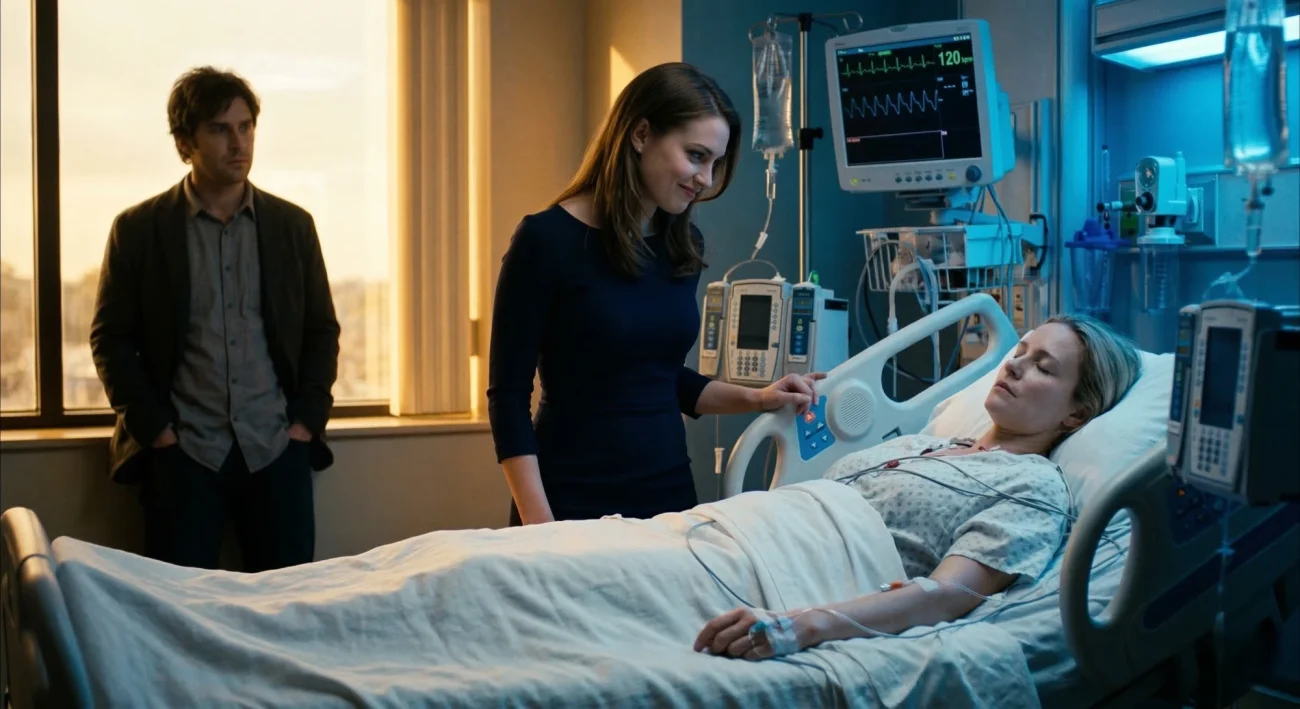
Two days later, the ICU smelled like rubbing alcohol and resignation.
Machines breathed for her in a rhythm that had nothing to do with living. Monitors beeped like clocks counting down to something nobody wanted to say out loud.
The door opened.
Catherine didn’t need to hear the voice to know who it was.
Margaret Lawson. Her mother-in-law. The woman who had disapproved of Catherine from the first dinner, the first holiday, the first ultrasound.
“I don’t understand why this is dragging on,” Margaret said.
“The doctors say it’s a miracle she’s alive,” Robert answered.
Her husband. Three years of marriage. Three years of whispered promises that now sounded like scripts he’d memorized from a greeting card.
“They don’t know if she’ll wake up,” he continued. “Or if she’ll wake up as herself.”
“And the baby?”
“A girl. She’s fine. In the nursery.”
A pause.
Catherine felt the silence like a blade pressed flat against her throat.
“We have to be realistic,” Margaret said. “We can’t carry a body forever.”
Then came the sentence that froze Catherine’s soul.
“Give it thirty days. If nothing changes, we make a decision.”
Robert hesitated.
One second.
The kind of second that separates a man from a coward.
“Okay,” he said. “Thirty days.”
They left. The door closed softly.
No violence. No shouting.
Just two people signing someone’s death sentence over a cup of hospital coffee.
That afternoon, Catherine heard something worse.
A woman’s laugh.
Young. Light. The kind of laugh that doesn’t belong anywhere near a dying woman’s bed.
“Is this her?” the woman asked.
“Yes, Valerie,” Robert said. “You didn’t have to come.”
“I wanted to see.”
Valerie walked around the bed slowly. Catherine could hear her heels clicking on the tile. She could smell perfume — something floral and expensive. Too expensive for a hospital visit.
“Poor thing,” Valerie said.
There was no pity in her voice. Just curiosity. The way someone looks at a car wreck from across the highway.
“Has she moved at all?” Valerie asked.
“No.”
“So she can’t hear us?”
“The doctors say it’s unlikely.”
Valerie exhaled. Catherine imagined her flipping her hair.
“What about the baby?”
“My mother’s handling it.”
“And the name?”
“Regina. Mom picked it.”
“That’s pretty.” A pause. “When this is over, Robert, we need to move fast. Your mother’s already talking to a lawyer about the insurance.”
“I know.”
“And the baby won’t be a problem?”
Robert’s voice dropped. “No. She won’t be a problem.”
Catherine lay perfectly still.
Inside her skull, a fire started.
Not grief. Not despair.
Rage.
The kind that doesn’t burn out. The kind that burns clean.
“I will not die here,” she thought.
“Not like this.”
On the seventh day, Margaret arrived with a folder.
Catherine heard the snap of the clasp. The rustle of papers. The click of a pen.
“Tell me the procedure to disconnect life support,” Margaret said.
Dr. Laura Bennett answered immediately. Young voice. Firm.
“I need to speak directly with Catherine’s parents. It’s hospital protocol.”
“They live in rural Kansas,” Margaret said smoothly. “Simple people. I already explained the situation to them by phone. They agree.”
It was a lie.
Catherine’s mother, Maria, would have torn through the walls of this hospital with her bare hands before agreeing to that.
“I’ll still need written consent from the next of kin on file,” Dr. Bennett said. “And I’ll need to verify contact with her parents independently.”
Margaret’s voice turned cold. “Doctor, I don’t think you understand who you’re speaking to. My family has donated to this hospital for fifteen years.”
“And I don’t think you understand that donations don’t override medical ethics, Mrs. Lawson.”
The door slammed.
Catherine wanted to cry. She wanted to cheer. She wanted to grab Dr. Bennett’s hand and never let go.
But all she could do was lie there.
Breathing someone else’s air.
Counting someone else’s time.
That night, Robert came alone.
He sat in the chair beside her bed. She heard him exhale slowly, the way he used to when he was rehearsing something difficult.
“I don’t know if you can hear me,” he said.
She wished she could open her eyes just to destroy him with a single look.
“When we got married, I did love you,” he said quietly. “But you changed, Catherine. You were always planning. Always pushing. Always trying to control everything.”
He paused.
“Valerie gets me. She doesn’t pressure me. She doesn’t make me feel like I’m failing.”
Another pause. Longer this time.
“When you’re gone, everything will be easier. Regina will grow up with Valerie. My mother already arranged everything.”
He stood up.
“I’m sorry,” he said.
And he left.
Catherine lay in the dark.
She didn’t cry.
She couldn’t.
But inside her locked body, something shifted. A wire connected. A signal fired.
Her right index finger twitched.
One millimeter.
Nobody saw it.
But Catherine felt it.
And it was enough.
On the eleventh night, two voices entered her room after visiting hours.
“I can’t believe we’re doing this,” a young man whispered.
“Shut up and hold the flashlight steady,” an older voice replied.
Catherine recognized the young voice. Xavier. The orderly who had found her pulse in the morgue.
The older voice belonged to Carlos Medina. Hospital janitor. Thirty-one years on the job. The kind of man who noticed things other people were paid to ignore.
“There’s something wrong here,” Carlos said quietly. “That woman doesn’t look like someone who should be unplugged. And that family — they’re circling her like vultures.”
“What can we do? We’re not doctors.”
“No. But we’ve got ears.”
Carlos pulled something from his pocket. Catherine heard a small click.
“Old audio recorder,” he said. “I taped it under the bedside table three days ago. Listen to what I got.”
He pressed play.
Margaret’s voice filled the room: “Give it thirty days. If nothing changes, we make a decision.”
Then Robert’s: “When you’re gone, everything will be easier.”
Then Valerie’s: “The baby won’t be a problem.”
Xavier went quiet for a long time.
“Jesus,” he finally said.
“Yeah,” Carlos said. “Now you understand why I need your help.”
The next morning, Dr. Bennett received a text from an unknown number.
“Laundry room B. 7 AM. Bring headphones.”
She almost deleted it. But something made her go.
Carlos was waiting, holding a flash drive.
“Before you say anything,” he said, “just listen.”
She put in the earbuds.
Three minutes later, she pulled them out.
Her face was white.
“How long have you been recording?”
“Nine days.”
“This is — Carlos, this could be —”
“Criminal. I know.”
Dr. Bennett stared at the flash drive. “There’s something else,” she said slowly. “Something in Catherine’s chart that doesn’t add up.”
She pulled up the file on her phone.
A handwritten note from the delivery room, buried under pages of post-op forms:
“Possible twin pregnancy. Pending confirmation.”
Carlos looked at her. “Twins?”
Dr. Bennett was already walking toward the elevator.
The neonatal unit was quiet at that hour. Soft blue light. The hum of incubators.
Dr. Bennett found what she was looking for in the back row.
A tiny baby girl in an incubator labeled:
“Baby Miller #2 — No birth registration.”
Twenty-one days old.
No visitors logged.
No family contact.
No name.
Dr. Bennett pressed her hand against the glass and closed her eyes.
“How did nobody catch this?” she whispered.
The neonatal nurse looked up from her station.
“We flagged it twice,” she said. “The family said they’d handle the paperwork. They never came back.”
That afternoon, Dr. Bennett confronted Robert in the hallway outside the ICU.
“Mr. Miller, we need to talk about your other daughter.”
Robert blinked. “What other daughter?”
“Your wife delivered twins.”
“That’s — no. That’s not possible. We were told there was one baby.”
“The records say otherwise.”
Margaret arrived fourteen minutes later. Her heels echoed through the corridor like a metronome counting down to detonation.
“What’s going on?” she demanded.
“There’s a second baby,” Robert said. “Nobody told us.”
Margaret’s mask slipped. Just for a second. But Catherine — listening through the cracked door of her room — heard it clearly.
“This complicates things,” Margaret muttered.
Then she lowered her voice.
“I know a lawyer. Some couples pay well for newborns. No one will miss a baby that officially never existed.”
The room went silent.
Robert said nothing.
He didn’t agree.
But he didn’t say no.
And that silence was louder than any word he had ever spoken.
Catherine heard everything.
Her heart rate spiked. The monitors screamed. Alarms blared down the hallway.
Nurses rushed in.
And for the first time in twenty-one days, Catherine’s fingers moved.
Not a twitch. A grip.
She grabbed the bed rail and held on like it was the edge of a cliff.
Dr. Bennett leaned close to her ear.
“Catherine, I know you’re in there. I know you can hear me. I promise — no one is going to hurt you. And no one is going to touch your daughters.”
A tear slid from Catherine’s closed eye down her temple and into her hair.
The next morning, Prosecutor Monica Hayes walked into the hospital flanked by two investigators.
She was tall. Sharp-featured. The kind of woman who wore flats because she didn’t need heels to be the most intimidating person in any room.
Dr. Bennett handed her the flash drive. Carlos and Xavier sat in plastic chairs in the conference room, looking like two men who had bet everything on a hunch and were waiting to see if the house would fold.
Monica listened to the recordings without expression.
When they finished, she removed the earbuds slowly.
“Who recorded this?” she asked.
Carlos raised his hand. “I did.”
“You’re a janitor.”
“Thirty-one years.”
Monica studied him. “Why?”
Carlos leaned forward. “Because I’ve cleaned every floor of this hospital since before these doctors were in med school. I know what a dying patient looks like. And I know what a family planning a funeral looks like before the patient is dead.”
Monica turned to Dr. Bennett. “What’s the patient’s actual medical status?”
“Incomplete locked-in syndrome,” Dr. Bennett said. “She’s conscious. She can hear everything. And she’s showing signs of motor recovery.”
“So she heard all of this?”
“Every word.”
Monica pressed her palms flat on the table. “If even half of this holds up, we’re looking at attempted insurance fraud, medical interference, falsified next-of-kin consent, and possible child trafficking.”
Xavier exhaled.
“What happens now?” Carlos asked.
“How long have the patient’s parents been out of contact?”
“Over three weeks,” Dr. Bennett said. “The mother-in-law told them Catherine died. Said the body was cremated.”
Monica’s jaw tightened. “She told grieving parents their daughter was cremated while she was still alive in the ICU?”
“Yes.”
Monica stood up. “Now we find Catherine Miller’s real family. And we do it before that woman files another piece of paperwork.”
It took two days.
Maria and Stephen Miller lived in a farmhouse outside Wichita. They hadn’t heard from their daughter in over three weeks.
When the investigators pulled into the gravel driveway, Stephen was on the porch.
“Mr. Miller?” the lead investigator said. “I’m Agent Torres with the District Attorney’s office. May we come inside?”
“What’s this about?”
“Your daughter, Catherine.”
Stephen’s face went gray. “Our daughter is dead. We were told —”
“Sir, your daughter is alive.”
Stephen gripped the porch railing.
“That’s not possible,” he said. “Margaret called us. She said Catherine bled out during delivery. She said the hospital cremated —”
“None of that is true, Mr. Miller. Catherine is in the ICU at Mercy General. She’s in a coma, but she’s alive. And she’s showing signs of recovery.”
Maria appeared in the doorway behind Stephen. She’d heard everything.
She screamed so loud the neighbors called 911.
They arrived at the hospital the next afternoon.
Maria walked into the ICU and stopped three feet from the bed.
Her daughter. Tubes in her arms. Machines breathing for her. Eyes closed. Skin pale.
But alive.
Maria took Catherine’s hand and pressed it to her cheek.
“They told us you were dead,” she whispered. “They told us you were gone.”
Stephen’s voice cracked behind her. “We buried an empty urn, Catherine. Your mother picked flowers from the garden.”
“I prayed every night,” Maria said. “I told God he made a mistake.”
Catherine couldn’t speak.
But she squeezed.
Once.
Twice.
Maria sobbed.
“She’s squeezing my hand,” Maria said. “Stephen — she’s squeezing my hand.”
Stephen stepped forward, took Catherine’s other hand, and held it against his chest.
“We’re here now,” he said. “Nobody’s taking you anywhere.”
On the twenty-fourth day, Catherine opened her eyes.
The light was blinding. Everything blurred and shifted like she was looking through water. But slowly the shapes became faces. And the faces became people she loved.
Her mother.
Her father.
Dr. Bennett.
And in the corner, Carlos and Xavier — the janitor and the orderly who had saved her life because they refused to look the other way.
Catherine’s lips moved.
The effort was enormous. Like pushing a boulder uphill with her tongue.
“Mom.”
Maria broke down completely.
“I’m here, baby. I’m right here.”
An hour later, they brought the babies.
Regina first. Bigger. Healthy. Dark hair like Robert’s.
Then the second baby. Smaller. Fragile. Eyes wide open, staring at the ceiling like she was seeing the world for the very first time.
Catherine held them both.
One in each arm.
She kissed their foreheads and closed her eyes.
“My girls,” she whispered.
Dr. Bennett stood at the foot of the bed. “The smaller one still doesn’t have a name.”
Catherine looked down at the tiny face pressed against her chest.
“Hope,” she said.
Because hope was the only thing that had kept her breathing when every person with power over her life had decided she was already gone.
The arrests happened on a Tuesday.
Margaret Lawson was taken from her home at 6:15 AM. Two officers knocked. A third waited by the car.
She opened the door in a silk robe, coffee in hand.
“Margaret Lawson?”
“Yes?”
“You’re under arrest for conspiracy to commit insurance fraud, falsifying medical consent, and facilitating the concealment of a minor. Turn around, please.”
Margaret didn’t move. “This is absurd. Do you know who I am?”
“Ma’am, turn around.”
“I want my lawyer.”
“You can call your lawyer from the station. Turn around.”
The handcuffs clicked. Margaret’s coffee cup shattered on the marble floor.
Her lawyer arrived in twenty minutes. It didn’t matter.
Robert Miller was arrested at Valerie’s apartment at 7:02 AM. He was wearing a bathrobe. He opened the door with a half-eaten piece of toast in his hand.
“Robert Miller?”
“Yeah?”
“You’re under arrest.”
He stared at the officers. “For what?”
“Conspiracy. Medical negligence by omission. Custodial interference.”
“I don’t — I didn’t do anything.”
The officer looked at him. “Sir, your wife was alive in a hospital bed for twenty-four days while you discussed pulling the plug and selling her baby. Hands behind your back.”
Robert asked if he could change first. They said no.
Valerie Price was not charged. But she was named as a material witness. Her name appeared in fourteen of the recorded conversations.
She moved out of the state within a week. No forwarding address.
The trial lasted three weeks.
Monica Hayes presented forty-seven minutes of audio recordings. Hospital surveillance footage. Catherine’s medical records. Testimony from Dr. Bennett, Carlos Medina, Xavier Trujillo, and the neonatal nursing staff.
On the stand, Carlos was asked why he’d risked his job to plant a recorder.
“Because I clean rooms,” he said. “And when you clean rooms for thirty years, you learn the difference between a family grieving and a family waiting.”
“Waiting for what?” Monica asked.
“Waiting for someone to die so they can get paid.”
Margaret’s defense attorney argued that the recordings were obtained without consent and should be inadmissible.
The judge disagreed.
“When a woman is lying in a coma while her family plots to disconnect her life support and sell her newborn child,” Judge Patricia Calloway said from the bench, “I am not inclined to protect the privacy of the conspirators.”
The courtroom erupted.
Robert’s attorney tried a different angle. He argued Robert was under his mother’s influence and had not actively participated in any criminal plan.
Monica played the recording of Robert saying, “When you’re gone, everything will be easier.”
She looked at the jury. “Does that sound like a man under someone else’s influence?”
Nobody answered. Nobody needed to.
Margaret was sentenced to twelve years.
Robert received eight years, with no parole eligibility for five.
Catherine’s full parental rights were restored. A restraining order was issued against every member of the Lawson family.
The insurance policy Margaret had taken out on Catherine — $1.2 million — was voided.
And Baby Miller #2 was formally registered with the state of Kansas under her legal name:
Hope Catherine Miller.
Six months later, Catherine stood behind the counter of a small bakery on Main Street in her hometown.
The sign above the door read: “Miller’s.”
No fancy logo. No tagline. Just the name.
Her mother worked the register. Her father built the shelves. The twins slept in a double stroller parked beside the flour bags.
One afternoon, Carlos Medina walked through the door.
He was wearing a clean flannel shirt and carrying a potted plant.
“Heard you opened up shop,” he said.
Catherine came around the counter and hugged him.
“You saved my life,” she said.
Carlos shrugged. “I just plugged in a recorder.”
“You listened when nobody else would.”
“Someone had to.”
Catherine wiped her eyes. “You want a job? I need someone to mop floors.”
Carlos laughed. “I just retired from mopping floors.”
“Then sit down and eat something. That’s an order.”
He looked at the twins.
“They’re beautiful,” he said.
“They’re everything,” Catherine replied.
“They look like fighters.”
“They get it from their mother.”
Catherine smiled. “And from a janitor who wouldn’t mind his own business.”
Carlos set the plant on the counter. A small cactus with one bright pink flower.
“Tough little thing,” he said. “Reminded me of someone.”
Catherine laughed.
It was the first real laugh she’d had in a year.
That night, after closing the shop, Catherine sat on the porch with both girls in her lap.
The Kansas sky was wide and dark and full of stars.
Regina was already asleep. Hope was staring up at the sky with those wide, serious eyes.
Catherine held them close.
She didn’t think about Robert. She didn’t think about Margaret. She didn’t think about the twenty-four days in the dark.
She thought about Dr. Bennett’s voice in her ear: “I know you’re in there.”
She thought about Carlos and Xavier sneaking into her room at midnight with a cheap recorder.
She thought about her mother’s hand on her cheek.
She thought about the first time she squeezed back.
And she knew — with the kind of certainty that lives in your bones — that the people who tried to erase her had failed.
Not because she was strong.
Because someone chose to notice.
And that made all the difference.
Original fictional stories. AI-assisted creative content.
