
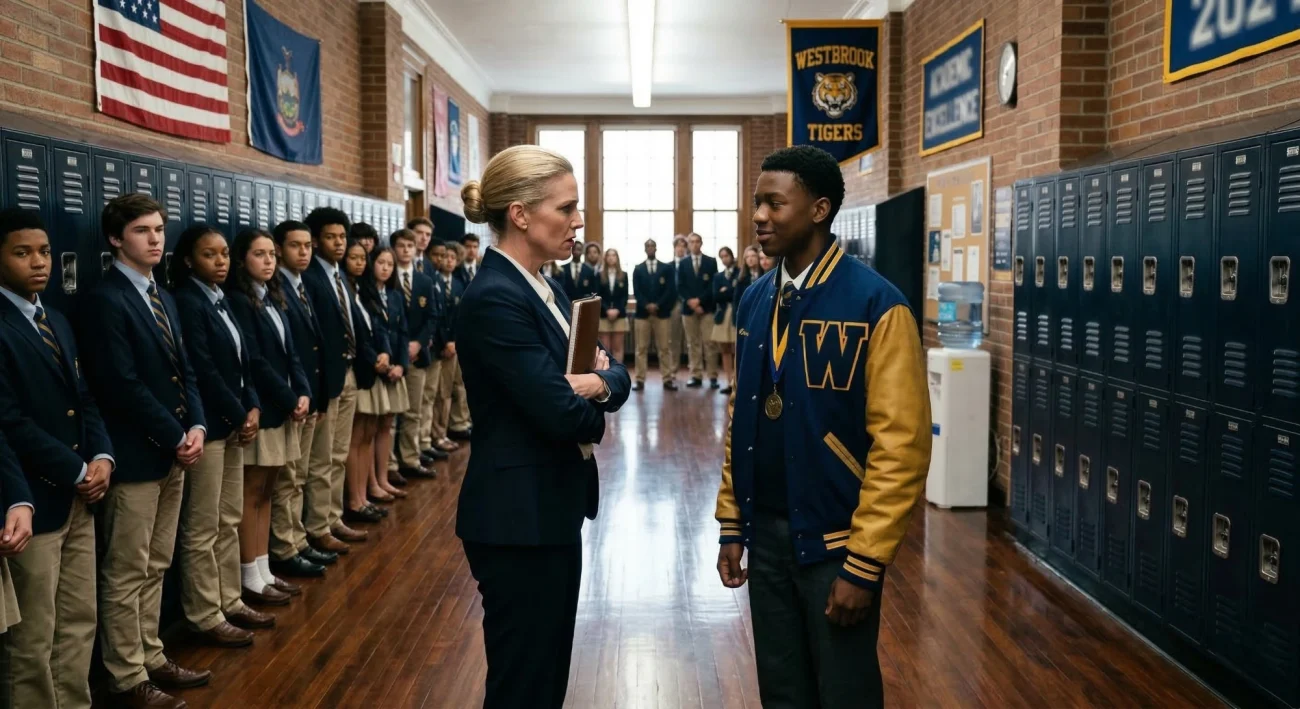
The first thing Marcus noticed about Westbridge Preparatory Academy wasn’t the columns or the manicured lawns.
It was the silence.
Not peaceful silence. Evaluating silence. The kind that sized you up before you could open your mouth.
His sneakers squeaked once against the polished hallway floor. A boy in a blazer glanced over. A girl in a plaid skirt whispered something to her friend. Marcus kept walking.
He had been here three minutes and already felt like an exhibit.
Room 214 was at the end of the east wing. He could smell the dry-erase markers before he even reached the door.
Inside, twenty students sat in neat rows. Sunlight poured through tall windows. At the front of the room stood a woman with blonde hair pulled tight and glasses that made her eyes look just a little too large — Mrs. Davenport, Advanced Mathematics, according to the schedule in his hand.
She was mid-sentence when Marcus stepped in.
She stopped.
Her eyes moved slowly — sneakers, backpack, face. The room went quiet in that particular way classrooms do when something uncomfortable is about to happen and everyone can feel it coming.
“You must be the new scholarship student,” she said. Her voice was smooth. Measured. The way a scalpel is precise.
“Yes, ma’am. Marcus Reed.”
She looked at her roster. Then looked up again. The thin smile she’d worn a moment ago was gone.
“You don’t belong here,” she said. Not loudly. She didn’t need to be loud. “People like you don’t deserve a school like this.”
The words landed like something physical.
A girl near the window inhaled sharply. A boy in the front row stared at his desk. No one laughed. No one spoke either.
Marcus felt heat flood his chest. For three full seconds, he stood completely still.
Then something shifted.
He thought about the science fair. He thought about the judge who had looked surprised when his name was called. He thought about his old middle school counselor who had told him to “be realistic.”
He met Mrs. Davenport’s eyes.
“Last time someone told me that,” Marcus said, “I won a championship.”
A murmur spread through the room.
Mrs. Davenport’s jaw tightened. “This isn’t some local contest. This is Westbridge. Excellence here is earned, not handed out.”
“I know,” Marcus said. “That’s why I’m here.”
He walked to an empty seat in the second row and sat down. He unzipped his backpack, took out his notebook, and opened it to a fresh page.
Mrs. Davenport stared at him for a long moment.
Then she turned to the whiteboard.
The first week was a war of small cuts.
Mrs. Davenport called on Marcus when she expected him to fail. She assigned him the hardest review problems. Once, she corrected him mid-sentence on a problem he had already solved correctly, then moved on without acknowledging her mistake.
The class watched all of it.
A boy named Tyler — blazer, lacrosse pin on his lapel, the easy confidence of someone who had never been underestimated — leaned over between problems one afternoon.
“She does this to everyone new,” Tyler said quietly.
“Does it usually work?” Marcus asked.
Tyler thought about it. “Yeah.”
“Then she hasn’t met me yet.”
Tyler almost smiled. He didn’t say anything else, but he stopped looking away when Mrs. Davenport did it after that.
By the third week, Marcus had the highest quiz average in the class.
Mrs. Davenport did not acknowledge it.
She handed back the quizzes face-down. Marcus flipped his over. 98. The girl next to him — Priya, quiet, always two steps ahead on the reading — glanced over.
“Nice,” she said.
“Thanks.”
“She curved the grades down for the top scorers last semester,” Priya said, her voice low. “Said it ‘normalized the distribution.’ Three people went to the department head.”
Marcus looked at the 98. “What happened?”
“Nothing. He’s her department head.”
He folded the quiz and put it in his folder.
That afternoon he went to the school library and pulled up the academic handbook online. He read the grading policy section twice. Then he found the appeals procedure. Then the section on academic discrimination.
He took notes.
The breaking point came on a Thursday.
The class was working through a practice exam — preparation for the statewide math assessment. Mrs. Davenport circled the room, glancing at papers, offering brief corrections.
She stopped at Marcus’s desk.
She looked at his work for a long moment without speaking.
“You copied this approach,” she said.
The room went still.
Marcus looked up. “Excuse me?”
“This solution method.” She tapped his paper. “This isn’t from our curriculum. Where did you get it?”
“I developed it.”
“Students at your level don’t develop alternate proof methods.”
“At my level,” Marcus repeated.
“You know what I mean.”
“I’m not sure I do.” His voice was steady. Completely steady. “Could you explain what you mean by ‘my level,’ Mrs. Davenport?”
The silence in the room had a different quality now.
Priya had stopped writing. Tyler had turned around in his seat.
Mrs. Davenport straightened. “I simply mean that this is advanced material—”
“That I solved correctly,” Marcus said. “Using a valid proof method. Which I can walk through step by step, right now, in front of the class, if you’d like.”
She said nothing.
“Would you like me to?” he asked.
Another beat of silence.
“Continue your work,” she said, and moved to the next row.
Tyler turned back around. Under his breath, barely audible: “Damn.”
That evening Marcus wrote everything down.
Not for a teacher. Not for a parent. For himself, first — dates, words, incidents, the quiz grades, the grading curve, the accusation in front of the class today. Then he went back through his notes from the handbook.
He wrote a formal complaint. Three pages. Clear, factual, no emotion.
His mother read it at the kitchen table.
She was quiet for a long time.
“You’re sure?” she said.
“Yes.”
“Because once you send this, it doesn’t go back.”
“I know.”
She looked at him. Then she set the pages down and nodded. “Then we send it.”
The meeting was scheduled for the following Tuesday.
Marcus, his mother, Mrs. Davenport, the department head — a man named Dr. Ellison with wire-rimmed glasses and the careful posture of someone used to managing conflict — and the school’s academic equity coordinator, a woman named Ms. Vance who had been brought in specifically because the complaint had included the word “discrimination.”
Ms. Vance had read the complaint. She had also, Marcus noticed, printed it out and highlighted sections.
Dr. Ellison opened the meeting with the standard language: “We take all concerns seriously. This is a listening session.”
Mrs. Davenport sat across from Marcus. She had not looked directly at him since they sat down.
“I want to address the grading concerns first,” Marcus said.
His mother put a hand on his arm — not to stop him. Just present.
“The quiz average discrepancy,” Marcus continued, “is documented across seven assessments. I have the scores here.” He slid a printed sheet across the table. “The class average after the curve was 74. My pre-curve score on each quiz ranged from 91 to 98. Post-curve, my reported grade dropped to 79. That’s not a standard deviation correction. That’s a targeted reduction.”
Ms. Vance made a note.
“That’s a mischaracterization,” Mrs. Davenport said. Her voice was still smooth. Still measured. But something beneath it had shifted. “Grading curves are standard practice—”
“Not when they’re selectively applied,” Marcus said. “The three students who scored below 75 were not curved down. Only the two students who scored above 90 were adjusted. I can show you the distribution.”
He had a second sheet. He slid it across.
Dr. Ellison picked it up. He looked at it for longer than Marcus expected.
“Where did you get this?” Dr. Ellison asked.
“Priya Torres shared her scores with me voluntarily. She’s the other student who was curved down. She’s prepared to submit a separate statement.”
Mrs. Davenport’s composure cracked — just slightly. Just enough.
“This is—” she began.
“And the incident on Thursday,” Marcus said. He was not raising his voice. He didn’t need to. “In front of the full class, I was accused of academic dishonesty for presenting a valid proof method that wasn’t in the assigned curriculum. I solved the problem correctly. The accusation was retracted only after I offered to demonstrate the method in front of everyone, which Mrs. Davenport declined.”
Ms. Vance looked up from her notes. “Mrs. Davenport, did you retract the accusation explicitly?”
A pause.
“I moved on,” Mrs. Davenport said.
“That’s not a retraction,” Ms. Vance said. Her tone was not unkind. It was precise.
The room was quiet.
Dr. Ellison set down the distribution sheet. He took off his glasses. He looked at Mrs. Davenport for a long moment.
“Margaret,” he said quietly.
It was the first time anyone had used her first name.
The outcome was formal and documented.
Mrs. Davenport was placed on a performance improvement plan. The grade curve was reversed — Marcus’s and Priya’s averages were recalculated. Marcus’s corrected average was a 95.
He was also officially recognized, for the record, as a merit scholarship student in good academic standing.
Ms. Vance stopped him in the hallway after the meeting.
“You prepared well,” she said.
“My mom helped.”
“You both did.” She paused. “This kind of complaint — documented, calm, specific — it’s harder to dismiss than anger. You understand that?”
“I’m starting to,” Marcus said.
The next time Marcus walked into Room 214, Mrs. Davenport was already writing on the board.
She did not stop when he entered.
She did not comment on his shoes or his backpack.
She called on him twice during the lesson — once when she expected the class to struggle, once when she didn’t. Both times, he answered correctly.
She moved on without comment.
Tyler caught him in the hallway after class.
“You good?” Tyler asked.
“Yeah.”
“Priya told me what you put together. The data and everything.”
Marcus shrugged. “It was just the facts.”
“Yeah but—” Tyler stopped. Tried again. “Most people just take it. They don’t want the trouble.”
“I know,” Marcus said. “That’s what she was counting on.”
They walked out of the east wing into the afternoon sunlight, the silence of the hallway behind them replaced by the ordinary noise of the school day — locker doors, voices, the comfortable chaos of a place Marcus was beginning to understand.
Not as somewhere he’d been allowed.
As somewhere he’d earned.
He adjusted the strap of his backpack and kept walking.
Original fictional stories. AI-assisted creative content.
