
The servers had been briefed on three things: keep moving, keep quiet, and do not draw attention.
Daniel had been told all three. He intended to follow all three.
He just hadn’t planned on the piano.
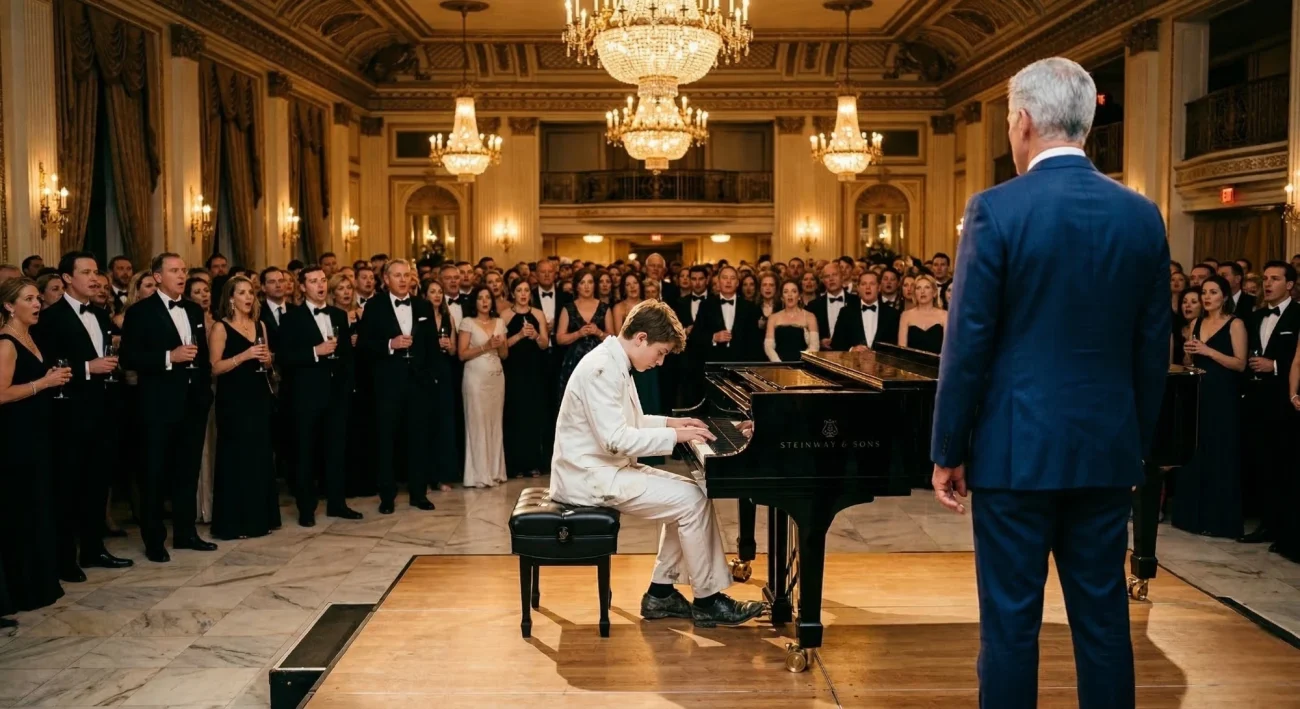
The estate belonged to Harlan Voss — tech money, old discipline, newer arrogance. His quarterly investor dinners were legendary in the kind of circles where “legendary” meant expensive and exclusive. Two hundred guests filled the grand hall. Caterers ghosted between them like shadows in uniforms.
Daniel was sixteen. He’d gotten the gig through his uncle’s catering company, which was the only reason he was holding a silver tray instead of sleeping on a pull-out couch in a studio apartment in Queens.
He moved through the room the way he’d learned to move through most rooms — low, careful, invisible.
But the piano stopped him.
It sat near the far wall like it owned the building. Black, glossy, enormous. A Steinway. Daniel didn’t know the model, but he knew what it meant — he’d seen one before, once, through a music school window he’d pressed his face against at age nine.
His mother had laughed. “Don’t stare,” she’d said. “They’ll think you want it.”
“I do want it,” he’d told her.
She’d smiled and squeezed his hand. “Then one day you’ll have one.”
That was seven years ago. She’d been dead for four.
Daniel wasn’t thinking about any of that when he set his tray down on the edge of a linen-covered table.
He didn’t plan it. He didn’t rehearse it. He just looked at the piano, and then he looked at the man standing closest to it — a tall man in a navy suit, laughing at something a woman in diamonds had said — and he heard his mother’s voice somewhere in his chest, low and certain:
Play.
“Excuse me,” Daniel said.
The man turned. Harlan Voss. Up close, his face had the particular smoothness of someone who had not been told no in a long time.
“Can I play the piano?”
The question landed in a small bubble of silence.
Harlan looked him up and down — uniform, tray, young face, worn shoes. The kind of look that measured and dismissed in the same motion.
“Do you even know how?” he asked.
The woman in diamonds smiled politely. Two men nearby glanced over.
“Yes,” Daniel said.
Harlan’s mouth curved. “Be my guest, then.”
It was not an invitation. It was a dare.
Daniel walked to the bench and sat down.
He didn’t rush. He didn’t perform nervousness for the watching guests. He pulled the bench to the right height — not too far, not too close — the way his mother had taught him when he was small enough to need a phone book under his feet to reach the keys.
His hands hovered.
His right sleeve shifted back slightly.
And there it was — a small tattoo on the inside of his wrist. Simple lines. A guitar shape, barely two inches, faded at the edges like something drawn by a young hand with an older meaning.
At the piano, Daniel didn’t notice the room at all.
He pressed the first note.
It was a C. Just one note.
But the way it rang — full, unhurried, intentional — made two guests nearby stop mid-sentence.
Then his left hand joined. Then both together.
Within eight bars, the hall was different.
It wasn’t that the music was loud. It was that it was present in a way the background playlist had never been. It moved through the room the way weather moves — not asking permission, not announcing itself, simply arriving.
Daniel played from the place where the music lived in him — not in his fingers, but somewhere behind his ribs, in the part of himself he kept locked on shifts like this one. His mother had called it “the real voice.” She said everyone had one. Most people spent their whole lives talking over it.
He didn’t.
The melody unfolded — a piece he’d written himself, over three years, in fragments. On subway platforms. In a school practice room at 6 a.m. before the janitors arrived. In the back of his uncle’s van on the way to catering jobs.
It wasn’t polished. It was alive.
Somewhere in the third minute, Harlan Voss stopped breathing normally.
He was staring at the tattoo.
His face had changed completely — not softened, not moved to tears, but something sharper. Confused. Almost afraid.
His assistant, Marcus, appeared at his elbow.
“Sir?”
“That tattoo,” Harlan said quietly. “The guitar.”
Marcus looked. “What about it?”
“Six years ago. There was a video.” Harlan’s voice dropped lower. “A kid playing on a broken keyboard outside a PATH station in Newark. Someone recorded it on their phone — it went around in music circles. The kid was maybe ten years old. And next to the keyboard, drawn in marker on the concrete—”
“A guitar,” Marcus said slowly.
Harlan nodded.
“That video never had a name. The kid disappeared. We tried to find him — I put out a search through the foundation. Nothing came back.”
Marcus looked at Daniel again. At the tray on the table. At the uniform. At the wrist.
“You think that’s him?”
Harlan didn’t answer. He was already moving toward the piano.
Daniel finished on a long, suspended chord — not a dramatic ending, but an honest one. The kind that doesn’t resolve, because some things don’t.
He lifted his hands.
The hall was silent.
Then someone began to clap. Then another. Then the room broke open — genuine, surprised applause, not the polite kind. The kind that happens when people have been moved before they had time to decide whether they wanted to be.
Daniel sat very still on the bench. The sound felt like too much.
He didn’t know what to do with being seen.
“Daniel.”
He looked up. Harlan Voss was standing directly in front of him. The mockery was gone. Something older had replaced it — something that looked, almost, like shame.
“How long have you been playing?”
“Since I was four,” Daniel said.
“Who taught you?”
“My mom.”
“Where is she?”
Daniel looked at the keys. “She passed. Four years ago.”
Harlan said nothing for a moment.
“I’m sorry.”
“You didn’t know her.”
“I know.” A pause. “I’m still sorry.”
It would have been easy to leave it there. Clean, contained. A rich man apologizing to a poor kid at a party.
But Harlan Voss had not built what he’d built by walking away from things that mattered.
“I looked for you,” he said. “After the Newark video. We had people trying to track down who that kid was for almost a year.”
Daniel frowned. “What video?”
“PATH station. You were playing a broken Casio keyboard someone left on the ground. It was — ” Harlan stopped. Restarted. “It was the most extraordinary thing I had heard in twenty years of funding music programs. And then you were just gone.”
Daniel stared at him.
“We had to move,” he said slowly. “After my mom died. My uncle took us to Queens. I didn’t — I didn’t know anyone recorded that.”
“It got maybe three thousand views,” Harlan said. “But the right people saw it. I saw it.” He paused. “Why did you stop playing?”
The question sat in the air between them.
“Because playing didn’t pay for medicine,” Daniel said. “And then it didn’t pay for anything else either. So I stopped.”
“For how long?”
“Two years.”
“And then?”
Something moved across Daniel’s face — not quite a smile, not quite grief.
“And then I couldn’t stop anymore,” he said. “So I just — kept going. Subway platforms mostly. School practice rooms. Wherever there was a piano I could get to.”
Harlan looked at him steadily.
“How are you doing in school?”
“Junior year. 3.8.”
“Do you have representation? An agent? Anyone managing your music?”
“I’m a waiter,” Daniel said flatly.
“Not tonight, you’re not.”
Around them, the dinner party had quietly ceased to function as a dinner party. Guests had drifted closer. The woman in diamonds had her phone out — not to film, but pressed to her chest like she’d forgotten it was in her hand. Two older men near the bar had stopped talking entirely.
A woman in a red dress stepped forward. Daniel recognized her — he’d seen her face on a concert program at school once. Elena Marsh. Conductor of the New York Philharmonic.
“What was that piece?” she asked.
“Mine,” Daniel said.
She blinked. “You wrote it?”
“Over the last three years.”
“Is it finished?”
He thought about it. “The ending changes. Depending on the day.”
Elena Marsh looked at Harlan. Harlan looked at Daniel.
“I have a foundation,” Harlan said carefully. “We fund young musicians. Full scholarships, instrument access, studio time, mentorship. We’ve placed twenty-three students in conservatories over the last decade.”
Daniel said nothing.
“I want to offer you a spot. Full support. Starting immediately.”
The hall was very quiet.
Daniel looked down at his hands on his knees — the same hands that had been balancing a silver tray an hour ago.
“Why?” he asked.
It was a genuine question. Not suspicious. Just honest.
“Because I laughed at you,” Harlan said. “When you asked to play. And because of that — and because of a lot of other moments like that one, that I’ve been too comfortable to examine — I have spent years funding music programs that helped children who already had access. Children whose parents could advocate for them. Children who looked like they belonged in the room.”
He paused.
“You didn’t look like you belonged in this room. And you are the most gifted musician I have heard in person in fifteen years.”
Another pause.
“I’m not trying to buy absolution, Daniel. I’m trying to be useful. Finally.”
The silence stretched.
Daniel looked at Elena Marsh, who gave a small nod — not pushing, just honest.
He looked at the piano.
He thought about his mother. About the music school window. About subway platforms at 11 p.m. and practice rooms at dawn and two years of silence that had felt like being buried alive.
“I have conditions,” he said.
Harlan blinked. “Tell me.”
“I keep writing my own material. No one tells me what to play.”
“Agreed.”
“My uncle knows everything. He approves the paperwork with me.”
“Of course.”
“And when I perform — ” Daniel’s jaw set. “I play my own pieces first. Before anything else on the program. Every time.”
Harlan held his gaze. “Every time.”
Daniel nodded once.
“Then yes,” he said. “I’ll take the spot.”
The dinner party ended differently than anyone had planned.
The catering staff wrapped up quietly. The guests lingered far longer than usual, still talking in low, animated voices near the piano. Elena Marsh sat beside Daniel for forty-five minutes, asking questions, writing things in a small notebook, listening more than she spoke.
Harlan stood near the window, looking out at the city below.
Marcus appeared beside him.
“Sir. You know this is going to complicate the Q4 grantee announcements.”
“Good,” Harlan said. “They needed complicating.”
Marcus studied him. “Are you all right?”
Harlan was quiet for a moment.
“I asked a sixteen-year-old waiter if he’d ever touched a piano in his life,” he said. “In front of two hundred people. And I was laughing when I asked it.”
Marcus said nothing.
“I have spent thirty years funding the arts,” Harlan said. “Thirty years. And tonight I almost let the most talented musician I have ever personally encountered walk out my door carrying an empty tray.”
He turned from the window.
“No. I’m not all right. But I’m going to do something about it. That’s the point.”
Six months later, Daniel walked onto a stage in Midtown Manhattan.
The hall held twelve hundred people.
He sat at the Steinway — not the one in Harlan’s estate, but one just like it, in a concert hall that smelled like wood polish and old velvet and decades of music.
He adjusted the bench. Right height. Not too far. Not too close.
He looked out at the audience once. Just once.
Third row, center — Harlan Voss, sitting very still, hands clasped, no phone out. Beside him, Elena Marsh. On Harlan’s other side, Daniel’s uncle — a stocky man in a rented suit, eyes already wet, pretending they weren’t.
Daniel turned back to the piano.
He lifted his hands.
And the ending — the one that had been changing, depending on the day, for three years — finally settled into something certain.
Not triumphant. Not easy.
Just true.
He played.
The hall held its breath.
And somewhere in the third row, a man who had once laughed at a question sat with tears running quietly down his face — not from guilt anymore, but from something rarer:
The understanding that he had almost missed this.
That the world had almost missed this.
And that the boy no one had seen coming was, note by note, making sure that would never happen again.
When the last chord finally resolved — full, clear, and final — the silence that followed lasted exactly four seconds.
Then twelve hundred people stood up at once.
Daniel lowered his hands.
He did not look frightened this time.
He looked like himself.
Like he had always been.
Like he always would be.
Original fictional stories. AI-assisted creative content.
