
I will always remember the smell of that morning.
Rain-soaked earth. Marigolds already wilting on the wreaths. Bitter, reheated coffee from the diner across from the funeral home. Some smells don’t leave you. They sink in and stay.
Antonio was buried on a Saturday at dawn, in a small mountain town where the church bells ring the same for weddings and funerals. The sky hung gray and low, heavy enough to feel like it might cave in.
I stood at the open grave in a black dress borrowed from a neighbor—mine no longer fit after the pregnancy. In my arms, Mateo. Barely six months old. In my other hand, Lucía’s small, clammy fingers. She was four, and her eyes never left the coffin, as if she expected her father to sit up and walk out the way he always did when he came home from the fields.
Then she tugged at my dress.
“Mom,” she whispered, her voice barely there. “Will Dad come back when they cover the hole?”
Something cracked inside me. I opened my mouth. Nothing came out. I pulled her close and held her like my arms alone could keep the world from crushing her.
Antonio’s brothers were there too. Eusebio and Ramón. Big men. Stone-eyed. Calloused hands. They had never liked me—I was always the poor girl, the woman who arrived with no land, no dowry, no respected surname. Antonio had always stood between us. Now that wall was gone.
When the last shovel of dirt fell, the crowd drifted off. Some offered condolences by memory. Others avoided my gaze like grief might be contagious. That was when Eusebio stopped me at the cemetery gate. His hand settled on my shoulder, pressing harder than necessary.
“Carmen,” he said, not meeting my eyes. “We need to discuss the inheritance.”
The word hit like a slap.
“What inheritance?” I asked quietly. Mateo had started to cry from hunger, and I shifted him against my chest.
Ramón lit a cigarette behind Eusebio’s shoulder. A dry, humorless laugh escaped him.
“The house on the old road wasn’t Antonio’s,” he said, smoke curling from his lips. “It was our father’s. Now that he’s gone too, everything gets divided among the brothers.”
My legs nearly went out from under me.
“And my children?” I asked. “Where are we supposed to live?”
Eusebio sighed, performing sympathy.
“There’s a place up in the mountains, near the dry creek. It’s old, but it’ll do. We’ll put it in your name. Papers will be signed.”
“You should thank us,” Ramón added. “Most widows get nothing.”
I didn’t argue. I had no allies, no strength, no options. I nodded. That night I went back to the house that would stop being mine within days.
Eusebio drove us up in his battered truck. The road disappeared into dirt. Then into nothing. When I stepped out, my stomach dropped.
The place was old stone, wrapped in moss. Roof riddled with holes. The door warped and rotting on its hinges. No windows—just boards nailed over gaps in the walls. The floor was bare earth, damp and cold. The air smelled of abandonment.
“There,” Eusebio said, tossing me a rusted key. “It’s yours now.”
They drove off laughing. I stood in the silence with my two children and watched the dust settle behind the truck.
That first night, we slept on the ground. Lucía shook so hard I felt it through my own body. Mateo cried from hunger until exhaustion finally took him. I held them both, trying to give warmth I didn’t have. We shared stale bread. Drank from the stream. I stared up at the sky through the broken roof and wondered if this was how our story ended.
Three days in, I felt eyes on me.
A man on horseback at the edge of the oak trees. Watching. Not threatening—just watching. He left before I could speak. Came back the next evening. And the next. Always at dusk.
On Friday, he rode close.
“My name is Don Aurelio,” he said. “I own the ranch that borders this land.”
His voice was calm, but concern filled his eyes. He told me this cabin wasn’t just a ruin. It was hiding something. Something that had caused disputes and deaths in this valley long before I arrived. If my brothers-in-law discovered it before my paperwork was finalized, I could lose everything.
“Or worse,” he said quietly. “Much worse than that.”
He rode off without explaining further. But I understood enough.
That night I lit a candle, took Antonio’s old knife, and I started on the walls.
Lucía sat in the corner watching me silently, the way children do when they know something serious is happening. Mateo slept, finally exhausted from crying. I knocked on the stone. Listened. Moved to the next section. Listened again.
Behind the old stove, the sound changed.
Hollow.
I dug with broken nails and bleeding fingers, pulling stones loose one by one. My heart was in my throat. When the loose stones gave way, a small cavity opened in the wall. Inside: a wooden box, dust-covered, thick with cobwebs.
I opened it.
Gold coins. Yellowed documents. Ejido land deeds. A handwritten will dated 1962.
My hands were shaking so badly I could barely read. But the language was plain and clear. Whoever held legal title to this stone house also held rights to the land, the water, and the livestock. Everything my brothers-in-law had coveted for decades was in this box. Hidden. Waiting for someone who wasn’t afraid.
I didn’t sleep at all that night.
I thought about running. Selling everything quietly. Disappearing with my children somewhere they’d never find us. But then I looked at Lucía—so small, so serious in the candlelight—and something shifted.
If I ran, I would be running for the rest of my life.
Two days later, a truck engine rumbled up the mountain path.
Eusebio. Ramón. And a man I didn’t recognize in a stiff collar—local lawyer, by the look of him. The three of them carried the certainty of men who have already decided how something ends.
They pounded on the door.
“Carmen!” Eusebio shouted. “You have no rights here. This house was never legally transferred. Come out peacefully or we drag you out.”
I stood still on the other side of the door. The documents were tucked inside my dress, pressed flat against my ribs.
Ramón’s voice again, harder: “We know you’re in there. Don’t make this ugly for your kids.”
I looked at my children.
Fear—yes. Real, physical fear.
But underneath it, something new. Something I had never felt before.
I opened the door. Looked at them. Said nothing.
Eusebio’s eyes swept the room. Something in my face unsettled him. He stepped forward.
“We’re done being patient. Pack whatever fits in a bag.”
“No,” I said.
The word surprised all of us—including me.
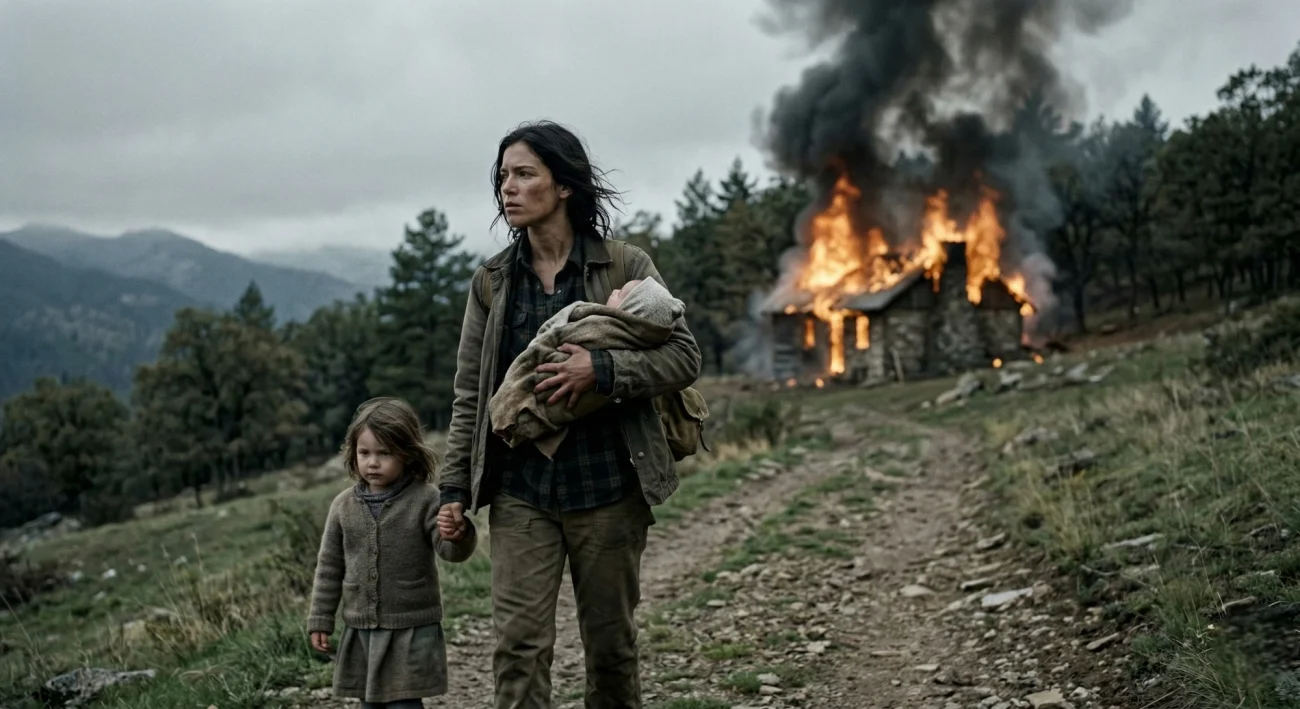
That night, when they thought I was trapped, I made the choice. I set fire to the cabin.
The smoke rose over the mountain and I ran—Mateo in my arms, Lucía’s hand locked in mine, the documents pressed against my heart. Through the trees. Through the dark. Behind us, shouting. Footsteps crashing through brush. Their voices carrying threats sharp enough to cut through smoke.
“She took something—find her!”
“The kids—grab the kids first!”
We hid beneath the roots of an ancient oak. The earth was wet up to our necks. Lucía didn’t make a sound. Mateo had stopped crying as if he understood, somehow, what silence meant.
We stayed there until the shouting faded. Until the mountain went quiet.
In that dark and wet silence, the frightened woman I had been my whole life stopped existing. And someone else was born in her place.
Don Aurelio found us at dawn.
He didn’t ask questions. He put us in his truck and drove.
In Oaxaca City, I registered every document with an honest notary. I found a lawyer who didn’t look at me the way people in the village did. I sat in courtrooms where clerks looked past me like I wasn’t there, and I spoke anyway.
I doubted. I cried through whole nights. I looked at my sleeping children and wondered if I was strong enough.
I didn’t stop.
The case took two years. Eusebio hired lawyers. He threatened witnesses. Ramón tried to bribe the notary. None of it held. The documents were original. The will was authenticated. The law was unambiguous.
The day the judge ruled in my favor, Eusebio stood up from his chair.
“This is impossible,” he said. “She’s nobody. She has nothing.”
The judge looked at him over his glasses.
“She has the deed,” he said. “Sit down.”
They lost the house. They lost the land. The cattle, the water rights, all of it. The court ordered restitution. Ramón spent four months in county detention for witness tampering. Eusebio never recovered financially. The empire they had stolen piece by piece over decades collapsed in a single ruling.
I stood outside the courthouse in the afternoon sun with Lucía on one side of me and Mateo on the other, and for the first time in longer than I could remember, I felt nothing pressing down on me.
Just air. Just light. Just quiet.
Fifteen years later, El Robledal is no longer a memory of pain.
It’s a working ranch that employs sixteen families. The stone cabin—rebuilt, solid—stands at the center of it. Lucía manages the books. Mateo handles operations with a seriousness that sometimes startles me because it looks exactly like his father.
I am no longer the poor widow people avoided at the cemetery gate.
I am the woman who found the documents in the wall.
I am the woman who ran through a burning mountain with her children and didn’t fall.
And if anyone asks what I learned from all of it—I tell them the same thing every time:
Dignity is not inherited.
It is defended. Earned. Rebuilt from scratch on damp earth with bleeding hands and no one watching.
And when they push you to the very edge—sometimes you don’t fall.
Sometimes you learn to fly.
Original fictional stories. AI-assisted creative content.
